Type your keyword below

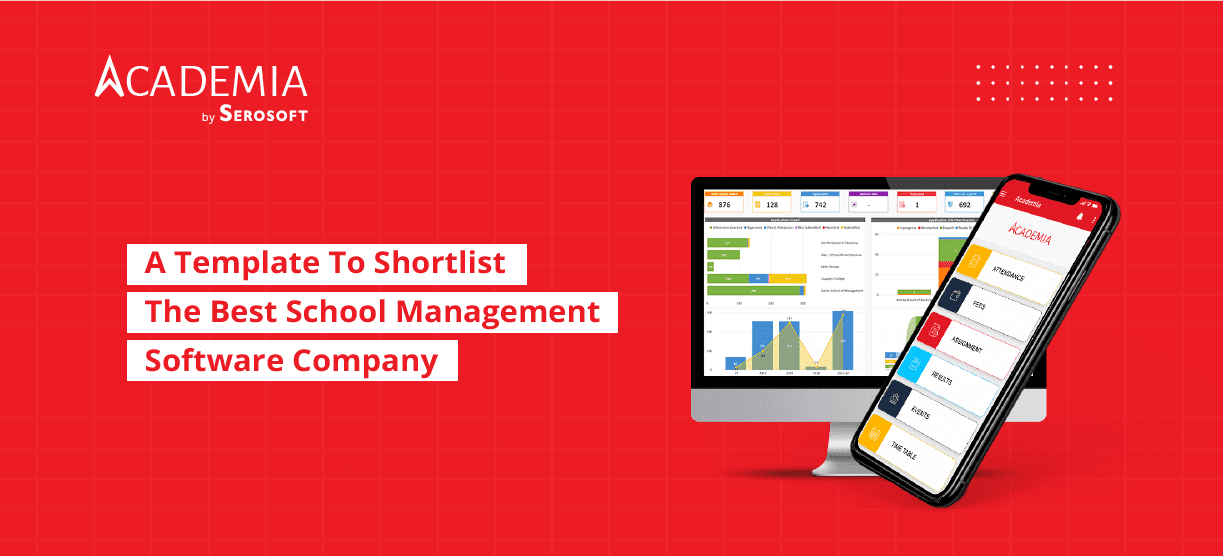
A Template To Shortlist The Best School Management Software Company

Are you the key decision-maker for school ERP implementation in your organization? If yes, here are some factors that can help you find the one in the haystack of thousands of education ERP software providers in the world. Let’s begin.

Factors to consider when choosing the right school management software company for your school 

  • Start by analyzing your needs

You cannot choose the best when you do not know what you want. Identify the needs of your school, talk to your staff, evaluate the problems and analyze the solution that you are looking for. 

Draft an outline of the solution you need to meet your objectives. Depending on the nature of the project, the requirements, and the reputation choose an offshore or onshore school management ERP software provider. 

  • Check the company’s expertise

You would find many companies with good products, but they may not be the right fit for you. You need to prioritize your needs over their vivid technical exuberance. If you need a product that is simple yet effective, that is what you get. Rather than a product with tens of features, nothing meets your needs. 

Talk to the vendors about how their product aims at solving your pain areas. The one that provides you with the right answer demonstrates the product’s functionality to meet your needs, and is genuine about the results that the product would drive is the one that you shortlist. 

  • Reputation

It is very important to understand you are not just buying a school administration and management system but are partnering with the company. Reputation is a very important factor. 

Look for people that are highly professional, and polite and provide you with flexibility. Check their customer testimonials and reviews on reliable sites such as Gartner Digital Markets & G2. Learn what opinion their customers have about their products as well as their services. Some bad reviews are okay, but a company with exceedingly bad reputation in the market is not the right fit for you. 

  • Budget

Cost is always an important factor when deciding between vendors. Determine if the cost of the product falls within your budget. Unless you are confident and the vendor guarantees you ROIs, you don’t want to buy a product that is eating up a large chunk of your school’s budget and resources. Having said that, do not compromise on quality at all. 

Many companies may provide you with an upfront cost of the product but have underlying additional fees and charges. Talk to the vendors about document management, data management, cloud cost, configurations, customer support, data migration costs, setup/training/maintenance costs, etc. 

  • After-sales support 

Unfortunately, there is no product in the world that is going to guarantee you 100% uptime. There would be instances when the product would show some problem running, and that is okay. What you need is a team that is available 24*7 to provide you instant support during these times. A good support, maintenance, and cloud-based solution that can be remotely updated, and upgraded are what you are looking for. 

Wrapping Up 

These were some factors that can help you decide between hundreds of school management ERP software. If you are looking for a vendor, you can consider Academia ERP which is a leading solution provider for eminent schools in 22 countries. Request the Academia school management system demo here

A Guide To Choice Based Credit System

The education ecosystem is changing rapidly, there are various changes and one of them includes a Choice Based Credit System (CBCS). This grading system changes the traditional teaching-learning system in India. 

To maximize skill-based education & enhance student learning outcomes in terms of their grades as well as skills, the National Education Policy has made some crucial changes in the traditional teaching-learning system in India. The right to choose subjects & the multidisciplinary education approach are the best takeaways. 

Do you know what a choice-based credit system is and how it can help higher education institutions? Let’s discuss it in this blog:

What is a Choice-Based Credit System?

The CBCS is a University Grants Commission (UGC) initiative and promotes the liberalization of the current conventional higher education models. With a student-based approach to learning or acquiring higher education, the CNCS allows students or learners the flexibility to choose their course from a list of elective, core, and soft skill courses.

A credit system for higher education measures different parameters like –

  • Student performance
  • Learning outcomes
  • Entrepreneurship skills
  • Contact hours
  • Innovation
  • Creativity & talent

UGC has categorized the groups as

  • Core Course – Core courses are there every semester and students have to compulsorily study the core or the main subject to meet the requirement of the program of that particular discipline.
  • Elective Course – Here, the student can choose any paper
  1.   Discipline-Specific Elective Course
  2. Generic Elective
  3. Project
  4. Ability Enhancement Courses
  5. Skill Enhancement Courses
  • Foundation Course
  1. Compulsory Foundation
  2. Elective Foundation
  3. CBCS moves away from numerical marking to grading semester-wise with two semesters in a year where students’ performances are evaluated and grading is done subject-wise.
  4. The CBCS works in compliance with other grading systems of institutes, all over the world.
  5. Different evaluation methods are followed, based on the suitability of the course approved by various legislative bodies.
  6. UGC recommends Letter Grades and Point Grade Systems to be applied
  7. Letter Grades are based on a student’s marks or percentage from his/her course
  8. Grade Point Systems are where marks are converted into grades based upon a fixed period.

What are the Features of CBCS?

Having multiple features of the Choice Based Credit System (CBCS), let’s discuss a few of them:

  • It is one of the best features as credits can be transferred if the student changes his/her branch of study
  • It has changed numerical marking to grading
  • It positively stigmatized the criteria of failing students
  • It facilitates student mobility
  • It provides potential assess to faculty members for student’s performance
  • It promotes easy course evaluation and is accessed to provide an effective and balanced result.

How Does CBCS Work?

The CBCS in higher education works on the simple principle of the choice being in students’ hands. Higher education institutions provide subject options to students, with a CBCS, students can choose subjects according to their choices and the credits needed for a particular semester. 

The students can attend any of the needed classes obtaining credits to pass any semester. 

A CBCS owns the following elements:

  • Semesters

In any educational institution, assessments are done semester-wise. A student progresses based on the courses taken rather than time like three years for science, arts, commerce, or four years for engineering, etc. The CBCS format provides flexibility in creating the curriculum and assigning credits based on the course section and patterns of learning and teaching. 

  • Credit system

Each course is assigned with a fixed credit. When a student passes a course, he gets the recognition of credit which is based on a course. If a student enrolls in a single course in a semester, he does not have to repeat that course later. 

  • Credit transfer

There are various ways for a student to cope with the study load and with a CBCS pattern he owns the freedom to study fewer courses, earn fewer credits and compensate for the next semester. 

  • Comprehensive continuous assessment

It provides a continuous evaluation of the student to the faculty members and also to the student himself. 

  • Grading

CBCS includes grading in a 10-point grading system. 

It includes

O (Outstanding): 10 

A+ (Excellent):9 

A (Very Good): 8

B+ (Good): 7

B (Above Average): 6

C (Average): 5

P (Pass): 4

F (Fail): 0

Ab (Absent): 0

Core Advantages of CBCS that Academia Modules Includes:

  • The student has a choice of inter/multidisciplinary courses:

With Academia, the students can select their inter/multidisciplinary courses in just a few clicks using the program and courses modules. Academia provides easier access to all stakeholders in the institutions starting from the faculty members, students, and parents for selecting, scheduling and finalizing the courses and subjects likewise. 

  • It promotes group work, research, examination, and assignments 

Using Academia modules like examination, assignments, and others, institutions get the authority to work effectively, research, and manage examination-related tasks and assignments, and more easily and efficiently at all levels like faculty members, students, and parents. 

  • Students progress at their pace

Students are the most important stakeholders of any institution, it is important to provide them with the best and Academia provides them with all the student databases provisioning, storing, and organizing all the student-related data and information. It can easily access, edit, or update data if needed.

Conclusion 

The implementation of the student-centric CBCS system is beneficial for institutes. Academia ERP, which provides the most reliable and trusted solutions to educational institutes, has inbuilt functionality to support the rollout of the CBCS for educational campuses.

How Higher Educational Institutions (HEIs) are set to transform due to NEP 2020?

The National Education Policy of 2020 is a revolutionary step taken by the Indian government. The policy is envisaged to change the current working of Higher Education Institutes in India and allows students to choose multiple disciplines as per their preference at every stage. 

Higher education in India is widespread. It is partially digitalized and has responsibly transformed the country into a knowledge hub and made it a knowledge economy. 

The National Education Policy (NEP) 2020 is based on five fundamental pillars – access, equity, quality, affordability, and accountability. It is designed to change the current education system

with high-quality knowledge resources and skill-based education.  It also primarily focuses on integrity and promotes equality in participation in varied disciplines, irrespective of what social and economic background they hail from.

What is the New National Education Policy?

Through this new education policy, the government of India aims at bringing more than 2 crore students into proper learning. It is projected that this crucial step would allow the government to achieve 100% GER (Gross Enrollment Ratio) in preschool, secondary, and higher education institutions by the end of 2030. 

These attempts are to prepare India to become a “global Knowledge Superpower”, by making the education ecosystem of India more flexible, holistic, and multi-disciplinary in line with the global skill demand. 

Let’s look at the major reforms the NEP 2020 is set to bring in for HEIs in India –

  1. Opens entry for large education institutions

As mentioned earlier, one goal of NEP 2020 is to increase the Gross Enrolment Ratio in higher education in India, including vocational education from 26.3 percent in 2018 to 50 percent by 2035. As per the NEP, 3.5 crore new seats will be added to higher education institutions. The NEP proposed multi-disciplinary, holistic undergraduate education. The Policy is focused on supporting skill education and streamlining educational planning, administration, and management at all levels.

The primary focus of NEP 2020 in Indian higher education is to transform HEIs into 

(a) Research-Intensive Universities (RUs)

(b) Teaching Universities (TUs)

(c) Autonomous Degree-granting Colleges (ACs)

This goal has to be achieved by 2040. 

According to reports, India needs an additional 1500 HEIs to encourage and accommodate more students. The policy proposes the setting up of large and foreign universities. It seeks to promote India as a global destination for quality and affordable education. It will allow high-performing Indian universities to set up campuses abroad while allowing ‘select’ universities in the top 100 in the world to operate in India. This would promote healthy competition among Indian HEIs. 

  1. Promotes Liberal & Flexible Education

NEP 2020 is designed to generate interest among students in the specialized area of research. This will lead to discoveries and acknowledge the importance of invention and scientific outcomes.

Arts and Science streams will not be separated strictly, as well as curricular  & extracurricular activities and vocational & academic qualifications. This is meant to promote a holistic and very versatile learning environment that will nurture open-mindedness and build well-rounded individuals. 

A revolutionary introduction in the Indian context is the freedom for learners to learn at their convenience. The new policy gives flexibility to students to choose from a variety of subjects and move out with a certificate, diploma, or full degree, depending on the number of years spent on the course. It gives students multiple entry and exit points in degree programs, which further encourages lifelong learning philosophy. 

An Academic Bank of Credit will be introduced which will store the academic credits of students earned from different HEIs digitally and these credits will be counted towards the final degree earned.

The policy has also asked HEIs to do away with high-stake examinations and bring in a continuous and comprehensive evaluation system. 

This reform is meant to help the students to nurture their creativity and critical thinking by motivating them to follow their passion in their chosen field. This will completely change the business models of HEIs in the future, along with their curriculum and delivery methods. Technology will be the integral support that will help in this seamless shift. 

  1. Eases Regulatory Structure

According to NEP 2020, there would be one common regulator for all HEIs in India -National Higher Education Regulatory Authority (NHERA). By eliminating the multiple, overlapping regulators, NHERA will create various verticals and cater to different disciplines and simplify degrees or diplomas. This change will ease the regulatory burden of HEIs and will allow them to focus more on their core role of imparting knowledge. The single regulatory system would provide autonomy to HEIs, which is crucial to innovations in education.  

Initiating a New Education Policy in 2022: Key Highlights

  • The policy emphasizes providing quality and affordable education to all students between 3-18 years of age group all over the country.
  • It also focuses on using technology in education to make it more accessible and effective.
  • The focus should be on online learning to ensure the highest quality education for students. As part of the new system, e-learning will be expanded to include online courses, which will allow students to study from anywhere and at any time.
  • It also promotes holistic and multidisciplinary education replacing rote learning.
  • The curriculum in India has been updated to incorporate more concepts and vocational education.
  • The policy seeks to provide vocational and technical education to students so that they are equipped to enter the workforce.
  • This policy introduces a new 5+3+3+4 education structure replacing the current 10+2 system.
  • The policy aims to increase the Gross Enrolment Ratio in higher education to 50% by 2035.
  • According to NEP, learning should be holistic, joyful, stress-free, and a lifelong process.

Conclusion

A change in the Indian higher education system was long overdue, and NEP 2020 marks a bold move away from the long-standing and established rote and herd learning practices in India. 

While the NEP 2020 aims at improving the operative environment for HEIs across India, it reveals the government’s intent to restrict the commercialization of higher education in India.

The NEP reforms introduced in the Higher Education System are set to result in – 

  • Institutional restructuring and consolidation
  • A holistic education eliminating rote learning
  • Internationalization
  • Teachers training
  • Professional education
  • High-quality research
  • Quality universities and colleges

Changes in the overall ecosystem will bring new challenges for educational institutions, staying updated with the latest developments can help educational institutions to address these challenges. For this, a higher education ERP or SIS can help institutions bring digital transformation and automation, you can also schedule a demo now!

A Checklist To Safeguard Your Institution’s Data

Today, data protection is one of the biggest challenges in the education sector with institutions being prone to vulnerabilities and frequently falling victim to massive data breaches. However, a checklist to safeguard data can help improve the overall security and prevent incidents of major data breaches from compromising their reputation.

Higher educational institutions and Schools are data treasure-troves as they often collect and process personal and confidential information about their prospective and enrolled students, alumni and staff. From personally sensitive information like addresses, health records and payment information, these institutions often run extensive networks across different campuses, with thousands of students and staff accessing their online portals through different devices at any time of the day or night. Hence, educational institutions are at high risk of having their data breached. In 2019 itself, Stanford University, education software developer Pearson and Georgia Tech have all suffered data breaches, with Georgia Tech alone having 1.3 million of their records exposed.

While educational institutions are required to take active measures to safeguard their data from unauthorized access, here is a checklist of how Academia can help institutions to protect their data and records.

– High scalability

Scalability in an ERP software is very crucial as it manages an institution’s growth by streamlining operational performance and maximizing productivity. Academia ERP (SIS/SMS/TMS) is highly scalable and can handle the increasing volume of data and the requirement of securely adding new users. The software is a robust solution meeting every expectation of a growing institute or chain of institutes.

This scalability offered by Academia solutions is beneficial for an institution as it allows the institute to focus on its growth and not the challenges associated including compromising on the security while handling huge volumes of sensitive and confidential data.

– Superior flexibility

Academia ERP(SIS/SMS/TMS) can be customised and configured as per the taxonomy of the institute. This allows for a personal touch to the terminology making it easier to interpret and allows even a non-technical person to operate the software easily without relying on technical help. The configuration features could also help to add extra functionalities as needed.

This superior flexibility from Academia makes an institute technologically advanced, future-ready and self-reliant. Academia SIS offers complete and detailed campus management solutions that improve an institution’s productivity, workflow efficiency and boost high ROI by streamlining administrative processes with automation. Academia’s MIS is highly configurable and scalable, aiding institutional growth. It provides data analytics with detailed reports for every department as required. 

The ease of use and familiarity of taxonomy results in lower incidents of human error, one of the major causes of security lapses.

– Diverse Reporting 

The diverse reporting in Academia ERP(SIS/SMS/TMS) offers dashboards for the administrators and for a range of user roles, which is extremely helpful to disseminate information faster from the existing data. It also offers visual aids with graphical representation like pie charts and bar graphs with consolidated data. With diverse reporting, it is easier to find student details year wise, their academic performances, extra-curricular activities, and all other activities. This helps in optimising time and resources while ensuring that reports are seamless and easily accessible in the most secure way. 

Academia’s diverse reporting helps to make more informed and data-driven decisions in the quickest and most hassle-free way. There is no time wasted in going through uncountable files for little details. It is a crucial tool to gain powerful insights into student data smartly and safely. 

– Cloud Enabled 

Cloud computing has become an essential aid for universities, colleges and schools for content delivery, communication and collaboration. The need for servers, storage and software have become essential to share resources, software and information, to computers and other devices.

Cloud computing also dramatically reduces the time, money and infrastructure that educational institutions need to reach out to new markets. The institutions achieve efficiency in operations with centralised control with students becoming more engaged with the available options and teachers focussing more on learner requirements instead of mundane admin tasks.

Academia’s products are cloud based, which helps to reduce risk and enhances data security. The cloud security not only helps the IT teams to recognise and remove risks in the system, but also enables them to create consistent security policies in all the branches of the institution.

Conclusion:

Finally, with the number of cyber attacks on the rise, data security has become a prime concern for educational institutes. Academia ERP software are built to work around huge volumes of data which are easily accessible by those who require to use them, yet with the tightest security possible. There are multi layers and types of information security control to combat abuses and breaches of security, at every level. To know more and learn about how Academia’s customised ERP solutions keep your data safe, among other benefits, please book a demo by clicking on ERP software for educational institutions.

Online only universities in UK – Technology to the rescue

As universities in the UK shut down due to COVID 19 in March, students had to move online to attend live-streamed lectures and swap practical group work for remote assignments. In an attempt to deal with dwindling scholarships, travel restrictions and redefined visa rules, many prestigious universities have moved their courses online. Here is a look at how universities are adapting to a new norm, while using technology for remote learning.

With the pandemic calling for social distancing, it is likely to disrupt normal life for a long time to come. Hence, universities in the UK have shifted to offering online only classes. Leading the pack in the shift to online courses is the prestigious University of Cambridge, which will begin their online only academic year 2020-2021 from October 6. The university announced that it will move its entire course online for the 2020-21 academic year, scheduled to begin on October 6.

The University of Manchester has moved online for the upcoming autumn term with Cardiff University also moving most of its classes online after the summer break. Despite moving online and not being able to offer the intercultural experience that international students seek, it is also believed that top universities like Oxbridge etc will likely be able to attract and retain international students with the UK University degree tag.

In the last few months, there has been totally unexpected changes in the world which should be looked upon as an opportunity for universities to adopt people-centred technology and bring in digital transformation. Today, it can be safely said that the universities meeting this challenge will be the ones to thrive in the future. These universities need to adapt and expand their digital platforms to offer what students really want. The next step would include collaborating with tech companies to create affordable modular online course options, accessible to all.

Universities moving online will have to compete with new formats, including coding bootcamps like Le Wagon, Codeworks and Northcoders which offer quicker, cheaper courses in subjects like web development and data science with in-built industry connections. However, moving online also comes at a cost, Hence, universities in the UK will make sure their investment in digital transformation will be for the long term, especially when they had been lagging behind universities from other countries for years.

Modular Courses

The success of online learning has been experienced with institutes such as The Open University. In recent years, universities like Oxford, Imperial and UCL have also started experimenting with free MOOCS (Massive Open Online Courses) through FutureLearn with a paid upgrade option. These courses have proved to be highly popular with their affordability and accessibility and a degree from an internationally recognised University.

For online courses, the focus today has been moving towards modular courses or even short courses that can be availed from home, to match career choices. Here, technology makes these courses available with excellent existing programmes. For example, Zoom or Microsoft Teams platforms are being used to record sessions and provide apt online support for students. Workshopping technology like the whiteboard tool Miro is a great visual way of showing work. Augmented Reality which already existed in the gaming industry is being adapted to play a part in more practical courses.

Modular learning programmes allowing to pick and mix from different courses is likely to be the model going ahead with students having their virtual shopping baskets filled with the best modules according to their needs instead of signing up for a degree or a higher education programme irrelevant to them. 

Going ahead

The growth and adoption of education technology started even before COVID 19 with global edtech investments reaching US$18.66 billion in 2019 and the overall market for online education projected to reach $350 Billion by 2025. But with COVID 19, there will be a rapid rise in usage of online technology whether it was in language apps, virtual tutoring, video conferencing tools, or online learning software.

Practically, it may look like the future of UK universities is in mixing online curriculum and offline experiences, which is known as blended learning. This will enable social distancing on campus and enhance the experience of studying. Interestingly, some innovative UK universities such as the University of East Anglia (UEA) already offered blended learning even before COVID 19. 

With a consortium of 10 universities led by Coventry recently awarded £3.7m to develop partly online postgraduate conversion courses in artificial intelligence and data science, a lot of universities are taking the online route. The pandemic kickstarted a lifelong online learning agenda which will also skill up employees whose jobs will become automated in the future.

Finally, elite universities will have the advantage of their name and reputation to continue trading on, but for many other universities that bring in students because of location or for a specific course, the future depends on identifying other differentiators to bring in students. Future learning will hence be more about the quality of the learning experience and how geared up universities are to teach remotely in an innovative way using various technologies. 

To get the full benefit of online classes, there is a specific need to go beyond just replicating the physical class through video capabilities and instead, using different collaboration tools and engagement methods which promote inclusion, personalisation and intelligence. With an abundance of ready to use content available across different digital media to enable capability building and meet targeted challenges, Universities will need to use well-designed digital tools for sharing knowledge and support information. The role of technology in online learning will have to be explored to its full potential.

7 Emerging Technologies that are Reshaping Education

In the field of education, emerging technologies are revolutionizing the learning process for students by enhancing the way students, teachers and institutions work. Technology has changed the world and cutting-edge technologies  are reshaping education in innovative and unimaginable ways. Students are getting the opportunities and unique experiences they need and deserve as emerging technologies promise to deliver exciting new resources for learners.

Let us take a closer look at the seven emerging technologies that are earmarked to make major waves and reshape education.

1. Augmented Reality & Virtual Reality

Mixed Reality and Simulations are pathbreaking experiences for learners and teachers too. AR, considered as one of the best emerging technologies in the world, can be used by educators in innovative ways to make lessons interesting and interactive. AR is useful in overlaying interactive digital elements to give real time experience and for promoting skills like creativity, critical thinking analysis and problem solving. AR promises to help learners capture their dreams and imaginations and take learning to the next level.

Virtual Reality, the next big thing in education, enhances student learning and engagement by cutting across all barriers and immersing students in what they are learning and helping them to process information better.

learning and helping them to process information better.

2. Artificial Intelligence

Artificial Intelligence (AI) in education is already transforming the way curricula are implemented in schools, with innovations that would have been impossible a few years back. AI applications have made the academic world more convenient and personalized. One of the key impacts of AI from kindergarten to graduate school is the different levels of individualized learning with adaptive learning programs, games and software, where students can work at their own pace.

AI aims to reshape education by supporting the sharing of first-person perspectives which will be useful for students research. From artificially generated content to image recognition and smart tagging systems, AI is also automating basic activities like grading homework and tests as it takes up a lot of time for teachers. While human grading may not be fully replaced, AI can help in providing detailed analysis of student performance in exams, and help in grading to a certain extent.

AI has resulted in automation of administrative jobs, saving time for educators.

3. 5G Technology

5G is the fifth generation of wireless technology which promises high speed and low latency wireless technology. 5G is meant to change the way educational institutions interact with much quicker downloads and increased efficiency and expanding the scope of connected devices and technology within the classroom.

Some universities have started implementing IoT integration for higher education where lectures and discussions on specialized topics can be conducted through virtual reality experiences. Seamless connectivity will bring in better engagement which will be a big boon for international students, along with faster downloads of files and resources and more powerful networks. 

Interestingly, 5G was supposed to be launched in India in 2020 and would have been extremely beneficial for students learning from home during the COVID-19 pandemic. However, things didn’t go as planned and the launch has been pushed to mid 2021.

4. Internet of Things

The Internet of Things (IoT) has tremendous potential to create smarter and connected schools and is already impacting the education sector by making learning simpler, faster and safer. IoT can save energy and lighting, and sensors across the campus can track traffic and the strategic positioning of security features like lighting would help students and visitors too.. IoT can help break the usual barriers to education like language, location or certain disabilities, besides helping everyone with bottom-line solutions.

5. Adaptive Learning

The Adaptive learning technology provides learning activities to students, based on their needs and learning style and behavior. It helps students with unique learning paths that are based entirely on their interests and learning ability. 

It can play a huge role in the educational system as it uses computer algorithms to orchestrate the interaction with the learner. Although this technology originated from AI, it actively caters with individualized resources and top learning activities to take care of the special needs of a learner.

6. Learning Analytics

When it comes to the process of learning for students, it needs efficient tracking and analyzing to understand results better. This is essential to bring about improvement which is a very important factor in education to improve the learning experience of every student. The learning analytics technology helps teachers to better record the learning rate and behavior of students so that teachers can provide targeted improvements to courses.

7. Blockchain

The Blockchain technology which has changed every industry dynamically, can prove to be very useful in the education sector as well. It is especially useful to collaborate around distributed information in a database. Blockchain can help in examination management, verifying student credentials, verifying certificates, managing life-long learning records etc. Besides effective analyzing and tracking, it can help teachers provide targeted improvement for courses and help students deliver enhanced results.

Blended Learning in the Education Sector: The Need of the Hour

Today the educational landscape is changing. The pandemic has opened the gate to think beyond the traditional learning & teaching methods. Teachers are adapting to new technologies as digital transformation becomes more convenient and necessary than ever before.

With the imminent reopening of schools and higher education institutions are planning to use a mixture of online learning and traditional teaching where students will come to schools for a few days a week. Hence, the concept of blended learning is leaping in the education world.

Even before the advent of the internet, correspondence education, and independent learning through distance education programs were prevalent. As digital platforms have become more accessible to purchase and implement, there has been more inclination towards mixing conventional and modern learning that could benefit students.

If it weren’t for technology, it wouldn’t be possible for educators to keep the education running even for a short period. Traditional teaching, online learning, online classes, and hybrid classes are all mediums for knowledge transfer and enable students to master in given subjects. These terms are becoming a part of 21st-century learning when talking about education, and blended learning is one popular concept among educators.

What is blended learning? 

There has been much confusion to find the meaning of blended learning. You can find many definitions for it. To sum up all the definitions of B-Learning, it is “enhancing teaching with the help of digital platforms and online educational content.”

Blended learning is one form of hybrid learning that uses multiple digital resources to expand the classroom approach. Hybrid learning does it in two-parts, separate sessions of face-to-face instruction and online sessions. In blended learning, both systems are integrated along with digital modalities to create a coherent and yet varied learning environment.

What is the difference between blended learning & hybrid learning?

Most of the time blended learning and hybrid learning are used interchangeably. It is similar if we see the broad spectrum but there is a subtle difference between them. Hybrid learning is a holistic approach that focuses mainly on enhancing learning experiences for students. As the name suggests, it is the combination of various methods of learning methods whether it is offline, online, distance learning, etc. It replaced most of the physical communication between teachers and students with online interactions. Whereas blended learning is an explicit combination of offline and online approaches of instructions. It is a perfect blend of online instruction and offline communication among learners & instructors.

What are the types of blended learning?

Blended learning has many types according to the usage and techniques such as; Remote Blended Learning, Flipped Classroom, Mastery-Based Blended Learning. But it is broadly classified into two categories, as synchronous learning and asynchronous learning.

In synchronous learning, groups of people connect with coaches/ instructors, and real-time discussion is similar to offline classes. It provides a sense of community and encourages them in more collaborative learning. Whereas in asynchronous learning, educational content is delivered to students. It is more like a distance learning program. It is more flexible and allows students to learn according to their pace. 

What is the objective of blended learning?

There is no doubt that technology aids learning, fuels the ultimate objective of education i.e., Knowledge Transfer and supports learners in a holistic learning environment. Blended learning is a combination of traditional and modern approaches that become convenient for teachers to adapt to new technologies with the conventional method’s backup. 

Blended learning enhances access to education and maximizes flexibility. A blended learning model meets students wherever they are by delivering content in a self-directed, digital format.


What are the methods of blended learning?

As it is all about flexibility, blended learning comes with numbers that educators are using nowadays.

One of the most famous ones is known as a flipped classroom. A flipped classroom is a teaching method that works in reverse i.e., from students to teachers. It is where teachers have questions that they share with students in advance. The responses from students help capture where the teachers will need to focus their guidance in a discussion. This way, they can target instructions in a way that is most effective for learners.

For example, a teacher might provide students with a discussion topic or question before class and ask for feedback via email or perhaps a shared online document. The teacher reviews the responses before class and uses that information to more intentionally direct the live discussion. Here student input comes first, with the activity coming second, the opposite to traditional learning, where the instructor will first facilitate discussion and then solicit feedback in response.

Just-in-time learning is another method. This is where teachers use class time for active learning and remove passive activities that students could do on their own, such as reviewing the syllabus.

It could also involve video tutorials and digital activities targeted for students to complete at their own pace. It allows teachers to focus classroom time entirely to hone in on confusion or lead group work or other collaborative activities.

Implementing more robust coaching and advising models are also an essential strategy for blended learning. Personalized, face-to-face support meets students’ expectations and allows to build rapport between instructors & learners intentionally. It creates a sense of accountability driven by the customized nature of the instructor-learner relationship.

What are the advantages and disadvantages of blended learning?

A significant benefit of blended learning is flexibility for students; the ability to control the pace. It also creates space for reflective thought for students. Digital resources are generally readily available unless there are budget issues.

But some fundamental issues create obstacles for penetration of blended learning. Unfortunately, ready access to high-speed internet isn’t a given for everyone, even for families with the internet in their home. Similarly, parents with a full-time job might need to prioritize it using the bandwidth. Moreover, having several siblings in the house who all need to stream video for school assignments at the same time, and a mobile hotspot won’t be sufficient.

One way to combat this is to incorporate blended learning activities that don’t just involve bumping someone in front of a screen but encouraging experiential learning or offline, more reflective, or independent tasks.

How Education ERP facilitates blended learning?

Education ERP is a management information system for educational institutions that helps educators to manage all administrative tasks through a single platform. It also improves communication among all the stakeholders thereby enhancing the overall student experience.

Solutions such as Academia ERP are integrated with a learning management system that enables institutions to facilitate education digitally. It also aids communication between teachers & students beyond campuses that makes learning more student-centric that is the ultimate goal of blended learning. 

In concluding note

Due to the outbreak of the pandemic, education leaders are bound to implement technology in educational institutions. The new normal of the post-COVID world of education will be inbuilt with EdTech to maintain institutional continuity. Ultimately, all learning methods are designed so that teachers can focus on the vital component of their role; student-focused education. That’s what learners need the most. Providing the content is laying the foundation, but working with learners to enhance their knowledge with that content is the key.

Blended learning allows teachers and students to work more cohesively by using all available resources in multiple ways to enhance learning and ultimately to help students find the method of learning that benefits them the most.

How Educational Institutions Save Time and Money with Automation

An age that swears by ambition and competition, the 21st century has also offered us varied tools to ensure that the fight is fierce! The digital revolution (also known as the 3rd Industrial Revolution ) is helping us make the best use of time & money in creating a better as well as a faster world. In the last 4 to 5 years, it has significantly penetrated the education industry too. Various EdTech solutions such as the Student Information System, Learning Management System, etc are playing an important role in efficiently managing the campus administration.

The main reason for this software becoming a favorite of the education industry is that they help in effective resource management to subsequently ensure student success.

Education ERP: An intelligent way of managing your institute

Here are the 5 ways automation can help in saving time and money:

Prompt Decision Making

If you are heading an institution or a particular department, decision-making is certainly a part of your daily calendar. It takes a huge amount of time to go through stacks of files that have data and references for you to arrive at a conclusion.

What if you can access all these details at the touch of a button without having to go through the pile for papers? Wouldn’t it’ll save you precious time?


Education ERP gives you the power to access all the details whenever you want. Student records (class-wise, course wise, year wise), employee records, ongoing courses and much more. It provides neat reports that help you in the quick analysis, which ultimately results in faster decision making.

Reduced stationery costs

According to an article on Edutopia, around $25,000/year is spent on paper alone by a school with a capacity of 100 teachers in the US. Not to forget other costs including printing and stationery.  

The education industry relies heavily on paper and stationery. While it can’t end it completely, it can definitely be minimized. With Education ERP such as Academia SIS, institutes can save up to 22% in printing and mailing costs. Being a cloud-based system, you can share documents with students, parents, and teachers on their portal or email address to save paper costs. Hard copies are redundant as all the data is securely saved on the cloud. This is an effective way to save a lot more than you can imagine.

Recommended reading: Technology in schools: What are the opportunities and challenges?

Reduction in academic reporting time

Education ERP has an integrated excel sheet tool, with this you can upload and download all the data, anytime you want. It saves your time in manual inputs to make academic reports. All data entered can be converted into excel sheets as and when needed.

For example, if you are running a campaign for admission, you can track enquiry, create data sheets in real-time and share them with other staff members. Not just this, you can also check the expense reports, target achieved and so on.

Faster turnaround time

When you are able to make decisions faster and save time in mundane administrative tasks the turnaround time of management processes is automatically shorter, helping you do more with less.

Digital transformation with ERP reduces paperwork, streamlines processes and makes work simpler that in turn speeds up the overall management. The information flow becomes smooth, transparent and it keeps everyone from multiple departments in the loop that aids in faster and more efficient task performance. Moreover, it also minimizes errors and removes data duplicity to get rid of rework in the process.

Automation resulting in High ROI

The primary focus of an educational institution is to offer quality education with world-class management, however, the quality and credibility of an institution do not depend only upon its faculty, but also its capital. 

Recommended reading: How a Student Information System Can Ease Your Pain

For any organization, the return on investment is a crucial factor to run any institution. It depicts the success of the entity. The education industry spends millions of dollars on quality education. 

An efficient solution to control and manage your capital is with the digital transformation of your institute. Using technology for your day to day tasks can seem expensive in the beginning, but in the long run, it helps in achieving high ROI.

Know more about how ERP System can help in ROI

Are you a smart educator who wants to use technology to save time and money in management? Try a free demo now!

Image source: freepik.com

Intelligent School – Transforming Education System

Smartphones, Smart TVs, Smartwatches and Intelligent schools: The demand for intelligent products is at a high level. People living in this “Intelligent” age can easily show how smart devices have dramatically improved their lives.

But is there anyone who can answer how efficient is an intelligent school system? Does an intelligent school influences the development of children? Or is it just another trick to score better than traditional schools?

Let us try and answer all your questions here so you can decide why it’s imperative to introduce smart classes in schools.

Let’s start with the million dollar question: What is an Intelligent School?

Intelligent school is a technology-based teaching-learning facility that prepares Multimedia tools such as movies, photos, audio, slides, etc. to make the learning process more effective. Unlike traditional schools, the curriculum and guidelines are not rigid, and teachers can use a variety of multimedia tools to improve their learning.

The definition of intelligent schools seems to be simple. However, the impact of introducing smart classes in schools should be considered. Most of today’s smart schools use advanced technologies to transfer the traditional school curriculum. In other words, these schools follow the traditional curriculum and only use new technologies to disseminate information. On the contrary, some educational institutions use intelligent education systems to change education processes completely and overcome the traditional education system.

Intelligent school goals – that makes a difference!

intelligent school-school-management-system Academia

Today’s goals determine the actions of tomorrow. That’s why the goals of Intelligent school are future-oriented and better aligned with the era of information and communication technology (ICT). Intelligent school system focus on the holistic development (physical, mental, emotional and psychological) of the students. It has been proven that there are no two identical persons. How can we achieve miraculous results if all students are treated equally? Intelligent schools are designed to recognize and enhance an individual’s ability to excel in the area of their choice. One of the key objectives of intelligent school systems is to promote students’ participation. In doing so, students must overcome their fears as they learn to express their opinions that prepare them for the outside world.

Intelligent School Blocks

Student Management System

To become an intelligent school, the first step is a student management system. This system automates many of your institution’s processes and allows you to focus on teaching and sharing knowledge.

Curriculum

The intelligent classroom program in schools is designed for the complete development of students. It is uniquely designed to integrate the knowledge and skills necessary for balanced and inclusive development.

Education

It gives freedom and flexibility to plan lessons unlike the traditional education system and combines learning strategies for a more effective transfer of knowledge.

Evaluation

Evaluation in an educational system is as important as the teaching-learning process. The rating in intelligent classes is continuous and integral. Accurate feedback is another important element of the evaluation in the ICT education system.

Teaching methods

Teaching methods in intelligent schools are student-centered. Teachers can use a variety of multimedia tools to develop student’s skills and talents. Teachers can even record their lessons and place them in a central network so students can consult them when needed.

After extensive discussions about Intelligent schools, it is easy to conclude that the intelligent school system is brilliant and should be introduced in schools to enable more effective student learning and development. It is true that creating intelligent schools in India is a challenge, but every step taken in this direction will make our education system and country stronger and superior!!!

Modern trends of education and technology in a sustainable future

Stemming from one of the pillars of the United Nations 2030 Agenda for Sustainable Development, quality education has taken a central stage. The agenda talks about equitable quality education that promotes lifelong learning opportunities along with inclusiveness. The overall goal is to connect the general trends affecting education in the information age. 

But why do you think sustainable development is talking so much about quality education? Shouldn’t it focus on the environment and the relationship between human development and its effect on nature? Well, after long research it was established that sustainable development cannot survive without social and cultural reforms and education plays an important role in building newer perspectives. Hence, sustainability cannot thrive without needling itself in the fabric of education. 

But to execute a change on a global scale is challenging. Education is one of the oldest industries and since digitalization has not fully penetrated into the working of education institutes it requires a major shift in the focus. As a result, the entire world is changing its policies. 

Furthermore, lifelong learning is centrally aligned with the concept. This global reform aims at being more agile in its approach. This global thought leadership has brought in trends of changes that we would like to discuss today.  

  • Information Technology 

Communication, connectivity, collaboration, transparency, and so many other things are amiss still in many educational organizations. The reason is their dependency on redundant methods of administration, management, and execution of academic activities. To counter that, education technologies are hustling to make technology and solutions cheaper. 

With a major focus on making technology user-friendly, technology partners are researching the industry to understand the digital literacy of the population in focus. Solutions for all the stakeholders in the ecosystem – Students, Faculty, Administrators, and Parents are available easily in the market. 

Edtech, digital learning, learning management systems, ERP, and other trending technologies have become an integral part of many institutes. Artificial Intelligence, Augmented Reality, Machine Learning, BigData, and Business Intelligence are being used to improve knowledge retention, student experience, student retention, and better student outcomes. Directly and indirectly, institutes are enjoying ample benefits from these technologies. 

But most of all global policymakers are aiming at digitalization because it gives them an opportunity to bring the world together and propagate the best practices for achieving sustainability goals. 

  • Change in aims and objectives

From implicit to explicit, the focus on skills has increased massively. It is not just a benefit for the students that are immediately “hire-ready” on passing their exams but it is in the interest of the world too. The more skill-based education is provided to the students along with their responsibilities to a sustainable future, the better outcomes are going to be achieved in the near future and future. 

Policymakers are ensuring professional responsibilities along with creative, strategic, and analytical thinking are taught to the students to build a better future. They want people to think of things in terms of the world, not just individual gains and losses. Promoting the participation of youngsters in achieving these goals is ensured through increased access to knowledge, availability of knowledge material in contemporary formats, and increasing collaboration and open communications through free forums and communities.

  • Education sustainability

Till now we have talked about the use of education to achieve sustainability goals. Now we should talk about educational sustainabilities. Educational ecologies are frameworks that are brought in place to promote education sustainability. It is a major shift in the current education curriculum. The ecologies provide an in-depth change in the content to improve the context of learning and align it with global goals. 

Furthermore, these ecologies are not just focused on classroom education at schools and universities, it also aims to penetrate training institutes and alternative education sources. Leaving no stone unturned, policymakers are focusing on all the prominent media and the changing infrastructure of the schools, colleges, universities, and training institutes to digital. 

Wrapping Up 

Education plays a crucial role in the lives of people. It nurtures inclusiveness and promotes shared goals that the world focuses to meet. When we talk about sustainable development, a lot of changes have to be done, not only in terms of policy and processes but also in terms of social, economic, and cultural reforms. To attain this education has changed drastically. And thus modern trends have been introduced to drive the education industry towards meeting better goals. 

Back to top