


Pankaj Joshi
Estd. Reading Time : 4 Min.
23rd Feb, 2026
Share On:
Are universities in the Middle East truly prepared for 2030?
Can existing campus systems handle AI-driven governance, predictive admissions, and real-time regulatory reporting?
What technology investments today will directly align institutions with national transformation agendas like UAE Vision 2030?
These are not future-facing questions. They are immediate strategic concerns for Vice Chancellors, Registrars, CIOs, and governing boards across the region.
According to global education technology studies, over 60% of higher education leaders believe legacy systems limit institutional agility, while nearly 70% report challenges in generating real-time, decision-ready reports from fragmented data environments.
In fast-transforming regions such as the UAE and broader GCC, this gap creates a critical risk: strategic misalignment with national digital transformation goals.
An AI-powered student information system addresses this challenge by integrating intelligent automation and unified governance into a single institutional framework. It enables universities to:
For institutions aligning with UAE Vision 2030, digital transformation is no longer optional infrastructure; it is a strategic positioning. The universities that act now will not only meet compliance expectations but lead the region in operational excellence, academic innovation, and global competitiveness.
This blog answers the critical question university leaders are asking today:
What role does an AI-powered student information system play in preparing Middle Eastern universities for 2030?
Across the Middle East, higher education reforms emphasize:
In the UAE specifically, UAE Vision 2030 prioritizes smart government services, innovation ecosystems, and AI-enabled institutional frameworks. Universities are central to achieving these national ambitions.
However, many institutions still operate with:
This operational fragmentation makes alignment with UAE Vision 2030 increasingly complex.
Traditional SIS platforms were designed to store student records. They were never built to connect departments, predict trends, automate compliance, or guide executive decisions.
A modern AI-powered student information system transforms static data into institutional intelligence.
Instead of simply capturing transactions, it enables:
In a policy-driven environment shaped by UAE Vision 2030, institutional foresight is as critical as operational efficiency.
The Middle East has become a global education destination. International student mobility is rising, and competition among institutions is intensifying.
Manual admissions processes introduce delays, inconsistencies, and compliance risks.
An AI-powered student information system enables universities to:
This level of intelligence ensures growth without administrative chaos, a necessity for institutions scaling under UAE Vision 2030.
Accreditation bodies across the Middle East require structured documentation, academic transparency, and measurable outcomes.
Yet many institutions still compile reports manually before inspections.
With an AI-powered student information system, universities can:
For universities aligning with UAE Vision 2030, proactive governance demonstrates institutional maturity and strategic credibility.
By 2030, students will expect real-time, AI-enabled digital services as a baseline experience.
Institutions leveraging an AI-powered student information system can deliver:
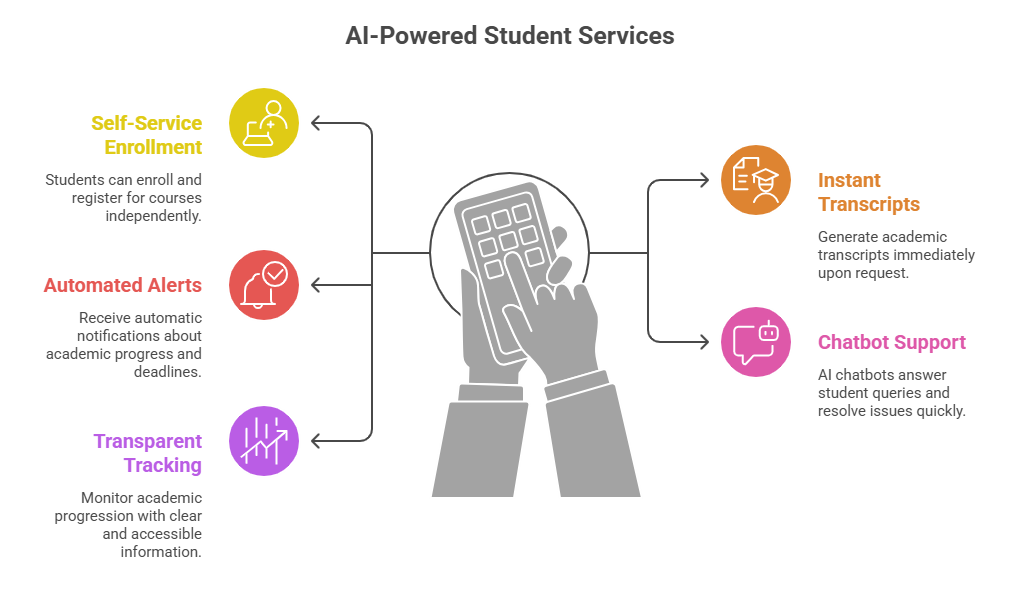
Improved student satisfaction directly influences retention, rankings, and institutional reputation, all central to the global positioning envisioned in UAE Vision 2030.
University leadership teams frequently face challenges answering strategic questions such as:
An AI-powered student information system converts institutional data into predictive dashboards and actionable insights.
Rather than relying on historical reports, leadership can make forward-looking decisions supported by analytics.
This shift from reactive reporting to predictive governance strengthens alignment with UAE Vision 2030’s data-centric policy direction.
Many Middle Eastern universities operate across multiple campuses or international partnerships. Governance consistency becomes complex without centralized systems.
An AI-powered student information system ensures:
As the UAE Vision 2030 encourages global collaboration and international competitiveness, system-wide visibility becomes indispensable.
Digital transformation requires:
Institutions that begin implementing an AI-powered student information system today will have the operational maturity required well before 2030.
Those who delay may face rushed implementations, fragmented digital ecosystems, and strategic misalignment with UAE Vision 2030 objectives.
The future of Middle Eastern higher education will be defined by institutional intelligence, not institutional size.
An AI-powered student information system is no longer just an IT investment. It is:
For institutions evaluating long-term digital strategy, platforms like Academia demonstrate how structured student lifecycle management can translate policy ambitions into measurable operational outcomes.
Universities that embed AI-driven intelligence into their core academic and administrative operations today will lead the region tomorrow.
The path to 2030 is already underway. The institutions that transform now will define what higher education in the Middle East looks like for decades to come.

Experience Academia – Your partner in transforming campus operations, a trusted all-in-one ERP/SIS solution.
Get the latest insights, trends, and updates delivered straight to your inbox!