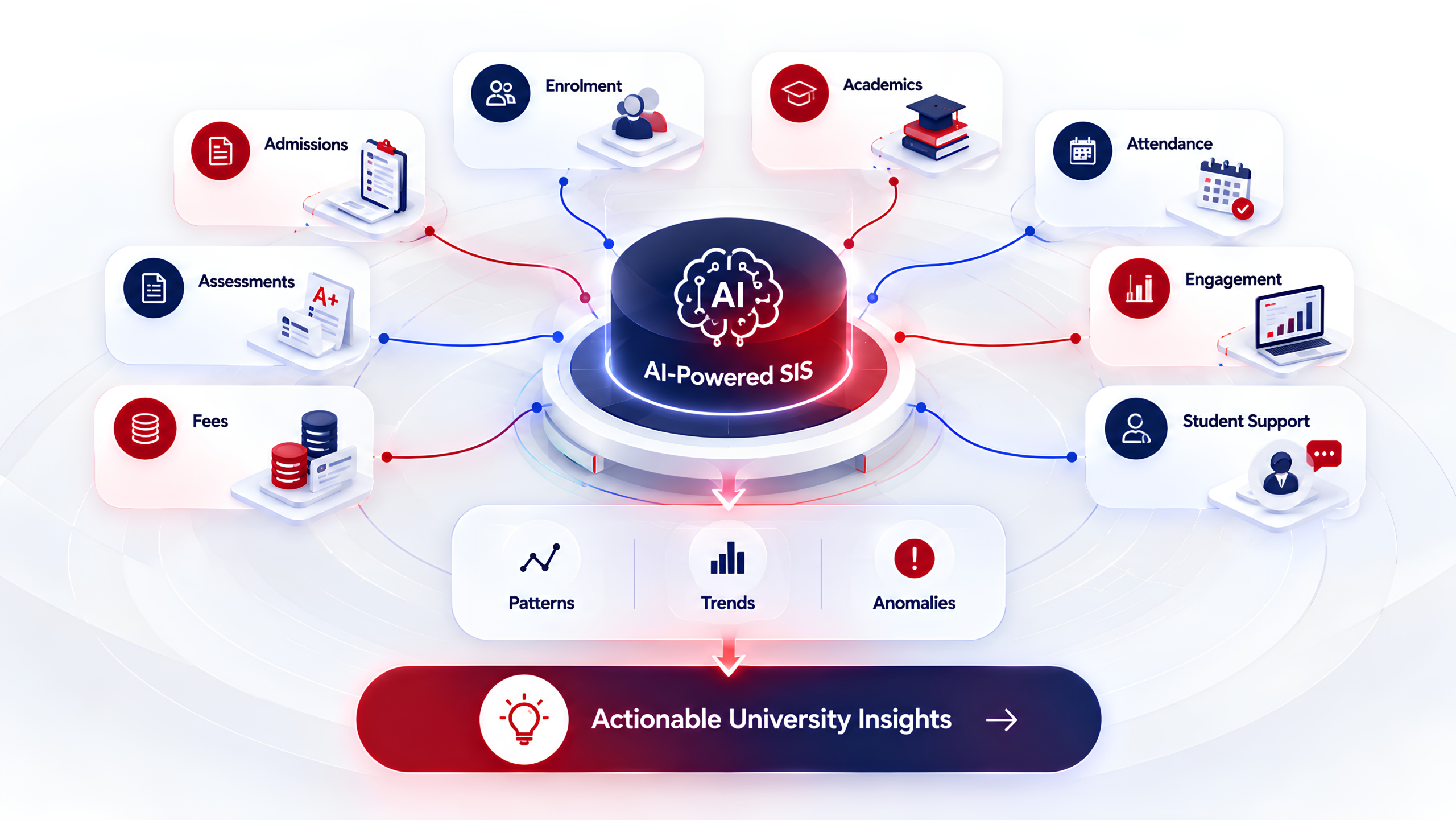
Universities already collect data at almost every point of institutional life: applications, enrolment, attendance, assessments, examinations, fees, student support and academic progression. The problem is that this information often remains distributed across different systems, making it difficult to see the relationships between events. An AI-powered Student Information System (SIS) can turn these records into a more connected view of what is happening across the institution, helping universities identify changes earlier, understand patterns, and support evidence-based decisions rather than assumptions.
The real value appears when datasets are viewed together. A fall in attendance may mean little on its own, but when it occurs alongside declining assessment scores and lower digital engagement, it can become a meaningful signal for academic support. Similarly, rising applications combined with falling enrolment conversion can reveal an admissions issue that a simple application report would miss. AI can help surface these relationships, trends and anomalies much faster than manual analysis.
For university leaders, the outcome is bigger than better reporting. Connected student data can support earlier intervention, smarter resource planning, stronger academic oversight, improved operational visibility and more responsive student services. The key is knowing which data to connect, what each dataset can reveal and where human judgement must remain part of the decision.
A traditional SIS primarily answers “What is the record?” An AI-enabled SIS can help answer “What is changing, what might explain it, and where should we look next?”
Jisc’s student analytics guidance notes that universities often already collect much of the data needed for analytics, but that information typically sits in administrative systems that make it difficult to use effectively. It also highlights strong data governance and data architecture as foundations for successful analytics.
That distinction matters. The university does not necessarily need another data source. It needs a better way to connect, interpret and act on the data it already has.
An AI-powered SIS can analyse application volume, applicant sources, programme preferences, offer rates, acceptance and enrolment conversion.
For example, suppose a university receives strong interest in a programme but sees a significant drop between offers and confirmed enrolments. AI can surface that change and help admissions teams investigate where conversion is weakening.
What it can reveal:
Where demand is growing and where applicants are being lost.
Enrolment data can reveal changes in programme demand, registration patterns, course selection, withdrawals and programme transfers.
Imagine one elective reaching capacity every semester while another consistently has unused seats. When enrolment data is compared with historical demand, programme structures and student choices, academic leaders can make more informed decisions about future offerings and capacity.
What it can reveal:
Where demand is shifting and where registration bottlenecks are emerging.
Grades, GPA, pass rates, failed courses, progression and completion provide some of the clearest indicators of academic performance.
AI can compare performance across courses, programmes, cohorts and academic periods and identify unusual changes.
For example, if a course’s pass rate declines over several terms, AI can help surface the pattern alongside attendance or assessment changes, giving the department more context than a single examination report.
What it can reveal:
Which academic outcomes are changing and where deeper investigation is needed.
Attendance becomes more useful when the system looks at patterns over time, rather than simply counting absences.
A student moving from 90% attendance to 65% over several weeks may warrant attention. The signal becomes stronger when the same student also shows falling assessment performance or reduced engagement.
That does not automatically mean the student is at risk. It means the institution has a reason to look earlier and understand the context.
What it can reveal:
Emerging disengagement and changes in participation.
Assessment data can include scores, missed submissions, submission timing and changes between assessments.
Consider a student who performs consistently well in weekly assessments but suddenly misses two major submissions. An AI-powered system can identify the change in pattern and prompt an advisor or faculty member to investigate.
The point is not to predict a student’s outcome from one missed assignment. It is to detect meaningful changes from the student’s normal pattern.
What it can reveal:
Whether academic performance is stable, improving or beginning to deteriorate.
AI can analyse course demand, programme enrolment, capacity, completion rates, failure patterns and progression.
This can help leaders distinguish between growth that is healthy and growth that is creating academic pressure.
For example, a programme may experience rapidly increasing enrolment while also seeing rising failure rates in core courses. Looking at those datasets together can help leadership investigate whether additional faculty, academic support or curriculum review is needed.
What it can reveal:
Which programmes are growing, underused, overloaded or showing emerging performance issues.
Depending on the systems connected to the SIS, universities can analyse portal activity, LMS interactions, digital communications, participation and other engagement indicators.
Jisc’s recent work on student analytics identifies attendance, virtual learning environment activity and assessment submissions as key indicators commonly used to understand engagement, while also emphasising the importance of considering academic progress and student circumstances together.
For example, a student who stops accessing learning materials while attendance and assessment performance decline presents a different signal from someone who misses one class.
What it can reveal:
Changes in student engagement that may deserve timely attention.
AI can analyse fee balances, payment patterns, scholarships, outstanding amounts and financial activity when these datasets are connected appropriately.
Imagine a student repeatedly postpones registration while carrying an unresolved fee balance. The system should not conclude that financial difficulty is the cause of disengagement. Instead, the pattern can help direct the case to the appropriate team for human review.
What it can reveal:
Where financial or administrative issues may intersect with student progress.
Advising records, support requests, interventions and case outcomes can tell universities more about how their support services are being used.
AI can help identify recurring patterns, for example, whether particular academic issues repeatedly trigger support requests or whether certain interventions are associated with improved continuation.
This turns support data from a historical record into a potential source of institutional learning.
What it can reveal:
Where support demand is concentrated and what interventions appear to need closer evaluation.
AI-powered SIS platforms can also analyse information beyond individual student records, including faculty workload, timetable utilisation, programme capacity, service turnaround and institutional KPIs.
Consider a programme where enrolment rises sharply. Leadership can compare that growth with faculty availability, classroom capacity and registration workload before the pressure becomes a larger operational issue.
What it can reveal:
Where institutional growth is creating capacity or operational pressure.
This is where the real value of AI begins.
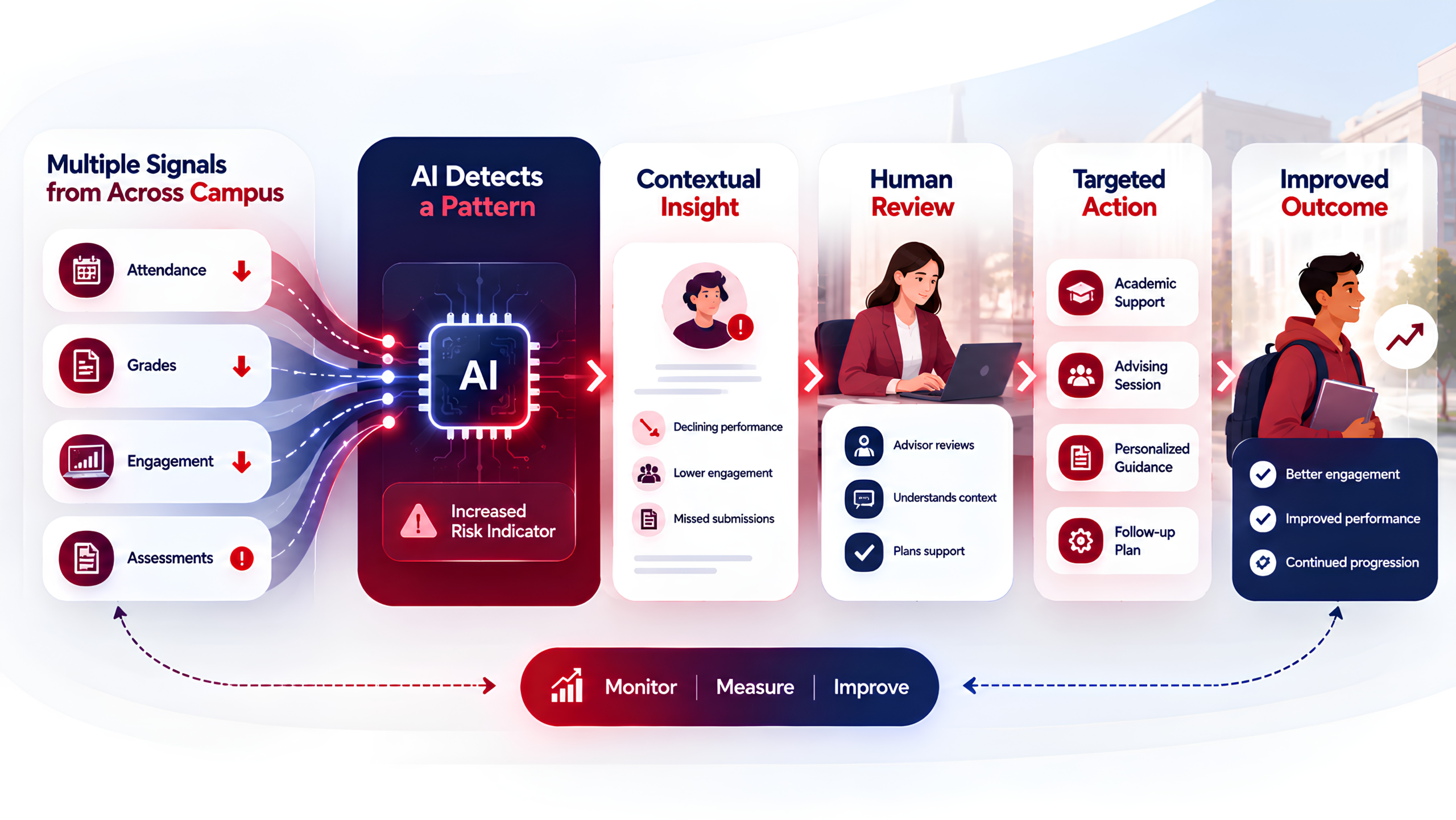
Consider four signals:
Attendance ↓
Assessment performance ↓
LMS engagement ↓
Missed submissions ↑
Individually, each one provides only part of the picture.
Together, they may create a stronger reason for an advisor to contact the student.
The same principle applies at the institutional level. Suppose applications are increasing, but offer acceptance is declining while enquiries about one programme are rising. Instead of viewing those numbers separately, AI can help leadership investigate the relationship between them.
The value of analytics ultimately comes down to what university leaders can do with the information.
A Rector or Vice-Chancellor may need to decide whether a programme has the capacity for further growth. A Dean may need to understand why a course’s performance has changed. A Registrar may want to identify where registration processes are slowing down.
TCS’s 2026 Higher Education Study, based on 200 senior leaders across the US, UK and Australia, found that nearly 80% of leaders were optimistic about long-term institutional growth, while digital transformation was identified as one of the top three growth drivers. The study also found that AI and machine learning were the top technology investment priorities for the next two years.
For leadership teams, this makes AI-powered SIS data useful beyond reporting. It can support decisions around programme demand, student success, resource allocation, operational performance and institutional growth.
A dashboard still requires users to know where to look.
AI can make institutional information more accessible by allowing authorised users to explore questions in more natural ways.
Academia currently highlights 400+ AI-powered reports alongside 800+ standard reports and dashboards, designed to help institutions analyse information and make reporting more accessible.
For example, rather than searching manually through several reports, a university leader could ask:
“Which programmes experienced the largest change in enrolment this year?”
The shift is from finding a report to asking a question.
With AI-powered reports, analytics, dashboards, and SERA AI, Academia brings admissions, academics, attendance, examinations, finance and student information into a connected environment, helping universities move beyond static reporting towards more actionable insights. Academia’s published analysis cites up to 30–40% improvement in decision-making speed through AI-powered analytics.
The practical value is not simply making decisions faster. It is giving university teams more time to interpret information, identify patterns, investigate emerging issues and decide what needs attention. Instead of spending hours preparing data, leaders can move more quickly from:
More data and better prediction also create responsibility.
Universities should ensure that:
Data is accurate before it is analysed.
Access is controlled according to legitimate institutional roles.
AI outputs are explainable enough for staff to understand how an insight or alert was generated.
Bias is monitored, particularly where historical data influences predictions.
Human judgement remains central, especially for student-support decisions.
Jisc’s guidance specifically recommends that where AI generates predictions or interpretations about students, institutions should provide meaningful ways for students to understand, question or correct those analytics.
The objective should always be support, not labelling.
Admissions can reveal demand. Attendance can reveal engagement. Assessment and academic data can reveal performance. Finance and support data can provide additional context. Operational data can show where institutional growth is creating pressure.
When these datasets become accessible through a connected AI-powered SIS, the university can move beyond “What happened?” towards “What is changing, why might it matter, and where should we act?”
That is where student data stops being a collection of records and starts becoming institutional intelligence.
See how Academia can help your institution connect student data, strengthen analytics and make AI a practical part of everyday university decision-making.
Depending on the systems and data sources connected to it, an AI-powered SIS can analyse admissions, enrolment, academic performance, attendance, assessments, course and programme data, engagement, fees, student support and institutional operations.
Yes. AI can analyse grades, GPA, pass rates, failed courses and progression patterns to identify changes across students, courses, programmes and cohorts.
Yes, when these data sources are integrated. Looking at attendance alongside assessment results and engagement activity can provide more context than examining attendance alone.
Yes. Connected analytics can support decisions around programme demand, student success, resource planning, operational performance and institutional growth, while final decisions remain with university leadership.
No. The value comes from relevant, reliable and appropriately governed data. Poor-quality or unnecessary data can make analysis less useful and increase privacy and governance risks.
Academia combines its SIS and Education ERP with AI capabilities, including 400+ AI-powered reports, AI-driven analytics and SERA AI, helping authorised users access and interpret institutional information more efficiently.

Experience Academia – Your partner in transforming campus operations, a trusted all-in-one ERP/SIS solution.
Get the latest insights, trends, and updates delivered straight to your inbox!