

Vijay Naga Prasad
Estd. Reading Time : 4Min.
17th Dec, 2025
Higher Education
Share On:
Higher education in Southeast Asia is expanding faster than ever. New campuses are opening, student mobility across borders is increasing, and governments are investing heavily in digital education initiatives.
However, beneath this growth lies a growing fear shared quietly by university leaders and administrators:
Are our systems strong enough to manage this scale?
What starts as progress often turns into pressure when institutions realise their management processes were built for a much smaller, simpler reality.
Managing higher education today in Southeast Asia is no longer just about enrollment and academics. Institutions must handle diverse student demographics, regional compliance requirements, outcome-based education models, and rising expectations for digital experiences.
Yet many universities continue to operate with fragmented systems. Admissions data lives in one platform, attendance in another, exams somewhere else, and reporting often depends on manual data consolidation.
As a result, leadership teams struggle to gain a clear, real-time picture of what is actually happening across their campuses.
According to the World Bank, strengthening institutional governance and data-driven decision-making is critical for Southeast Asia to meet future workforce and economic demands
Source: (https://www.worldbank.org/en/topic/education).
The challenge is not a lack of effort-it is a lack of integration.
When systems do not communicate with each other, even routine tasks become inefficient. Administrators spend valuable time reconciling data instead of improving student outcomes. Faculty members lack timely insights. And leadership decisions are often based on outdated information.
Over time, this operational friction impacts retention, compliance, and overall institutional credibility.
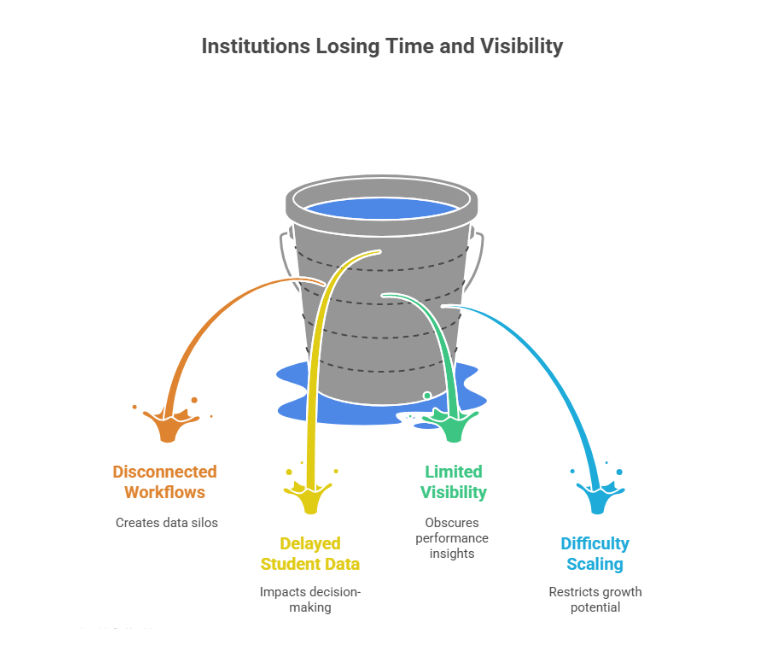
This problem becomes clearer when we look at daily operations. Many Southeast Asian institutions face:
While these issues may seem operational, their impact is deeply strategic.
Forward-thinking institutions across Southeast Asia are responding by rethinking how they manage the student lifecycle.
Instead of adding more tools, they are consolidating operations into a single, unified Student Information System (SIS). This shift enables institutions to move from reactive administration to proactive management.
With centralized data and automated workflows, institutions gain clarity. Decisions become faster, more confident, and aligned with long-term goals rather than short-term fixes.
UNESCO also emphasizes that digital education systems play a crucial role in improving institutional capacity and learning outcomes across ASEAN countries.
Source: (https://www.unesco.org/en/education).
A well-designed SIS does more than digitize processes. It creates continuity across the entire academic journey-from admissions to graduation.
When student data flows seamlessly across departments, institutions can track progress, identify risks early, and ensure compliance without administrative overload. More importantly, leaders gain real-time insights that support strategic planning and accreditation readiness.
This transformation allows institutions to scale confidently without compromising quality or student experience.
Southeast Asia is not a monolithic education market. Regulatory frameworks, academic structures, and institutional priorities vary widely across countries.
Therefore, institutions need systems that are flexible, scalable, and designed with regional realities in mind. Cloud-enabled, mobile-friendly platforms that support compliance and multi-campus operations are becoming essential-not optional.
ASEAN education frameworks consistently highlight the need for digital infrastructure that supports quality, accessibility, and cross-border collaboration.
When higher education management systems are aligned with institutional goals, the impact is transformative.
Students experience smoother journeys and faster responses. Administrators regain control over workflows. Leadership teams move from firefighting to future planning.
Most importantly, institutions are better equipped to deliver measurable academic and career outcomes-something Southeast Asia’s growing youth population urgently depends on.
Southeast Asia’s higher education sector is full of opportunity. But growth without structure leads to inefficiency, risk, and lost potential.
Institutions that invest in an integrated, student-centric management system like Academia are not just solving today’s challenges. They are building resilient campuses ready for the next decade of transformation.
Because in higher education, sustainable growth is never accidental-it is planned and designed.

Experience Academia – Your partner in transforming campus operations, a trusted all-in-one ERP/SIS solution.
Get the latest insights, trends, and updates delivered straight to your inbox!