
Michele Du Rand
Estd. Reading Time : 4 Min.
28th Aug, 2026
Share On:
Student services are becoming one of the most visible parts of the university experience.
For students, the quality of a university’s digital services is often measured in simple moments: How quickly can I register? Can I check my fees without visiting an office? Where can I find my timetable? How easily can I access my results? Can I track an application or request without repeatedly contacting the university?
For institutions, however, delivering these experiences requires much more than putting forms online. Admissions, registration, academics, fees, attendance, examinations and student support all generate information that needs to work together.
This is where a modern Student Information System (SIS) can make a difference.
South African universities are increasingly focusing on integrated student lifecycle systems, automation and digital service delivery. For example, the Central University of Technology’s current student academic lifecycle project aims to integrate and automate processes from application and admission through progression, registration and graduation.
The opportunity is clear: digitise the service, connect the data and make the student journey easier.
Traditional student services often depend on a combination of departmental systems, emails, spreadsheets, paper-based processes and in-person interactions.
This can create friction for both students and staff.
A student may need to contact one department about registration, another about fees and another about academic records. Staff, meanwhile, may have to search across different systems before they can provide a complete answer.
The challenge is therefore not simply to digitise individual services.
It is to connect them.
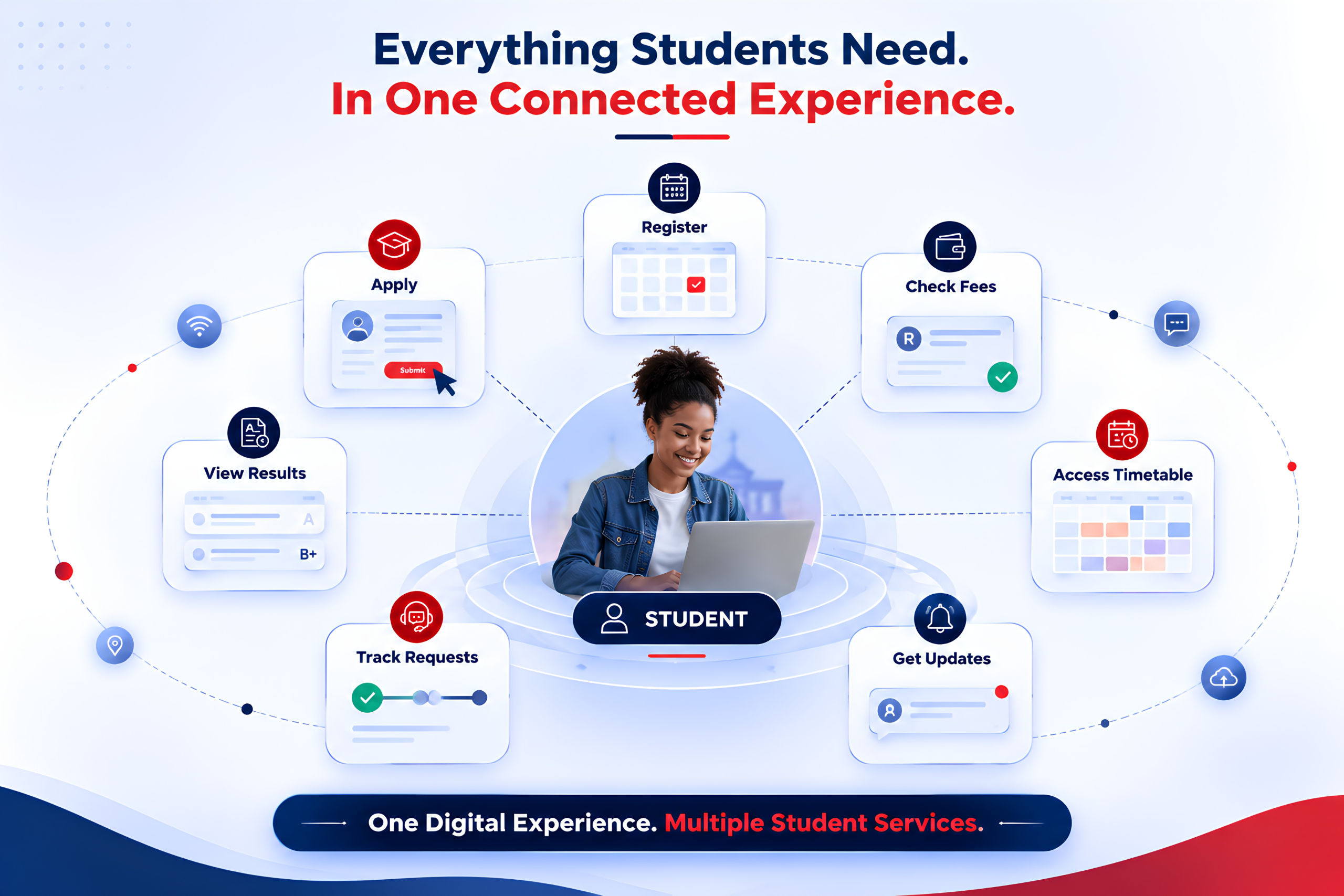
A modern SIS can bring together:
Admissions → Registration → Fees → Academics → Attendance → Examinations → Student Services → Graduation
This gives students a more consistent digital experience while providing staff with better access to the information they need.
A modern SIS can support a wide range of student-facing and administrative processes.
These can include:
The important point is that these services should not operate as disconnected digital islands.
When they are connected through a common student record, information can move more efficiently between processes.
According to Academia’s research, the objective of a modern SIS is to unify academic and administrative workflows on a single digital platform, helping institutions centralise data, automate operations and improve student experience.
Students do not see the university as a collection of departments.
They see it as one institution.
If a student changes a programme, for example, relevant information may need to be reflected across registration, academic records, fees and other services. When systems are disconnected, the student may have to repeat the same request several times.
A connected SIS can reduce this friction by allowing relevant information to flow across the student lifecycle.
This can help universities provide:
Students can access relevant information without depending on manual responses from multiple departments.
Students can complete routine tasks, submit requests and access information digitally.
Connected records reduce the risk of students receiving different information from different departments.
Automated notifications can keep students informed about applications, registration, fees, examinations and other important activities.
The result is a shift from students chasing information to information being available when students need it.
Not every process needs the same level of automation.
Universities should start with high-volume, repetitive processes where manual intervention creates the greatest delays.
These may include:
Admissions: Application processing, document verification and admission workflows.
Registration: Course registration, approvals and academic clearance.
Attendance: Digital attendance capture and academic tracking.
Examinations: Scheduling, assessment workflows and results processing.
Fees: Fee visibility, payment processes and financial information.
Student Requests: Approvals, documents and administrative requests.
Automation can reduce repetitive work while creating more consistent processes.
Academia’s South Africa offering specifically highlights automated digital workflows across areas such as admissions, academic tracking, attendance, examinations and results processing.
Digitising a process creates value, but connecting the information behind that process creates even more.
Consider a student’s registration journey.
The university already has information about the student’s programme, academic history, fees and eligibility. If these records remain in separate systems, registration may require several manual checks.
With a connected SIS, authorised staff and digital workflows can access the relevant information within the same environment.
This can create a simpler process:
Student record → Eligibility → Registration → Approval → Confirmation
The same principle can apply across examinations, fees, attendance and student support.
The result is not simply faster administration.
It is better use of institutional data.
Digital transformation is incomplete if students still need to rely heavily on physical offices for routine services.
A modern SIS should make relevant services accessible through convenient digital channels.
Students may need to:
Academia’s platform provides mobile access for students and staff, alongside digital-first admissions and enrolment capabilities.
This can help universities move towards a self-service model, where staff focus more on complex cases, and students can manage routine activities independently.
Student-facing digital services can also transform the staff experience.
When students can independently access information and complete routine tasks, staff spend less time responding to repetitive enquiries.
Automation can further reduce manual coordination.
For example:
Manual process:
Student request → Email → Department review → Follow-up → Approval → Student notification
Connected process:
Student request → Digital workflow → Approval → Automated notification
This creates greater consistency while reducing unnecessary administrative effort.
A connected SIS can also give staff a clearer view of the student’s information, helping them respond without repeatedly requesting data from other departments.
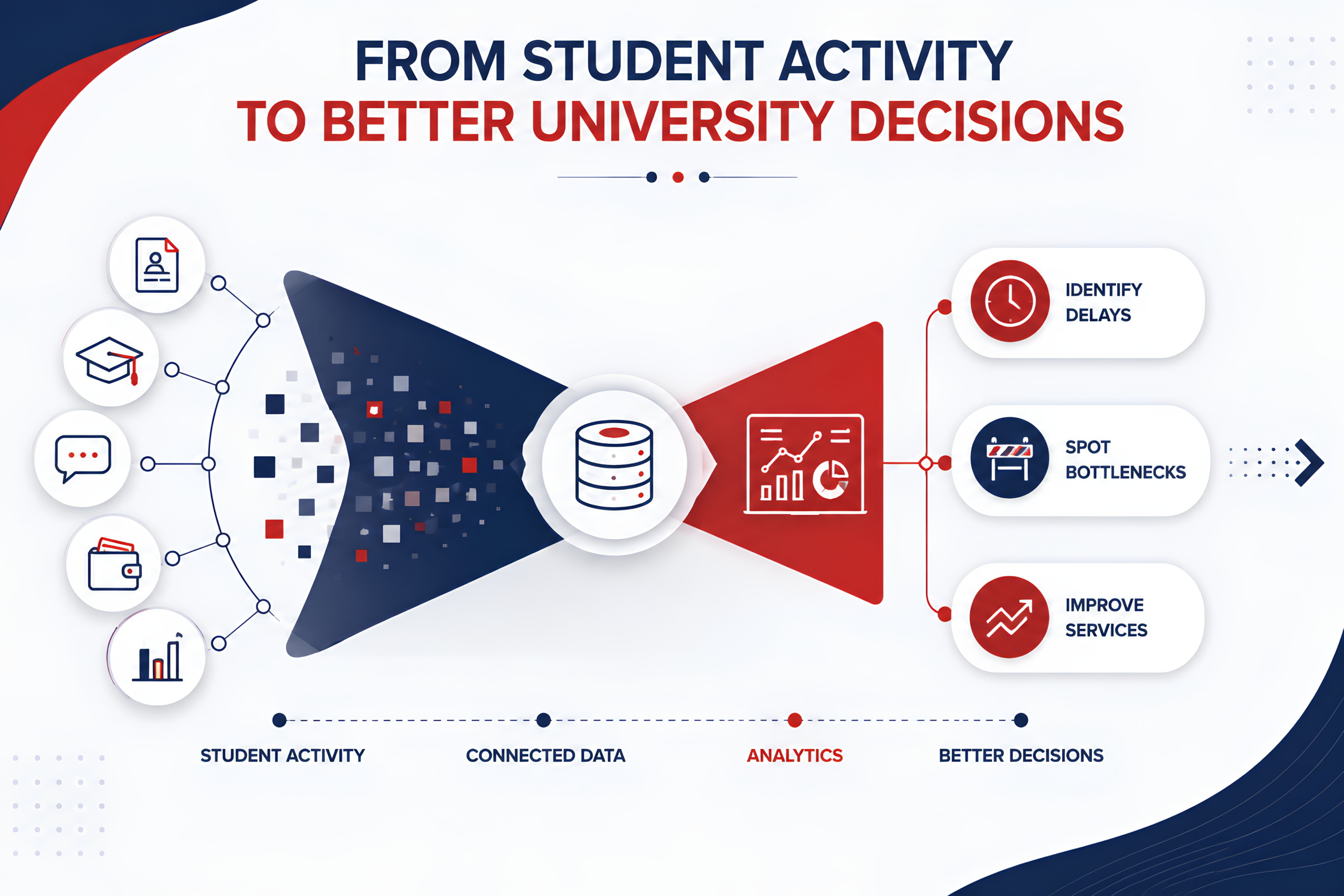
Digitisation generates valuable institutional data.
Universities can use this information to understand:
Analytics can turn these observations into actionable insights.
From Academia’s perspective, real-time insights are an important part of modern student management because they allow institutions to monitor operations and make faster, more informed decisions. Its SIS provides real-time tracking, role-based access and analytics capabilities across institutional operations.
The objective is to move beyond asking “How many requests did we process?” to understanding “Where can we improve the student experience?”
Choosing an SIS should involve more than checking whether it has individual modules.
Universities should evaluate how well the platform connects the entire student experience.
| Capability | Why It Matters |
|---|---|
| Student lifecycle management | Connects services from admission to graduation |
| Self-service | Gives students easier access to routine services |
| Workflow automation | Reduces manual processing and delays |
| Centralised data | Creates a consistent student record |
| Analytics | Helps identify bottlenecks and trends |
| Mobile access | Supports convenient digital engagement |
| Integration | Connects existing university systems |
| Security | Protects sensitive student information |
| Scalability | Supports growing student populations |
| Local requirements | Supports South African academic and reporting needs |
For South African institutions, local requirements are particularly important. Academia’s South Africa platform highlights capabilities around NSFAS management, NSC results integration, HEMIS and TVET MIS reporting, alongside core student lifecycle processes.
Academia by Serosoft provides a Student Information System designed to connect academic and administrative workflows within a unified digital environment.
For South African institutions, the platform supports the student lifecycle across admissions, academics, attendance, examinations, fees and student services, while also providing workflow automation, analytics and mobile access.
The value lies in bringing these capabilities together rather than treating every service as a separate technology project.
Universities can use the platform to:
Academia’s approach is to create a connected digital environment where student information, workflows and services work together across the complete lifecycle.
That means digital transformation can become more than moving paper forms online.
It can become a way to redesign how the university serves students.
South African higher education is moving towards more connected, student-centred digital environments.
Recent institutional initiatives show that universities are looking beyond individual digital services towards integrated student lifecycle management, automation and data-driven decision-making.
The future model is not:
More portals → More passwords → More disconnected systems
It is:
One connected student journey → Integrated services → Better data → Faster decisions → Better student experience
For university leaders, this creates an important opportunity.
The question is no longer simply “Which student services can we digitise?”
It is:
“How can we connect our digital services so the entire student experience becomes simpler?”
Your students should not have to navigate disconnected systems to get simple things done.
Academia can help South African universities connect student information, automate workflows and create a more seamless digital student experience.
Explore Academia SIS and see how your institution can move towards a more connected, efficient and student-centred campus.
Digitising student services means moving processes such as admissions, registration, fees, examinations, student requests and academic records into connected digital workflows that students and staff can access more efficiently.
An SIS can centralise student information, automate workflows, enable self-service, improve communication and give authorised staff better access to relevant student records.
Universities can digitise admissions, registration, attendance, examinations, results, fees, student requests, communication and graduation-related processes through an integrated SIS.
Self-service allows students to access information and complete routine tasks without depending on manual assistance for every interaction. This can improve convenience while reducing repetitive administrative enquiries.
Universities should evaluate lifecycle coverage, automation, integrations, analytics, mobile access, security, scalability and support for South African requirements such as HEMIS and NSFAS-related processes.
Yes. Academia states that its SIS can integrate with third-party and legacy platforms, allowing institutions to maintain secure data flows while modernising their student information environment.

Experience Academia – Your partner in transforming campus operations, a trusted all-in-one ERP/SIS solution.
Get the latest insights, trends, and updates delivered straight to your inbox!