“Institutions still relying on traditional,
Tracking attendance in sheets &
Keeping exams & marksheet generation conventional!
But, For institutions to excel & rule
They must leave behind the workflow
That’s old-school.”
Embracing modern systems isn’t optional – it has become essential.
If these lines reflect your campus reality, this blog shows the way out – challenges, solutions, and the future of student management.
Central Asia’s higher education sector is at a crossroads. Countries like Kazakhstan, Kyrgyzstan, Uzbekistan, and Tajikistan are investing in digital transformation-but many institutions still rely on outdated systems, manual workflows, and fragmented data.
To truly modernize, universities need a reliable, scalable student ERP that works as a student management system, academic ERP, and more.
Many universities in Central Asia continue to rely on disconnected software, spreadsheets, or even paper-based operations. This fragmentation means admissions, attendance, finance, and academics are not integrated, creating operational inefficiencies and data duplication.
While some urban universities (e.g., in Almaty or Tashkent) benefit from strong internet connectivity, others struggle with inconsistent IT infrastructure. This infrastructure gap makes the rollout of a sophisticated ERP higher education solution more challenging.
Researches point to infrastructural inequality as the key barrier to transformation.
Many institutions face limited funding, which makes it hard to invest in modern academic ERP systems. As studies show, financial constraints remain one of the biggest obstacles to higher education digital transformation.
Digitizing student records, attendance, and academic data introduces serious cybersecurity and data privacy challenges. Without a proper student management system with strong controls, universities risk data breaches or misuse.
Quality assurance in Central Asian universities is under special scrutiny, with calls for more standardized processes and accountability across institutions. An ERP system that provides reliable data can play a crucial role in improving transparency and institutional quality.
Faculty and staff in many universities may lack experience with ERP systems or data analytics. Combined with institutional inertia, this limits the adoption of modern digital tools. The global research also highlights the digital skills gap as a hindrance to successful transformation.
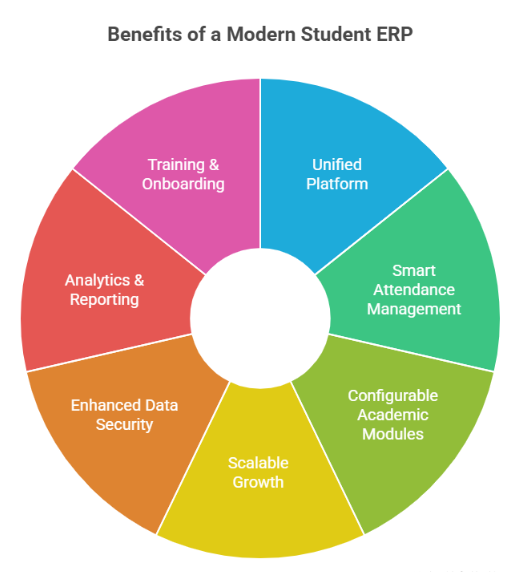
A student ERP platform developed for higher education can directly address these challenges:
The future of higher education in Central Asia depends on smart, data-driven digital transformation. By adopting a robust student ERP or academic ERP, institutions can streamline operations, ensure data security, and improve student success.
For universities in Central Asia that want to lead, innovate, and scale – investing in the right ERP higher education system is not just an option – it’s a necessity.

Experience Academia – Your partner in transforming campus operations, a trusted all-in-one ERP/SIS solution.
Get the latest insights, trends, and updates delivered straight to your inbox!