Type your keyword below

How Central Asian Universities Can Transform with a Modern Student ERP: Overcoming Legacy Challenges

Introduction:

“Institutions still relying on traditional,

Tracking attendance in sheets &

Keeping exams & marksheet generation conventional!

But, For institutions to excel & rule

They must leave behind the workflow
That’s old-school.”

Embracing modern systems isn’t optional — it has become essential.

If these lines reflect your campus reality, this blog shows the way out — challenges, solutions, and the future of student management.

Central Asia’s higher education sector is at a crossroads. Countries like Kazakhstan, Kyrgyzstan, Uzbekistan, and Tajikistan are investing in digital transformation—but many institutions still rely on outdated systems, manual workflows, and fragmented data. 

To truly modernize, universities need a reliable, scalable student ERP that works as a student management system, academic ERP, and more.

Challenges Faced by Central Asian Higher Education Institutions

1. Legacy Systems and Fragmented Processes

Many universities in Central Asia continue to rely on disconnected software, spreadsheets, or even paper-based operations. This fragmentation means admissions, attendance, finance, and academics are not integrated, creating operational inefficiencies and data duplication.

2. Limited Infrastructure & Digital Divide

While some urban universities (e.g., in Almaty or Tashkent) benefit from strong internet connectivity, others struggle with inconsistent IT infrastructure. This infrastructure gap makes the rollout of a sophisticated ERP higher education solution more challenging. 

Researches point to infrastructural inequality as the key barrier to transformation.

3. Financial Constraints & Sustainability

Many institutions face limited funding, which makes it hard to invest in modern academic ERP systems. As studies show, financial constraints remain one of the biggest obstacles to higher education digital transformation. 

4. Data Security & Accountability

Digitizing student records, attendance, and academic data introduces serious cybersecurity and data privacy challenges. Without a proper student management system with strong controls, universities risk data breaches or misuse.

5. Need for Quality Assurance

Quality assurance in Central Asian universities is under special scrutiny, with calls for more standardized processes and accountability across institutions. An ERP system that provides reliable data can play a crucial role in improving transparency and institutional quality.

6. Skill Gaps & Resistance to Change

Faculty and staff in many universities may lack experience with ERP systems or data analytics. Combined with institutional inertia, this limits the adoption of modern digital tools. The global research also highlights the digital skills gap as a hindrance to successful transformation.

Why a Modern Student ERP Is the Solution:
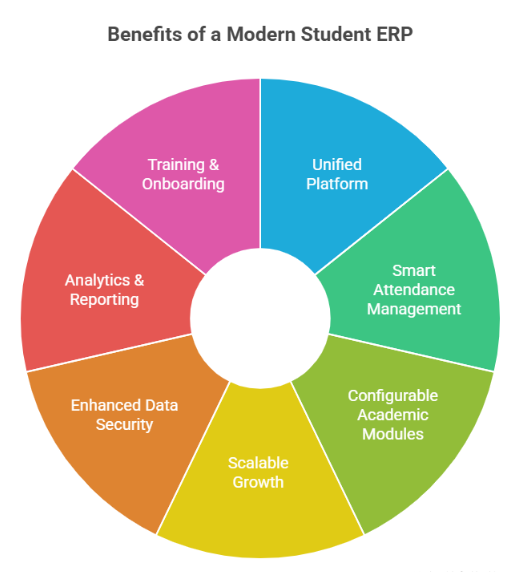
 

student erp

A student ERP platform developed for higher education can directly address these challenges:

  • Unified Platform: A full-feature student management system brings together admissions, academics, attendance, and finance into one system — eliminating silos.
  • Smart Attendance Management Software: Built-in modules for attendance tracking help automate daily processes, reduce manual work, and maintain real-time records.
  • Configurable Academic ERP Modules: Universities can customize the ERP to match their academic structures, credit systems, and local workflows without heavy IT dependence.
  • Scalable Growth: As campuses grow or expand regionally, the ERP system scales with minimal fuss — helping institutions future-proof their operations.
  • Enhanced Data Security: A modern ERP ensures role-based access, encryption, and compliance, helping institutions protect sensitive student data.
  • Analytics & Reporting: Advanced analytics allow administrators to draw actionable insights — such as predicting dropout risks or identifying student performance trends.
  • Training & Onboarding: Quality ERP providers support capacity building, helping staff and faculty adapt to new systems and avoid resistance.

Real-World Context: Central Asia Is Already Moving

  • Under the HiEdTec project, universities across Central Asia (including in Kyrgyzstan and Uzbekistan) are exploring ICT integration to modernize education.
  • Governments in the region — notably in Kazakhstan — are actively pushing digital university models as part of national AI and smart campus strategies.

Source: https://astanatimes.com/2025/09/exclusive-kazakhstan-cements-status-as-regional-academic-hub/?utm_source=chatgpt.com

Best Practices for Implementing a Student ERP in Central Asia

  1. Start with Key Modules
    Begin ERP adoption with high-impact areas: implement attendance management software, student registration, and academic modules first to quickly improve ROI.
  2. Prioritize Training & Change Management
    Invest in staff and faculty training to build comfort and familiarity with the new academic ERP system and increase operational management.
  3. Ensure Compliance & Localization
    Choose a student ERP that offers multilingual support (e.g., Russian, Uzbek) and aligns with regional data protection policies.
  4. Adopt a Phased Rollout
    Roll out the system in phases — pilot with a few departments or campuses to refine the deployment, then scale out.
  5. Use Analytics for Continuous Improvement
    Leverage ERP data for decision-making: identify student retention issues, financial trends, or administrative bottlenecks.

Conclusion

The future of higher education in Central Asia depends on smart, data-driven digital transformation. By adopting a robust student ERP or academic ERP, institutions can streamline operations, ensure data security, and improve student success.

For universities in Central Asia that want to lead, innovate, and scale — investing in the right ERP higher education system is not just an option — it’s a necessity.

AI‑Enhanced Platforms for Efficiency & Success — Using AI to improve operations and outcomes

“The future belongs not to those who adapt to change slowly, but to those who harness change swiftly — especially when it’s powered by AI.”

In the age of digital transformation, AI isn’t a futuristic concept anymore — it’s the engine driving efficiency, clarity, and unprecedented outcomes across industries. Just as a compass helps a sailor navigate the uncertain seas, AI serves as the guiding force for modern institutions seeking clarity amidst complexity. And for educational institutions, that journey toward transformation is no longer optional — it’s essential.

At Academia, we’ve embraced this reality. Our AI‑powered platform is designed to boost administrative productivity, optimize academic processes, and improve student experiences — while presenting data in ways that drive better decisions and outcomes.

Why AI Matters in Education Today

According to McKinsey,  please add citations or remove the name organizations that successfully integrate AI can boost productivity and make faster, data‑driven decisions. In higher education, this translates into streamlined operations, improved student engagement, and a reduced burden on faculty and staff. 

Transitioning from manual processes to AI‑driven workflows empowers institutions to focus more on strategic goals rather than repetitive tasks.

While traditional systems help with basic automation, AI‑enhanced platforms take it several steps further — embedding intelligence into every interaction. 

At Academia, artificial intelligence doesn’t merely automate; it augments human capability.

Wondering how?

See How Academia–AI‑Enhanced Platform is a Game Changer?

AI-Powered System

To understand the true impact of an AI platform like Academia, let’s break down the core benefits institutions experience:

1. Faster, Smarter Decision‑Making

AI systems analyze trends, detect patterns, and generate insights in a fraction of the time it would take humans. With Academia’s AI‑powered reports and analytics, institutions get access to:

  • 800+ built‑in reports covering admissions, exams, fees, attendance, and more 
  • Interactive dashboards that update in real time 
  • Predictive insights to support proactive actions 

These capabilities empower leaders with clarity — no more guessing, only informed decisions based on reliable data.

For a broader look at how analytics are reshaping decision‑making, explore this piece by Forbes add a link to Forbes article on AI‑driven analytics.

2. Enhanced Student Experiences

Students today expect fast, personalized support — and AI delivers exactly that. One of the core features of Academia’s platform is SERA, the AI‑enabled personal assistant.

SERA assists students 24/7 with:

  • Answers to academic questions 
  • Guidance through administrative tasks 
  • Instant support without queues or delays 

Through natural language understanding, SERA provides accurate responses — which means student satisfaction goes up while staff workload goes down.

3. Intelligent Enrollment Support

Traditional admissions often require students to fill out lengthy forms, visit campuses, or wait for support. Academia uses agentic AI to simplify this entire journey.

Here’s how:

  • Students begin enrollment by chatting with the AI chatbot 
  • The system accepts and verifies student information in real time 
  • Enrollment data is immediately reflected in both student and admin portals 
  • Delays and confusion are eliminated 

This isn’t just automation — it’s smart processing backed by instantaneous updates that ensure accuracy and transparency.

4. Automated Remark Generation

Teachers spend hours writing individual remarks for student performance reports. Academia’s AI‑driven automatic remark generation streamlines this process:

  • Faculty simply enter a few keywords or performance traits — just one or two words. 
  • The AI instantly crafts complete, context-relevant remarks for each student. 
  • This saves time, ensures accuracy, and maintains personalization across every student’s report.

The outcome? Faculty save time, increase productivity, and maintain high quality in academic feedback.

5. Predictive Performance Insights

Beyond generating reports, Academia’s AI can analyze student performance patterns and highlight early warning signs of academic risk or disengagement. These insights empower educators to intervene early — significantly improving retention and success rates.

Key Benefits of AI‑Enhanced Platforms in Education

Below is a summary of tangible benefits that institutions gain by adopting AI platforms like Academia:

  • Data‑driven governance: Better strategic planning with accurate, real‑time insights 
  • Operational efficiency: Reduced manual workloads and administrative overhead 
  • Student satisfaction: Faster query resolution and personalized support 
  • Time savings: More time for educators to focus on teaching and mentoring 
  • Improved compliance: Standardized workflows that adhere to institutional and regulatory requirements

Transitioning to AI isn’t about replacing humans — it’s about amplifying human intelligence to handle tasks that once consumed valuable time and energy.

Addressing Common Concerns About AI Adoption

Even with its benefits, some institutions hesitate to adopt AI because of perceived complexity or fear of disruption. Let’s clear up a few common misconceptions:

AI Is Too Complex

With thoughtful onboarding and adaptive design, Academia’s AI features are intuitive. You don’t need a technical degree to use AI‑enabled tools — they’re built for educators, administrators, and students alike.

Data Security Is a Risk

AI systems must adhere to stringent security standards. Academia equips institutions with secure data practices and compliant infrastructure to protect sensitive student information.

Wrapping Up- 

Efficiency and success aren’t outcomes — they’re ongoing processes shaped by thoughtful innovation. In the AI era, institutions that leverage intelligent platforms like Academia stand to gain not only operational excellence but also a transformative impact on the entire educational experience.

From AI‑powered analytics to agentic enrollment chatbots, SERA student support, and automatic remark generation, Academia’s AI suite empowers institutions to do more with less — and do it with precision, speed, and confidence.

Contact our team of experts to schedule your free demo today and see these capabilities in action. 

How Higher Ed Institutions in the Gulf Can Win with a Student Information Management System

In the heart of the Gulf and Oman’s higher education landscape, institutions face a paradox: they’re growing in size and ambition, yet many still rely on dated processes and fragmented technology. As student numbers surge, regulatory demands tighten, and digital expectations rise, the pressure on administrators and academics grows.

This is the moment where a student information management system, or higher-ed ERP focused on student workflows, becomes not just a convenience — but a necessity.

The Challenge: Growth + Complexity = Risk

Unified Student Information Management System

In Oman and the broader Gulf, institutions are expanding—new branches, larger intakes, more international students. 

Yet, many still manage admissions, attendance, fees, and marksheets with spreadsheets, disconnected systems, and manual workflows. 

Modern student information systems consolidate data across time and departments, enabling institutions to act in real time.

The key pain points include: 

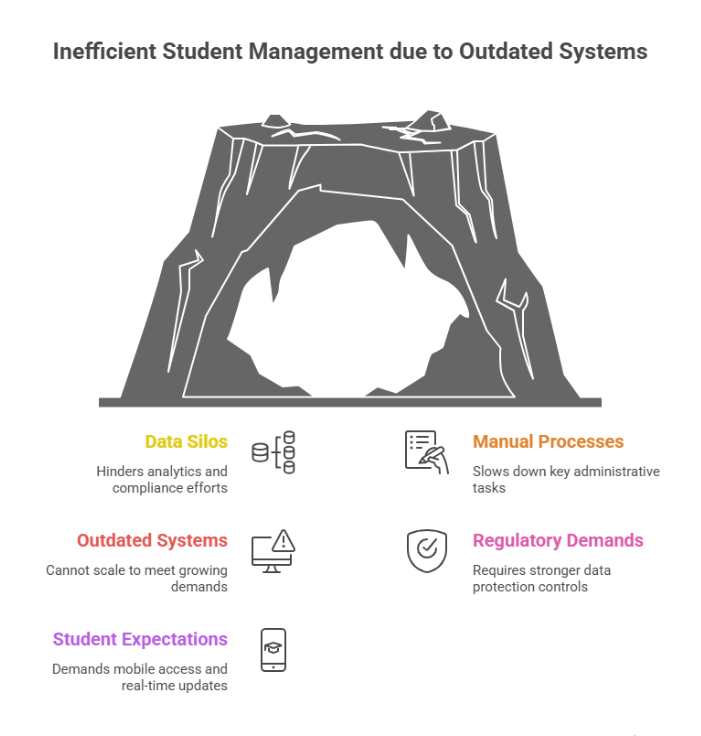
  • Data silos across departments make analytics and compliance harder.
  • Manual processes that slow down admissions, grading, fee settlement, and reporting.
  • Outdated systems that cannot scale to multiple campuses or currencies.
  • Regulatory and data-protection demands (now a global expectation) are pressing for stronger controls.
  • Student and faculty expectations of mobile access, real-time updates, and seamless experience.

If your institution is relying on patchwork systems or legacy software, the risk isn’t just inefficiency — it’s falling behind in the competitive regional market.

The Solution: A Unified Student Information Management System like Academia

A purpose-built system for higher education does more than record data.

Academia, a thoughtfully designed student information management system for higher ed institutions, orchestrates the entire student lifecycle — from application to alumni engagement. 

Its digital framework allows higher education institutions to manage student data comprehensively. 

Here’s what Academia’s modern SIS delivers, especially for institutions in Oman and the Gulf:

  • Centralised student database: All student, academic, administrative, and financial data in one interoperable platform.
  • Agentic AI for student enrollment: Enables students to explore and enroll in courses or programs instantly through an AI chatbot, simplifying the entire admission journey without manual forms or standing in queues.
  • Workflow automation: Admissions, registration, exams, marksheet remark generation, attendance, and fee processing are all streamlined and automated.
  • AI-powered reports & analytics: Dashboards that guide management with actionable insights.
  • Self-service portals: For students, faculty, and parents — improving engagement and reducing staff burden.
  • Cloud-readiness & scalability: The ability to scale across campuses, geographies, and currencies.
  • Strong governance & compliance: Robust access control, audit trails, and regulatory compliance built in.

Modern SIS solutions are transforming administrative tasks from time-consuming chores into smooth, automated processes. Read the full blog here.

https://www.academiaerp.com/blog/streamlining-higher-ed-administration-how-sis-transforms-daily-tasks-for-efficiency/

Region-Specific Considerations for Oman & Gulf Institutions

When selecting and implementing such a system in this region, there are important factors:

  • Localization: Support in Arabic and English languages, multiple campuses, local fee structures, and regional compliance.
  • Vendor support & training: ERP implementations in the Middle East often fail due to cultural, user-adoption, or customisation mismatches.
  • Data sovereignty & security: Ensure the system meets local and international standards (for example, ISO 27001, GDPR-like controls).
  • Mobile-first experience: Many students in the region access services via mobile; a mobile-friendly system matters.
  • Change management: Legacy systems may be entrenched; successful implementations depend on stakeholder alignment, training, and phased rollout.

The Impact: What Good Looks Like

Adopting a robust student information management system like Academia isn’t just about digitising tasks — it’s about transforming the campus. 

The benefits seen globally, and increasingly in the Middle East, include:

  • Faster admissions and registration turnaround.
  • Reduction in manual errors (grades, attendance, and fee tracking).
  • Improved student and faculty satisfaction.
  • Real-time decision making using accurate data.
  • Operational cost savings, better allocation of resources, and improved institutional agility.

Conclusion: Don’t Just Digitise — Transform

For higher education institutions in Oman and the Gulf region, the question today isn’t whether you need digital systems — it’s whether your systems are future-ready. A student database management system or higher ed ERP is only as valuable as the impact it delivers.

When an institution adopts the right platform — one that manages student information, strengthens community engagement, supports informed decision-making, and scales effortlessly — operations evolve from reactive to visionary. The campus moves beyond data entry to become a strategic powerhouse.

Schedule your personalized demo call today. 

Africa’s Higher Education Revolution: Why Institutions Need a Smart Student Information Management System

Across Africa, higher education is not just growing — it’s transforming. 

From long-standing higher education hubs to rapidly growing campuses, the region is experiencing a powerful surge toward digital transformation.

Yet amid this momentum lies a persistent challenge: managing massive amounts of student and institutional data efficiently.

As enrollments soar and digital expectations rise, institutions are realizing that spreadsheets and outdated software can no longer sustain their ambitions. What they need is a student information management system — or better yet, a comprehensive higher ed ERP — designed to connect every process, person, and performance metric seamlessly.

African Higher Ed Challenge: Data Chaos in a Digital Age

Universities across Africa are expanding faster than their systems can handle. Admissions offices drown in paperwork, exam departments spend weeks compiling results, and administrators juggle multiple systems for attendance, finance, and analytics.

According to a report by UNESCO, Africa’s higher education enrollment has grown by over 60% in the last decade, yet digital infrastructure hasn’t kept pace. 

The result?

  • Fragmented data silos across departments.
  • Slow decision-making due to the lack of real-time analytics.
  • Compliance risks from weak data governance.
  • Limited scalability for multi-campus and online learning environments.

This imbalance between growth and governance creates inefficiency — and institutions lose both time and trust.

The Game-Changer: Unified Student Information System

A student database management system does far more than store information. It builds a truly connected campus, bringing admissions, academics, examinations, and alumni relations together on one unified and synchronized platform. 

For African universities aiming to become globally competitive, adopting an ERP for higher education means:

  • Transparency in administration – no more lost records or delays.
  • AI-driven reports & analytics that transform raw data into real-time insights.
  • Automation of repetitive tasks, freeing staff to focus on strategy.
  • Cloud scalability for multi-campus or remote programs.
  • Localized compliance like NITA & PDPO for national education standards and data privacy.

As World Bank research emphasizes, technology-led higher education can accelerate Africa’s development goals — only if systems are modern, scalable, and data-smart.

How a Higher Ed ERP Drives Institutional Impact

A modern ERP for higher education goes beyond technology — it builds accountability, speed, and insight. Here’s how it reshapes the African education ecosystem:

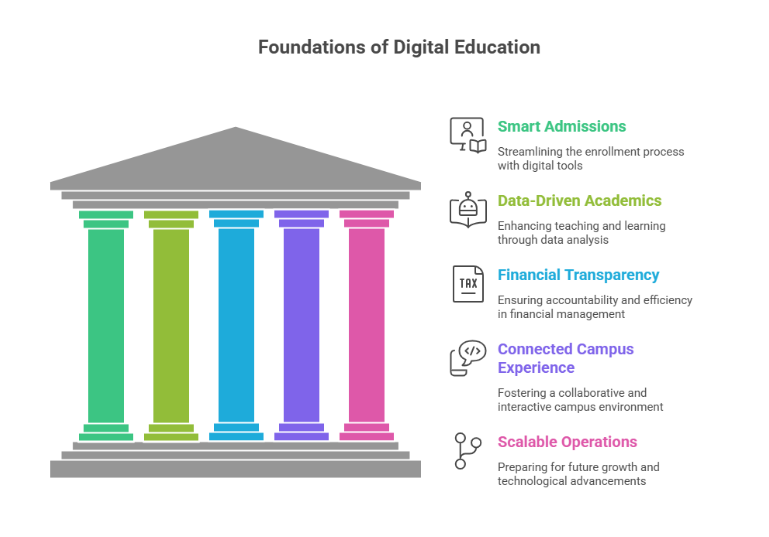
  1. Smart Admissions & Enrollments
    Digitize application processing and student onboarding for faster, transparent admissions cycles.
  2. Data-Driven Academics
    Centralized dashboards enable faculty to monitor attendance, results, and progress in real time.
  3. Efficient Financial Management
    Automated fee tracking, settlements, and audit-ready reports bring clarity to institutional finances.
  4. Improved Student Experience
    Self-service portals and mobile apps empower students to access results, academic schedules, and attendance anywhere.
  5. Long-Term Institutional Planning
    Real-time analytics support better decision-making and long-term growth strategies.

Digital Transformation

Local Relevance: Why Africa Needs a Student Information System Now

Africa’s education vision is clear — access, quality, and innovation. However, legacy systems stand in the way of scaling this vision.

In East Africa, universities are adopting cloud-based solutions to manage online learning efficiently. In West Africa, regulatory reporting and accreditation are pushing institutions toward centralized student information management systems. Meanwhile, Southern African universities are emphasizing AI-driven analytics for decision-making and research performance tracking.

Platforms like Academia SIS, trusted by 400+ institutions across 30+ countries, are empowering African campuses to transition from manual to modern — ensuring compliance, scalability, and real-time intelligence.

Choosing the Right Partner: Beyond Price

While affordability matters, universities should remember that a low-cost SIS often means hidden charges — lack of scalability, poor service, and limited innovation. 

Choosing the right student academy management system isn’t about saving today; it’s about investing in a sustainable, AI-powered tomorrow.

When selecting a provider, ensure:

  • Proven implementation success in African institutions.
  • Multi-campus, multilingual capability.
  • Data compliance and global certification (ISO 27001, GDPR).
  • Continuous innovation through AI and analytics.
  • Dedicated post-implementation support.

How the Middle East Can Build Future-Ready Campuses With a Modern Student Information System (SIS)

“Technology doesn’t replace people in education; it empowers them to do what truly matters.”

Running a university today is a lot like conducting a grand symphony. Every department—Admissions, Academics, Finance, Examinations, Student Services—plays its own instrument. But without a unified system, the rhythm breaks. You hear overlaps, delays, and missing notes.

This is exactly what many Middle Eastern institutions encounter daily — juggling manual tasks, spreadsheets, and fragmented systems.

And that is why forward-thinking universities across the UAE, Saudi Arabia, Oman, Qatar, and Bahrain are now shifting towards cloud-based student information systems like Academia SIS—a platform that brings all departments onto one synchronized stage.

Why Middle Eastern Institutions Are Facing New Pressure

The region’s higher education landscape is evolving faster than ever. Yet several operational challenges continue to slow down institutional growth.

1. Students Expect Faster, Digital-First Experiences

Today’s learners expect:

  • Quick admission decisions
  • Self-service access from mobile
  • Real-time updates
  • Transparent attendance and grades

Without a modern campus management system, institutions struggle to deliver this.

2. Multi-Campus Expansion Adds Complexity

Managing multiple campuses means dealing with:

  • Disconnected academic records
  • Manual attendance tracking
  • Campus-wise fee variations
  • Accreditation data delays

A central campus information system becomes essential.

3. Compliance & Accreditation Require Accurate Data

Accrediting bodies across the Middle East demand:

  • Timely reports
  • Program outcomes
  • Student data transparency

Manual systems simply cannot keep up.

Why Middle Eastern Universities Prefer Academia SIS

A comprehensive solution like Academia ERP for a university helps institutions overcome scattered data, manual workloads, and compliance hurdles.

✔ End-to-End Automation

With built-in modules like:

  • Admission management system
  • Attendance management software
  • Academic ERP software
  • Campus ERP implementation

Student management lifecycle becomes faster, more accurate, and more transparent.

✔ Fully Cloud-Based Architecture

A cloud-based student information system ensures:

  • Zero IT infrastructure cost
  • Campus-wide access anytime
  • High scalability for future expansion

✔ Real-Time Dashboards & Analytics

Leadership gets a single source of truth for:

  • Enrollment trends
  • Attendance patterns
  • Academic performance
  • Retention metrics

This makes decision-making significantly more strategic.

Middle East’s Biggest Bottleneck: Admissions

Admission season is a pressure point for most institutions. Long waiting times, slow communication, and missing documents impact both enrollment and reputation.

A smart admissions and enrollment management software solves this through:

  • Automated application workflows
  • Digital document collection
  • Integrated fee payments
  • Real-time status tracking
  • Communication alerts (SMS/Email)

Read UNESCO’s insights on digital adoption in education:
https://www.unesco.org/en/digital-education

How Academia SIS Addresses Region-Specific Challenges

1. Saudi Arabia — Aligning With Vision 2030

Saudi institutions must enhance transparency and digital readiness.
Academia ERP for college ensures:

  • Streamlined campus operations
  • Data-driven reporting
  • Faster accreditation support

Vision 2030 Reference: https://www.vision2030.gov.sa/

2. UAE — Competing Globally

UAE universities aim for international benchmarks.
Academia SIS supports:

  • Multi-campus management
  • Outcome-Based Education (OBE)
  • International program structures

3. Oman & Bahrain — Optimizing Costs

Institutions here seek the best ERP for higher education with measurable ROI.
Academia delivers:

  • Reduced manual workload
  • Lower admin overhead
  • Improved student experience

What Makes Academia the Preferred Choice?

Fast & Guided Implementation

The campus ERP implementation process is structured to save time and reduce disruption.

High Flexibility & Configuration

Every institution operates differently.
Academia adapts to:

  • Local policies
  • Program structures
  • Approval workflows

Scalable for Multi-Campus Institutions

Whether 300 or 30,000 students, the system grows effortlessly.

Real-Term Savings With Academia SIS

Universities across the Middle East report:

🔹 60–70% reduction in manual workload

Automated workflows replace repetitive tasks.

🔹 40% improvement in student satisfaction

Due to transparency and self-service access.

🔹 30% savings on administrative costs

Less paperwork, fewer errors, faster processing.

🔹 Leadership gains real-time visibility

Leading to faster decisions and smoother operations.

Helpful Resources

Conclusion: The Middle East Is Ready for Smart, Synchronized Campuses

As higher education grows across the region, institutions need more than just software—they need a unified system that brings people, processes, and data together.

A modern student information system like Academia ERP for universities and colleges empowers institutions to do exactly that: streamline operations, improve academic quality, and deliver exceptional student experiences.

The question isn’t “Do we need an SIS?”
It’s “How quickly can we transform our campus?”

[Schedule Your Free Demo]

Why Southeast Asian Universities Need a Student Info Makeover — and How Academia’s Higher Education ERP System Steps Up

Imagine you’re navigating the skytrain during rush hour: crowded, chaotic, delays at every station. You can’t reach your destination smoothly because the route is clogged — that’s how many universities in Southeast Asia operate when student data, admissions, schedules, and reports are managed manually or across disconnected systems.

Just like a smart metro map — clean, real-time, and efficient — a modern higher education ERP system can clear that chaos.

Regional challenge: growing student populations + legacy systems = administrative bottlenecks

In countries across Southeast Asia — Thailand, Philippines, Vietnam, Indonesia — higher-education institutions are grappling with swelling student numbers, increasing course complexity, and rising expectations for better student services. Manual or fragmented systems lead to:

  • Data silos: Admissions, academic records, attendance, transcripts, and fee payments stored in different spreadsheets or software. This fragmentation creates confusion, duplication, and delays. 
  • Slow enrolment & registration: Paper-based or disjointed processes delay student registration, reduce efficiency, and increase errors.
  • Limited analytics and poor decision-making: Scattered records make it hard to quickly analyse enrollment trends, student performance, or resource usage — critical for planning new courses or allocating faculty. (OpenSIS)
  • Security & compliance concerns: Handling sensitive student data across ad-hoc systems (spreadsheets, local servers) increases privacy risks and compliance challenges.
  • Scalability issues: As institutions grow — more departments, programs, and students — legacy systems simply can’t scale efficiently, causing admin overload and errors.

Because of these challenges, many Southeast-Asian institutions find themselves stuck — processing remains slow, transparency weak, and student satisfaction low.

The solution: How Academia Higher Education ERP System transforms campus management

Here’s how Academia Higher Education ERP System solves these pain points and delivers a modern, connected campus — particularly beneficial for Southeast Asia’s fast-growing institutes.

Academia ERP

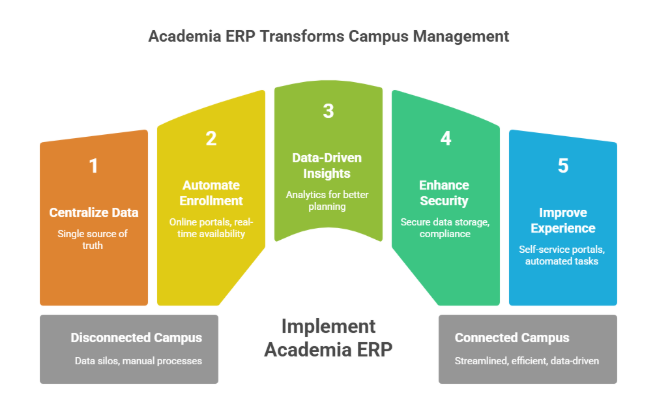
Centralized, clean data — no more silos

With Academia ERP, all student-related data — admissions, academic records, attendance, transcripts, fee status — is consolidated into a single secure database. This eliminates duplication, ensures consistency across departments, and provides a single source of truth. (Academia ERP)

Fast, automated enrollment & registration

Students no longer wait in queues or fill out stacks of forms. Through online portals, course catalogs and class registrations are managed digitally — real-time seat availability, waitlists, scheduling conflicts alert, and auto notifications — streamlining enrollment for both students and staff. This is where cloud education ERP demos showcase their real impact. (Academia ERP demo)

Data-driven insights for smarter planning

Built-in analytics and reporting allow administrators to view enrollment trends, course demand, attendance patterns, and performance metrics — enabling better decisions on faculty allotment, course offerings, and infrastructure planning. This is a key reason institutions invest in higher education ERP software.

Enhanced security, compliance & scalability

Hosted on Azure cloud, Academia ERP ensures secure data storage, encryption, role-based access, and audit trails — crucial for student privacy and institutional compliance. As institutions grow, the system scales smoothly, supporting new programs, campuses, and larger student cohorts.

Improved student & faculty experience

Students gain self-service portals to check schedules, grades, transcripts, and admission status. Faculty and admin staff benefit from automated attendance, grade management, and transcript generation, reducing paperwork and boosting satisfaction across stakeholders. (Student Information System)

A quick real-world example

A university in South East Asia handling 12,000+ students recently shifted from manual spreadsheets to Academia ERP. Within one semester, enrollment processing time dropped by 40%, transcript generation became click-based, and faculty reported fewer administrative delays — letting them focus more on teaching and less on paperwork.

Why Southeast Asia should adopt higher education ERP now

With rising enrollments, increasing digital expectations, and growing demand for operational efficiency, institutions need systems that are reliable, scalable, and data-driven. Market analysis shows Asia-Pacific is among the fastest-growing regions for education ERP software adoption, particularly cloud-based and mobile-first solutions. (Global Growth Insights)

Legacy infrastructure is increasingly risky: high maintenance, poor user experience, limited mobility, and difficulty integrating with modern education technologies (LMS, analytics, mobile apps) hamper growth. By adopting a modern platform like Academia Higher Education ERP System, universities can ensure future-readiness, operational efficiency, and better student outcomes.


Call to action: Transform your campus today

If your student population is growing fast, or you constantly deal with paperwork and data chaos, it’s time to explore Academia ERP in action. From cloud-based management to AI-powered insights, this education ERP Philippines and Southeast Asia solution offers a modern, connected campus experience.

Experience the difference with an Academia Higher Education ERP System demo today, and move from administrative chaos to streamlined efficiency.

Back to top