Ghanaian universities manage vast amounts of personal information, from student applications and academic transcripts to financial records, identification documents, and staff information. As institutions expand digital learning, online admissions, and integrated campus services, protecting this information has become a critical governance responsibility. Compliance with Ghana’s Data Protection Act, 2012 (Act 843) requires institutions to handle personal data lawfully, transparently, and securely, while giving individuals appropriate control over their information.
However, compliance cannot depend on privacy policies alone. Disconnected databases, unrestricted staff access, duplicate spreadsheets, and poorly governed third-party applications can create gaps in data protection. A well-configured Student Information System (SIS) can help universities establish consistent processes for managing records, controlling access, and supporting accountability. AI can further assist with identifying unusual activity and data inconsistencies, provided its use is carefully governed.
This guide explains Ghana’s data protection requirements, why compliance matters for higher education, how an SIS can support stronger safeguards, and what university leaders should evaluate when building a secure digital campus.
Ghana’s primary data protection legislation is the Data Protection Act, 2012 (Act 843). The Act establishes the legal framework for collecting, holding, using, disclosing, and protecting personal information. The Data Protection Commission (DPC) is responsible for regulating compliance and protecting individuals’ privacy rights.
Universities should understand several practical obligations under the Act:
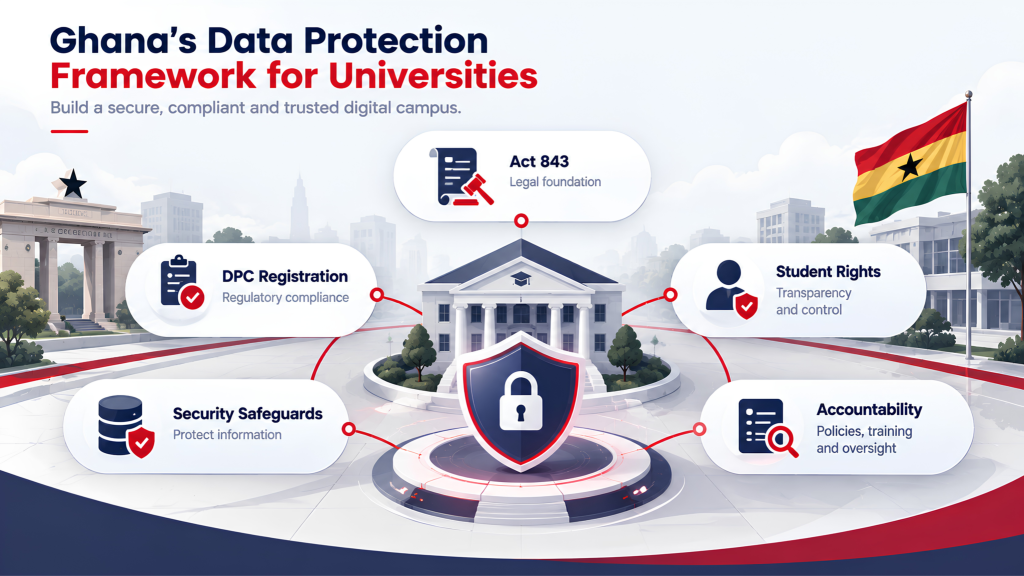
The DPC’s guidance for organisations also highlights registration, appointing and training a data protection supervisor, publishing an organisational privacy policy, and implementing reasonable security measures.
For universities in Accra, Kumasi, Cape Coast, Tamale and other education hubs, compliance should be embedded into everyday administrative processes rather than treated as a one-time legal exercise.
University records can contain names, contact information, identification details, academic results, financial information, and other personal data. If exposed or accessed inappropriately, these records can create risks ranging from targeted phishing and impersonation to reputational harm and the disclosure of confidential information.
The risk is not limited to external cyberattacks. Sending a spreadsheet to the wrong recipient, allowing former employees to retain system access, or storing student documents in unsecured shared folders can also compromise privacy.
Students expect universities to protect the information they provide during applications, registration, examinations, and fee payments. Parents, sponsors, faculty members, and institutional partners also depend on responsible information handling.
A university that can explain how it collects, accesses, shares, and protects personal information demonstrates accountability. Weak data governance, by contrast, can undermine confidence in digital services and make students reluctant to share information needed for legitimate institutional processes.
Ghana’s tertiary education sector operates across universities, technical universities and other tertiary institutions, each with different administrative requirements. The National Development Planning Commission’s 2024 Annual Progress Report records tertiary enrolment of 693,307 students in 2024, compared with 711,695 in 2023.
This figure reflects the scale of the sector, not the number of individual records held by universities. Nevertheless, institutions need reliable processes to manage student information throughout the academic lifecycle, particularly as services become increasingly digital.
A Student Information System provides a structured environment for managing student records and related academic workflows. Its contribution to compliance depends on the features available, how they are configured, and the university’s policies and operating practices.
Not every employee needs access to every record. Admissions staff may require application documents, lecturers may need class lists and assessment information, and finance teams may need fee-related records.
An SIS with appropriately configured role-based permissions can help restrict access according to job responsibilities. Universities should regularly review permissions, remove access when employees leave, and ensure privileged accounts receive additional scrutiny.
The practical benefit: fewer unnecessary access opportunities and clearer responsibility for handling student information.
When departments maintain separate spreadsheets and exchange files through email, duplicate records can multiply. Each copy creates another location that must be protected, updated, and eventually disposed of appropriately.
A centralised SIS can help authorised departments work with consistent student records rather than maintaining disconnected databases. Controlled workflows can also support more structured information sharing between admissions, academics, examinations, finance and student services.
However, centralisation alone does not guarantee compliance. Institutions must still govern exports, integrations, backups, third-party access and data retention.
Where supported, audit logs can help authorised personnel review record changes, access attempts and administrative actions. These records can assist investigations and internal reviews when a university needs to understand how information was accessed or modified.
An SIS can also help organise processes for correcting student records and managing information throughout its lifecycle. Universities must establish clear retention schedules and ensure records are not deleted prematurely when legal or institutional obligations require their preservation.
From an institutional governance perspective, the objective is to make data handling more consistent, traceable, and accountable, not simply to digitise existing paperwork.
AI can help universities identify patterns that manual checks may overlook. Its role should be to support security and compliance teams, not replace human judgement or institutional responsibility.
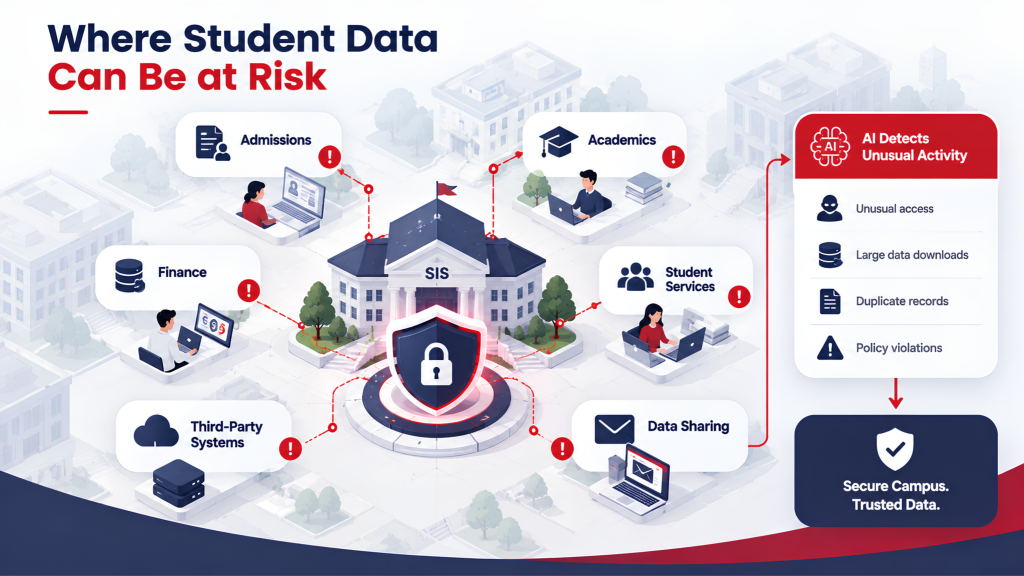
The Data Protection Commission’s compliance guidance identifies high-risk processing and the introduction of new technologies as circumstances in which a Data Protection Impact Assessment may be necessary under the Act. Universities should assess proposed AI applications carefully, especially when processing sensitive information or introducing automated profiling or decision-making.
Gartner’s research, Top Technology Trends in Higher Education for 2025, highlights AI strategy and cyber risk among the issues higher education technology leaders must address. For Ghanaian institutions, this reinforces the need to evaluate innovation alongside security, privacy, and governance.
Academia by Serosoft provides a Student Information System designed to help institutions manage student information and academic administration within a structured digital environment. For universities evaluating digital infrastructure, the relevant question is how the platform’s available functionality can support their specific data governance requirements.
Three priorities deserve attention:
Academia’s approach to student information management should be evaluated in the context of each university’s compliance needs, deployment configuration, contracts, and operational policies. Institutions should request appropriate technical documentation and verify the controls available before making procurement decisions.
An SIS can support data protection, but it cannot independently make a university compliant with Act 843. Compliance remains an ongoing responsibility involving institutional leadership, data protection personnel, staff training, risk assessment, and appropriate oversight of technology providers.
Before implementing a new SIS or reviewing an existing one, university leaders should ask:
These checks can help universities identify gaps and prioritise improvements without treating software procurement as a substitute for governance.
For Ghanaian universities, data protection and regulatory compliance are essential to responsible digital transformation. Meeting the requirements of Act 843 involves more than publishing policies: institutions need clear processes, appropriate safeguards, accountable personnel, and regular reviews.
A well-governed SIS can help universities manage student information more consistently, while responsibly deployed AI can support risk detection and investigation. The strongest approach combines technology with institutional accountability and continuous improvement.
Explore Academia Student Information System and request a personalised demo to discuss your institution’s student information management needs.
The Data Protection Act, 2012 (Act 843), is Ghana’s primary legislation governing the processing and protection of personal information. The Data Protection Commission oversees compliance.
Data controllers and processors must meet the applicable registration requirements under Act 843. Institutions should confirm their status, registration category, and renewal obligations directly with the DPC.
An appropriately configured SIS can support controlled access, consistent record management, structured workflows, and auditability where those capabilities are available. Policies, training, contracts, and ongoing monitoring remain essential.
No. AI may help identify suspicious activity and prioritise investigations, but it cannot eliminate every risk. It must complement established security controls, incident-response procedures and human oversight.
Ask about access controls, authentication, encryption, audit logs, backups, retention, data locations, third-party processors, incident notification, integration security, and AI-related data processing. Request documentation to verify how the proposed configuration meets the institution’s requirements.

Experience Academia – Your partner in transforming campus operations, a trusted all-in-one ERP/SIS solution.
Get the latest insights, trends, and updates delivered straight to your inbox!