Academia Higher-Ed Executive Roundtable in Uzbekistan | 14 October 2026 — Shaping the Future of Higher Education Together
X
Academia Higher-Ed Executive Roundtable in Uzbekistan | 14 October 2026 — Shaping the Future of Higher Education Together


Pankaj Joshi
Estd. Reading Time : 4 Min.
28th Apr, 2026
Share On:
A straight-talking guide for institutional leaders in the UAE, Saudi Arabia, and the wider GCC who know the pressure is real and are ready to act.
Let us begin with something every Vice Chancellor, Registrar, and CIO in the Middle East already knows but rarely says out loud in a board meeting.
Your institution is operating under more scrutiny, more regulatory pressure, and more competitive threat than at any point in the last decade. And a significant number of the systems holding your operations together were not built for any of this.
That is not a criticism. It is simply the reality of where higher education in this region finds itself in 2026, caught between exceptionally ambitious national visions and operational infrastructure that has not kept pace.
This blog is for the leaders who are ready to close that gap.
The Ambition Is Real. The Infrastructure Gap Is More Genuine
Across the GCC, higher education is in the middle of an unprecedented transformation. The Middle East’s higher education market stands at $115 billion, projected to reach $175 billion by 2027 — with Saudi Arabia’s Vision 2030, UAE’s development agenda, and Qatar, Bahrain, and Oman all pushing their institutions to modernise, perform, and prove it.
The MENA EdTech market is growing at 18% CAGR. And yet, inside many institutions, the daily reality looks quite different from the national ambition.
Here is what the data — and frankly, what institutional leaders themselves — consistently report:
That is the competitive reality. And a Student Information System is precisely where the gap begins.
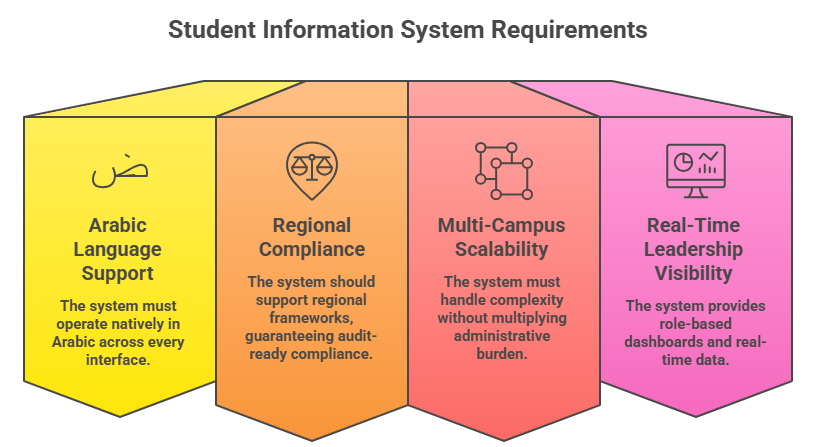
Not every Student Info System is built with the Middle East in mind. Here is what regional specificity actually looks like in practice — and what any institution in the GCC should demand before signing a contract:
The system must operate natively in Arabic across every student-facing and staff-facing interface. Not as a translated overlay. Not as a separate module. As a built-in, seamless capability that makes adoption effortless for every user.
A modern Student Information System should support CAA, CHEDS, NCAAA, MoE, and regional frameworks, guaranteeing audit-ready compliance — and integrate statutory reporting and government requirements directly into institutional workflows. Compliance should not require a special project every year. It should be a byproduct of how the system operates every day.
Whether your institution operates across two campuses or fourteen, the Student Info System must handle complexity without multiplying administrative burden. A single view of operations across all sites is not a luxury, it is a baseline requirement for any institution with growth ambitions.
A modern student information system provides role-based dashboards and real-time data to inform strategic, vision-aligned decision-making. When a government ministry asks your institution for enrolment data, retention rates, or graduate outcomes, you should be able to pull that information in minutes, not days.
Be honest with yourself as you read these. If more than two apply to your institution, you are already operating at a disadvantage:
In an era where higher education is rapidly evolving, Middle Eastern universities and colleges are facing an urgent reality: traditional administrative systems can no longer keep up with the pace of academic transformation.
If any of these questions made you uncomfortable, you are not alone.
What is a Student Information System and why does it matter specifically for Middle East universities?
A Student Information System manages the entire student lifecycle — from enquiry through admissions, academics, fees, and alumni. For Middle East universities, it ensures CAA, NCAAA, and MoE compliance, supports Arabic-English operations, and aligns institutions with national goals like Vision 2030.
How long does it typically take to implement a Student Information System in a Middle East university?
Timelines vary based on institutional size, but modern SIS platforms are designed to deliver core modules early without disrupting ongoing operations. The key factor is the quality of the implementation partner and how closely they work with your institution throughout.
How does a modern SIS help with CAA and NCAAA accreditation compliance?
A modern Student Information System embeds accreditation frameworks into daily workflows, so compliance data and audit documentation are generated automatically. Institutions walk into every review cycle with accurate, ready documentation — no last-minute scramble.
What happens to our existing data during a migration to a new Student Information System?
A reputable SIS partner conducts structured migration with full data mapping and integrity checks to ensure nothing is lost. Your student records, financial data, and academic history transfer completely and securely.
Is a cloud-based Student Information System safe for Middle East institutions given regional data regulations?
Yes — modern cloud-based SIS platforms for the Middle East are built to meet UAE and GCC data residency requirements. They typically offer stronger security than ageing on-premise systems through encryption, automated updates, and role-based access controls.
Academia by Serosoft is a Gartner®-recognised Student Information System trusted by 400+ institutions across 32 countries — with a growing and proven presence across the UAE, Saudi Arabia, and the wider Middle East. Built for bilingual operations, CAA and NCAAA compliance, multi-campus scalability, and AI-powered efficiency, Academia is the platform regional institutions are choosing when they decide to stop managing legacy systems and start leading with confidence.
If you are evaluating your Student Information System options or preparing for your next accreditation cycle, we would welcome a conversation.
Book a Free Demo with an Academia Specialist →
No pitch. No pressure. Just a genuine look at what is possible for your institution.

Experience Academia – Your partner in transforming campus operations, a trusted all-in-one ERP/SIS solution.
Get the latest insights, trends, and updates delivered straight to your inbox!