The UAE’s higher education sector is undergoing rapid digital transformation under We the UAE 2031, making technology decisions more strategic than ever. One of the biggest questions universities face today is whether to continue with their existing Student Information System (SIS) or transition to a cloud-based platform.
This article explores both approaches from the perspective of UAE universities, comparing them across scalability, AI readiness, operational efficiency, security, and long-term value. Backed by insights from the World Bank, UNESCO, and decades of implementation experience from Academia by Serosoft, it provides practical guidance for institutional leaders looking to future-proof their campuses.
“Our Student Information System has served us well for years, but is it ready for the future?”
This question is becoming increasingly common among university leaders across the UAE.
A decade ago, choosing an SIS was primarily about managing admissions, examinations, student records, and fee collection. If those processes ran smoothly, institutions considered their technology investment successful.
Today, expectations are far greater.
Students expect seamless digital experiences. Faculty need integrated teaching and administrative platforms. Leadership teams want real-time dashboards and AI-powered insights to improve enrolment, student success, and institutional planning.
As a result, the Student Information System has evolved from an administrative application into the digital backbone of the modern university.
The conversation has shifted from “Which SIS has the right features?” to far more strategic questions:
For many UAE universities, answering these questions is the first step towards digital transformation.
Higher education plays a central role in the UAE’s ambition to become one of the world’s most innovative knowledge economies.
Through We the UAE 2031, the government is accelerating digital transformation, encouraging institutions to adopt technologies that improve efficiency, innovation, and global competitiveness.
For universities, this means investing in systems that go beyond administration to support:
According to the World Bank’s report, The Cloud Imperative: Strategies and Practices, cloud computing is no longer viewed simply as an IT upgrade; it has become a strategic capability that enables agility, innovation, and long-term digital transformation.
For institutional leaders, the decision is no longer about adopting new technology. It is about ensuring today’s technology can meet tomorrow’s expectations.
UAE universities are at different stages of their digital transformation journey. While some institutions continue to operate legacy on-premise SIS deployments, others have adopted hosted, hybrid, or cloud-based environments. Many are also working with customised systems that have evolved to meet specific institutional requirements.
As universities modernise, the focus is shifting from maintaining existing systems to evaluating whether those systems can support future institutional goals.
Key questions include:
Rather than asking, “Which SIS vendor should we choose?”, universities are increasingly asking:
“Is our current SIS deployment future-ready?”
Think of your university as a busy international airport.
Every day, thousands of activities take place simultaneously, from admissions and course registration to examinations, finance, student services, and graduation. The Student Information System acts as the airport’s control tower, ensuring every process remains connected and efficient.
The real difference lies in how that control tower is managed.
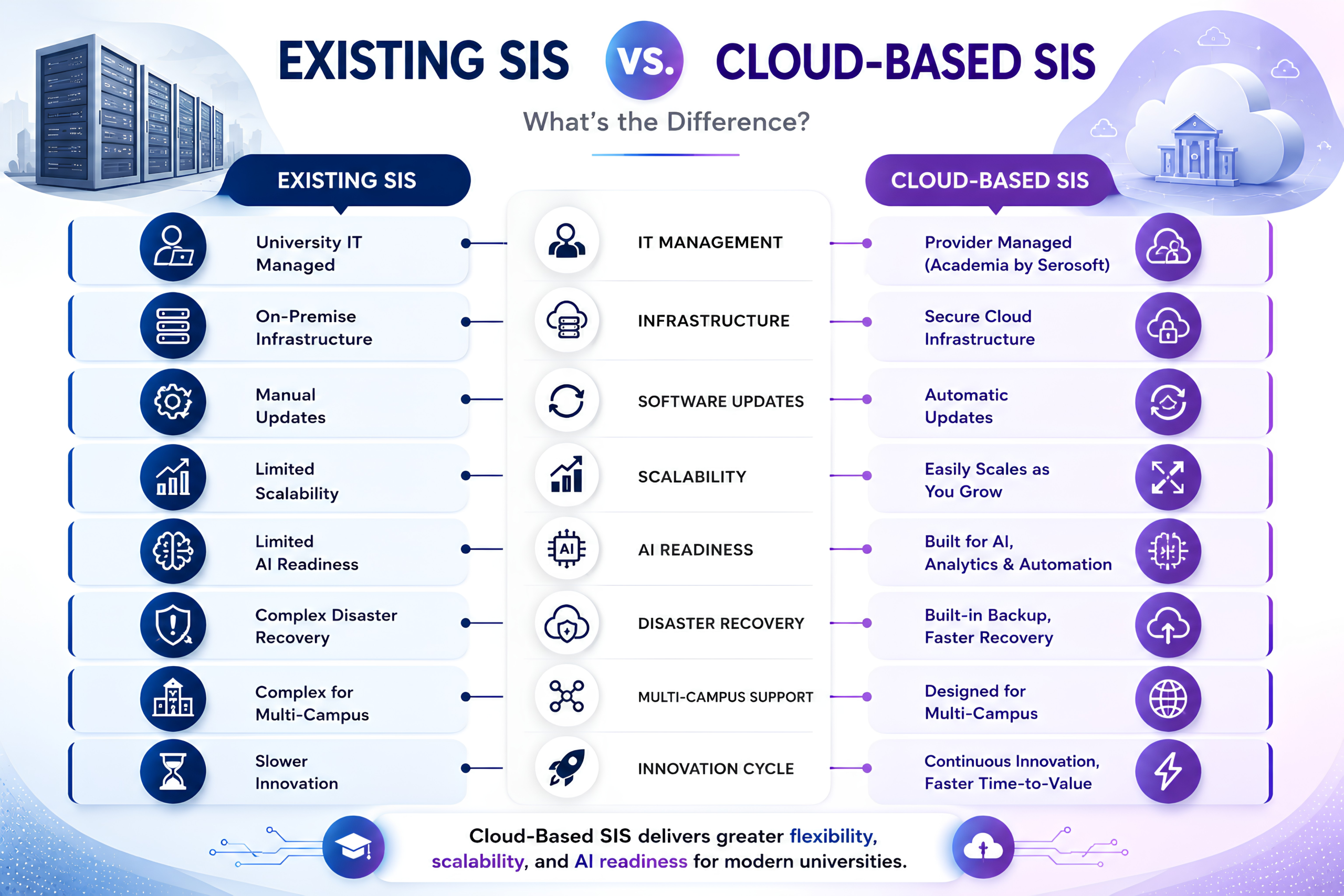
An existing SIS typically relies on the university’s own infrastructure and IT resources. A modern cloud-based SIS, however, shifts infrastructure management to the cloud, allowing institutions to focus on education, innovation, and student success rather than hardware maintenance.
| Feature | Existing SIS | Modern Cloud-Based SIS |
|---|---|---|
| IT Management | Managed by the university’s IT team | Managed by the cloud provider |
| Infrastructure Dependency | On-campus servers and hardware | Secure cloud infrastructure |
| Software Updates | Manual and scheduled | Automatic and continuous |
| Scalability | Requires additional hardware | Scales on demand |
| AI Readiness | Limited integration | Built for AI and analytics |
| Remote Accessibility | VPN or campus network | Secure access from anywhere |
| Disaster Recovery | Institution-managed | Built-in redundancy |
| Multi-campus Support | Complex | Centralised management |
| Innovation Cycle | Slower | Continuous enhancements |
The comparison reflects why cloud-based Student Information Systems are becoming an increasingly strategic choice for universities seeking greater agility and long-term sustainability.
Imagine a university with 10,000 students today.
Within five years, enrolment grows by 60%, a second campus opens, online programmes expand, and AI-powered student services become a priority.
An existing SIS may require additional hardware, infrastructure upgrades, and greater IT investment to keep pace.
A modern cloud-based SIS, on the other hand, scales as institutional needs evolve without disrupting campus operations.
According to the UNESCO Global Education Monitoring Report, participation in higher education continues to rise across the region, reinforcing the need for universities to invest in digital infrastructure that can support future growth while maintaining quality.
The shift to the cloud isn’t just about replacing servers; it’s about preparing universities for the future.
As student expectations evolve and digital transformation accelerates, institutions need systems that are intelligent, scalable, and connected. A modern cloud-based Student Information System helps universities adapt to changing academic, operational, and regulatory demands without constantly investing in new infrastructure.
Artificial Intelligence is redefining higher education by enabling universities to make faster and more informed decisions.
A modern cloud-based SIS can help institutions:
Unlike traditional deployments, cloud-native platforms are designed to process large volumes of institutional data, making AI capabilities easier to implement and scale.
Academia by Serosoft Perspective: A modern Student Information System should do more than digitise campus operations; it should empower institutional leaders with AI-driven insights that improve student success, operational efficiency, and strategic decision-making.
Today’s university ecosystem extends far beyond student records.
A future-ready SIS should seamlessly integrate with:
These integrations eliminate data silos, reduce manual work, and create a seamless experience for students, faculty, and administrators.
Security remains one of the biggest concerns when moving to the cloud. However, modern cloud platforms often provide stronger security capabilities than institutions can maintain independently.
Leading cloud providers continuously invest in:
Rather than managing hardware and security patches, university IT teams can focus on innovation and strategic initiatives.
Many institutions assume continuing with their current SIS is the most economical option. However, the true cost extends well beyond existing infrastructure.
| Hidden Cost | Impact on Universities |
|---|---|
| Server maintenance | Ongoing hardware replacement and upkeep |
| Software upgrades | Downtime and increased IT effort |
| Cybersecurity management | Continuous monitoring and patching |
| Disaster recovery | Additional infrastructure investment |
| Backup management | Increased storage and administrative workload |
| Infrastructure expansion | Additional capital expenditure |
When viewed over the long term, these operational costs often make cloud deployments a more predictable and cost-effective investment.
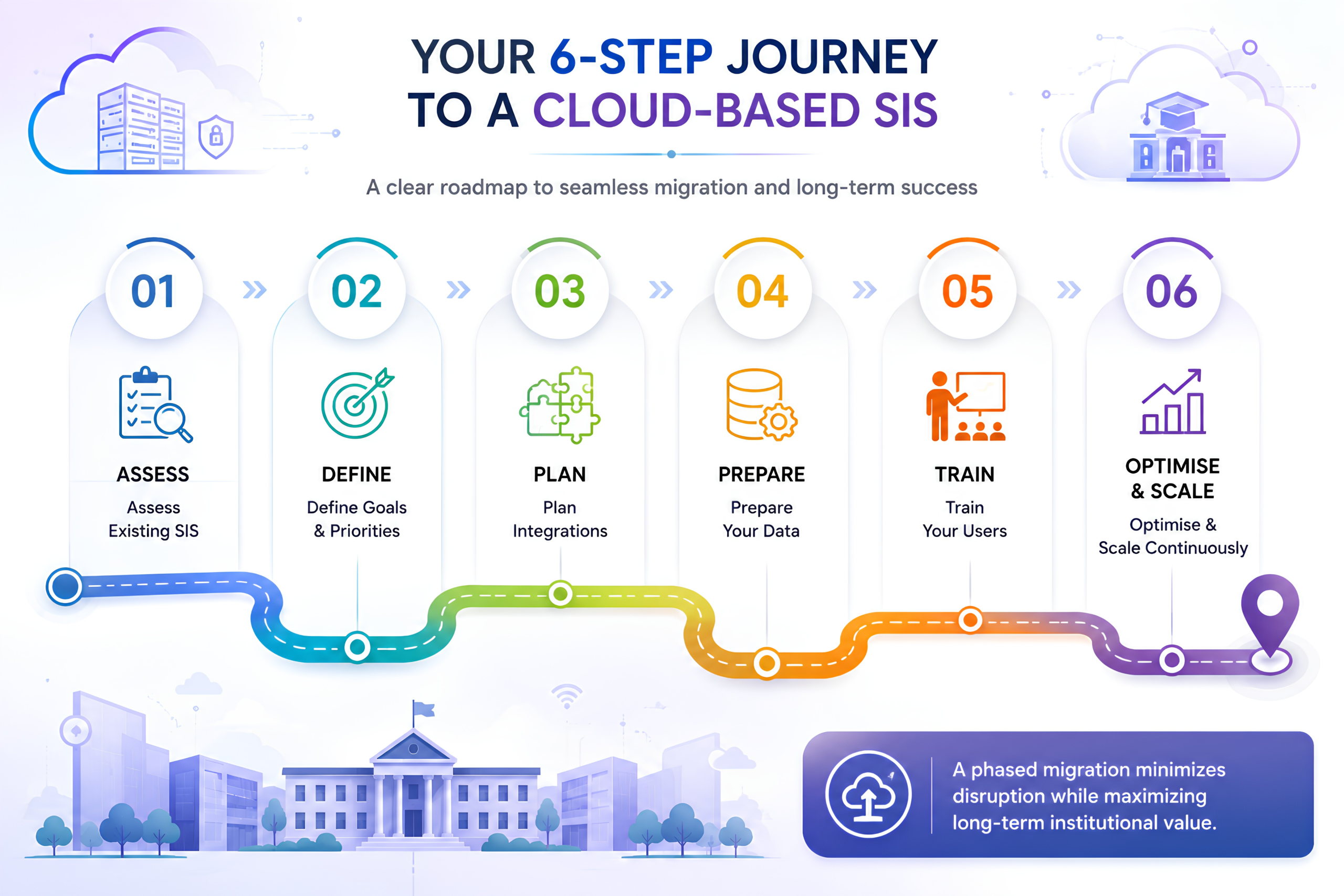
A successful cloud migration requires careful planning rather than a simple technology replacement.
| Step | Action |
|---|---|
| 1. Assess | Evaluate your existing SIS capabilities and limitations. |
| 2. Define Goals | Identify priorities such as AI readiness, scalability, or improved student experience. |
| 3. Plan Integrations | Map connections with LMS, ERP, HR, Finance, CRM, and government platforms. |
| 4. Prepare Data | Clean, validate, and securely migrate institutional data. |
| 5. Train Users | Prepare faculty, administrators, and IT teams through structured change management. |
| 6. Optimise | Continuously monitor performance and adopt new capabilities. |
There is no one-size-fits-all answer. The right choice depends on an institution’s digital maturity, strategic priorities, and long-term vision. However, for universities planning significant growth and innovation, cloud-based platforms provide greater flexibility and future readiness.
Choosing the right technology partner is just as important as choosing the right technology.
Built specifically for higher education, Academia by Serosoft enables universities to manage the complete student lifecycle from admissions and academics to examinations, graduation, alumni engagement, and analytics through a single integrated platform.
With cloud-native architecture, AI readiness, workflow automation, multi-campus capabilities, and seamless integrations, Academia helps institutions build connected digital campuses while simplifying administration and improving student experiences.
Drawing from Academia by Serosoft’s experience across higher education institutions globally, universities achieve the greatest value when they move from disconnected systems to a unified platform that evolves alongside institutional goals.
An existing SIS refers to a university’s current deployment, often managed through on-premises or hosted infrastructure. A cloud-based SIS is delivered through secure cloud infrastructure, offering automatic updates, greater scalability, and easier remote access.
Cloud platforms support digital transformation by enabling AI, improving scalability, reducing infrastructure management, and delivering better digital experiences for students and staff.
Yes. Modern cloud platforms incorporate enterprise-grade security measures, including encryption, multi-factor authentication, disaster recovery, and continuous monitoring.
Yes. Most modern cloud SIS platforms integrate seamlessly with LMS, ERP, HR, Finance, CRM, payment gateways, and government reporting systems.
Institutions should assess their current deployment, integration requirements, data quality, security needs, regulatory obligations, and long-term strategic goals.
Academia by Serosoft provides a cloud-native, AI-ready Student Information System that helps universities streamline operations, improve decision-making, and create connected, future-ready campuses.

Experience Academia – Your partner in transforming campus operations, a trusted all-in-one ERP/SIS solution.
Get the latest insights, trends, and updates delivered straight to your inbox!