

Michele Du Rand
Estd. Reading Time : 4 Min.
10th Feb, 2026
Share On:
Running a higher education institution in South Africa today is a bit like managing air traffic during peak season. Thousands of data points move simultaneously, student enrolments, funding claims, graduation records, personal information, and every single one must land safely, accurately, and on time.
Now imagine relying on spreadsheets, disconnected tools, or an outdated education management system to manage this complexity.
One missed HEMIS submission.
One POPIA lapse.
One inconsistency in DHET reporting.
The consequences? Funding delays, audit red flags, reputational damage, and in some cases, regulatory penalties that institutions simply cannot afford.
This is why a compliance-first Student Information System is no longer a “nice to have” in South Africa. It’s foundational to institutional survival, credibility, and growth.
South African institutions operate under one of the most tightly regulated higher-education frameworks globally. At the centre of this ecosystem sit three critical pillars:
The Department of Higher Education and Training (DHET) governs policy, funding allocation, reporting standards, and institutional accountability. Every registered public and private institution must submit accurate, timely, and verifiable data to remain compliant.
DHET doesn’t just ask whether data is submitted; it scrutinises how reliable that data is.
The Higher Education Management Information System (HEMIS) is the primary mechanism through which institutions report student, staff, qualification, and graduation data to DHET.
HEMIS data directly influences:
Inaccurate or inconsistent HEMIS submissions can result in:
Without a structured Student Information System, HEMIS reporting becomes a high-risk manual exercise.
With the enforcement of the Protection of Personal Information Act (POPIA), institutions are now legally responsible for how student and staff data is collected, stored, processed, and shared.
This includes:
POPIA compliance is not optional, and breaches can lead to serious legal and reputational consequences.
Many South African institutions still rely on:
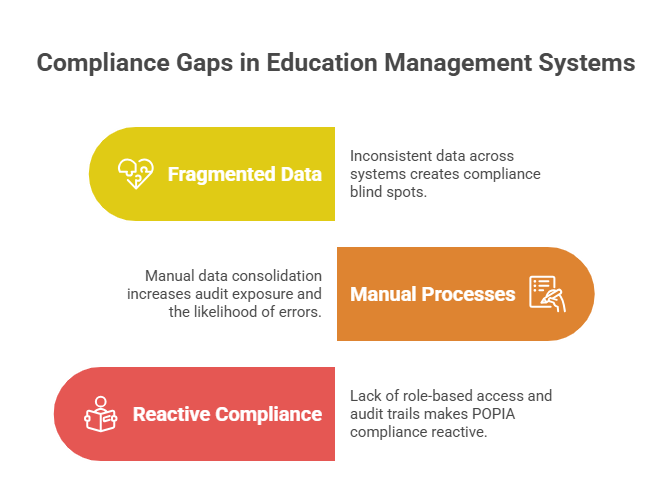
This creates three major risks:
When data lives across systems, consistency breaks down. One mismatch between departments can invalidate an entire HEMIS submission.
Manual uploads, spreadsheets, and human interventions significantly increase the likelihood of errors, especially during high-pressure submission cycles.
Without role-based access, encryption, and audit trails, institutions struggle to demonstrate POPIA compliance during audits or investigations.
A compliance-first Student Information System is not built around features; it’s built around regulatory responsibility.
Here’s what that looks like in practice:
A modern SIS should:
This ensures reporting accuracy without last-minute firefighting.
A compliance-first system embeds:
This allows institutions to confidently demonstrate POPIA adherence, not just claim it.
Instead of pulling data together at the end of the academic cycle, a strong education management system:
Compliance becomes continuous, not seasonal.
Across South Africa, higher education leaders are asking a more strategic question:
“Does our current Student Information System protect us, or expose us?”
Institutions upgrading their SIS are typically driven by:
A compliance-first approach shifts the narrative from damage control to institutional confidence.
Vice-Chancellors, Registrars, CIOs, and Compliance Officers now share a common reality:
Regulatory data integrity impacts funding, reputation, and long-term sustainability.
A future-ready Student Information System:
In South Africa’s evolving regulatory environment, institutions that treat compliance as a system design principle, not an afterthought, will lead with confidence.
HEMIS accuracy determines funding.
DHET compliance protects institutional standing.
POPIA safeguards trust.
Trying to manage all three through disconnected or legacy systems is no longer viable in South Africa’s increasingly audit-driven higher education landscape.
This is where a compliance-first Student Information System makes the difference.
Academia’s Student Information System is designed with South African institutions in mind, aligning seamlessly with HEMIS reporting requirements, supporting DHET-aligned data structures, and embedding POPIA-ready data governance into everyday operations. Compliance isn’t handled at the end of the cycle; it’s built into the way data is captured, managed, and reported from day one.
Book your free compliance-focused demo of Academia SIS today and see how your institution can stay audit-ready, funding-secure, and future-ready, without the operational strain.

Experience Academia – Your partner in transforming campus operations, a trusted all-in-one ERP/SIS solution.
Get the latest insights, trends, and updates delivered straight to your inbox!