Universities collect far more than names and enrolment numbers. They hold identity documents, financial records, academic results, disability-related information, disciplinary records, and details about students’ families. Every application, fee payment, examination, and support request creates another piece of personal information that must be handled responsibly.
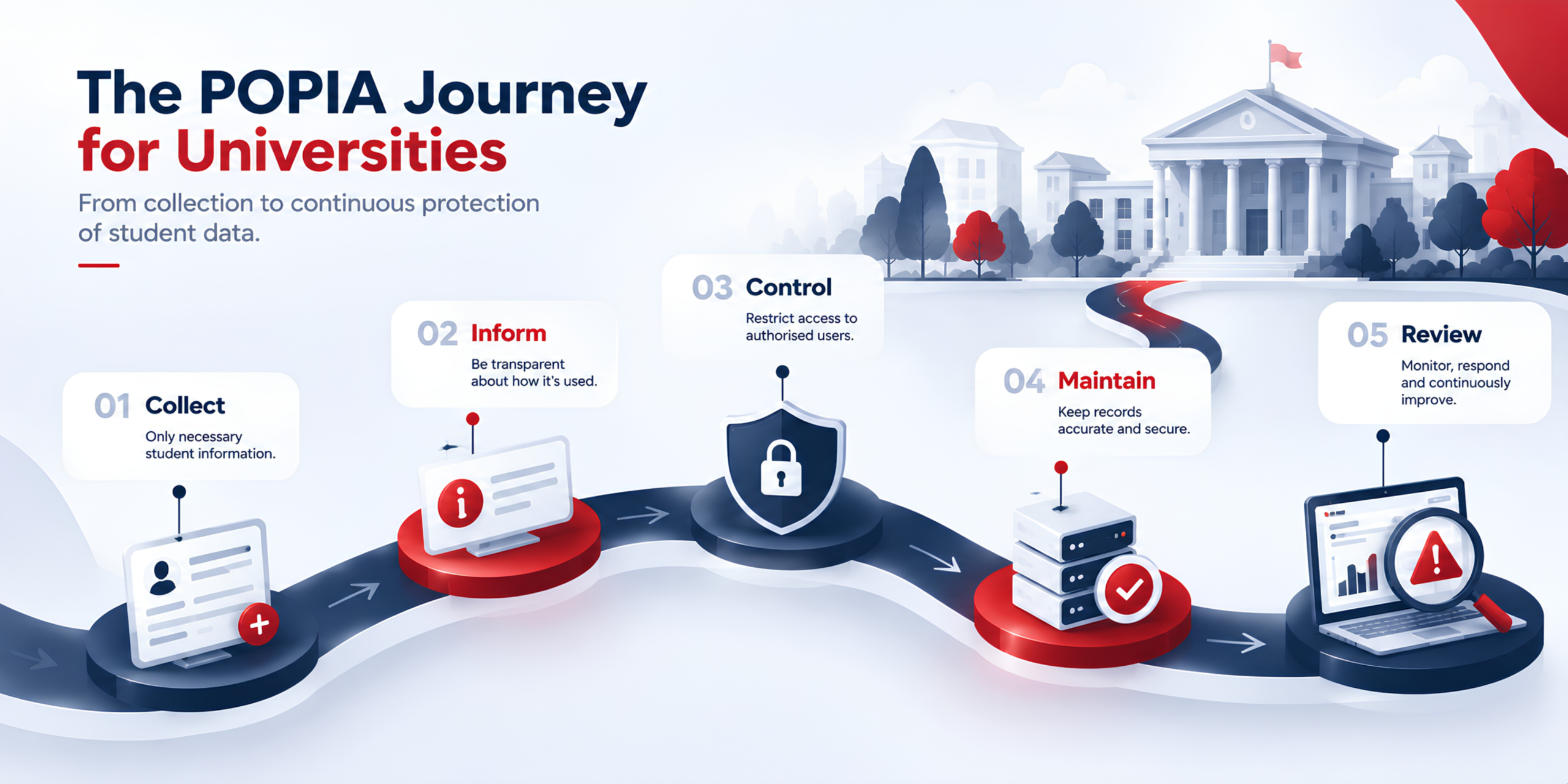
For South African universities, protecting this information is both a legal obligation and a responsibility to the people who trust them with it. The Protection of Personal Information Act (POPIA) establishes requirements for how personal information is collected, used, stored, shared, and secured. Yet policies alone cannot protect data when it moves between departments, spreadsheets, email accounts, and disconnected systems.
A well-governed Student Information System (SIS) can help institutions bring student information under stronger controls. AI can add another layer of intelligence by helping identify unusual activity, flagging potential risks, and supporting faster responses. The challenge is to use these technologies without introducing new privacy risks.
POPIA applies to public and private bodies that process personal information, subject to the Act’s provisions and exceptions. Its eight conditions for lawful processing cover accountability, processing limitation, purpose specification, further processing limitation, information quality, openness, security safeguards, and data subject participation. Read the official POPIA Act.
For universities, these requirements translate into everyday operational decisions:
Compliance is not achieved simply by installing software or publishing a privacy policy. Universities must establish appropriate technical and organisational safeguards, review whether they work, and keep them updated as risks change.
Section 19 specifically requires responsible parties to take appropriate, reasonable measures to protect personal information against loss, unauthorised destruction, unlawful access and unlawful processing. Section 21 also addresses security obligations involving operators that process information on a university’s behalf, including written contractual arrangements.
A compromised student record can expose identity and contact details, enable impersonation or phishing, reveal confidential academic information, and undermine a student’s confidence in the institution. If financial or other sensitive information is involved, the consequences may extend beyond the university’s systems.
The risk is not limited to cyberattacks. An employee sending a spreadsheet to the wrong recipient, excessive staff permissions, an unsecured device, or an outdated account that remains active can also expose information.
In December 2025, South Africa’s Department of Basic Education reported a breach involving National Senior Certificate examination materials. Its investigation identified unauthorised access to papers across three subjects, with the suspected spread limited at that stage to learners in seven schools in the Pretoria area. The department described how access controls, investigation procedures and multiple layers of verification helped detect and investigate the incident. Read the government’s statement.
This was an examination-material breach, not evidence of a university SIS breach. Nevertheless, it illustrates a relevant lesson for higher education: information must be protected throughout its lifecycle, access must be controlled, and institutions need procedures to detect and investigate irregularities.
Students provide information because they need to apply, enrol, receive financial support, complete assessments and access services. They should not have to wonder whether their personal documents are being circulated unnecessarily or whether their results can be viewed by unauthorised people.
Strong data protection supports trust in the institution. It also helps universities demonstrate that privacy is part of their governance practices, rather than an afterthought when an incident occurs.
A Student Information System can provide a more structured environment for managing student records and controlling how authorised users access them. Its value depends on the features implemented, institutional configuration, security practices, and the university’s own governance processes.
Not every employee needs access to every student record. An admissions officer may need application documents, while a lecturer may need class lists and academic information. A finance team may require fee-related records but not confidential counselling notes.
An SIS with appropriately configured role-based permissions can help limit access according to job responsibilities. Universities should also review permissions when employees change roles, leave the institution, or no longer require access.
The practical benefit: fewer unnecessary access opportunities and clearer accountability for who can view or modify information.
When departments maintain separate spreadsheets and exchange files through email, copies of student data can multiply. Each additional copy creates another place that must be protected, updated, and eventually disposed of appropriately.
A centralised SIS can give authorised teams access to shared, current records without requiring every department to maintain its own duplicate database. Access controls and approved workflows can help reduce unnecessary exports and sharing.
Centralisation alone, however, is not a guarantee of security. Universities must still govern integrations, exports, backups, third-party access and the information shared with external service providers.
When a student disputes a record change or a university investigates suspicious activity, knowing what happened matters.
Where supported, audit logs can help institutions review events such as record changes, access attempts and administrative actions. These records can support investigations and accountability, provided logs are protected, retained appropriately and reviewed by authorised personnel.
POPIA compliance involves more than securing information while it is in use. Universities also need processes for handling requests to access or correct records, and for retaining or disposing of information in line with applicable legal, regulatory and institutional requirements.
An SIS can help maintain organised records and support these workflows. The university must still define retention rules, assign responsibilities, and ensure that records are not deleted prematurely when another legal obligation requires their preservation.
AI can help universities move from relying only on manual checks towards more proactive risk detection. Its role should be to support trained security and compliance teams, not to replace human judgement or institutional accountability.
AI-based security tools can analyse activity patterns and flag events that warrant investigation. For example, repeated access attempts, unusual volumes of record retrieval, or activity inconsistent with a user’s normal behaviour may justify a closer review.
These signals are not proof of wrongdoing. Legitimate work can also produce unusual patterns, so alerts should be assessed in context before action is taken.
Duplicate student profiles, inconsistent identifiers, and conflicting records can create operational errors and lead to information being sent to the wrong person. AI-assisted matching and anomaly detection may help identify records that require verification.
The final correction should follow approved procedures. AI should not silently alter important student records or treat an uncertain match as a confirmed identity.
When a potential incident occurs, AI-assisted tools may help security teams organise alerts, summarise relevant logs and prioritise events for investigation. This can help teams focus on potentially significant activity, subject to the quality of the underlying data and the tool’s capabilities.
Using AI to protect data creates its own responsibilities. Universities should establish which information an AI tool can access, whether prompts or records are stored, how vendors use submitted data, and whether outputs can expose confidential information.
Student records should not be copied into public AI tools simply to summarise, analyse or troubleshoot them. Institutions should use approved tools, limit access to the minimum necessary data, validate outputs and keep human oversight over consequential decisions.
Gartner’s Hype Cycle for Higher Education, 2026 identifies sophisticated security threats, technical debt and ungoverned AI pilots as challenges facing higher education technology leaders. The implication for universities is clear: AI adoption must be accompanied by stronger governance, not introduced as a separate experiment outside existing controls.
Academia by Serosoft provides a Student Information System designed to help institutions manage student information and academic administration within a structured digital environment. By bringing student records and administrative workflows into a connected system, universities can work towards more consistent information management and better control over how student data is handled.
For South African universities, the value of an SIS extends beyond digitising administrative tasks. It lies in establishing clearer processes for accessing, updating, managing and sharing student information. When evaluating Academia SIS, institutions should consider how its available functionality and configuration can support their specific data protection requirements.
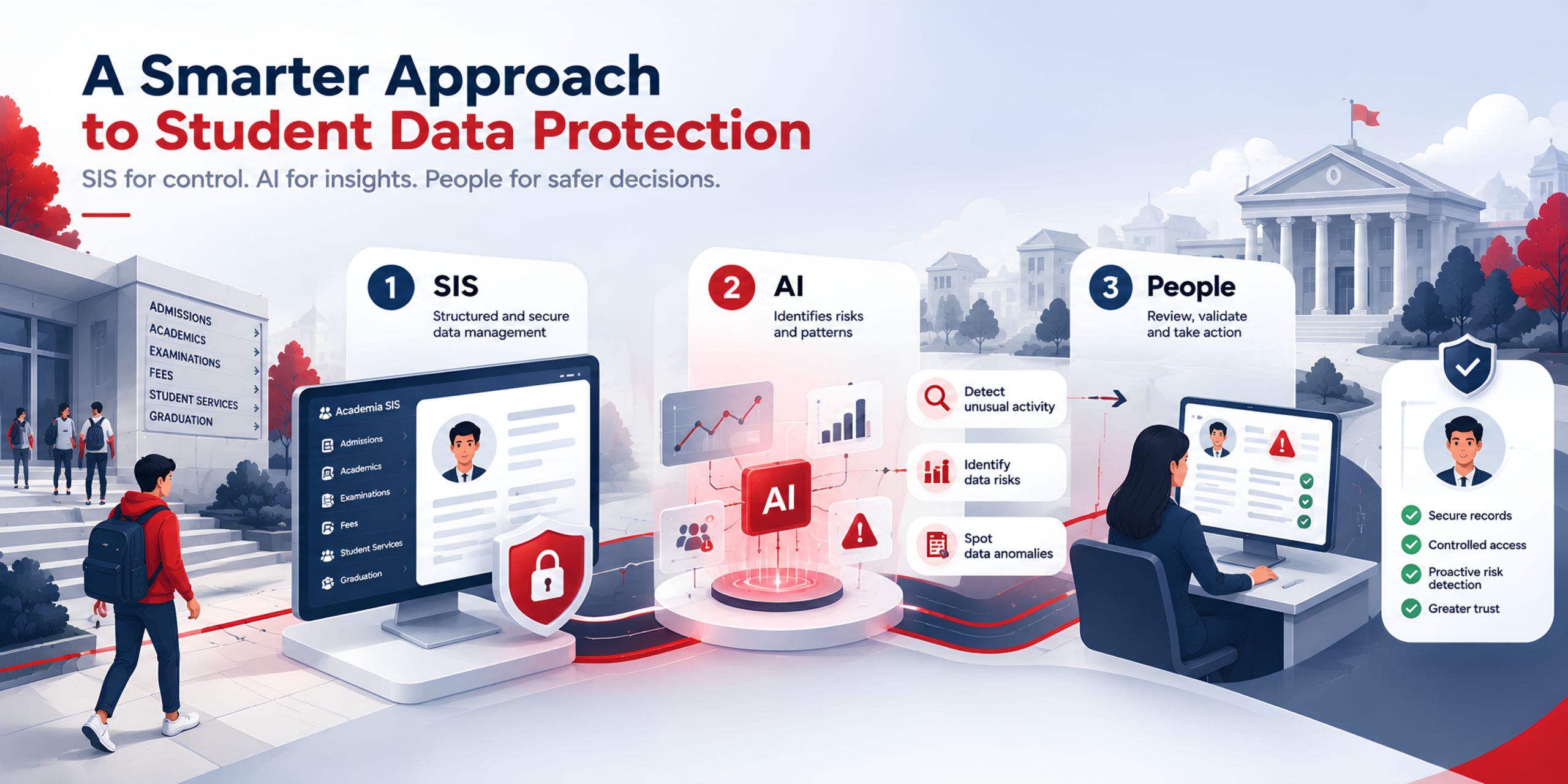
Three priorities are particularly important:
These measures can help universities build a more structured approach to student data governance. However, an SIS is an enabler of compliance, not a substitute for it. Universities must still establish appropriate policies, assess risks, train staff, review third-party arrangements, and regularly evaluate whether their safeguards remain effective.
Before choosing or reviewing an SIS, university leaders should ask:
These questions help turn POPIA from a policy document into an operational practice.
For South African universities, POPIA compliance is about protecting students’ rights while maintaining the integrity of institutional operations. An SIS can help bring records, permissions, and workflows under stronger control, while appropriately governed AI can support anomaly detection, data-quality checks, and incident investigation.
The strongest approach combines technology with clear policies, trained staff, regular reviews, and accountability. Universities evaluating their digital infrastructure should assess not only what an SIS can automate, but also how it supports secure data handling throughout the student lifecycle.
Explore Academia SIS and request a personalised demo to discuss your institution’s student information management needs.
No. An SIS can support access controls, record management and documented workflows, but compliance also requires appropriate policies, contracts, staff training, risk assessments and ongoing oversight.
Depending on the institution and its processes, this can include identity and contact details, academic records, financial information, application documents and other personal or sensitive information. The safeguards required depend on the information and the risks associated with processing it.
No. AI may help identify suspicious activity and prioritise investigations, but it cannot eliminate every threat. It must operate alongside established security controls, incident-response procedures and human oversight.
Ask about access permissions, authentication, encryption, audit logs, backups, data retention, subprocessors, data locations, incident notification, contractual responsibilities, and how AI-related processing is governed. Request relevant documentation and verify that the controls meet your institution’s requirements.

Experience Academia – Your partner in transforming campus operations, a trusted all-in-one ERP/SIS solution.
Get the latest insights, trends, and updates delivered straight to your inbox!