

Amit Kulkarni
Estd. Reading Time : 4 Min.
14th Feb, 2026
Share On:
A student information system plays a critical role in how higher education institutions manage, track, and govern student data across the entire academic lifecycle. From admissions and enrolment to academic records, assessments, and graduation, a centralized student info system ensures accuracy, consistency, and real-time access to student information.
Institutions without a robust SIS often struggle with data duplication, manual effort, and limited visibility into student progress, which directly impacts administrative efficiency and student experience.
When implemented as part of a broader Education ERP ecosystem, a student information system becomes the academic backbone of the institution, supporting compliance, improving decision-making, and enabling scalable growth.
Rather than being a backend tool, SIS functions as a strategic enabler that helps institutions operate with clarity, control, and confidence in an increasingly data-driven higher education environment.
Every university talks about student success. Yet, behind the scenes, student data is often scattered across departments, systems, and spreadsheets, making it difficult to track progress, ensure accuracy, or support informed decisions.
This is where a student information system (SIS) becomes indispensable.
A well-implemented SIS does not just store data.
It connects the entire student lifecycle into one coherent, intelligent framework.
At its core, a student information system is the central platform that manages, tracks, and governs student-related data throughout their academic journey.
This includes:
Unlike isolated tools, an SIS ensures that every department works from the same source of truth.
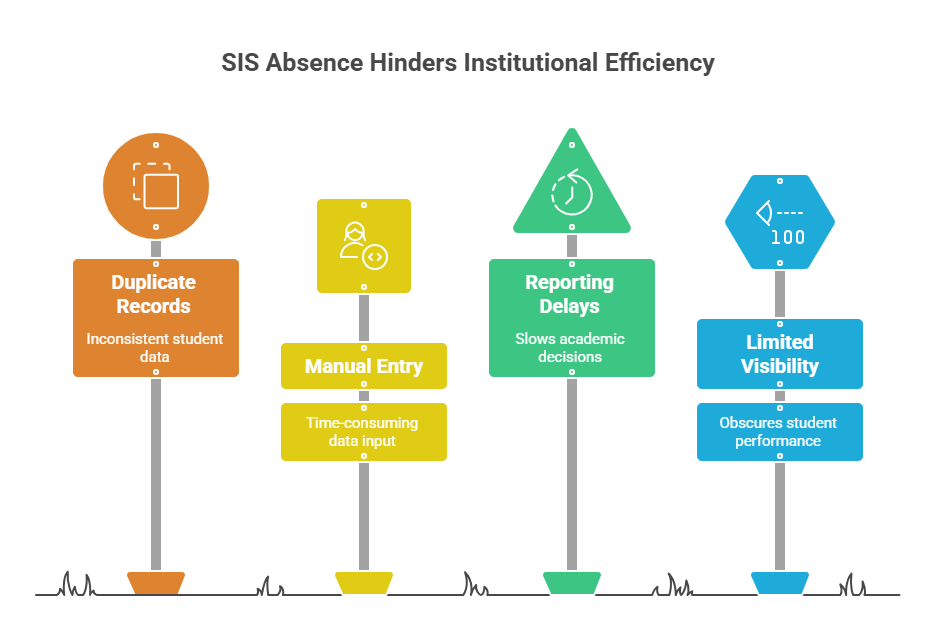
Without a centralized student info system, institutions face recurring challenges:
Over time, these issues impact not just operations, but student trust and institutional reputation.
One of the strongest advantages of an SIS is the reduction of manual effort.
With automation and centralized workflows:
Efficiency is not just about speed; it’s about accuracy, consistency, and control.
From a student’s perspective, administrative delays feel like institutional inefficiency.
A modern student information system enables:
When systems work seamlessly behind the scenes, students experience fewer bottlenecks and greater confidence in the institution.
A modern SIS should enable institutions to:
Anything less creates limitations that surface as the institution grows.
Too often, SIS adoption is viewed as a backend system upgrade. In reality, it is a strategic leadership choice that defines how effectively an institution operates.
When leadership prioritizes SIS:
Institutions that implement the right student information system early:
SIS is not about managing students; it is about enabling institutional excellence.
Student Information System: The Foundation
A Student Information System is the foundation upon which truly digital campuses are built. When aligned with a broader ERP strategy, it becomes more than an operational tool; it drives efficiency, strengthens leadership visibility, and enables sustainable institutional growth. For institutions serious about the future, an SIS is not just another feature in the tech stack; it is a strategic necessity.
This is where solutions like Academia step in, designed to simplify the entire student lifecycle while giving institutions the clarity and control they need to scale with confidence.
If your institution is rethinking how to modernize student management without adding complexity, now is the time to take the first step.
Book a free demo today and explore how the right SIS can power your next phase of growth.

Experience Academia – Your partner in transforming campus operations, a trusted all-in-one ERP/SIS solution.
Get the latest insights, trends, and updates delivered straight to your inbox!