Summary: Choosing the right Student Information System is becoming increasingly important for South African universities as student numbers grow and institutional operations become more complex. The Department of Higher Education and Training reports that more than 1.3 million students were enrolled across public and private higher education institutions in 2023, with enrolments projected to reach 1.6 million by 2030. Universities therefore need systems that can support not only day-to-day administration but also long-term institutional growth.
This buyer’s guide explores the key questions universities should ask before selecting an SIS. It examines how to assess institutional requirements, evaluate both core and advanced SIS capabilities, and assess areas such as reporting and analytics, integrations, cloud deployment, configurability, data security and POPIA requirements. It also explores the growing role of AI, what universities should look for in implementation and vendor support, and how to make the final SIS decision.
The key takeaways are clear: universities should begin by identifying the problems they actually need to solve, evaluate how well an SIS connects data and processes across the complete student lifecycle, and look beyond individual features to assess advanced capabilities that can improve efficiency, visibility and decision-making. They should also consider whether the platform can integrate with their wider technology ecosystem, adapt to institutional requirements without excessive customisation, support responsible data governance and remain relevant as their needs evolve.
Ultimately, the guide helps university leaders move beyond simply asking “Which platform has the most features?” and instead evaluate whether an SIS can connect data, streamline processes, support better decision-making and provide a strong foundation for long-term institutional growth and future readiness.
The buying process should begin before the first vendor demonstration.
Universities should first understand the problems they are trying to solve. An institution replacing a legacy system may be struggling with fragmented data and difficult integrations. Another may already have a functioning SIS but need better reporting, automation or support for multiple campuses and learning models.
This assessment should look at the complete operating environment. Where does duplicate data entry occur? Which reports require manual consolidation? Which processes still depend on spreadsheets or email? And where do students or staff experience unnecessary delays?
A useful starting point is to map the student lifecycle and identify where information or processes break down. Only then can a university create meaningful evaluation criteria for potential vendors.
This matters because a feature that appears impressive during a demonstration may have little value if it does not address an actual institutional requirement.
Admissions, student records, registration, academic management, examinations and fees form the foundation of any Student Information System. However, when comparing SIS platforms, universities should look beyond whether these basic capabilities are available.
The more important question is whether the system can support a connected, efficient and evolving university environment. Core processes should work together, allowing information collected at one stage of the student journey to flow seamlessly across admissions, academics, finance and student services without repeated data entry or disconnected records.
Beyond these fundamental capabilities, universities should also assess the advanced features that can improve efficiency, visibility and the overall student experience. Depending on institutional requirements, these may include:
These features may not always be the starting point of an SIS evaluation, but they can play an important role in determining how well a platform supports a university as its operational and strategic requirements evolve.
At Academia, this connected approach is central to how we approach higher education technology. The objective is not simply to provide separate modules, but to create continuity between the processes, information and insights that different university teams depend on.
Reporting should be one of the most important parts of an SIS evaluation.
Many platforms can generate reports. But there is a significant difference between a system that stores data and one that helps institutional leaders access, understand and use that data.
The 2025 EDUCAUSE QuickPoll on data modernisation found that 68% of respondents were already in the process of modernising their data environments, while only 1% believed their institution had fully modernised its data management and strategy. Operational efficiency, student success and retention, and data visualisation and decision support were among the leading drivers for modernisation.
The lesson for SIS buyers is important. If admissions, academics, finance and student services operate with disconnected information, reporting often becomes a manual exercise in collecting and reconciling data before anyone can begin analysing it.
At Academia, we believe reporting should move beyond simply answering “What happened?” University leaders increasingly need to explore trends, understand patterns and access information without waiting for lengthy manual report preparation. This is why Academia combines institutional reporting with AI-powered analytics and 400+ AI reports, helping institutions access information more quickly and meaningfully.
When comparing SIS vendors, universities should therefore ask not only how many reports are available, but also whether the platform provides configurable reporting, real-time visibility, dashboards and analytical capabilities that support actual decision-making.
An SIS rarely operates alone.
South African universities may already use learning management systems, finance platforms, payment gateways, identity systems, communication tools and other specialised applications. The SIS must therefore fit into a wider technology ecosystem.
Poor integration can create duplicate data entry and data inconsistencies. Over time, institutions can find themselves with plenty of information but no reliable, unified view.
The EDUCAUSE research identifies siloed data and older technology as persistent barriers to modernisation. Its findings reinforce an important procurement principle: buying a new platform without considering how it connects to the existing environment can simply create another silo.
Universities should ask vendors how integrations are managed, whether APIs are available and how easily the platform can connect with both current and future systems.
From Academia’s perspective, integration is not an additional feature to consider after implementation. A connected SIS should act as part of a wider digital ecosystem, allowing institutional information to move where it is needed.
There is no universal answer.
A cloud-based SIS may offer scalability, easier access across campuses and reduced infrastructure management. An on-premise approach may suit institutions with particular infrastructure or control requirements.
The decision should therefore be based on the university’s own operating model rather than a general assumption that one approach is always better.
South Africa’s higher education environment also includes significant diversity in how students access education. DHET data for 2023 showed that 34.7% of public higher education enrolments were through distance learning. This makes accessibility, scalability and the ability to support different learning journeys important considerations for technology buyers.
The real question is:
“Which deployment model best supports our institution’s accessibility, scalability, security and long-term technology strategy?”
Universities are complex institutions. Academic structures, approval processes, programmes and administrative rules can differ significantly.
However, buyers should distinguish between a configurable platform and one that requires extensive custom development.
A configurable SIS allows institutions to adapt workflows and processes without fundamentally changing the software. Heavy customisation may initially appear attractive, but it can create long-term challenges around upgrades, maintenance and dependency.
During evaluation, universities should understand what can be configured independently and what requires vendor development.
At Academia, configurability is designed to give institutions flexibility while maintaining the advantages of a scalable platform. The goal is not to force every university into an identical process, but neither is it to create a completely different software product for every institution.
An SIS manages some of the university’s most important information, including personal, academic and financial data.
Security should therefore be evaluated as part of the procurement process, not after a vendor has been selected.
Universities should understand how access is controlled, how permissions are managed, whether audit trails are available and how the vendor approaches data protection and governance. POPIA considerations also make it important to understand how personal information is processed and protected.
The key is to look beyond a simple statement that a platform is “secure”.
A serious evaluation should examine the controls behind that claim and ask how the vendor supports the university’s own responsibilities around information governance.
Yes, but universities should evaluate AI carefully.
The question should not be:
“Does this SIS have AI?”
It should be:
“What does the AI actually help us do, and how is institutional data governed?”
UNESCO’s 2025 survey found that 19% of participating higher education institutions already had formal AI policies, while another 42% were developing guidance. The findings reflect a broader shift: universities are exploring AI, but governance and responsible adoption are becoming equally important.
For SIS buyers, this means looking beyond AI labels. Practical capabilities may include intelligent reporting, analytics, automation and easier access to institutional insights. But vendors should also be able to explain how AI operates and what controls surround its use.
Academia’s approach includes SERA AI, AI-powered analytics and intelligent reporting capabilities designed specifically around higher education use cases. The objective is to help institutions move from simply accessing data towards asking more meaningful questions of it.
The quality of the platform matters. But so does the journey of getting there.
SIS implementation can involve data migration, process redesign, integration, staff training and change management. Universities should therefore evaluate the vendor’s implementation methodology as carefully as the product itself.
Before making a decision, ask:
The strongest vendor relationship should extend beyond implementation. An SIS is a long-term institutional platform, so universities should also assess the vendor’s product roadmap and ability to support future requirements.
The final decision should bring together functional, technical and strategic requirements.
Rather than selecting a platform because it performs well in one area, universities should assess the complete picture: student lifecycle coverage, reporting, integration, configurability, security, implementation and future readiness.
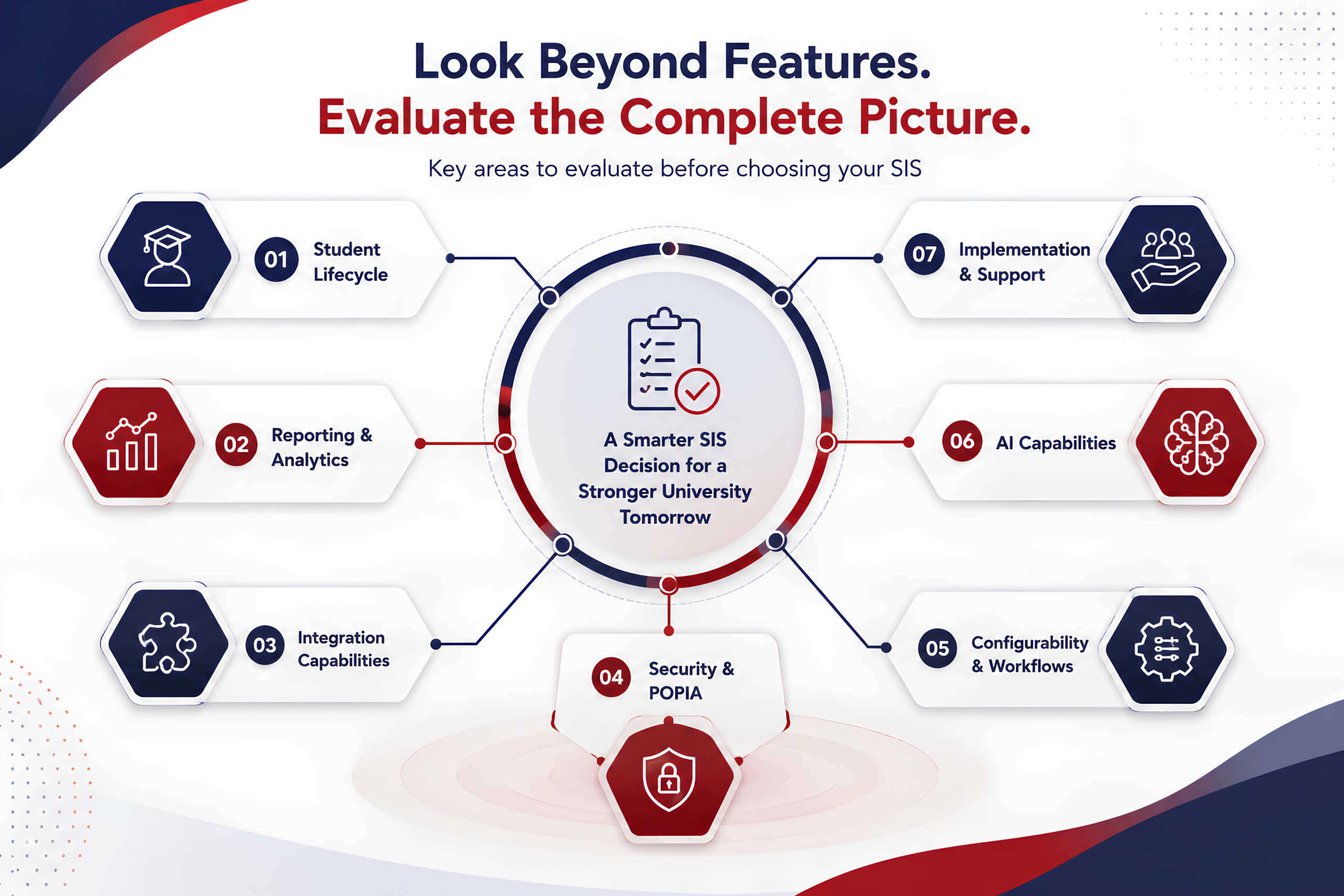
A practical evaluation can focus on these core areas:
| Evaluation Area | What to Assess |
|---|---|
| Student lifecycle | Does the SIS connect key student processes? |
| Reporting | Can users access reliable, actionable information? |
| Integration | Does it connect with the existing ecosystem? |
| Configurability | Can it adapt without excessive customisation? |
| Security | Are governance and access controls robust? |
| AI | Are the capabilities practical and responsibly governed? |
| Implementation | Can the vendor support migration and change? |
| Future readiness | Does the platform and vendor roadmap support long-term growth? |
The best decision is rarely about choosing the platform with the longest feature list.
It is about choosing the system that creates the strongest foundation for the university’s future.
Academia by Serosoft is an AI-powered Student Information System and Education ERP designed to support the complete student lifecycle, from admissions and enrolment to academics, examinations, fees, student services, graduation and alumni management.
For South African universities, Academia brings together connected student data, configurable workflows, integrations, reporting and AI-powered capabilities within one platform. Its reporting and analytics capabilities, including 400+ AI reports and SERA AI, can help institutions move beyond manual data collection towards faster access to institutional insights.
The platform is designed to help universities streamline processes, connect their wider technology ecosystem and build a more efficient, data-informed approach to institutional operations.
South African universities are operating in an increasingly complex environment, with more than 1.3 million students enrolled across public and private higher education institutions and further growth planned towards 2030.
That makes the SIS more than an administrative system. It can become the foundation connecting students, processes, data and institutional decisions.
The right platform should therefore do more than manage records. It should provide connected workflows, meaningful reporting, strong integration capabilities, flexibility and a clear path towards responsible AI adoption.
At Academia, we see the SIS buying decision as an opportunity to move beyond fragmented operations towards a more connected and intelligent institution.
The final question for every university is therefore:
“Are we choosing a system that will simply manage today’s processes or one that can help us build the university of tomorrow?”
Whether you are replacing a legacy platform, improving institutional reporting or building a more connected digital ecosystem, the right SIS can create a stronger foundation for long-term transformation.
Discover how Academia by Serosoft helps universities manage the complete student lifecycle, connect institutional data, automate workflows and turn information into actionable insights through AI-powered capabilities.
Request Demo | Speak with an SIS Expert
Universities should evaluate student lifecycle coverage, reporting, integrations, configurability, security, POPIA-related data governance, implementation support and long-term scalability.
Reporting helps universities turn institutional data into useful information. Buyers should assess data accuracy, dashboards, configurability, real-time visibility and analytical capabilities rather than simply counting pre-built reports.
Integration is critical because universities use multiple systems. A well-integrated SIS can reduce duplicate data entry, improve data consistency and provide a more connected institutional view.
Yes. However, universities should evaluate practical use cases, data governance, transparency and human oversight rather than selecting a platform based simply on AI branding.
Academia by Serosoft provides an AI-powered Student Information System that supports the complete student lifecycle, configurable workflows, integrations, institutional reporting, AI-powered analytics and SERA AI.

Experience Academia – Your partner in transforming campus operations, a trusted all-in-one ERP/SIS solution.
Get the latest insights, trends, and updates delivered straight to your inbox!