

Gaurav Koriya
Estd. Reading Time : 4 Min.
30th Aug, 2026
Share On:
A Student Information System (SIS) is often described as the technology behind student records, admissions and academic administration. But for modern universities, that definition is no longer enough.
Students expect faster, simpler digital services. Faculty need timely access to academic information. Administrators need connected workflows instead of spreadsheets and repetitive data entry. And university leaders need reliable information to make decisions about enrolment, progression, resources and institutional performance.
The result is a fundamental shift in what universities should expect from an SIS.
A great SIS should not simply store student information. It should connect the student lifecycle, automate routine work, make institutional data more actionable and give every stakeholder a better way to interact with the university.
So, what separates a genuinely effective SIS from a system that simply checks the basic requirements?
The best SIS platforms are built around a simple principle: student information should move with the student, not get trapped in departmental systems.
From enquiry and application to enrolment, academics, attendance, examinations, fees, student services and graduation, every stage creates information that can be valuable to another part of the institution.
A strong SIS should help universities:
The goal is not simply to have more technology. It is to have technology that makes the university work better.
A university may have separate systems for admissions, academics, finance, examinations, attendance and student services. The problem begins when these systems do not communicate effectively.
A student may submit information during admission, provide the same information again during registration and encounter another disconnected process when accessing finance or examination services.
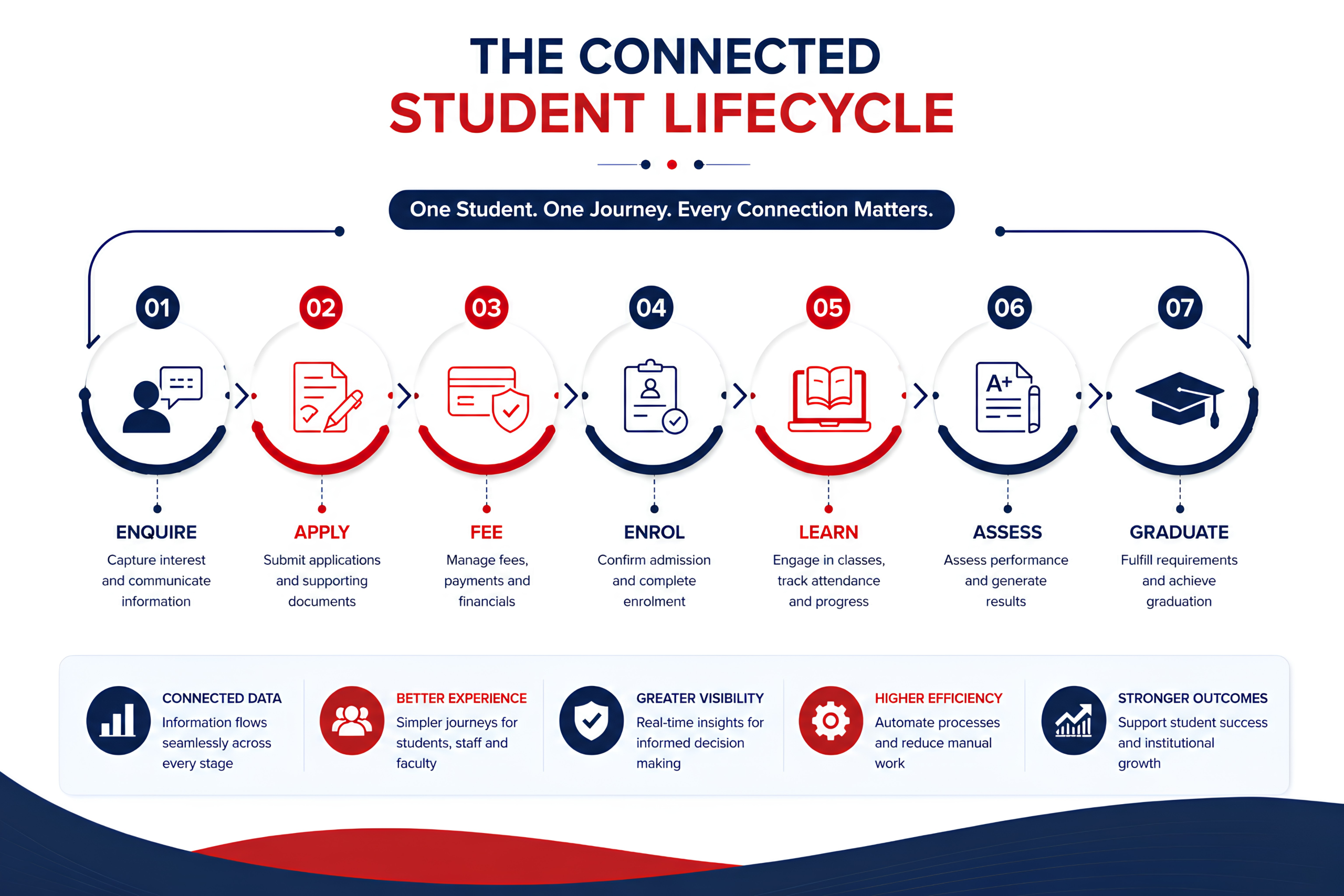
A connected SIS creates a different experience:
Enquiry → Admission → Fees Enrolment → Academics → Attendance → Assessment → Graduation
Information can move through these stages while authorised users access the information relevant to their role.
According to Academia’s research, a modern SIS should be viewed as an institutional platform rather than simply a student database. Connecting academic, administrative and student-facing processes can give universities greater visibility across the student lifecycle while reducing unnecessary duplication.
Not every SIS feature has the same strategic value. Universities should focus on capabilities that solve real operational challenges and remain useful as institutional requirements evolve.
At the foundation of every effective SIS is a reliable student record.
Universities should be able to manage personal details, academic history, programme information, enrolment status, documents and other relevant records within a structured environment.
This creates a single source of truth, reducing conflicting information across departments and the need for staff to manually reconcile records.
Admissions should not exist as an isolated process.
A modern SIS should connect enquiries, applications, document submission, evaluation, admission decisions and enrolment with the student’s ongoing institutional record.
This creates a smoother transition from prospective student to enrolled student, while reducing repetitive data entry and improving visibility into applications and enrolment activity.
Universities are constantly changing. New programmes are introduced, curricula evolve, credit structures change, and institutions adopt new academic pathways.
A rigid SIS can turn every change into a technology problem.
A strong platform should support configurable programmes, courses, curricula, academic rules, credits, registration and progression without requiring extensive redevelopment whenever the institution changes its academic model.
From Academia’s perspective, flexibility is one of the most important characteristics of a future-ready SIS. The platform should adapt to the institution’s academic structure rather than forcing the institution to work around its technology.
University employees spend significant time managing approvals, checking information, sending reminders and moving requests between departments.
Workflow automation can support areas such as:
The benefit is not automation for its own sake. It is giving staff more time to focus on work that requires human judgement.
Universities generate enormous amounts of information every day. But having data and being able to use it are two different things.
University leaders may want to know:
If answering these questions requires manually collecting spreadsheets from multiple departments, the information may already be outdated.
A modern SIS should provide dashboards, reports and analytics that turn institutional data into usable insight.
The value is moving from:
“What happened?” → “What is happening?” → “What should we do next?”
Students rarely think in terms of university departments. They simply expect the university to work.
They want to apply, register, check their timetable, view attendance, access results, make payments and receive important updates without navigating disconnected processes.
This makes student-facing functionality an essential part of a modern SIS.
A strong platform should provide convenient digital access to relevant services through web and mobile channels. When students can access information themselves, universities can also reduce unnecessary enquiries and administrative workload.
The result is a shift from administration-first technology to student-centred technology.
No university operates entirely within one platform.
Institutions may already use an LMS, finance applications, payment gateways, identity systems, communication tools and other specialised applications.
Replacing everything simply because a university is implementing a new SIS is rarely practical.
Instead, the SIS should be able to work with the technology the institution already uses.
Universities should ask:
A strong SIS should become the connective layer, rather than another isolated application.
Student information can include personal, academic and financial data, making security a core SIS requirement.
Universities should look for capabilities such as:
Security, however, is not only about technology. Universities also need clear governance, policies and staff practices around how information is accessed and used.
A system that works for a university today may not work five years from now.
Institutions grow, student numbers increase, campuses expand, and new programmes are launched. A scalable SIS should be able to support:
More students + More programmes + More campuses + More data + More integrations
without becoming increasingly difficult to manage.
Universities should therefore evaluate scalability not just in terms of infrastructure, but also academic structures, workflows, integrations and institutional growth.
A long feature list does not necessarily mean a better SIS.
Instead of asking “How many modules does this vendor have?”, universities should ask whether the platform can solve their most important operational challenges.
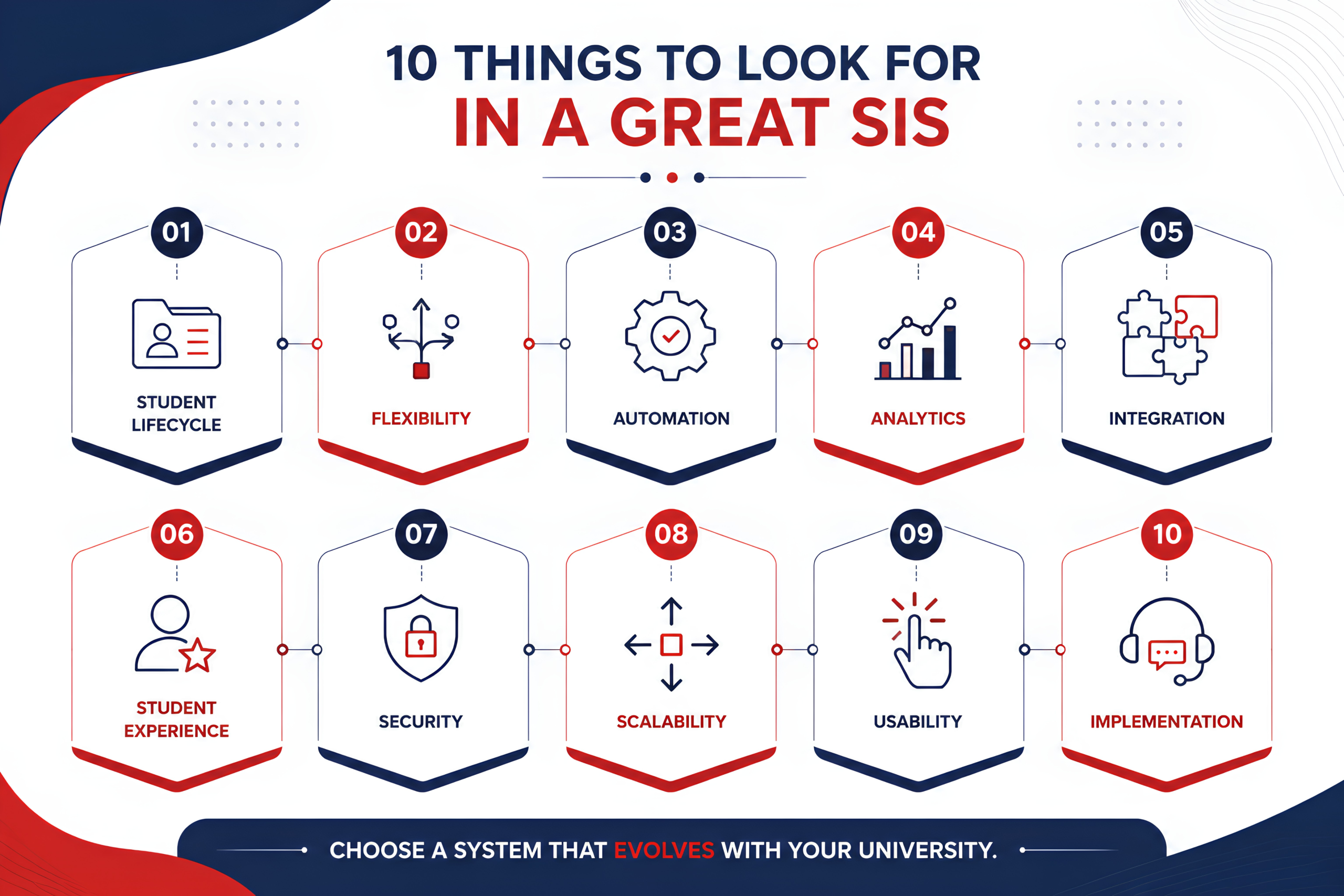
| What to Evaluate | Why It Matters |
|---|---|
| Student lifecycle | Connects processes from admission to graduation |
| Academic flexibility | Supports changing programmes and structures |
| Automation | Reduces repetitive administrative work |
| Analytics | Enables data-informed decisions |
| Integration | Connects existing university technology |
| Student experience | Improves digital access and self-service |
| Security | Protects sensitive student information |
| Scalability | Supports institutional growth |
| Usability | Encourages adoption across stakeholders |
| Implementation support | Helps ensure successful transformation |
According to Academia’s research, universities should evaluate an SIS based not only on what it can do today, but also on how well it can evolve with the institution. A future-ready platform should support changing academic requirements, growing student populations, expanding integrations and increasingly data-driven decision-making.
Academia by Serosoft brings student lifecycle management, academic administration and institutional operations together through a unified higher education platform.
Its capabilities cover areas including admissions, academics, attendance, examinations, fees, student records, student services, analytics and reporting.
The platform is designed to help universities move away from disconnected processes towards a more integrated digital environment.
For university leaders, this means greater visibility.
For staff, it can mean fewer repetitive processes.
For students, it can mean easier access to services.
For the institution, it creates a stronger digital foundation for future growth.
The real question is therefore not whether your university needs an SIS.
It is whether your current system is helping your university move forward or holding it back.
The future of SIS technology is moving beyond record management.
Universities increasingly need platforms that combine:
Connected data + Automation + Analytics + Integration + Student experience
The transformation can be summarised simply:
From records → to intelligence
From departments → to connected processes
From manual work → to automation
From reactive administration → to proactive student support
A great SIS is ultimately not defined by how many features it has.
It is defined by how much better it helps the university operate, serve students and make decisions.
Your university shouldn’t have to work around disconnected systems, manual processes and limited visibility.
See how Academia can connect your student lifecycle, automate university workflows and turn institutional data into actionable insight.
Book a Demo and explore what a more connected university experience could look like for your institution.
A Student Information System is a platform used by educational institutions to manage student information and processes such as admissions, enrolment, academics, attendance, examinations, fees, records and student services.
Key features include centralised student records, admissions and enrolment, academic management, workflow automation, analytics, reporting, integrations, student self-service, security and scalability.
Integration allows an SIS to exchange information with other university systems such as LMS, finance, payment and communication platforms. This reduces data silos and repetitive data entry.
An SIS can give students digital access to services such as registration, attendance, timetables, fees, examinations, results and notifications through web and mobile channels.
Universities should evaluate an SIS based on academic flexibility, lifecycle coverage, automation, analytics, integrations, security, scalability, usability, implementation support and long-term adaptability.
No. A well-designed SIS can support students, faculty, administrators and university leadership by connecting relevant information and workflows across the institution.

Experience Academia – Your partner in transforming campus operations, a trusted all-in-one ERP/SIS solution.
Get the latest insights, trends, and updates delivered straight to your inbox!