

Vijay Naga Prasad
Estd. Reading Time : 4 Min.
20th Jan, 2026
Share On:
“Technology is best when it brings people together.”
In higher education, this couldn’t be more relevant. A Student Information System is not just about digitizing records or automating tasks; it’s about connecting departments, aligning faculty and administrators, and ensuring leadership operates with a shared, accurate view of institutional data.
When an SIS truly works, admissions, academics, examinations, and compliance teams stop functioning in silos and start moving in sync. Decisions become faster, collaboration improves, and leadership stays on the same page because everyone is working from one reliable source of truth.
To understand why this matters so much, let’s look at a real situation many institutions across Southeast Asia face every day.
At 9:00 a.m. on a Monday morning, the registrar’s office at a growing university in Southeast Asia is already flooded with calls.
A student’s enrollment status doesn’t match the exam list.
Faculty are chasing attendance data from three departments.
Leadership wants a consolidated report for an accreditation review by the end of the day.
None of these problems exists because institutions lack intent or effort.
They exist because information is scattered, systems don’t talk to each other, and decisions rely heavily on manual work.
Across the APAC region, higher education institutions are expanding rapidly, but their digital foundations often struggle to keep pace. This is why the conversation around smarter campus technology has shifted from tools to systems, and from isolated platforms to integrated solutions.
Universities across Southeast and Central Asia are operating in one of the fastest-evolving education landscapes in the world. Countries like Indonesia, Vietnam, the Philippines, Malaysia, Kazakhstan, and Sri Lanka are witnessing:
However, many institutions still operate with fragmented platforms, one for admissions, another for academics, spreadsheets for reporting, and emails for approvals. As a result, leadership teams struggle to access real-time insights, while operational teams spend hours reconciling data.
This growing complexity is forcing institutions to reassess how they manage academic and administrative data at scale.
The challenge is not digitization alone; it’s connected digitization.
When systems are not designed to function as a single ecosystem, institutions experience:
Over time, these gaps don’t just slow operations; they affect institutional credibility, student satisfaction, and leadership confidence.
This is where a modern student information system becomes foundational rather than optional.
To operate efficiently in a multi-campus, regulation-driven, and data-intensive environment, institutions now require more than basic automation. They need a unified digital backbone that supports scale, transparency, and governance.
A future-ready campus platform must enable:
In essence, institutions are moving toward platforms that function as a comprehensive education erp, rather than disconnected software tools.
Across APAC, institutions evaluating digital transformation consistently look for systems that offer:
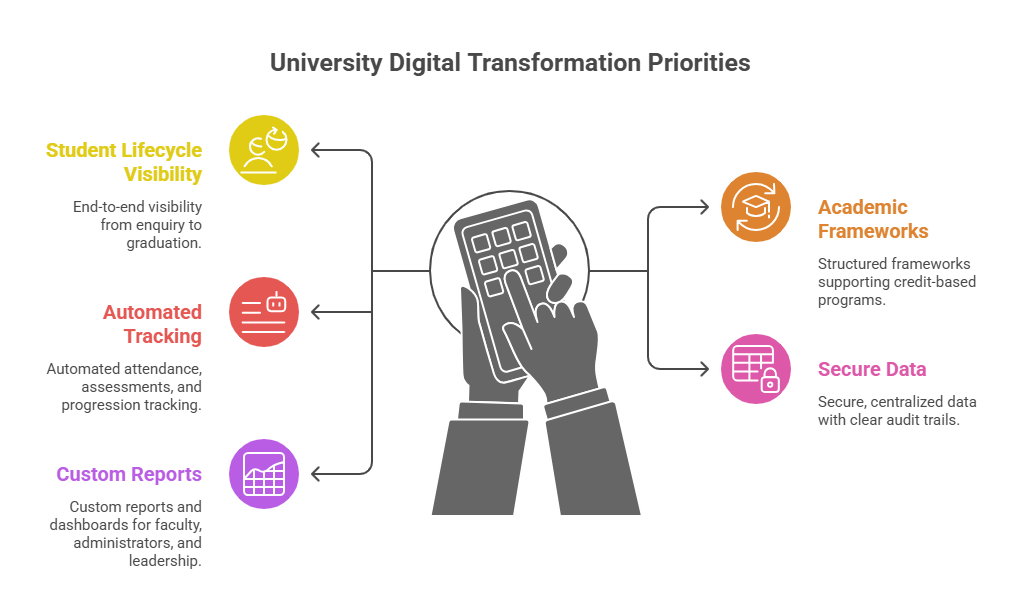
These capabilities reduce manual intervention, improve data accuracy, and allow institutions to operate with greater confidence and control.
As institutions scale, every additional department, program, or campus increases data complexity. Without integration, leadership decisions rely on partial or delayed information.
A unified student information system eliminates this risk by ensuring all stakeholders work from the same source of truth. Admissions data aligns with academic records. Attendance connects seamlessly with assessments. Reporting becomes reliable, timely, and consistent.
When paired with a robust education erp, institutions gain not just operational efficiency, but strategic clarity.
Regulatory bodies across the Asia-Pacific are increasingly emphasizing transparency, traceability, and accountability. Accreditation frameworks now expect institutions to demonstrate:
Institutions relying on manual processes often find compliance stressful and time-consuming. In contrast, digitally mature universities use automation to stay audit-ready at all times, without last-minute data compilation.
This shift is accelerating the adoption of platforms that combine academic depth with enterprise-grade reliability.
The real value of a modern student information system lies in how it transforms everyday operations into strategic assets. When data is accurate and accessible, leadership can:
This is why forward-looking institutions are no longer asking whether to modernize, but how quickly they can transition to a connected education erp model.
As higher education across APAC grows in scale and complexity, institutions need a connected digital backbone, not fragmented tools. Academia SIS is a future-ready student information system designed to unify departments, automate academic operations, and give leadership real-time visibility through AI-driven intelligence.
Higher education in the APAC region is entering a decisive phase. Growth, complexity, and accountability are rising simultaneously. Institutions that continue to rely on fragmented systems risk operational strain and missed opportunities.
On the other hand, those that invest in a unified digital foundation position themselves for long-term resilience, better governance, and stronger student outcomes.
This is where Academia SIS becomes a strategic advantage. Designed for the evolving needs of APAC institutions, Academia enables universities to connect departments, automate critical processes, and lead with data-driven confidence.
Book a free demo today or speak with our experts to see how Academia can help your institution build a future-ready digital campus.

Experience Academia – Your partner in transforming campus operations, a trusted all-in-one ERP/SIS solution.
Get the latest insights, trends, and updates delivered straight to your inbox!