

Vaibhav Kushwaha
Estd. Reading Time : 4 Min.
13th Aug, 2026
Share On:
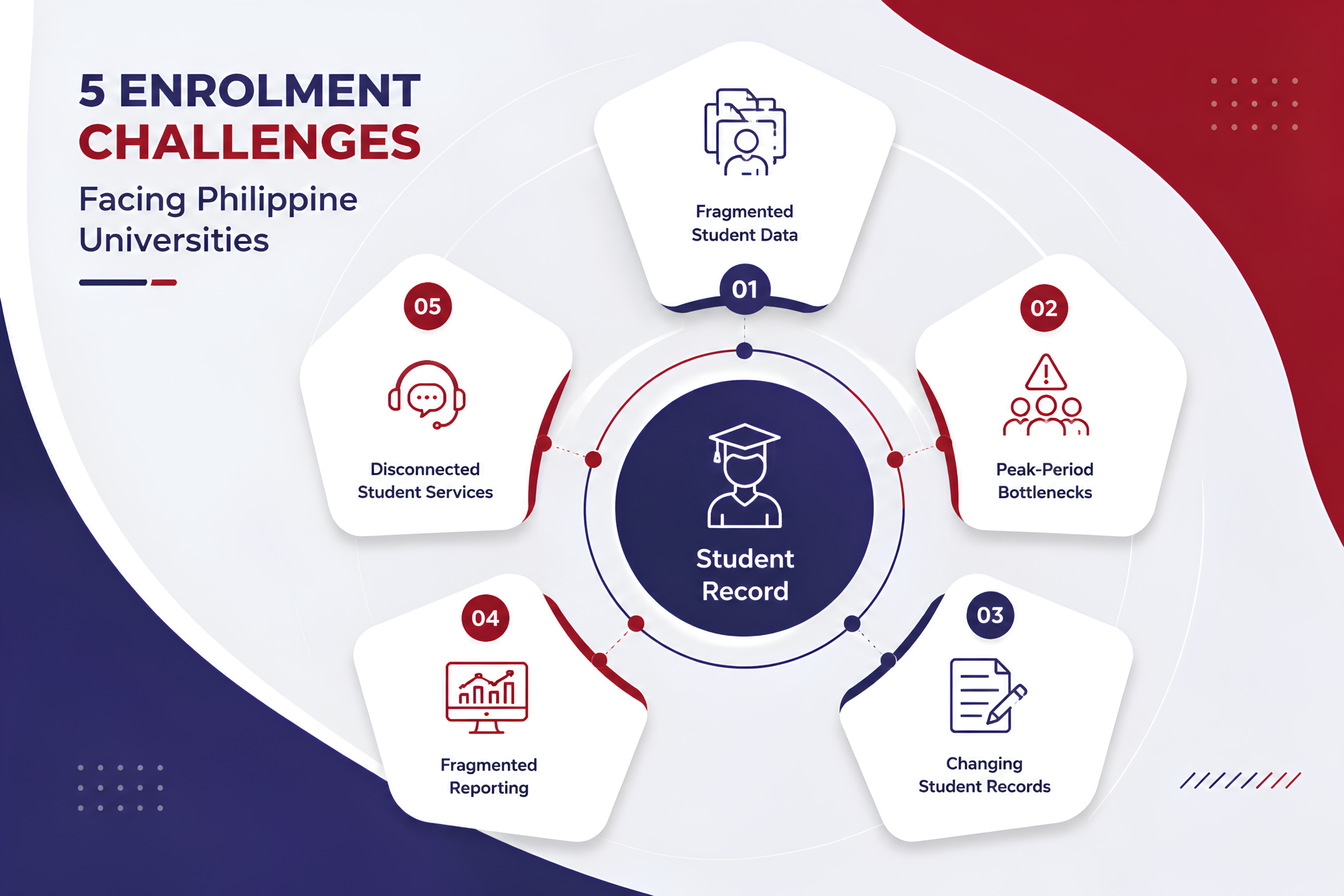
Enrolment is one of the most important administrative processes in a university. It brings admissions, academics, finance, student services, and the registrar together around one outcome: getting students successfully enrolled and keeping their records accurate throughout their academic journey.
For Philippine universities, however, that process is becoming increasingly complex.
CHED’s 2025 statistics list 2,334 higher education institutions for AY 2024–25, covering private institutions, state universities and colleges, local universities and colleges, and other government institutions.
As institutions manage growing student populations, multiple programmes, digital services, and increasingly complex academic structures, the volume of student information also grows.
This raises an important question:
Why do enrolment and student records remain a challenge even when universities are already using digital systems?
The answer often comes down to one issue: Connectedness.
Enrolment is not a single transaction.
A student’s journey may involve application, document verification, admission, registration, payment, course selection, academic advising, and student services. Later, the same record may need to support programme changes, examinations, graduation, and requests for official documents.
When different departments manage these activities through separate systems, spreadsheets, forms, or manual workflows, information can become fragmented.
The result is more than administrative inconvenience. It can affect data accuracy, reporting, staff productivity, and the student experience.
The World Bank’s work on digital transformation in the Philippines similarly highlights the importance of digital infrastructure, data, digital skills, and digitally enabled services in improving institutional efficiency.
Admissions, the registrar, finance, and academic departments may each need access to student information. When these systems are not connected, staff may repeatedly enter, export, verify, or reconcile the same data.
The solution: A centralised student record should act as a reliable source of information, while integrations allow relevant data to move between connected systems.
The objective is not simply to store more data. It is to make sure authorised teams are working with consistent, up-to-date information.
During enrolment, staff may be handling document verification, approvals, payments, registration issues, and student queries at the same time.
Manual approvals and email-based processes can quickly create bottlenecks.
The solution: Universities can automate repeatable workflows such as approvals, notifications, document checks, and status updates. Staff can then focus on exceptions and student support rather than repeatedly moving information between departments.
A student’s record does not stop changing after enrolment.
Programme shifts, subject changes, academic standing, scholarships, leaves of absence, and personal-information updates can all affect the record.
When updates are made separately, inconsistencies become more likely.
The solution: Universities need lifecycle-based record management, where relevant changes are reflected across the processes and departments that depend on them.
University leaders need answers about enrolment trends, programme demand, student progression, finances, and academic performance.
But if information is spread across multiple databases, staff may have to export spreadsheets, clean data, check discrepancies, and manually prepare reports.
This is where data modernisation becomes important. EDUCAUSE’s 2025 QuickPoll found that 68% of respondents were in the process of modernising their institutional data environment, while only 1% considered their institution fully modernised. The report also identifies fragmented and siloed data environments as a major barrier.
The solution: Move towards connected institutional data and real-time dashboards so that reporting becomes less about collecting information and more about understanding it.
Students increasingly expect to submit applications, access records, make payments, and request documents digitally.
If they have to visit different offices or repeatedly submit information that the university already has, the problem is no longer just administrative.
It becomes a student experience issue.
The solution: A modern SIS should provide student self-service capabilities while connecting the information behind those services.
Fixing enrolment challenges does not always require completely changing every system a university uses. The first step is to identify where information gets stuck, where staff repeat the same work, and where students have to wait for a process that could be automated.
A more connected enrolment environment can bring together admissions, document verification, registration, payments, academic records, and student communication within a coordinated workflow.
The impact can be significant. Academia’s analysis of AI in higher education notes that more than 60% of higher education administrators spend over half of their workday on tasks with no direct academic value, while workflow automation can potentially reduce routine administrative effort by 25–40%.
For Philippine universities, the opportunity is to redirect that administrative effort towards work that requires judgement, advising, and direct student support.
A well-designed SIS should allow information captured during one stage of the student journey to support the next stage without unnecessary re-entry.
For example, once an applicant is admitted, relevant information should be available for enrolment and academic processes. Once enrolment is completed, the same student record can support course registration, fees, academic tracking, and future student services.
This creates a more consistent flow of information while reducing the need for staff to manually reconcile records.
| Enrolment Challenge | What a Modern SIS Can Do |
|---|---|
| Repeated data entry | Reuse verified student information |
| Manual approvals | Automate rule-based workflows |
| Delayed status updates | Trigger real-time notifications |
| Scattered records | Maintain a centralised student profile |
| Slow reporting | Provide dashboards and AI-powered reports |
| High student-query volumes | Enable digital self-service |
| Difficult record tracking | Maintain structured, auditable information |
The objective is not to automate everything.
It is to automate the repetitive parts while keeping people responsible for decisions that require human judgement.
| Capability | What Philippine Universities Should Look For |
|---|---|
| Student records | Centralised and continuously updated information |
| Enrolment | Automated and configurable workflows |
| Admissions | Seamless applicant-to-student transition |
| Integration | Connectivity with LMS, finance, payments and other systems |
| Reporting | Real-time dashboards and analytics |
| Student services | Digital self-service and request tracking |
| Security | Role-based access and auditability |
| Scalability | Support for growing programmes and campuses |
| AI | Practical automation and intelligent insights |
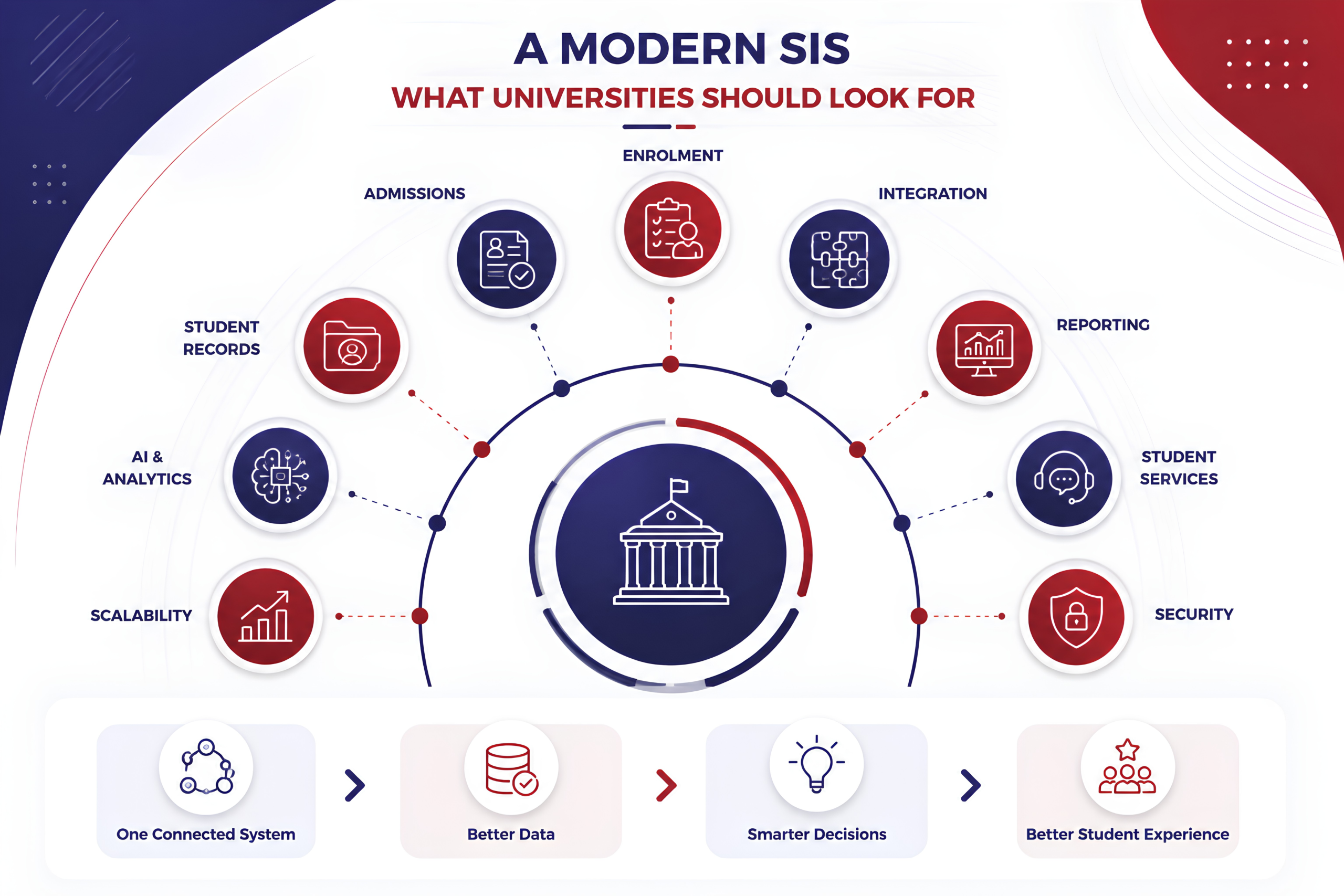
A modern SIS should therefore connect people, processes, and information, rather than simply digitising individual forms.
AI is becoming another consideration for higher education technology.
UNESCO’s 2025 survey found that 19% of responding higher education institutions already had a formal AI policy, while another 42% were developing guidance. One in four respondents had already encountered ethical issues related to AI.
For enrolment and student records, AI can support areas such as document processing, student queries, workflow automation, analytics, and reporting.
But universities should not ask only:
“Does the SIS have AI?”
They should ask:
“Can AI work securely with our institutional data and support useful decisions?”
That makes data quality, governance, security, and human oversight just as important as the AI capability itself.
A quick assessment can help identify where modernisation may be needed:
If several of these are missing, adding another standalone application may not solve the underlying problem.
The priority may be connecting the student lifecycle itself.
Academia by Serosoft is an AI-powered Student Information System designed to manage the higher education lifecycle from prospecting and admissions through academics, student services, graduation, and alumni engagement.
Academia currently reports 400+ institutions across 32 countries and 1M+ learners and educators benefiting. Its SIS provides centralised student data, real-time tracking, role-based access, interoperability, analytics, and configurable workflows.
For enrolment and records management, this connected approach can help universities reduce repeated data entry, improve information visibility, automate administrative workflows, and give students more convenient digital access to services.
Academia also provides AI-powered analytics and reporting, including 400+ AI-powered reports, alongside a broader library of institutional reports and dashboards.
The value is not simply having more technology.
It is having technology that allows admissions, enrolment, academics, finance, student services, and records to work from connected institutional information.
Digital transformation in the Philippines is moving beyond basic digitisation. The World Bank identifies digital data infrastructure and digitally enabled services as important components of the country’s broader transformation agenda.
For universities, the same principle applies.
The future of enrolment is not another online form.
It is a connected environment where student information can move securely through the right workflows, staff can access reliable data, and students can complete more services without unnecessary administrative friction.
For Philippine universities, the question is therefore no longer:
“Do we have a system for enrolment?”
It is:
“Can our SIS give us a reliable, connected view of the student throughout the entire lifecycle?”
That is the shift from simply managing enrolment to building a more connected, data-driven, and student-centric university.
When admissions, registration, finance, academics, and student services operate in silos, even a digital process can create unnecessary work.
See how Academia by Serosoft connects the student lifecycle through unified records, automated workflows, digital self-service, and AI-powered insights, helping Philippine universities make enrolment simpler, faster, and more connected.
Request Demo | Talk to an SIS Expert
Enrolment involves multiple departments, approvals, payments, academic requirements, and student records. When these processes rely on disconnected systems or manual workflows, delays and data inconsistencies can occur.
Universities can centralise student information, integrate departmental systems, automate workflows, establish role-based access, and provide digital self-service for common student requests.
Yes. Workflow automation can support approvals, notifications, document processing, registration, and other repeatable tasks, reducing the amount of manual coordination required from staff.
Integrated data gives departments a more consistent view of student information and helps leadership access reliable information for reporting, planning, and decision-making.
AI can add value through automation, analytics, document processing, and student support. However, universities should evaluate AI alongside security, governance, integration, data quality, and scalability.
They should evaluate student lifecycle coverage, integration, workflow automation, reporting, security, scalability, self-service, configurability, and AI capabilities, not just the number of modules.

Experience Academia – Your partner in transforming campus operations, a trusted all-in-one ERP/SIS solution.
Get the latest insights, trends, and updates delivered straight to your inbox!