

Pankaj Joshi
Estd. Reading Time : 4 Min.
16th Jan, 2026
Share On:
At universities across the Middle East, leadership meetings are no longer dominated by expansion plans alone. Instead, a different question keeps surfacing: Can our current systems actually support the scale, compliance, and student expectations we are committing to?
As institutions grow faster, welcome international students, and operate across multiple campuses and regulators, operational cracks begin to show. Manual workarounds multiply. Data lives in silos. Decision-making slows down. This is precisely why forward-looking institutions in the region are reassessing the role of student information system software as a strategic foundation rather than just an IT tool.
Over the last decade, universities in the Middle East have transformed dramatically. Cross-border programs, international accreditations, and government-mandated reporting are now standard, not optional.
However, many institutions are still relying on disconnected tools that were never designed for this level of complexity.
As a result,
Without a modern education management system, institutions risk slowing down at the very moment they need to accelerate.
Legacy campus systems often evolved department by department. Admissions adopted one tool, academics another, and examinations something else entirely. Over time, this creates operational friction that directly impacts both staff efficiency and student experience.
Common challenges seen across Middle East institutions include:
These issues don’t stem from the lack of effort; they stem from systems that were never designed to work as one.
Universities that are scaling successfully in the region share one common trait: they treat digital infrastructure as an institutional strategy. They expect student information system software to support leadership decisions, not just administrative tasks.
A modern platform is expected to unify academic operations, automate workflows, and create a single source of truth across campuses and departments. This is where a purpose-built education management system begins to deliver measurable value.
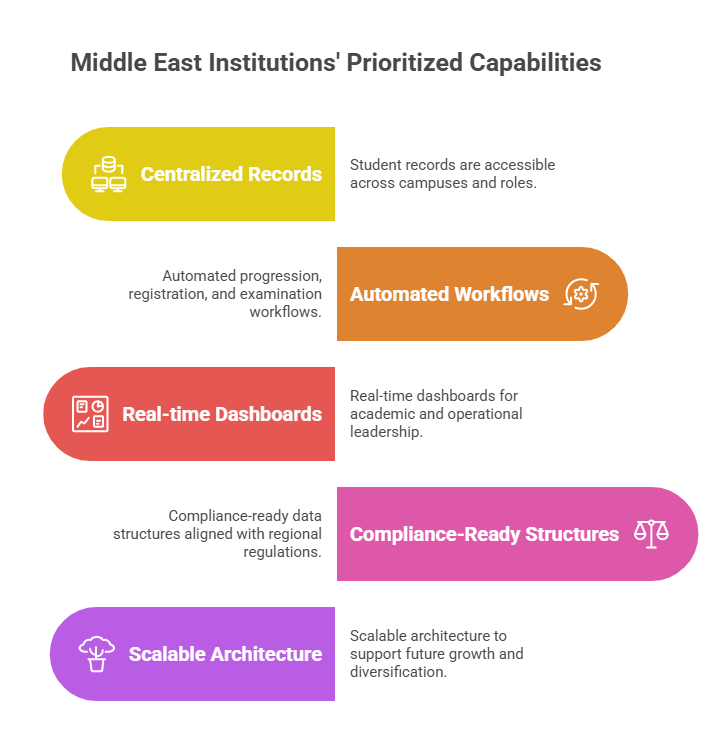
These capabilities are no longer “nice to have.” They are essential for institutions competing regionally and globally.
When implemented correctly, student information system software changes how institutions function at every level. Administrative teams shift from reactive tasks to proactive planning. Faculty gain clarity and consistency in academic processes. Leadership benefits from reliable, real-time insights instead of delayed reports.
More importantly, students experience smoother journeys, from application to graduation, without feeling the friction of internal processes. This is where the true return on investment of an integrated education management system becomes visible.
How Academia SIS Addresses Daily Operational Challenges for Institutions
To turn a modern vision into daily reality, institutions need more than just strategy – they need a system built for end-to-end operational excellence. Academia SIS, recognised in the Gartner® Magic Quadrant™ for Student Information System SaaS 2025, is a cloud-native, AI-powered education management system that helps universities overcome everyday bottlenecks and scale with confidence.
Academia SIS serves as a centralized source of truth for student data across departments. From admissions to results, every update flows through one unified platform, eliminating data silos, manual reconciliation, and fragmented reporting.
Academia automates end-to-end admissions workflows, from enquiry capture to offer letter generation. Agentic AI-assisted enrollment significantly reduces manual data entry and decision delays, enabling faster onboarding and improved accuracy even at high application volumes.
Academia simplifies course registration through bulk uploads and job-based automation for mapped programs. This reduces repetitive administrative work while ensuring students are enrolled accurately and efficiently.
Academia enables integrated billing with auto-generated invoices and multi-channel payment tracking across programs. Finance teams gain complete visibility, reduced errors, and better control over collections and follow-ups.
Academia’s examination module supports exam scheduling, hall planning, attendance-initiated exam holds, bulk marks entry, automatic SGPA/CGPA calculations, custom marksheet templates, and performance dashboards, all managed from a single interface. Results and analytics can be published via portals, email, or SMS with minimal manual effort.
Academia provides real-time dashboards and automated, command-based report generation. Leadership teams gain immediate insights into admissions trends, student performance, financial health, and operational efficiency, without manual data compilation.
Academia integrates attendance tracking (including QR-based and biometric options) with student portals and mobile apps, ensuring timely communication, improved engagement, and academic transparency for all stakeholders.
Each of these capabilities doesn’t just automate work; it connects processes, reduces dependency on spreadsheets, and creates systemic transparency. As a result, institutions can focus less on administrative firefighting and more on academic quality, compliance, and strategic planning, precisely what the modern higher education landscape demands.
The Middle East higher education market is becoming increasingly competitive. Students compare experiences globally, regulators demand transparency, and leadership teams are expected to make faster, data-backed decisions. Institutions that delay modernization often find themselves constrained by systems that cannot keep up.
In contrast, universities that invest early in the right student information system software position themselves to scale confidently, maintain compliance, and deliver consistently high-quality student experiences across campuses.
Digital transformation in higher education is no longer about replacing tools-it’s about building a connected operational backbone. A well-implemented education management system enables institutions to move from fragmented execution to coordinated excellence.
For Middle East universities focused on sustainable growth, international credibility, and operational resilience, the question is no longer if modernization is needed-but how soon it can be achieved. Platforms like Academia by Serosoft help institutions simplify daily operations, improve visibility across the student lifecycle, and scale with confidence.
If your institution is ready to move toward a truly connected digital campus, book a free demo of Academia SIS and see how it can support your operational and academic goals.

Experience Academia – Your partner in transforming campus operations, a trusted all-in-one ERP/SIS solution.
Get the latest insights, trends, and updates delivered straight to your inbox!