

Amit Kulkarni
Estd. Reading Time : 4 Min.
16th Mar, 2026
Share On:
What is a student information system (SIS), and why does it matter?
A student information system is the centralised digital backbone of any educational institution. It manages everything from admissions, enrollment, and academic records to fees, attendance, timetables, and compliance reporting. A well-built SIS eliminates silos, reduces manual errors, and gives administrators, faculty, and students a unified experience, all in one place.
How do I know if my current SIS system has outgrown my institution’s needs?
If your staff is still manually exporting data into spreadsheets, if students are complaining about slow portals, if generating a compliance report takes days instead of minutes, or if your IT team dreads every academic year rollover, your system has already outgrown you.
According to Gartner, over 60% of higher education institutions report that their legacy administrative software is a primary barrier to achieving their digital transformation goals.
Is migrating to a new student information system risky?
Migration carries risk only when it is unplanned. With a structured migration methodology, a robust platform, and an experienced implementation partner, migration is not just safe; it is transformative. Modern Student Information System platforms like Academia are purpose-built to make migration seamless, with zero disruption to ongoing operations.
Let’s be direct: most educational institutions are running on systems that were built for a world that no longer exists.
The average higher education institution in India is still operating on software that was implemented between 8 and 15 years ago. These platforms were designed for smaller student populations, simpler compliance requirements, and a paper-dominant administrative culture. Today, they are collapsing under the weight of real-time demands.
Academia’s Insight:
According to a 2023 EDUCAUSE survey, 74% of higher education technology leaders identified their legacy student information system as a “critical obstacle” to operational efficiency. A further 68% said their current platform could not support hybrid learning workflows, digital fee collection, or real-time accreditation reporting without significant manual workarounds.
The question is no longer whether to migrate.
The question is how to migrate without disrupting the academic calendar, losing historical data, or overwhelming your staff.
Before diving into a migration strategy, it is worth establishing what you are migrating toward, because the destination defines the journey.
A modern student information system is not just a database with a better interface. It is an integrated ecosystem that connects every department through a single source of truth. Here is what that looks like in practice.
Unified data architecture — any update made in one module instantly reflects across the entire system, no manual syncing, no duplication.
Real-time analytics and dashboards — leadership gets instant visibility into enrollment, fee collection, student performance, and faculty workload.
Role-based access and workflow automation — every user sees exactly what they need, nothing more and nothing less.
Mobile-first design — attendance, assignments, fee payments, and notifications, all accessible from any device, anywhere.
Compliance-ready reporting — NAAC, NBA, NIRF, and AICTE reports generated in minutes, not weeks.
There is a pattern to how institutions recognize they have reached the migration tipping point.
Check if any of the following situations sound familiar.
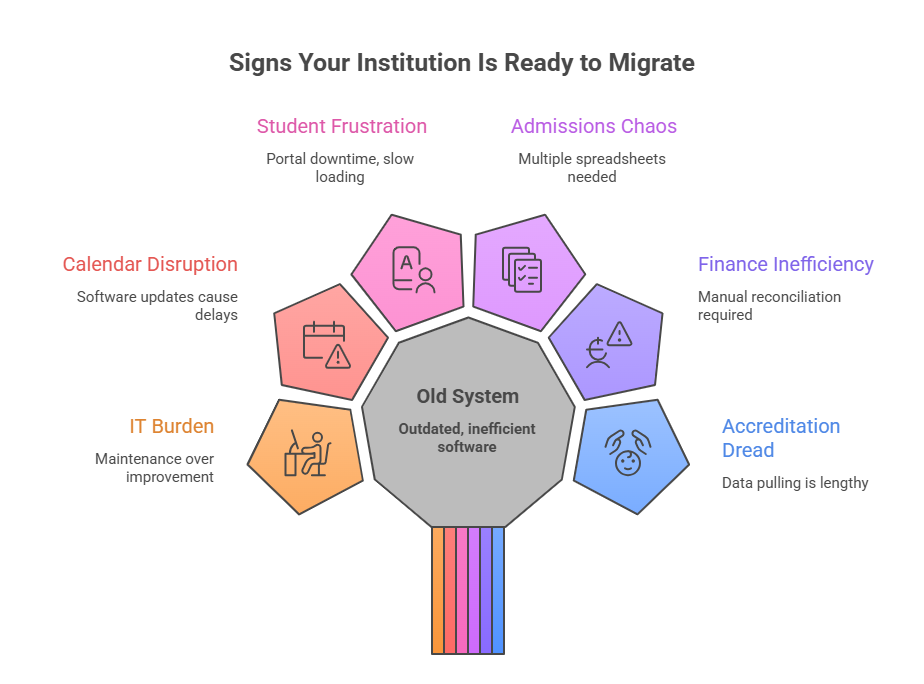
These are not isolated technical complaints. They are symptoms of a system that has fundamentally stopped serving your institution’s mission.
Most migration guides go vague at exactly the point where clarity matters most. A high-quality migration follows a disciplined, phased methodology. Here is what that actually looks like.
Phase 1: Discovery and Data Audit: Before any data moves, the implementation team conducts a thorough audit of your existing system — cataloguing every module, identifying duplicate records, data gaps, and inconsistencies, and establishing exactly what needs to move and in what condition it needs to arrive.
Phase 2: Data Mapping and Transformation Every legacy system has its own quirks — non-standard field names, outdated structures, and custom configurations. Data mapping creates a precise translation layer between your old system and the new one. Without this step being done rigorously, records end up misattributed, orphaned, or simply wrong — and the consequences cascade across every dependent function.
Phase 3: Parallel Operation and Testing: The new system runs alongside your existing one simultaneously for a defined validation period. Staff uses it for real workflows while the legacy system stays live as a fallback. Discrepancies are caught and resolved in a controlled environment before the formal switchover, think of it as a dress rehearsal before opening night.
Phase 4: Controlled Go-Live: Go-live is not a single dramatic moment; it is a gradual, monitored transition running in the background of normal operations. The switchover is staggered by module, rollback procedures are tested in advance, and a hypercare period of 30 to 60 days ensures any live issues are resolved before they impact students or staff.
Academia is not a generic enterprise platform that has been adapted for education. It was designed for the specific operational realities of colleges, universities, and school groups across the globe.
That specificity matters enormously during migration.
When a platform understands that your admissions cycle, your fee structure, your examination scheduling, and your accreditation reporting all have interdependencies that are unique to a higher education institution, it can build migration tools that account for those realities rather than working against them.
Here is what makes Academia’s migration approach different.
Phased implementation for uninterrupted migration. A good student ERP does not migrate your institution all at once. Academia adopts a phased implementation approach, breaking the migration into structured, sequential stages that are completed and validated one at a time. This ensures your day-to-day operations continue without disruption, right through to go-live.
Zero-downtime migration architecture. Academia’s cloud-native infrastructure means that data transfer and system configuration happen in the background. Your students can still log into the old portal, your admissions team can still process applications, and your finance office can still collect fees while Academia is being set up and populated. The transition is invisible to the people who depend on continuous access.
Dedicated migration project managers. Every institution that migrates to Academia is assigned a dedicated project manager who owns the migration timeline, communicates with all stakeholders, manages dependencies, and escalates issues before they become problems. This is not a support ticket queue. It is a named, accountable person who is invested in your success.
Comprehensive staff training woven into the migration timeline. One of the most underestimated risks of any migration is the human one. Staff who do not understand the new system will resist it, work around it, or create the same inefficiencies the migration was supposed to eliminate. Academia integrates role-specific training into the migration timeline so that by go-live day, every department is already comfortable with the workflows they will use every day.
Historical data preservation with full audit trails. No institution can afford to lose decades of student records. Academia’s migration process preserves the complete academic history of every student, including grades, attendance, fee payments, disciplinary records, and examination history, with full audit trails that meet regulatory requirements.
The first 30 days with Academia are designed to be straightforward and pressure-free.
Week one begins with a discovery session where Academia’s team takes the time to understand your institution’s structure, current system, and migration goals. Weeks two and three involve a preliminary data audit, resulting in a clear feasibility report covering timelines, resource requirements, and risk mitigation. By week four, a detailed migration roadmap is agreed upon, milestones are set, and your dedicated project manager is in place.
From there, migration proceeds on a transparent, agreed timeline, all the way through go-live and into the hypercare period.
Considering a migration? Speak to Academia’s team for a no-obligation institutional assessment and find out what a move to a modern student ERP would look like for your institution.

Experience Academia – Your partner in transforming campus operations, a trusted all-in-one ERP/SIS solution.
Get the latest insights, trends, and updates delivered straight to your inbox!