

Nrapendra Mishra
Estd. Reading Time : 4 Min.
24th Mar, 2026
Student Management Software
Share On:
Q: What is a student management system and why does it matter in 2026?
A student management system (SMS) is a centralised digital platform managing the complete student lifecycle — from inquiry and admission through academics, fees, assessments, and alumni engagement. In 2026, institutions still running legacy or siloed tools are actively losing enrolments, rankings, and accreditation scores to those that aren’t.
Q: How long does it take to implement a campus management system across a large university?
A single-campus deployment typically takes 3–6 months, while multi-campus networks can range from 8–18 months. Cloud-native platforms with modular rollout strategies significantly compress these timelines.
Q: What global ERP solution is purpose-built for higher education institutions outside the US and Europe?
Academia is built specifically for the regulatory and academic structures of emerging markets across South Asia, Southeast Asia, Africa, and the Middle East — offering region-specific compliance, multilingual support, and flexible deployment models.
Q: What ROI can a university expect from implementing a student management system?
Nucleus Research indicates an average ROI of $7.23 for every $1 spent. Institutions typically report a 20–35% reduction in administrative overhead and a 15–25% improvement in fee collection rates within the first two academic years.
Most institutional finance leaders calculate the cost of a new student ERP implementation. Very few calculate the cost of not implementing one. That asymmetry is where institutions quietly lose the competitive ground they’ve spent decades building.
Consider what legacy, fragmented systems actually cost at scale. When your admissions team uses one tool, your registrar another, your finance office a third spreadsheet, and your faculty a fourth portal, the real cost isn’t licensing fees. It’s the invisible tax paid in duplicated effort, delayed decisions, and student frustration.
Operational cost data from EDUCAUSE’s 2024 survey of 312 higher education institutions globally:
The academic registrar who spends 3 weeks before each semester manually reconciling student records across three different platforms isn’t a productivity problem. It’s a systems design problem. And the registrar is spending political capital managing data instead of enabling academic policy.
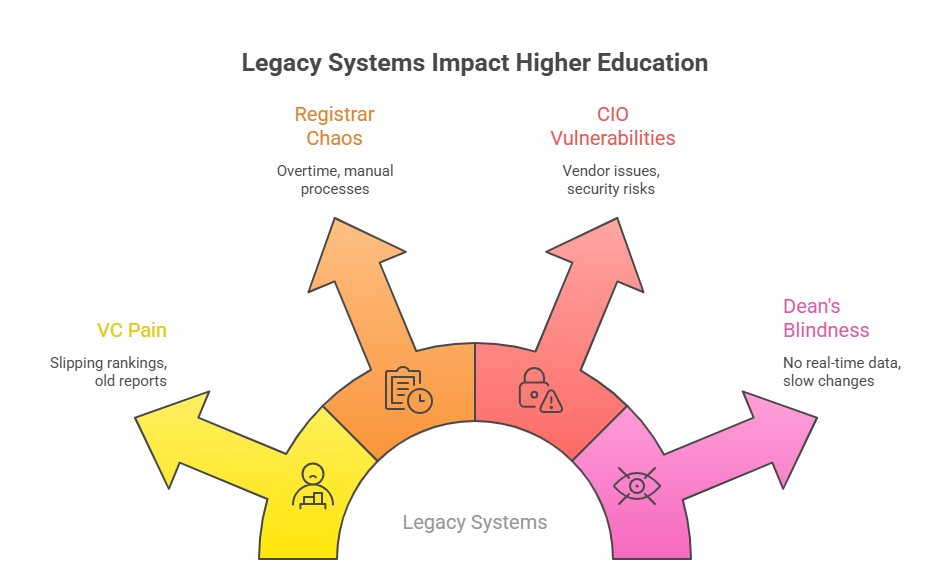
The pressures of running modern higher education aren’t uniform.
Understanding who bears what burden is critical before evaluating any university management system.
The Vice Chancellor / President
Primary Pain Point: Rankings slipping. Accreditation audits are approaching. No single dashboard to see institutional health. Decisions are made on reports that are 6 weeks old by the time they land on the desk.
The University Registrar
Primary Pain Point: Managing 15,000+ student records across multiple legacy systems. Exam scheduling conflicts. Manual transcript generation. Semester-start chaos that costs her team 800 hours of overtime annually.
The Chief Information Officer
Primary Pain Point: Maintaining 8 different vendor relationships for systems that don’t talk to each other. Security vulnerabilities in legacy on-premise software. No API architecture for future integrations.
The Academic Director / Dean
Primary Pain Point: Cannot see student performance data in real time. Faculty feedback loops are broken. Curriculum changes take a full semester to reflect in the system. Zero predictive insight on at-risk students.
Each of these personas is experiencing a different symptom. But they all trace back to the same root cause: an institution running without a unified student management system architecture.
Every metric your institution tracks, enrolment numbers, fee collection rates, and pass percentages, is a lagging indicator. By the time the data is visible, the student experience that generated it has already happened. And in 2026, that student experience is being shaped every day by the quality of your student management system.
Consider the journey of a first-year international student arriving at your campus. That student needs to complete fee payment, confirm hostel allocation, register for elective courses, and access the timetable, ideally before orientation week ends. In an institution operating fragmented systems, each requires a different portal, login, and often a different physical counter.
That particular student came from a world where banking, transportation, entertainment, and food delivery are all managed through a single, intelligent app. Your administrative system is the first real experience of your institution’s culture. And right now, for too many students at too many universities, that first experience communicates: we are not built for you.
Academia’s Insights:
McKinsey’s 2024 Education Insights report found that 41% of students cited “frustrating administrative processes” as a contributing factor in their intention to transfer or drop out, second only to academic difficulty.
In the next 36 months, pressure on higher education institutions is coming from three directions at once.
The Accreditation Arms Race — Bodies like QS, THE, and NAAC are increasingly weighing data transparency and operational efficiency. Institutions without real-time, audit-ready data will find accreditation far more burdensome.
The Transnational Education Expansion — Demand for internationally recognised credentials is surging across Africa, the Middle East, and Southeast Asia. Only institutions with the right operational infrastructure can capture this market.
The AI-Native Generation — Students entering from 2026 onward expect personalisation and intelligence from institutional systems. AI-driven ERP capabilities are rapidly becoming a baseline expectation, not a differentiator.
The Institutions That Will Lead in 2030 Are Making the Decision Today
There is no globally competitive higher education institution in 2030 still running the same fragmented, legacy stack it had in 2020. The question is not whether your institution needs a modern student management system; it is whether you act proactively or are forced to react under pressure from an accreditation audit, a competitor’s enrolment surge, or a student satisfaction crisis.
ERP in education is not a cost centre. It is the operating infrastructure on which academic excellence, institutional efficiency, and student success are built.
Academia is purpose-built to be that infrastructure, designed specifically for institutions across South Asia, Southeast Asia, Africa, and the Middle East, and trusted by universities ready to lead rather than follow.
The institutions that make this decision in 2026 will be the ones their peers benchmark against in 2030.
Ready to see it in action? Book your free Academia demo today.

Experience Academia – Your partner in transforming campus operations, a trusted all-in-one ERP/SIS solution.
Get the latest insights, trends, and updates delivered straight to your inbox!