
Type your keyword below

Your Competitors Already Switched to a Campus Management System — Here’s What You’re Losing Every Single Day You Don’t

Key Takeaways — Read This Before Your Rivals Do

  • Universities without a campus management system are bleeding hours, revenue, and student trust, silently.
  • Leading institutions in 2026 run on a Higher Education ERP that unifies admissions, academics, finance, and compliance.
  • A modern Student Information System reduces manual reporting time by up to 60% in the first semester.
  • 5 brutal signs your institution has already fallen behind, and what to do right now.
  • The exact features top-ranked universities look for before signing any university management system deal.
  • Academia is the platform smart institutions are choosing, grab a free demo before your seat fills up.

Here’s a truth nobody in higher education wants to say out loud: while your team is still chasing data across five different spreadsheets, forwarding emails to track admissions, and manually compiling accreditation reports, other universities have already automated all of it.

And they’re using that saved time to recruit better students, respond faster, and outperform you on every metric that matters.

This is the hidden cost of not having a modern campus management system. It doesn’t show up as a line item in your budget. It shows up as lost students, burnt-out staff, and ranking stagnation.

The question in 2026 is no longer “do we need this?” It’s “how much longer can we afford to wait?”

The Institutions Pulling Ahead Right Now Are All Running a Campus Management System

Top-ranked universities aren’t pulling ahead because they have bigger budgets. They’re pulling ahead because they’ve eliminated the administrative drag that slows everyone else down.

A campus management system is the single platform that connects every moving part of a university, student enrolment, timetabling, fee management, faculty records, exam scheduling, and accreditation reporting, under one roof.

The result? 

Decisions that used to take days happen in hours. Reports that used to require a team working overtime are generated automatically. And students get the seamless digital experience they now expect as a baseline, not a bonus.

40% — Drop in admin overhead after ERP implementation 

3x — Faster student grievance resolution 

60% — Less time wasted on manual compliance reporting

5 Painful Signs Your Institution Is Already Falling Behind, Don’t Ignore These
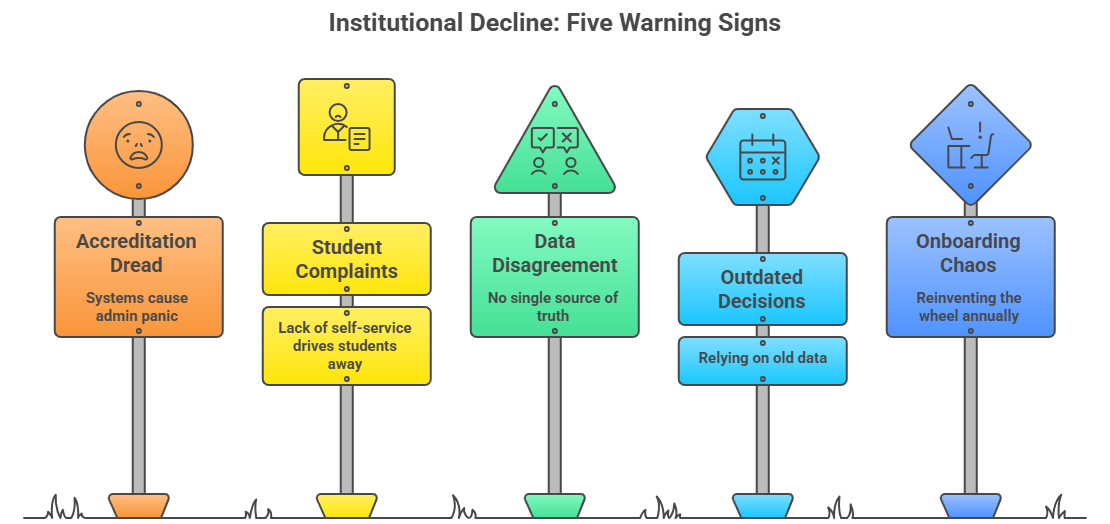
5 Painful Signs Your Institution Is Already Falling Behind, Don't Ignore These


  1. Your staff dreads accreditation season

If the words “NAAC audit” send your admin team into panic mode, that’s not a people problem; it’s a systems problem. A modern Higher Education ERP generates compliance reports automatically, pulling live data across departments the moment you need it. No all-nighters. No scrambling.

  1. Students are complaining and then leaving

Gen Z students in 2026 won’t wait in a queue or call an office to check their attendance or fees. If your institution can’t offer self-service access through a proper Student Information System, they’ll find one that can, at the time of choosing a college, and sometimes after already enroling.

  1. Your data lives in 10 different places

When finance has one enrolment number, academics has another, and the registrar has a third, nobody actually knows what’s true. That’s not a data problem. That’s the absence of a university management system that enforces a single source of truth.

  1. You’re making leadership decisions on last month’s numbers

Real-time dashboards aren’t a luxury anymore; they’re a survival tool. Institutions with a campus management system can see live fee collection rates, semester-wise enrolment trends, and faculty load data without requesting a report from IT and waiting three days.

  1. Onboarding a new batch feels like starting from zero every year

If your admissions and onboarding process involves reinventing the wheel each cycle, manual document collection, disconnected communication, and zero visibility into where each applicant stands, you’re wasting time that compounds every single year.

What the Best Higher Education ERP Actually Looks Like in 2026

Not all platforms are created equal. Here’s what genuinely high-performing institutions demand before committing to any Higher Education ERP:

AI-driven capabilities that actually save time. The best platforms in 2026 don’t just store data — they act on it. From automating repetitive admin tasks like attendance tracking and fee reminders to flagging at-risk students before they disengage, AI frees your faculty from busywork and gives them back the minutes that matter — the ones spent mentoring, guiding, and actually teaching.

One unified database — not 10 integrations pretending to be one. Every module from admissions to alumni must share data natively. Patchwork API connections are a support ticket waiting to happen.

Accreditation-ready reporting. Built-in frameworks for NAAC, NBA, NIRF, and UGC compliance — with automated report generation that doesn’t require IT intervention.

Mobile-first for students and faculty. In 2026, a campus management system without a mobile interface will be obsolete. Period.

Configurable workflows. No two universities operate identically. Your system should adapt to you, not force you to redesign your institution around its limitations.

Scalability built in. Whether you’re managing 3,000 students today or planning to scale to 30,000, your platform should grow with you, not become the bottleneck that holds you back.

The ROI Your Finance Committee Will Actually Care About

Let’s talk numbers. 

Institutions that implement a full-suite campus management system typically report: a 40% drop in administrative costs within the first year, significantly improved fee collection compliance, and a measurable lift in student satisfaction scores that directly impacts retention.

But the metric nobody talks about enough? Speed. When a prospective student submits an inquiry and gets a response in hours instead of days, because your Student Information System automated the follow-up, your conversion rate goes up. That’s revenue, not just efficiency.

The institutions that invest in a university management system today aren’t just buying software. They’re buying a competitive advantage that compounds every semester.

The Institutions Moving Fast Are Already Talking to Academia, Will You Be Next?

Academia is a purpose-built campus management system designed for universities and colleges that refuse to be left behind. One platform. Every function. Zero chaos.

From admissions and academics to fee management and accreditation reporting — Academia gives your institution the operational edge it needs to lead in 2026 and beyond.

Book Your Free Demo Today →

30 minutes. No commitment. Just clarity on what your institution has been missing.

Is Your University Bleeding Money? What a Campus Management System Can Fix Before It’s Too Late

Key Takeaways

  • Universities still relying on disconnected, legacy systems are losing revenue, students, and staff productivity every single day.
  • A modern campus management system unifies every institutional function, admissions, finance, and academics into one intelligent platform.
  • A purpose-built campus management system/higher education ERP dramatically reduces manual workloads, improves compliance readiness, and boosts student retention.
  • Institutions that delay digital transformation are already falling behind competitors who’ve made the switch.
  • The right campus management system pays for itself through recovered revenue, reduced admin costs, and stronger enrolment outcomes.

Let’s not sugarcoat it.

Right now, somewhere in your university, a member of staff is manually updating an attendance register. Another is chasing overdue fee payments through a spreadsheet. Your admissions team is toggling between three different tools trying to track a single applicant’s journey.

And while all of this is happening, a prospective student just abandoned your enrolment form because the process felt outdated & time consuming. 

This is the quiet crisis that most institutions refuse to talk about. But ignoring it doesn’t make it cheaper. It makes it catastrophic.

The good news? It’s entirely fixable, and faster than you think. Indeed.

Let’s figure out how.

The Real Cost of “We’ll Deal With It Later”

Here’s what most university leaders underestimate: operational inefficiency isn’t just an inconvenience. It has a direct, measurable impact on your institution’s bottom line and reputation.

Every manual process is a liability. Every disconnected system is a data breach waiting to happen. Every frustrated student is an enrolment you’re about to lose to a competitor who made technology a priority three years ago.

The global higher education ERP market is projected to surpass $15 billion by 2027. Institutions worldwide aren’t investing at that scale because it’s trendy. They’re doing it because the cost of inaction is now greater than the cost of transformation.

The institutions winning today, growing enrolment, retaining students longer, and running leaner operations, made one decisive move: they invested in a proper campus management system. The ones still hesitating are watching their rankings, revenue, and reputation erode in real time.

You’re either ahead of this curve or behind it. There is no middle ground.

What a Modern Campus Management System Actually Solves

What a Modern Campus Management System Actually Solves

A campus management system isn’t software for software’s sake. When implemented correctly, it is the single most impactful operational decision a university can make.

Here’s where it changes everything.

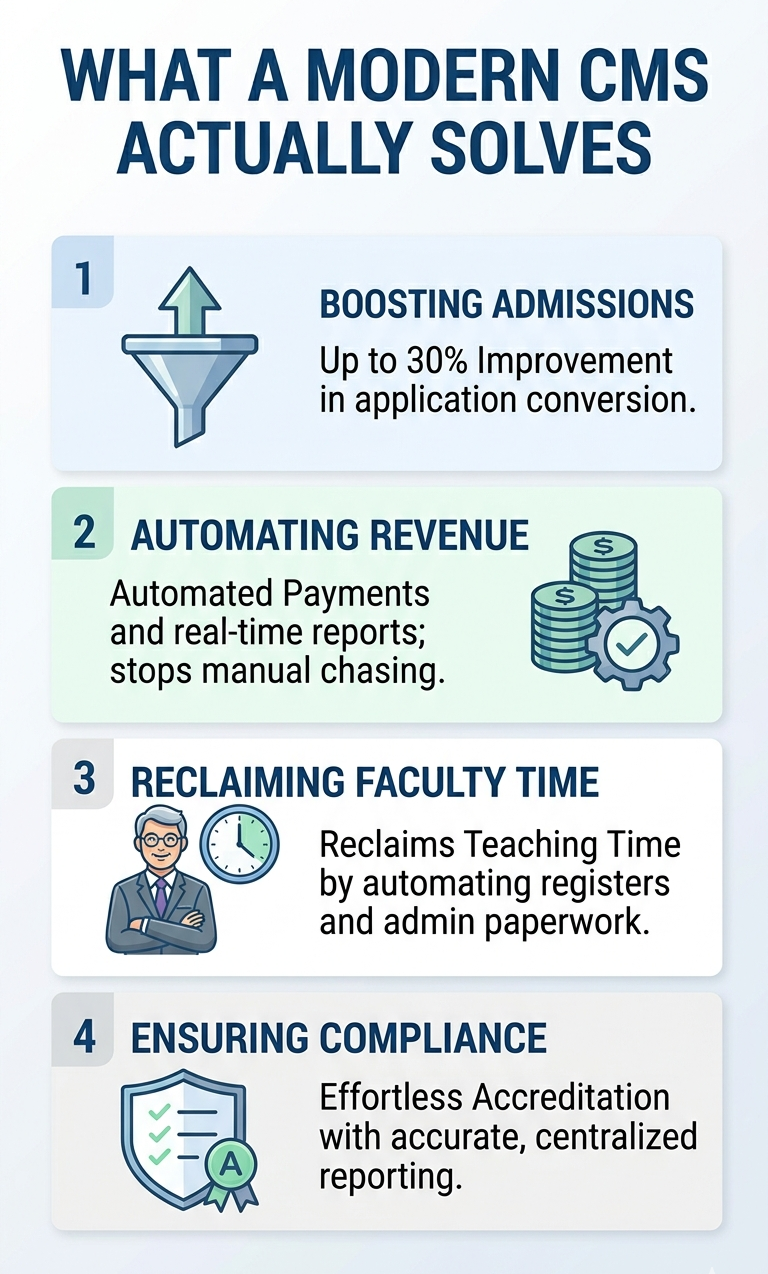
Enrolment and admissions leakage. Leads arrive through multiple channels, website forms, education fairs, and social media campaigns. Without centralised tracking, your admissions team is flying blind. Universities that integrate a CRM-linked campus management system have reported up to 30% improvement in application-to-enrolment conversion. That’s not a marginal gain. That’s transformational.

Fee collection and revenue recovery. Chasing outstanding dues manually is time-consuming and embarrassing for both staff and students. A well-configured higher education ERP automates payment reminders, generates real-time financial reports, and flags overdue accounts, so your finance team focuses on strategy, not chasing invoices.

Faculty time and morale. When academic staff spend hours on attendance registers, mark sheets, and administrative paperwork, it chips away at the quality of teaching. That’s a student experience problem disguised as an admin problem. Automate the routine, and you give your faculty back their most valuable asset, time.

Compliance and accreditation readiness. Regulatory bodies do not accept “our systems don’t talk to each other” as an excuse during audits. A centralised campus management system makes accreditation reporting accurate, consistent, and virtually effortless.

What Separates a Great Higher Education ERP From a Costly Mistake

Not every platform deserves your budget. Here’s how to tell the difference before you commit.

It must be purpose-built for academia. Generic ERP tools retrofitted for higher education miss critical nuances, credit systems, examination workflows, grade schemes, accreditation data structures. A dedicated higher education ERP handles all of this natively, saving months of painful customisation.

Real-time analytics, not stale reports. Leadership needs live data, enrolment trends, attendance patterns, and fee collection rates, not a PDF summary from a fortnight ago. If your platform can’t surface actionable insights on demand, it’s a limitation you’ll feel every single day.

Seamless integration across your tech stack. Your learning management system, biometric attendance tools, payment gateways, and communication platforms must work in harmony. Siloed software is an expensive relic of a previous decade.

A mobile-first experience. Today’s students expect everything on their smartphones. A campus management system without a polished mobile interface isn’t just inconvenient; it’s a signal to students that your institution is behind the times.

Dedicated implementation and adoption support. The best software in the world fails without proper onboarding. Insist on a vendor who partners with you through go-live and beyond, not one who hands you a user manual and disappears.

The Window to Act Is Closing

Every semester you delay is a semester of revenue lost, students underserved, and staff burnt out on processes that should have been automated years ago.

Your competitors are not waiting. They are actively upgrading their infrastructure, their student experience, and their operational efficiency right now. The question isn’t whether your institution needs a modern campus management system; it’s whether you act before the gap becomes impossible to close.

This is precisely where Academia comes in. Built exclusively for higher education institutions, Academia brings your entire campus ecosystem, admissions, academics, finance, examinations, and alumni onto one powerful, intelligent platform. Hundreds of universities across the region trust Academia to run smarter, scale faster, and deliver the student experience that today’s learners demand.

Don’t let another semester pass with systems that are costing you more than you realise. 

Book your free demo with Academia today — and see exactly what your institution has been missing.
Is Your University Built to Last? Why Middle East Higher Ed Institutions Can’t Wait Any Longer for Digital Transformation

Quick Answers Before You Dive In

Q: What is a Student Information System, and do we actually need one?
A Student Information System (SIS) is a centralised platform managing the full student lifecycle, admissions, academics, finance, and beyond. If your team is still relying on spreadsheets, manual registers, or disconnected tools, you need one more than you realise.

Q: Is this really the right time to think about digital transformation, given regional instability?
It’s the most important time. Institutions with strong digital infrastructure are the ones that kept students enrolled and operations running when physical access became restricted. Waiting for “the right time” is the most expensive decision a university can make.

Let’s Be Honest About What’s Happening

The Middle East’s higher education sector carries extraordinary ambition. World-class institutions, rising enrolment targets, and a generation of learners who expect a seamlessly connected campus experience.

And right now, it’s also carrying real weight. Regional conflict, displacement, and operational uncertainty are realities that higher education leaders are navigating every single day.

This blog acknowledges that, and it’s precisely because of that pressure that this conversation matters.

Because the institutions that will come through this period stronger are not necessarily the largest or the best-funded. They’re the ones that built a digital foundation strong enough to keep functioning when everything else is uncertain. 

A Student Information System is that foundation.

4 Signs Your Institution Is Already Falling Behind

4 Signs Your Institution Is Already Falling Behind

You don’t need to be in an active crisis to feel the impact of outdated infrastructure. Here’s where it quietly shows up:

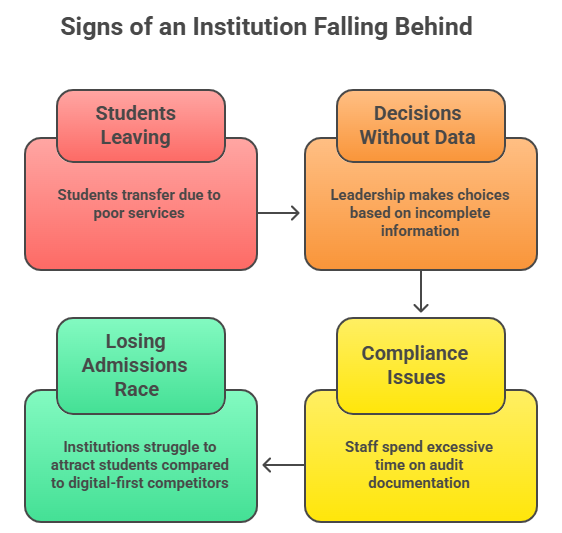
  • Students Are Leaving, and You’re Not Catching It Early Enough: Delayed fee processing, unclear grade communication, inaccessible student support, each of these is a reason a student considers transferring. A modern Student Information System gives students 24/7 self-service access to what they need, eliminating friction before it becomes a decision to leave.
  • Leadership Is Making Decisions Without Real-Time Data: If your Vice Chancellor’s weekly report is pieced together from department emails and spreadsheets, your institution is already running behind. In a stable environment, that’s inefficient. In an unstable one, it’s a liability. A student ERP delivers live dashboards, enrolment, finance, and academic outcomes — so decisions are grounded in facts, not estimates.
  • Compliance Is Consuming Your Best People: Across the GCC and broader MENA region, accreditation requirements are growing more rigorous. Institutions without centralised data spend weeks preparing audit documentation manually. Institutions with a student ERP generate those reports in minutes, freeing your people to focus on what they were actually hired to do.

  • You’re Losing the Admissions Race to Digital-First Universities: When a prospective student compares your institution to one offering a seamless online application, real-time admission status, and instant digital communication, and yours asks them to visit the office with physical documents, the decision is already made. 

A Student Information System is no longer just an operational tool. It’s a brand signal.

What Resilience Actually Looks Like for a University in Crisis

Resilience doesn’t mean being unaffected. It means continuing your mission, educating students, supporting faculty, and maintaining institutional integrity when the environment around you is disrupted.

With the right student ERP, that looks like this:

Operations continue remotely: Cloud-based systems mean your team keeps working even when campus access is limited. Admissions don’t stop. Student communications don’t go dark.

At-risk students get flagged automatically: Declining attendance, unresolved financial holds, and academic performance drops. A modern Student Information System surfaces these patterns without someone having to run a report. In a period of regional stress, that early warning system is invaluable.

Leadership stays confident: When your Board asks, “What is the current state of the institution?” — the answer should take 30 seconds. A student ERP makes that possible.

“We’ll Do It Next Year” Is the Most Expensive Sentence in Higher Education

Every year of delay compounds. 

Students who transferred because the experience didn’t meet expectations are gone, along with their tuition revenue. Accreditation audits that required weeks of manual work, time your staff won’t get back. Competitive ground ceded to international branch campuses in the region that already invested in digital infrastructure and are actively winning enrolment.

Digital transformation in Middle East higher education is not a question of if. It is already happening. The only question is whether your institution leads it or gets left behind by it.

Conclusion: The Right Infrastructure Changes Everything

At Academia by Serosoft, we’ve built a higher education ERP designed specifically for institutions like yours. 

We know the leaders reading this are carrying more than operational responsibility. You’re carrying the futures of thousands of students, many navigating some of the most challenging circumstances of their lives. They deserve an institution that is digitally ready to support them — no matter what the environment demands.

If you want to see what a purpose-built Student Information System looks like for your institution, not in theory, but built around your actual workflows and challenges, let’s talk.

[Book Your Free Demo →]

Back to top