
Academia Higher-Ed Executive Roundtable in Uzbekistan | 14 October 2026 — Shaping the Future of Higher Education Together

X

Type your keyword below

The Real Reason Middle East Universities Lose Students Before Enrolment

Key Questions Answered!

Why do Middle East universities lose students before enrolment even begins? 

Most universities lose prospective students not to competitors, but to silence within their own admissions process. When students submit an application and receive delayed or inconsistent responses, their confidence drops and they disengage, often enrolling elsewhere simply because another institution communicated faster and more clearly.

What role does a student information system play in reducing pre-enrolment drop-offs? 

A student information system centralizes all applicant interactions, automates follow-up communication, and gives admissions teams real-time visibility into each student’s journey. This eliminates the fragmented, manual workflows that cause delays, ensuring every prospective student receives timely, personalized communication at every stage of the process.

How does a higher education ERP improve admissions conversion rates? 

A higher education ERP integrates data across departments and communication channels into a single platform, enabling institutions to manage the entire admissions journey, from application to enrolment, with consistency and scale. By removing friction, unifying touchpoints, and enabling proactive outreach, an ERP helps universities transform their admissions function from an operational task into a competitive advantage.

Overview

Every year, universities across the Middle East invest heavily in marketing campaigns, recruitment drives, and international outreach.

Applications come in. Interest is high.

And yet, enrolments don’t match expectations.

The common assumption?
“We’re losing students to competitors.”

But that’s rarely the full story.

The real problem is far less visible and far more damaging.

The Silent Drop-Off No One Talks About

A prospective student submits an application.

They’re interested. They’re motivated. They’re ready.

But then:

  • They wait for a response
  • They don’t receive clear next steps
  • Their queries go unanswered
  • Communication feels fragmented

Days turn into weeks.

And slowly, that initial excitement fades.

Eventually, they move on, not necessarily because another university was better, but because another university was faster, clearer, and more responsive.

This is where most institutions lose students.

Not at the top of the funnel, but right in the middle of it.

It’s Not a Demand Problem—It’s a Momentum Problem

The Middle East is one of the fastest-growing higher education markets, with increasing demand from both domestic and international students.

So why aren’t conversion rates keeping up?

Because admissions today is not just about collecting applications.

It’s about maintaining momentum.

Every interaction, or lack of it, either builds confidence or creates doubt.

When students don’t hear back quickly, they start questioning:

  • “Did my application go through?”
  • “Am I even being considered?”
  • “Should I apply somewhere else?”

And in a competitive landscape, hesitation is enough to lose them.

This is exactly where a well-implemented student information system begins to make a difference, by ensuring every student interaction is tracked, timely, and consistent.

The Hidden Gaps in the Admissions Journey

Most institutions don’t realize where the breakdown actually happens.

It’s not one big issue; it’s a series of small, compounding gaps:

1. Delayed Responses

Admissions teams are often handling high volumes manually, leading to slower turnaround times, especially without a centralized student information system.

2. Fragmented Communication

Emails, calls, and messages are scattered across systems, making it hard to track conversations, something a unified higher education ERP is designed to solve.

3. Lack of Visibility

There’s no real-time view of where a student is in the journey, which results in missed follow-ups and confusion.

4. Inconsistent Follow-Ups

Some students get timely updates. Others are left waiting due to lack of automation.

Individually, these may seem manageable.

But together, they create friction that directly impacts enrolment outcomes.

Why Speed Alone Isn’t Enough

Many universities try to solve this by simply “responding faster.”

But speed without structure doesn’t fix the core issue.

If responses are:

  • Incomplete
  • Inconsistent
  • Not personalized

The experience still feels broken.

What students really expect today is:

  • Instant acknowledgment
  • Clear next steps
  • Continuous communication
  • A guided journey, not a fragmented one

This is where a robust higher education ERP enables institutions to deliver structured, consistent, and personalized communication at scale.

The Shift: From Processing Applications to Managing Experiences

Forward-thinking institutions are rethinking admissions.

They are no longer treating it as an operational task.

They are treating it as a student experience journey.

That shift requires:

  • Centralized data across all touchpoints
  • Automated yet personalized communication
  • Real-time visibility into every application
  • Proactive follow-ups instead of reactive responses

A modern higher education ERP/student information system integrates these capabilities, ensuring every student interaction is captured and optimized.

When this happens, something powerful changes:

Students stop feeling like applicants.
They start feeling like future members of the institution.

How Institutions Can Close the Gap

To reduce pre-enrolment drop-offs, universities need to focus on three key areas:

1. Eliminate Response Delays

Ensure every student receives timely communication at every stage—enabled by automation within a student information system.

2. Unify Communication Channels

Bring all interactions into one system for better tracking and consistency—something a higher education ERP is built for.

3. Build a Guided Admissions Journey

Provide clarity, direction, and continuous engagement from application to enrolment.

This is not about adding more effort.

It’s about enabling smarter systems that support admissions teams in delivering a seamless experience.

The Real Competitive Advantage

In today’s landscape, universities are not just competing on reputation or rankings.

They are competing on experience.

The institutions that win are the ones that:

  • Respond faster
  • Communicate better
  • Remove friction from the journey

A well-implemented student information system, supported by a scalable higher education ERP, becomes the backbone of this experience.

Because when students feel guided, informed, and valued, they don’t drop off.

They commit.

Final Thought

If your institution is seeing strong application numbers but lower-than-expected enrolments, the problem may not be external.

It may be happening within your own process.

The good news is that this is a solvable problem. Institutions that have moved to purpose-built platforms like Academia are discovering that the right student information system does not just manage data — it manages momentum. Every automated follow-up, every unified communication thread, every real-time visibility into an applicant’s journey adds up to an experience that makes students feel guided rather than forgotten. 

The question is:

Are you losing students to competitors or are you losing them in the silence between your own steps?


Book your free personalized demo today.

Why Southeast Asian Institutions Are Switching to a Modern Campus Management System

What Is a Campus Management System and Why Does It Matter in Southeast Asia?

A campus management system is an integrated digital platform that manages every institutional process, from student admissions and course enrolment to examinations, finance, and alumni relations, under one unified roof.

Southeast Asia’s higher education sector is growing rapidly. Countries like Indonesia, Vietnam, Thailand, Malaysia, and the Philippines are seeing record enrolment numbers, increasing regulatory demands, and a rising expectation for digital-first student experiences. Traditional, siloed administrative tools simply cannot keep up.

Institutions across the region are now asking: How do we manage thousands of students efficiently, ensure compliance, and still deliver a world-class learning experience? 

The answer lies in adopting a robust campus management system built for the demands of modern higher education.

How Does a Higher Education ERP Solve Southeast Asia’s Unique Challenges?

A higher education ERP goes beyond basic administration. It connects departments, automates workflows, and gives leadership real-time visibility into institutional performance. Here’s how it addresses the specific pain points of Southeast Asian universities:

  • Multi-campus management across geographically spread institutions
  • Multilingual and multi-currency support for diverse student populations
  • Regulatory compliance with local accreditation and government bodies
  • Scalability to accommodate rapidly growing enrolment numbers
  • Data-driven decision making through real-time dashboards and reports

A well-implemented higher education ERP eliminates manual processes, reduces administrative burden, and empowers faculty to focus on what matters most, teaching.

Why Are AI-Powered Features Becoming a Priority for Southeast Asian Institutions?

Across the region, leadership teams are demanding smarter tools. AI is no longer a luxury; it is a competitive necessity. Here is what institutions are prioritising:

  • Faster, evidence-based decisions at the leadership level
  • Personalised student experiences that improve retention
  • Automated administrative tasks that free up staff time
  • Predictive analytics to identify at-risk students early

Southeast Asian governments and accreditation bodies are also increasingly requiring institutions to demonstrate outcomes through data, making AI-driven reporting an institutional imperative, not just a feature.

How Does Academia SIS Leverage AI to Empower Institutions?

Academia by Serosoft is built with AI at its core. Here is how its intelligent features are transforming campuses across Southeast Asia:

🔹 AI-Driven Reports & Analytics: Generate comprehensive institutional reports in a single click, in real time. Leadership gets the insights they need for faster, smarter decisions — without waiting for manual data compilation.

🔹 SERA — AI-Enabled Personal Assistant: SERA is Academia’s intelligent student assistant that answers queries around the clock, reducing pressure on administrative staff and improving the student experience significantly.

🔹 Agentic AI Chatbot for Course Enrolment: Students can now enrol in courses simply by having a conversation with an AI chatbot. No forms. No queues. Just a seamless, intuitive experience that today’s digital-native students expect.

🔹 AI-Driven Remark Generation on Marksheets: Faculty no longer need to write individual remarks manually. Academia’s AI generates personalised, contextual remarks for each student, saving hours of work every semester.

These features make Academia’s campus management system uniquely positioned for the Southeast Asian market, where institutions need speed, scale, and intelligence, all at once.

What Should Institutions Look for When Choosing a Higher Education ERP?

Choosing the right higher education ERP is a long-term strategic decision. Institutions should evaluate solutions on:

  • End-to-end functional coverage across all departments
  • AI and automation capabilities built natively into the platform
  • Mobile accessibility for students, faculty, and administrators
  • Local implementation and support availability in Southeast Asia
  • Proven track record with institutions of similar size and complexity
  • Scalability to support future growth without re-platforming

Conclusion: It’s Time to Transform Your Campus with Academia SIS

The future of higher education in Southeast Asia is digital, data-driven, and AI-powered. Institutions that invest in the right campus management system today will be the ones leading the region tomorrow.

Academia by Serosoft is purpose-built to deliver exactly that — a comprehensive higher education ERP that combines powerful administration tools with cutting-edge AI capabilities designed for the modern campus.

Ready to see Academia in action? Book Your Free Demo Today → and discover how Academia SIS can transform your institution’s operations, student experience, and leadership decision-making — all from one intelligent platform.

Frequently Asked Questions (FAQs)

Q1. How does a Campus Management System improve student retention and outcomes in Southeast Asian universities?

A campus management system improves student retention by giving institutions real-time visibility into student performance, attendance, and engagement. AI-driven analytics help faculty identify at-risk students early and intervene proactively before dropout occurs. Features like personalised AI assistants, automated reminders, and seamless course enrolment reduce friction in the student journey. For Southeast Asian institutions managing thousands of students across multiple campuses, this level of intelligent oversight directly translates into better retention rates and stronger academic outcomes.

Q2. How does a higher education ERP help institutions in Southeast Asia meet compliance requirements? 

A higher education ERP like Academia SIS is designed to accommodate the diverse regulatory frameworks across Southeast Asian countries. It enables institutions to maintain accurate student records, generate government-mandated reports, track accreditation parameters, and ensure audit readiness at all times. With built-in AI-driven analytics, leadership can monitor compliance metrics in real time and take corrective action before issues escalate — significantly reducing the risk of regulatory penalties.

Q3. How long does it take to implement a campus management system like Academia SIS? 

Implementation timelines vary based on institution size, complexity, and existing infrastructure. However, Academia by Serosoft follows a structured implementation methodology that typically gets core modules live within a few weeks for smaller institutions and a phased rollout for larger universities. The platform also offers dedicated onboarding support, training, and local implementation assistance to ensure a smooth transition with minimal disruption to daily academic operations.

Why Middle East Universities Can No Longer Run on Manual Systems, And What the Region’s Leading Institutions Are Doing About It

A straight-talking guide for institutional leaders in the UAE, Saudi Arabia, and the wider GCC who know the pressure is real and are ready to act.

Let us begin with something every Vice Chancellor, Registrar, and CIO in the Middle East already knows but rarely says out loud in a board meeting.

Your institution is operating under more scrutiny, more regulatory pressure, and more competitive threat than at any point in the last decade. And a significant number of the systems holding your operations together were not built for any of this.

That is not a criticism. It is simply the reality of where higher education in this region finds itself in 2026, caught between exceptionally ambitious national visions and operational infrastructure that has not kept pace.

This blog is for the leaders who are ready to close that gap.

The Ambition Is Real. The Infrastructure Gap Is More Genuine 

Across the GCC, higher education is in the middle of an unprecedented transformation. The Middle East’s higher education market stands at $115 billion, projected to reach $175 billion by 2027 — with Saudi Arabia’s Vision 2030, UAE’s development agenda, and Qatar, Bahrain, and Oman all pushing their institutions to modernise, perform, and prove it.

The MENA EdTech market is growing at 18% CAGR. And yet, inside many institutions, the daily reality looks quite different from the national ambition.

What Is Actually Happening Inside Middle East Institutions Right Now

Here is what the data — and frankly, what institutional leaders themselves — consistently report:

  • Admissions teams are managing enquiries across WhatsApp, email, phone, and walk-ins, with no unified system capturing or converting them
  • Faculty are manually entering attendance, tracking it on spreadsheets, and submitting it through processes that have not changed in years
  • Examination and result management involve multiple people, multiple files, and a significant margin for human error
  • Compliance and accreditation teams are spending weeks — sometimes months — manually compiling documentation for CAA, NCAAA, or other regulatory bodies
  • Leadership is making strategic decisions based on reports that are already weeks out of date by the time they land on the desk

That is the competitive reality. And a Student Information System is precisely where the gap begins.

What a Student Information System Built for This Region Must Actually Deliver

Student Information System

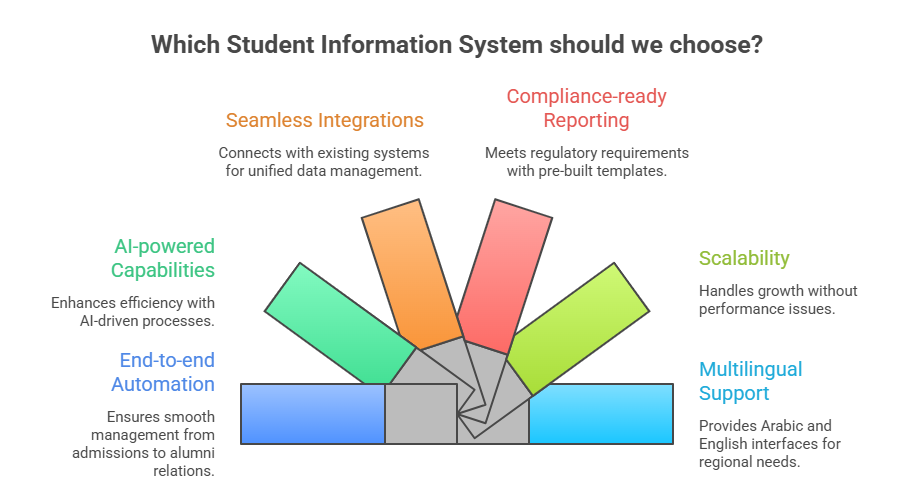
Not every Student Info System is built with the Middle East in mind. Here is what regional specificity actually looks like in practice — and what any institution in the GCC should demand before signing a contract:

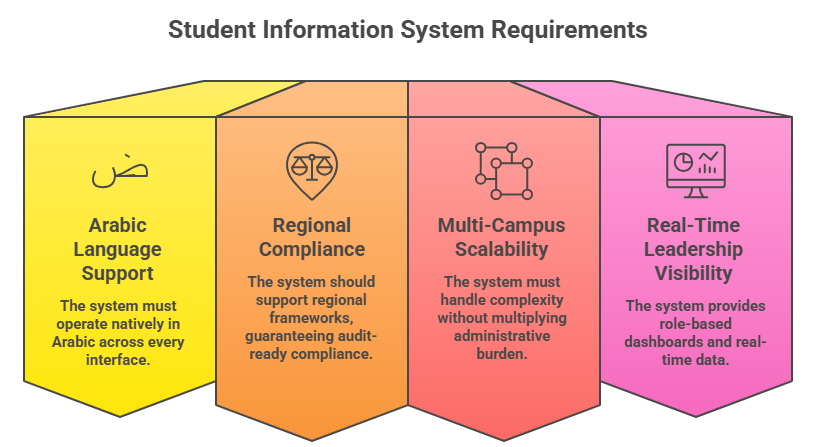
Arabic Language Support — Not as an Add-On

The system must operate natively in Arabic across every student-facing and staff-facing interface. Not as a translated overlay. Not as a separate module. As a built-in, seamless capability that makes adoption effortless for every user.

Regional Compliance Built In

A modern Student Information System should support CAA, CHEDS, NCAAA, MoE, and regional frameworks, guaranteeing audit-ready compliance — and integrate statutory reporting and government requirements directly into institutional workflows. Compliance should not require a special project every year. It should be a byproduct of how the system operates every day.

Multi-Campus Scalability

Whether your institution operates across two campuses or fourteen, the Student Info System must handle complexity without multiplying administrative burden. A single view of operations across all sites is not a luxury, it is a baseline requirement for any institution with growth ambitions.

Real-Time Leadership Visibility

A modern student information system provides role-based dashboards and real-time data to inform strategic, vision-aligned decision-making. When a government ministry asks your institution for enrolment data, retention rates, or graduate outcomes, you should be able to pull that information in minutes, not days.

The Five Signs Your Institution Has Outgrown Its Current System

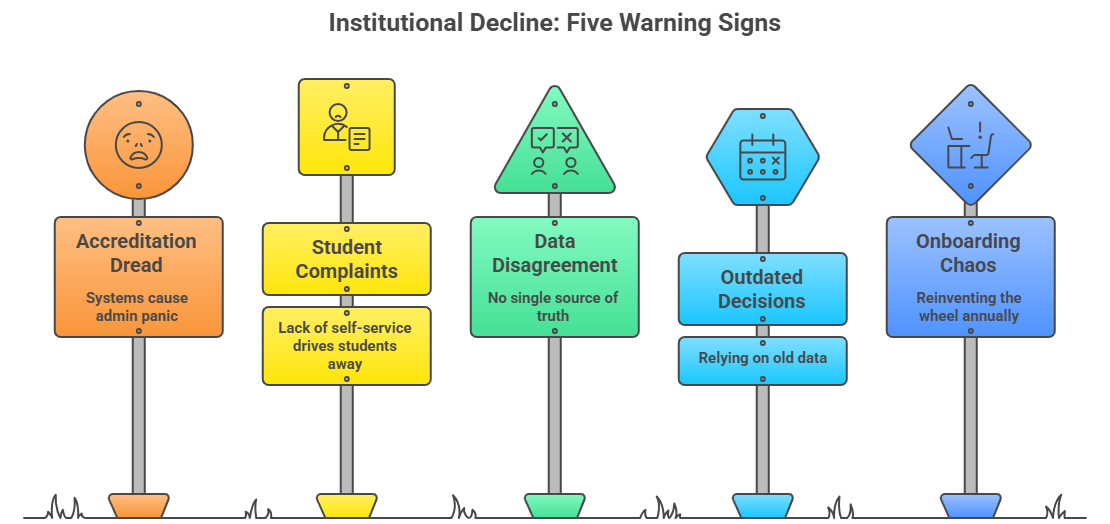
Be honest with yourself as you read these. If more than two apply to your institution, you are already operating at a disadvantage:

  • Your compliance team dreads accreditation season — not because of the standards, but because of the manual work involved in meeting them
  • Leadership decisions are made on last month’s data — because nobody can access live institutional information without asking someone to compile a report
  • Students are complaining about the digital experience — slow portals, difficult registration, unclear communication, inaccessible results
  • Different departments are using different tools — and nobody has a complete, unified picture of what is happening across the institution
  • Your IT team spends more time maintaining the current system than improving it — because the legacy platform demands constant patching, workarounds, and manual intervention

In an era where higher education is rapidly evolving, Middle Eastern universities and colleges are facing an urgent reality: traditional administrative systems can no longer keep up with the pace of academic transformation.

Three Questions Every Middle East Institutional Leader Should Ask Before 2026-27 Admissions Open

  • Is your current Student Information System capable of generating CAA or NCAAA compliance reports automatically — or is someone on your team manually building those documents right now?
  • When your next accreditation review arrives, will you walk in with confidence — or will the six weeks before it be your institution’s most stressful period of the year?
  • Are the international branch campuses operating in your market running on better technology than you are — and what is that costing you in enrolment?

If any of these questions made you uncomfortable, you are not alone.

Frequently Asked Questions

What is a Student Information System and why does it matter specifically for Middle East universities?
A Student Information System manages the entire student lifecycle — from enquiry through admissions, academics, fees, and alumni. For Middle East universities, it ensures CAA, NCAAA, and MoE compliance, supports Arabic-English operations, and aligns institutions with national goals like Vision 2030.

How long does it typically take to implement a Student Information System in a Middle East university?
Timelines vary based on institutional size, but modern SIS platforms are designed to deliver core modules early without disrupting ongoing operations. The key factor is the quality of the implementation partner and how closely they work with your institution throughout.

How does a modern SIS help with CAA and NCAAA accreditation compliance?
A modern Student Information System embeds accreditation frameworks into daily workflows, so compliance data and audit documentation are generated automatically. Institutions walk into every review cycle with accurate, ready documentation — no last-minute scramble.

What happens to our existing data during a migration to a new Student Information System?
A reputable SIS partner conducts structured migration with full data mapping and integrity checks to ensure nothing is lost. Your student records, financial data, and academic history transfer completely and securely.

Is a cloud-based Student Information System safe for Middle East institutions given regional data regulations?
Yes — modern cloud-based SIS platforms for the Middle East are built to meet UAE and GCC data residency requirements. They typically offer stronger security than ageing on-premise systems through encryption, automated updates, and role-based access controls.

Academia by Serosoft is a Gartner®-recognised Student Information System trusted by 400+ institutions across 32 countries — with a growing and proven presence across the UAE, Saudi Arabia, and the wider Middle East. Built for bilingual operations, CAA and NCAAA compliance, multi-campus scalability, and AI-powered efficiency, Academia is the platform regional institutions are choosing when they decide to stop managing legacy systems and start leading with confidence.

If you are evaluating your Student Information System options or preparing for your next accreditation cycle, we would welcome a conversation.

Book a Free Demo with an Academia Specialist →

No pitch. No pressure. Just a genuine look at what is possible for your institution.

Is Your Student Information System Actually Running Your Institution, Or Just Recording It?

A guide for higher education leaders who need more than a database.

There is a question that does not get asked enough in institutional leadership meetings.

Not “which Student Information System should we buy?”, but rather: “Is our current SIS helping us lead, or just helping us cope?”

Because there is a significant difference between a system that stores data and a system that drives decisions. And in 2026, with enrolment pressures mounting, compliance cycles growing more complex, and student expectations at an all-time high, that difference is the difference between institutions that are thriving and those that are quietly falling behind.

If you are a Vice Chancellor, Registrar, CIO, or any campus leader responsible for how your institution runs day to day, this blog is written for you.

The Student Info System Was Never Supposed to Be Just a Filing Cabinet

When the concept of a Student Information System first emerged, institutions needed a way to organise records — admissions data, grades, attendance, fees. A digital filing cabinet, essentially.

That era is over.

Today’s student management systems look dramatically different from even five years ago. Old institutions’ digital filing cabinets for student records have evolved into sophisticated platforms that leverage artificial intelligence, predictive analytics, and seamless integrations to create more personalised, efficient, and engaging educational experiences.

Yet walk into the administrative offices of many institutions today, and you will still find staff manually reconciling spreadsheets, chasing down data from three different departments, and producing compliance reports that take weeks to compile.

The technology has evolved. The question is whether your institution has evolved with it.

What Campus Leaders Are Actually Dealing With

Let us be honest about what the day-to-day reality looks like for most institutional leaders.

Leadership teams need live enrolment trends, academic performance patterns, attrition risks, compliance readiness, and financial forecasts, not static reports produced weeks later.

But that is exactly what most legacy Student Information Systems deliver: delayed, disconnected, and incomplete information that forces leadership to make million-pound decisions based on last month’s data.

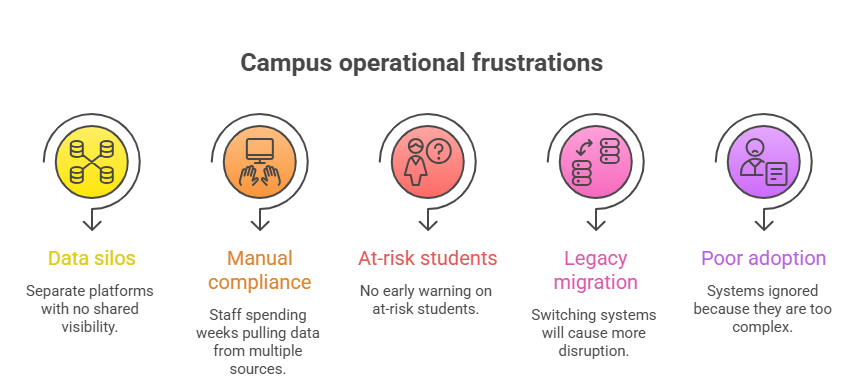
Here is what campus leaders consistently flag as their biggest operational frustrations:

Student Information System

  • Data silos — Admissions, finance, academics, and examinations all running on separate platforms, with no shared visibility
  • Manual compliance reporting — Staff spending weeks every cycle pulling data from multiple sources just to meet regulatory requirements
  • No early warning on at-risk students — By the time leadership sees a retention problem, it is already too late to act on it
  • Legacy migration fear — The belief that switching systems will cause more disruption than staying on a broken one
  • Poor adoption — Systems that are technically implemented but practically ignored because they are too complex for everyday users

Higher education institutions are simultaneously confronting multiple challenges: declining enrolment numbers, increased cybersecurity threats, and the need for better data-driven decision-making.

None of these are people problems. They are infrastructure problems.

What a Modern Student Information System Should Actually Do

A modern SIS is not a product. It is a strategic backbone.

Here is what it should deliver, not as a wish list, but as a baseline expectation for any institution serious about operational excellence:

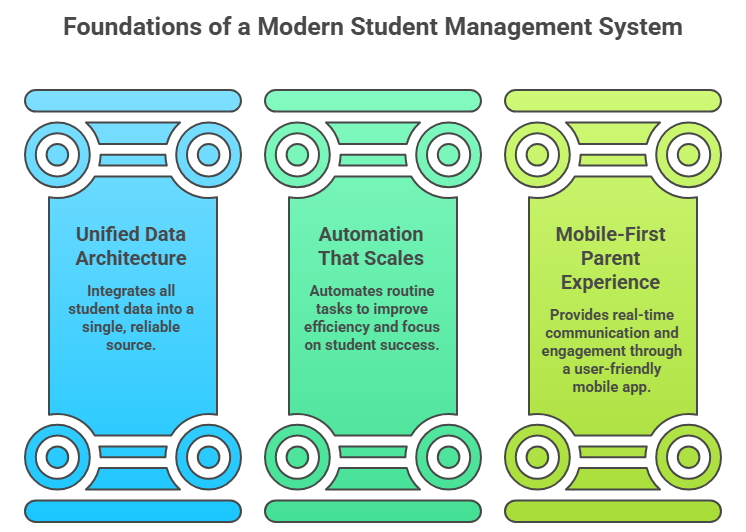
1. A Single Source of Truth Across Every Department

Every department, admissions, academics, examinations, finance, and compliance, should be working from the same data, in real time. When a student’s enrolment status changes, every relevant stakeholder should see it instantly. Not after a manual update. Not after a weekly sync. Instantly.

2. Real-Time Visibility for Leadership

Institutional leaders need early-warning indicators, not delayed reports. A modern Student Info System surfaces live dashboards that give leadership a clear, up-to-date picture of enrolment trends, student performance, financial position, and compliance status, without waiting for someone to compile a report.

3. Automated Compliance, Not Manual Scrambling

Whether it is NAAC, UGC, NEP 2020, GDPR, OFSTED, or any regional accreditation framework, compliance should be built into the system, not bolted on afterwards. Automated reporting means your staff spends their time on strategy, not on data entry.

4. A Student Experience That Matches Modern Expectations

Today’s students expect the same seamless digital experience from their institution that they get from every other service in their lives. Students expect autonomy, transparency, speed, and simplicity. A modern SIS delivers self-service portals, instant access to schedules and results, and frictionless communication, not queues at administrative counters.

5. AI That Works in the Background, Not Just as a Feature

The most impactful AI in a Student Information System is not the kind that gets announced in a press release. It is the kind that quietly saves your faculty hours on marksheet remarks, flags a struggling student before they disengage, and lets a prospective student complete their entire enrolment through a conversational interface without ever needing to call your admissions office.

The Migration Myth That Is Holding Institutions Back

Here is the conversation that happens in almost every institution still running on a legacy Student Info System:

“We know it is not working. But switching will be too disruptive.”

The biggest SIS failure point is not technology; it is adoption. And this is precisely why implementation methodology matters as much as the platform itself.

The institutions that have successfully modernised their Student Information System share one common factor: they chose a partner, not just a product. A partner who was physically present during implementation. Who modified the rollout plan based on immediate operational needs. Who delivered critical modules early so that day-to-day operations were never interrupted.

Migration does not have to be a nightmare. Done correctly, it is the last disruption your institution will ever have to absorb.

Five Questions Every Campus Leader Should Be Asking Right Now

Before your next leadership meeting, consider these:

  • Can your leadership team access live enrolment and retention data at any moment without asking anyone to compile a report?
  • How many hours does your staff spend each month on tasks that a modern SIS would automate entirely?
  • Do your admissions, academics, finance, and compliance teams work from a single shared platform, or are they still emailing spreadsheets to each other?
  • When a student starts showing signs of disengagement, does your system flag it proactively, or do you find out after they have already left?
  • If you had to migrate to a new Student Information System tomorrow, would the fear of disruption be the thing stopping you, and is that fear holding your institution back more than the disruption itself would?

If any of these questions made you pause, you already know the answer.

A Note on Choosing the Right Student Info System Partner

There is no shortage of Student Information System vendors in the market. What is in short supply is the combination of global capability, local understanding, fast implementation, and genuine on-ground support that makes the difference between a system that gets used and one that gets abandoned six months after go-live.

The right SIS partner should be able to show you — not just tell you — what institutions like yours have achieved. Real institutions. Real numbers. Real people willing to speak on the record.

Academia by Serosoft is a Gartner®-recognised Student Information System trusted by 400+ institutions across 32 countries. From AI-powered enrolment automation to real-time compliance reporting and end-to-end student lifecycle management, Academia is built for institutions that are serious about digital transformation — not just talking about it.

If you are evaluating your Student Information System options or considering a migration, we would welcome the conversation.

Book a Free Demo with an Academia Specialist →

How Can a Modern Campus Management System Future-Proof Your Institution?

What Defines a True Campus Management System in 2026?

At its core, a Campus Management System is no longer just a database; it is the central nervous system of an educational institution. Unlike the rigid software of the past, today’s systems are cloud-native and mobile-first.

When we talk about digital transformation, we are talking about the ability to track a student from the first “Request Information” click to their 50th alumni donation. This continuity is only possible when your Student ERP handles everything from financial aid and course scheduling to LMS integration.

Expert Insight: The Data Gap. According to a 2025 Gartner Higher Education report, institutions that utilize a unified Campus Management System see a 25% increase in administrative efficiency compared to those using three or more disconnected software vendors.

How Does a Student ERP Improve the Learner Experience?

Modern learners expect “Amazon-level” service. They want to register for classes, check grades, and pay tuition via their smartphones.

How do we meet this expectation? 

By deploying a robust Student ERP, institutions provide a single point of truth. Students no longer have to visit three different offices to resolve a registration hold. Instead, the system triggers automated workflows that notify the student and the advisor simultaneously, resolving bottlenecks in real-time.

What role does AI play in this journey? 

The Campus Management System utilizes predictive analytics. By analyzing historical data within the ERP, the system can flag students who are at risk of dropping out based on attendance patterns and mid-term grades—well before the final exam.

When is the Right Time to Upgrade Your Campus Management System?

The “wait and see” approach is becoming a liability. If your current staff is spending more than 20% of their time on manual data entry or reconciliation between systems, you are already behind.

When evaluating a new Student ERP, ask these three questions:

  • Is it Scalable? Can it handle a 20% surge in enrollment without lagging?
  • Is it Interoperable? Does it play well with your existing LMS and financial tools?
  • Is it Secure? Does it meet global cybersecurity standards to protect sensitive student data?

Fact Window: The Cost of Legacy Systems 

Research from EDUCAUSE indicates that maintaining “Technical Debt” in legacy campus software costs institutions nearly double the price of a modern SaaS migration over a five-year period due to hidden maintenance and productivity losses.

Why is a Student ERP Critical for Financial Sustainability?

In an era of fluctuating enrollment, financial transparency is a survival trait. A Student ERP provides leaders with a “360-degree view” of the institution’s financial health.

How does it impact the bottom line?

  • Admissions Automation: Reducing the “Time to Enroll” prevents lead leakage.
  • Revenue Assurance: Automated billing and collection alerts reduce outstanding receivables.
  • Resource Optimization: Data-driven course scheduling ensures that classrooms and faculty hours are utilized at peak efficiency.

How does a Campus Management System simplify compliance? 

For many institutions, the end of the year is a scramble for data. A global-standard Campus Management System automates the collection of KPIs required for rankings and accreditation. Instead of “collecting” data, you are simply “exporting” it.

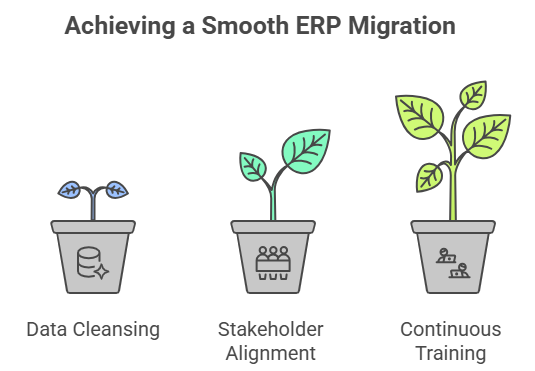
How Can You Ensure a Successful Migration to a New Student ERP?

How Can You Ensure a Successful Migration to a New Student ERP

The most common fear among registrars and IT heads is the “disruption” of a rollout. However, the global expert approach to implementation minimizes this risk through phased migration.

Step 1: Data Cleansing – Moving clean, validated data into the new Student ERP.

Step 2: Stakeholder Alignment – Ensuring faculty and staff understand the “Why” behind the “How.”

Step 3: Continuous Training – Transitioning from a one-time setup to a culture of continuous digital improvement.

Expert Insight: Implementation Success 

A study by Deloitte on Digital Transformation in Higher Ed found that the #1 predictor of ERP success was Executive Sponsorship. When leadership views the Campus Management System as a strategic asset rather than an IT expense, adoption rates jump by 40%.

Summary: What Is Your Institution’s Next Step?

The goal of a Campus Management System is to make the technology invisible so that the focus remains on education. Whether you are a small private college or a large public university, your Student ERP should be the foundation upon which you build your future.

Are you ready to see how Academia can unify your campus? Don’t let fragmented data hold your institution back. Move toward a unified, 360-degree view of your student journey today.

Frequently Asked Questions:

Q: Why is the transition to a unified Student ERP becoming a priority now?
Global higher education is facing a “digital-first” shift. Institutional leaders are moving away from fragmented legacy software to a unified Student ERP to eliminate data silos, reduce operational costs, and meet the rising expectations of tech-savvy students.

Q: What is the primary ROI of a Campus Management System?
The ROI is found in efficiency and retention. By automating manual administrative tasks, staff can focus on student success. Furthermore, real-time data allows for early intervention, directly improving graduation rates and institutional reputation.

Q: How does a global SIS expert ensure compliance?
Leading systems are built with regional compliance frameworks (like NAAC, NIRF, or GDPR) integrated into the core architecture, ensuring that reporting is a byproduct of daily operations, not a manual month-end crisis.

Why Is Your Institution Losing Good Staff — and Can a Student Information System Actually Fix It?

Nobody talks about it openly. But behind closed doors, it is the conversation happening at every institution that hasn’t yet modernised its operations.

Your best faculties are leaving. Your most experienced coordinators are burning out. And the reason isn’t salary — though that is the excuse most often given in the exit interview. The real reason? They are exhausted from doing the work that technology should be doing for them.

And at the centre of it all is a Student Information System, or rather, the painful absence of a proper one.

Why Are Institutions With No Proper Student Information System Losing Their Best Staff?

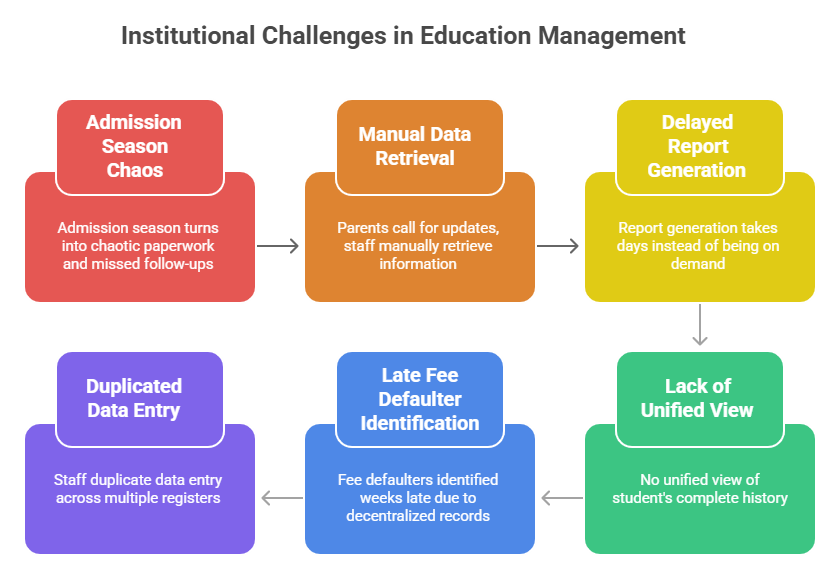
Here’s the plain truth: your staff didn’t sign up to be data entry operators. They signed up to educate, guide, and shape young people. But without the right Student Information System, that is exactly what they become, human bridges between broken tools.

Think about what a typical week looks like without a centralised system. A teacher stays two hours late every Friday, manually compiling attendance reports. An admissions coordinator spends her mornings reconciling enquiry data that should have been centralised automatically. A finance officer re-enters the same fee records across three separate registers because none of them communicate with each other.

This is not inefficiency. This is institutional burnout in slow motion.

Industry Fact

According to a Gallup Workplace Report, employees who feel their tools and processes actively hinder their work are 2.4 times more likely to report burnout, and burnout is the leading precursor to voluntary resignation across professional sectors, including education.

Source: Gallup State of the Global Workplace Report, 2023

61%

Some staff cite administrative overload as their top reason for leaving

4.5 hrs

Lost per staff member weekly to duplicated data entry in fragmented systems

2.8x

Higher compliance risk in institutions without centralised student data management

These aren’t abstract statistics. This is your institution. Your people. And the longer this continues, the more it costs you, not just in operational inefficiency, but in the morale, loyalty, and eventual departure of the very people your students depend on.

Why Is It Always the Systems — Not the Staff — That Need to Be Questioned First?

Here is something most institutional leaders find uncomfortable to hear. When performance slips, when errors creep in, when communication breaks down between departments, the instinct is to look at people. To question processes. To introduce new policies.

But what if the problem isn’t your people at all?

“Give brilliant people broken tools, and you’ll get broken results. Give them the right systems and watch what they build.”

A well-implemented Student Information System doesn’t just manage data. It removes friction from every part of your institution’s daily operation. Before the lesson even begins, your faculties already know:

  • Which students flagged an attendance concern yesterday
  • Who has a pending academic support note
  • Which pupil needs a quiet word

Your leadership team can review attendance trends, fee collection status, and academic performance indicators in real time—before the day even begins.

That isn’t a luxury. That is what modern institutional leadership looks like.

Industry Fact

McKinsey & Company found that employees spend nearly 20% of their working week searching for internal information or tracking down colleagues to help with tasks — work that integrated digital systems eliminate almost entirely.

Source: McKinsey Global Institute, “The Social Economy” Report

Honestly, ask yourself — does your institution face any of these?

student information system

What Does a Genuinely Powerful Student Information System Actually Unlock for an Institution?

Most vendors will hand you a feature list. We’re going to give you something more valuable: a clear picture of what your institution actually looks and feels like when the right Student Information System is in place.

Your admissions process becomes a competitive advantage

  • Students choose institutions based on experience
  • Every enquiry, application, and follow-up is tracked in one place
  • Prospective parents feel attended to, not chased
  • Your team builds relationships, not paperwork trails

Your staff get their evenings back

  • Automated workflows handle attendance, fee reminders, and timetable conflicts
  • Report generation stops being a manual ordeal
  • Staff shift from data processors back to educators and leaders
  • Better systems mean better morale and stronger retention

Your leadership makes decisions on today’s data, not last week’s

  • Real-time dashboards available at a glance
  • Live academic performance and attendance tracking
  • Instant fee collection summaries without running a single query
  • No more decisions based on estimates, memory, or outdated reports

Industry Fact

Gartner Research highlights that organisations that invest in integrated data management platforms report up to a 30% improvement in operational decision-making speed, directly attributable to real-time access to unified data rather than siloed departmental records.

Source: Gartner, “Data and Analytics Trends” Report, 2024

What Should You Really Prioritise When Choosing a Student Information System — Beyond the Feature List?

Here’s what nobody tells you when you’re evaluating platforms: features are table stakes. Every vendor will show you attendance tracking, fee management, and report generation. That is the baseline. What separates a system that transforms your institution from one that simply adds complexity is something far more nuanced.

Adoption ease

  • Worthless if staff abandon it within a term
  • Must be intuitive for first-time users
  • Must be powerful enough for data-driven administrators

Genuine customisation

  • Every institution has a unique structure; your system should reflect that
  • Timetabling, fee categories, and compliance requirements must be configurable
  • A system that forces its template on you is working against you

Scalability without disruption

  • Should grow from single-campus to multi-branch without costly overhauls
  • New modules, users, and capabilities added seamlessly
  • Built for where your institution is going, not just where it is today

A partner, not just a vendor

  • Implementation is the beginning, not the finish line
  • Look for responsive support, genuine training, and regular updates
  • The best vendors evolve their roadmap alongside the needs of education

Your Institution Deserves Better. Let’s Show You How

See exactly how Academia, a modern Student Information System and Education ERP System, can transform your daily operations, reduce staff burden, and elevate the experience for every parent, student, and educator in your institution.

Book Your Personalised Demo

Why Your Institution is Failing Without a Modern Student Information System in 2026

Overview: In the fast-evolving educational landscape of Southeast Asia, manual administrative processes are no longer just an inconvenience; they are a liability. 

A modern Student Information System (SIS) is the digital heart of any competitive institution or university, consolidating admissions, grading, and communication into a single source of truth. 

By integrating a robust Student ERP, institutions can automate 40% of routine tasks, drive 20% higher student retention through AI analytics, and ensure 100% data compliance with regional regulations.

Do you want to know a secret?

Most educational leaders in Southeast Asia are currently losing the “efficiency war.” They think they are being “digital” because they use spreadsheets and email.

But here is the truth: If your data isn’t talking to itself, your institution is silent.

In 2026, the gap between “surviving” and “thriving” schools is defined by one thing: their tech stack. If you aren’t using a high-velocity Student Information System, you aren’t just behind the curve. You’re off the map.

1. The Death of the Spreadsheet: Why a Student ERP is Non-Negotiable

We’ve all seen it. The “Master Spreadsheet” that only one person knows how to edit. When that person goes on vacation, the whole admissions process grinds to a halt.

In regions like Indonesia and Vietnam, where student enrollment is surging, this “manual-first” approach is a recipe for disaster. A Student ERP (Enterprise Resource Planning) replaces these fragmented tools with a unified engine.

Think of it like this: A Student ERP isn’t just software. It’s a central nervous system.

  • Admissions: No more lost paper forms.
  • Finance: Automated fee collection and scholarship tracking.
  • HR: Managing faculty workloads without the headache.

2. Speed is the New Currency in Southeast Asian Education

Parents in Singapore, Thailand, and Malaysia are more demanding than ever. They want real-time updates, not a paper report card sent home three weeks late.

A world-class Student Information System gives them a window into the classroom. When a student misses a 9:00 AM lecture in Ho Chi Minh City, the parent should know by 9:05 AM via a mobile push notification.

If you can’t provide that level of transparency, they will find a school that can. Speed doesn’t just improve satisfaction; it builds trust. And in education, trust is your only real product.

3. Using a Student Information System to Predict the Future

One of the biggest mistakes I see is using data only to look at the past. “How many students did we have last year?”

That’s the wrong question.

The right question is: “Which 15% of my current students are at risk of dropping out next semester?”

Modern Student Information System platforms now come with “Nudge Tech” and predictive analytics. By tracking attendance patterns, library usage, and mid-term grades, the system flags at-risk students before they fail. This isn’t science fiction; it’s standard practice for the top 5% of institutions in 2026.

4. Why Compliance is Your Secret Competitive Advantage

Governments across the ASEAN region are tightening data privacy and reporting standards. Whether it’s PDPA in Thailand or the latest educational mandates in the Philippines, manual reporting is a nightmare.

A localized Student ERP automates these reports. Instead of your staff spending two weeks every quarter compiling data for the Ministry of Education, you click “Export.”

That’s hundreds of man-hours saved. Hours that your staff could be spending on what actually matters: Student Success.

5. Scaling Your Institution Without Scaling Your Stress

Growth is usually painful. More students mean more records, more faculty, and more room for error. But it doesn’t have to be that way.

When you implement a scalable Student ERP, your administrative overhead stays flat while your enrollment grows. You’re building a foundation that supports 1,000 students just as easily as 10,000.

The Bottom Line

The digital transformation of Southeast Asian education isn’t “coming”—it’s already here. You can either be the school that sets the standard or the school that wonders where all its students went.

At Academia, we’ve spent years perfecting the balance between power and simplicity. Our platform is more than just a Student Information System; it’s a growth partner designed for the unique challenges of modern campuses.

Stop fighting your data and start using it.

Ready to see what the future of education looks like? Book your free demo of Academia today and discover how we can transform your administrative chaos into a streamlined success story.

Is Your University Management System Quietly Failing Your Institution?

European universities are under more regulatory, financial, and student-experience pressure than ever. Yet most are running on systems that were never built for this moment. Here’s what you’re missing, and what it’s costing you.

Quick Overview– Your Questions, Answered First

  • Why do so many universities in Europe still struggle with student data even after investing in software?

Because most institutions buy software that manages data, not one that connects it. A modern university management system unifies admissions, academics, finance, and compliance into a single source of truth. Without that, the staff spend hours reconciling spreadsheets instead of serving students.

  • Is an Education ERP only for large universities, or can mid-sized institutions benefit too?

Absolutely mid-sized too. In fact, smaller and mid-sized European universities gain the most from an Education ERP because they typically have fewer administrative staff. Automating enrolment, timetabling, and reporting with the right ERP can save the equivalent of several full-time roles annually.

  • How does a university management system help with GDPR compliance in Europe?

A purpose-built university management system stores, processes, and controls student data according to GDPR frameworks by design, with role-based access, audit trails, data retention policies, and consent management built directly into the platform. Generic CRMs or ERP tools retrofitted for education simply cannot match this.

Let’s be honest. Most European universities are one audit cycle away from a compliance headache. One failed accreditation away from a reputational crisis. And one academic year away from losing students to institutions that simply offer a smoother experience.

The culprit? Fragmented, outdated, or mismatched administrative infrastructure. And often, nobody inside the institution even realises it’s happening, until it’s too late.

This piece is for the registrars, the CIOs, the academic directors, and the vice chancellors who are tired of band-aid solutions. Let’s talk about what a truly effective university management system looks like in 2026, and more importantly, what you’re probably not looking for that you should be.

European Universities Are Facing a Crisis Most Won’t Publicly Admit

Across the Europe, Germany, France, the Netherlands, and the wider EU, higher education institutions are grappling with a convergence of pressures: falling domestic enrolment rates, rising international student expectations, the Bologna Process’s ongoing harmonisation demands, and the EU’s tightening grip on data governance.

Meanwhile, administrative teams are stretched thin. Staff are toggling between five different platforms just to process one student’s enrolment.

That is not a people problem. That is a systems problem.

“A university that can’t get its back-office right will eventually fail its students at the front door — no matter how prestigious its name.”

This is exactly where a modern university management system changes the game. Not as a luxury. As a necessity.

What Most Institutions Actually Look for, And What They Miss

When European institutions evaluate platforms, they tend to focus on the obvious: can it handle student records? Can it produce transcripts? Does it integrate with our LMS?

Fair questions. But they’re the baseline. The real differentiation, the things that will determine whether your institution thrives or just survives over the next decade, lies deeper.

What to look for in a University Management System that most evaluation checklists miss:

  • Multi-campus, multi-language support — Critical for pan-European institutions with campuses across different regulatory zones and language environments.
  • Granular GDPR controls built-in — Not bolted on. Consent management, right-to-erasure workflows, and audit logs need to be core features, not add-ons.
  • Programme-level financial tracking — Understand the true cost and revenue of each degree programme, not just institutional totals.
  • Student success analytics — Predictive early-warning systems that flag at-risk students before they drop out, not after.
  • Configurable accreditation reporting — Whether you’re reporting to QAA, ACQUIN, HCERES, or NVAO, your system should adapt to your accreditor, not the other way around.

If your current platform doesn’t check these boxes, you’re not just behind, you’re exposed.

How a Modern Education ERP Transforms Day-to-Day Operations

The term Education ERP gets thrown around a lot. But the institutions that truly benefit from it understand one thing: it’s not software. It’s infrastructure.

Think of it like electrical wiring. You don’t notice it when it works. But when it fails, everything stops.

A well-implemented Education ERP connects your admissions pipeline to your academic records to your finance office to your regulatory reporting — in real time, without manual handoffs.

Here’s what that actually looks like in practice. A student applies from Poland, gets accepted, enrols, has a payment query, and requests a transcript within the same week. In a fragmented system, that’s four separate teams, four separate platforms, and days of wait time. In a connected Education ERP? It’s one workflow, one dashboard, and a fraction of the time.

The Hidden Costs of Staying With Legacy Systems

Nobody likes to talk about switching costs. But let’s talk about the cost of not switching.

The real price your institution pays for outdated infrastructure every year:

  • Staff overtime and burnout — Administrative staff in EU universities spend an estimated 30–40% of their working week on tasks that a modern system would automate entirely.
  • Student drop-off at enrolment — A clunky enrolment experience, especially for international students, directly increases abandonment rates before a student even sets foot on campus.
  • Compliance penalties — GDPR violations can result in fines of up to €20 million or 4% of annual turnover. A non-compliant data architecture is not a risk — it’s a liability.
  • Accreditation risk — Incomplete, inconsistent, or manually compiled accreditation data is one of the leading causes of deferred or failed accreditation outcomes across European institutions.
  • Reputation damage — In an era where student reviews are public, a poor administrative experience travels fast. Prospective students talk. And listen.

The question isn’t whether you can afford to upgrade. It’s whether you can afford not to.

Why European Institutions Are Making the Switch Now — Not Later

The timing is not coincidental. The EU’s push for the European Education Area means digital infrastructure is no longer optional. Erasmus+ digital integration requirements are evolving. The European Student Card Initiative demands interoperability that legacy systems simply cannot deliver.

Beyond regulation, student expectations have shifted permanently post-pandemic. Students expect mobile access to their academic records, real-time fee statements, and digital document requests — not email chains and PDF forms.

Institutions that modernised their university management system three to five years ago are already seeing measurable advantages: higher enrolment conversion rates, improved student satisfaction scores, and significantly reduced administrative headcount costs.

Those waiting are not preserving the status quo. They’re falling behind it.

What Differentiates a Great University Management System From a Good One

Here’s the uncomfortable truth about the EdTech market: most platforms look identical in a demo. They all have dashboards. They all have reporting. They all say “configurable.”

The differentiation becomes visible only six months post-implementation — when your edge cases emerge, when your accreditation cycle begins, when your IT team realises how much they’re still doing manually.

The best university management system for European institutions is one architected specifically for the complexity of European higher education — not adapted from a US community college model or a corporate ERP with an academic skin on top.

It should handle credit transfer frameworks like ECTS natively. It should support multiple academic calendars. It should allow your faculty to manage grades, attendance, and course content without needing an IT ticket every time something changes.

That’s not an ambitious wish list. That’s the minimum standard for 2026.

Meet Academia — Built for European Higher Education

Academia is a purpose-built university management system and Education ERP designed specifically for the regulatory, academic, and operational demands of European institutions.

From GDPR-compliant data management to ECTS-native credit transfer and accreditation-ready reporting — Academia does the heavy lifting so your teams don’t have to.

Stop patching a system that was never built for you. Book a free demo today and see exactly how Academia fits your institution’s real challenges — no commitment, no sales pressure, just answers.

African Universities Are Sitting on a Ticking Clock – And a Student Management System Is the Only Way Out

Overview:

Before we get into the core of this, let’s address three questions that institutional leaders across Africa are actively asking about student information systems right now:

“We have multiple departments running on different systems. Is a student information system going to actually bring all of this under one roof?” 

Absolutely. A modern student information system is built precisely for this. It unifies admissions, academics, finance, attendance, and examinations into a single platform, so your departments stop working in silos and start working as one connected institution.

“Our enrolment numbers are growing. Will a student information system be able to scale with us without breaking down?” 

That’s one of the strongest arguments for implementing one now rather than later. A cloud-based student information system scales with your institution seamlessly, whether you’re adding 500 students or opening a new campus entirely, without additional administrative headcount or infrastructure costs.

“We’re preparing for accreditation. Can a student information system actually help us get there faster and with less stress?” 

More than most institutions realise. Accreditation bodies want data accuracy, process transparency, and outcome tracking, all of which a student information system delivers out of the box. Institutions that walk into accreditation reviews with a live, integrated system are far better positioned than those compiling reports manually at the last minute.

Africa’s Higher Education Boom Is Real, But the Infrastructure Isn’t Keeping Pace

Sub-Saharan Africa has the fastest-growing youth population on the planet. Nigeria alone adds hundreds of thousands of university applicants to the system every year. Kenya’s universities are bursting. South Africa’s institutions are under pressure to expand access whilst maintaining quality. Ghana is investing aggressively in higher education infrastructure.

The demand for higher education has never been higher. But the administrative systems running these institutions? In many cases, they haven’t changed significantly in 15 years.

The result is predictable: overwhelmed registrars, delayed results, frustrated students, compliance gaps, and leadership making critical decisions based on incomplete data. It’s not sustainable, and the institutions that recognise this urgency right now are the ones who will own the next decade of African higher education.

The gap between those institutions and the rest is a student management system.

What a Modern Student Management System Actually Changes, And What It Doesn’t

Let’s be honest about something: a student management system won’t fix a broken culture or make poor leadership better. But it will eliminate the operational chaos that makes good leadership nearly impossible.

A proper student management system centralises everything that currently lives in too many places. Student enrolment, attendance, academic records, examination schedules, results, transcripts, fee payments, scholarship tracking, all of it, in one place, accessible in real time by the right people.

For a Nigerian university with 20,000 students across multiple faculties, that means:

  • No more results disputes caused by grade entry errors across disconnected systems
  • No more students queueing for hours to pay fees or collect clearance documents
  • No more attendance registers that go missing or get altered after the fact
  • No more end-of-semester chaos when multiple departments try to compile data simultaneously
  • Real-time visibility for department heads, deans, and the vice chancellor, without waiting for compiled reports

This isn’t a luxury upgrade. For institutions serious about growth and accreditation, a robust student management system is the operational foundation on which everything else is built.

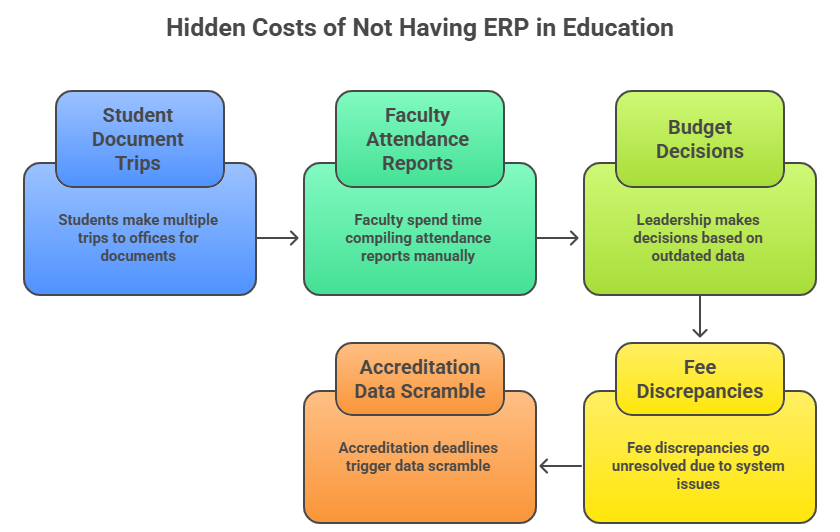
The Hidden Cost of Not Having ERP in Education

The Hidden Cost of Not Having ERP in Education

Here is something the EdTech industry doesn’t talk about enough: the cost of not digitising is far higher than the cost of investing in the right platform. Every inefficiency has a price — and it compounds every semester.

What institutions are silently losing without ERP in education:

  • Every time a student makes three trips to three different offices for one document, that’s staff time, student time, and institutional reputation being eroded quietly. 
  • Every time a faculty member spends Friday afternoon manually compiling attendance reports, that’s academic energy going into administrative waste. 
  • Every time leadership makes a budget decision based on last quarter’s numbers, because this quarter’s numbers aren’t ready, that’s strategic risk accumulating. 
  • Every time a fee discrepancy goes unresolved for days because finance and academics don’t share a system, that’s a frustrated student one step closer to disengagement. 
  • Every time an accreditation deadline triggers a campus-wide data scramble, that’s a crisis that a proper system would have prevented entirely.

Student Management System Adoption Is Accelerating, Don’t Be the Last to Move

Here’s the competitive reality no one wants to say out loud: students and parents now compare institutions before choosing. And the comparison isn’t just about ranking or programme offerings anymore. It’s about experience.

Can I apply online? 

Will I get fee reminders automatically? 

Can I check my results on my phone? 

Does the university communicate proactively? 

These are questions the next generation of African university students are already asking.

The institutions answering “yes” to all of them, because they’ve invested in a comprehensive student management system, are winning enrolment. 

The ones still routing application forms through physical offices are watching their conversion rates decline, and their reputation suffers in ways that take years to recover.

In South Africa and Kenya, where EdTech adoption in higher education is moving fastest, early movers are already establishing reputational advantages that will compound over the next five to ten years. The window to catch up is not indefinitely open.

Meet Academia: The Student Management System Built for Growth-Stage Institutions

Academia by Serosoft is an AI-powered Student Management System and Education ERP trusted by 400+ institutions across 32 countries, with an active and growing presence across Africa. 

From admissions and attendance to examinations, finance, and alumni management, Academia covers the entire student lifecycle on a single, cloud-based platform designed to scale with your institution.

  • 40+ modules spanning every academic and administrative function
  • Fully configurable to your institution’s academic structure, grading system, and fee framework
  • Mobile apps for students, faculty, parents, and administrators, built for mobile-first environments
  • AI-driven analytics and 400+ configurable reports for data-driven institutional leadership
  • Multi-campus management, seamless integrations, and no technical dependency for day-to-day configuration

Book your free demo today and discover what Academia can do for your campus → academiaerp.com

Is Your University Losing Students Because of Outdated Systems? Here’s What Middle Eastern Institutions Are Doing Differently

Overview

Before we get into the core of this, let’s address the three questions that almost every higher education administrator in the region is quietly wrestling with right now:

Q1. Can a university truly scale without a centralised system managing its student data? 

It can try. But it will hit a wall, usually during peak admission season or accreditation review, when disconnected spreadsheets and manual processes simply can’t keep up with institutional demand.

Q2. Why do students at some GCC universities get results, fee receipts, and timetables instantly, while others wait days? 

It comes down to infrastructure. Institutions running a modern student information system have automated what others are still doing by hand. The experience gap between those two types of campuses is something students notice immediately and remember when recommending the institution to others.

Q3. Is it really possible to manage attendance, examinations, finance, and admissions from one platform, or is that just a sales pitch? 

It’s very much a reality in 2026. A well-implemented student information system does exactly this, and the institutions in the UAE, Saudi Arabia, and Qatar that have made this shift are already seeing the difference in operational efficiency, student satisfaction, and leadership decision-making.

The Middle East Higher Education Sector Is Moving Fast. Is Your Institution Keeping Up?

Saudi Arabia’s Vision 2030. The UAE’s National Agenda for Education. Qatar’s Education City. These aren’t just political slogans; they’re institutional mandates with real deadlines and real accountability.

The universities and colleges that are thriving in this environment have one thing in common: they’ve stopped treating their administrative software as a back-office tool and started treating it as a strategic asset.

Meanwhile, institutions still running on fragmented spreadsheets, legacy software, and manual workflows are watching their accreditation ratings stagnate, their student satisfaction scores decline, and their best faculty leave for better-equipped environments.

The window to act isn’t wide open. It’s closing.

What a Student Information System Actually Means for a GCC Institution

What a Student Information System Actually Means for a GCC Institution

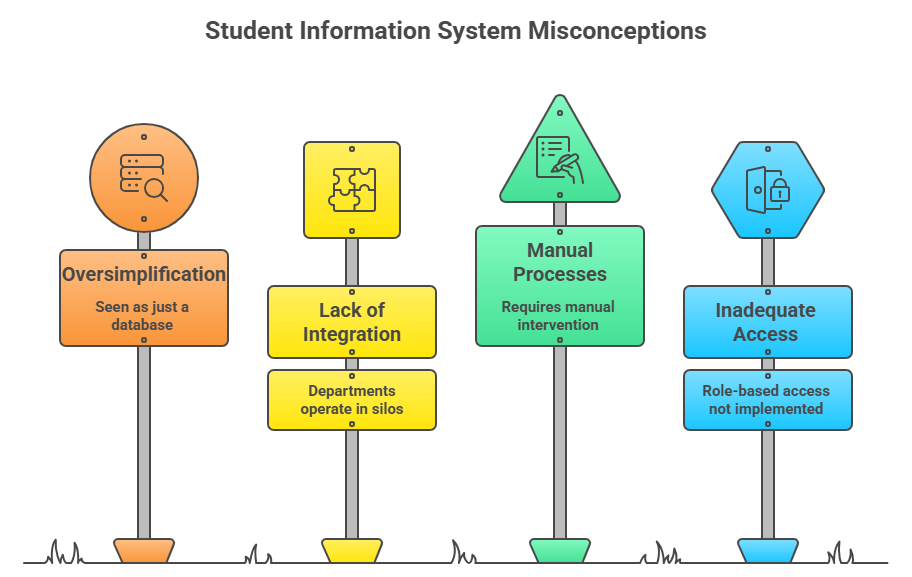
Most administrators hear “student information system” and picture a glorified database. That’s a dangerous oversimplification, and it’s costing institutions real money.

A modern student information system is the digital infrastructure your institution can lean on. It connects admissions to academics, academics to finance, finance to compliance, and compliance to leadership insights. When it works well, your institution runs like a well-oiled machine. When it doesn’t, every department operates in its own silo, and the student pays the price.

Here’s what a purpose-built student information system handles for a GCC university today:

  • End-to-end admissions and enrolment management, from enquiry to first-day registration
  • Real-time attendance tracking with automated alerts to students and faculty
  • Examination scheduling, grading, and transcript generation without manual intervention
  • Fee collection, scholarship management, and financial reporting with complete audit trails
  • Role-based access portals for students, parents, faculty, and administrators, each seeing exactly what they need

This isn’t optional in 2026. If your student information system can’t do all of this, and do it in Arabic as well as English, you’re already behind.

Why Higher Education ERP Is the Missing Layer Most Institutions Overlook

Here’s a scenario that plays out in universities across the UAE and Saudi Arabia every single semester: The admissions team onboards 400 new students. The finance team sends out fee notices three days late because the data didn’t synchronise. The academic department manually updates timetables in a separate system. HR doesn’t know which faculty are overloaded. And the Vice Chancellor is making strategic decisions based on a report that’s already two weeks out of date.

That’s not a people problem. That’s a systems problem. And it’s exactly what a well-implemented higher education ERP is designed to eliminate.

A higher education ERP integrates every department, academics, finance, compliance, and facilities into a single platform with a single source of truth. No more waiting for interdepartmental emails. No more reconciling conflicting spreadsheets. No more surprises during accreditation visits.

The institutions winning accreditation battles and ranking improvements in the GCC are the ones who’ve made this investment. Those who haven’t are scrambling to explain the gaps.

The Student Information System Gap That’s Quietly Hurting Enrolment Numbers

Let’s talk about something that rarely makes it into board meetings but shows up painfully in enrolment data: the applicant dropout rate during the admission process itself.

In many Middle East institutions, prospective students are still being asked to submit physical documents, visit the campus multiple times for paperwork, and wait days for status updates. In a region where students have the option to apply to internationally-ranked universities with fully digital admission portals, a clunky experience is enough to lose them permanently.

A modern student information system fixes this at the source. Automated admission workflows, online document submission, real-time application tracking, and instant communication through student portals and mobile apps transform the experience from frustrating to frictionless.

The question isn’t whether you can afford to upgrade your student information system. It’s whether you can afford to keep losing qualified applicants to institutions that already have.

The Right Time to Act Was Yesterday. The Next Best Time Is Today.

Every semester that passes without a centralised, AI-powered student information system is a semester of avoidable errors, missed opportunities, and frustrated students and staff.

Institutions in the UAE, Saudi Arabia, Qatar, and Kuwait are actively deploying integrated platforms right now. The early adopters are already seeing measurable improvements in enrolment conversion, student retention, and accreditation readiness. The laggards are playing catch-up with less time and more pressure.

Which side of that line does your institution want to be on?

Discover Academia SIS, Built for Institutions Like Yours

Academia by Serosoft is an AI-powered Student Information System and Higher Education ERP trusted by 400+ institutions across 32 countries, including a growing number of universities and colleges across the Middle East. From admissions and attendance to finance, examinations, and analytics, Academia manages the complete student lifecycle on a single, unified platform.

  • 30+ integrated modules covering every academic and administrative function
  • AI-driven dashboards with 400+ configurable reports for real-time decision-making
  • Multi-campus management from a single, centralised interface
  • Mobile apps and personalised portals for students, faculty, parents, and administrators
  • Low/no-code configurability, adapt the system to your institution’s needs, not the other way around

Your institution can’t afford to wait another semester. 

Book your free demo today and see exactly what Academia can do for your campus → academiaerp.com

Is Your Institution Dying? Why 2026 is the Year Higher Education ERP Either Saves You or Sinks You

It’s happening.

You can feel it in the frantic board meetings. You see it in the declining enrollment numbers. You hear it in the whispers of faculty struggling with systems that feel like they were built during the dial-up era.

Let’s be honest: America’s higher education sector is under a microscope. Between the “enrolment cliff” and the upcoming discontinuation of Grad PLUS loans in July 2026, the margin for error has officially hit zero.

If you’re still managing your university with disconnected spreadsheets and a legacy “Student Information System” that doesn’t talk to your finance department, you aren’t just behind.

You’re a target.

Here is the truth: In 2026, the institutions pulling ahead aren’t necessarily the ones with the biggest endowments. They are the ones with the best data.

The Brutal Reality of the 2026 Enrolment Cliff

We’ve talked about it for years, but now the “cliff” is here. There are fewer higher ed graduates, and the ones who are applying are more sceptical than ever about the ROI of a degree.

If your admission process takes three weeks to respond to a query because someone had to manually verify a transcript, that student is gone. They’ve already been scooped up by a competitor whose Higher Education ERP sent an automated, personalised acceptance text within minutes.

Speed isn’t just a luxury anymore. In a world of AI, speed is survival.

Why Your Current System is Killing Your ROI

Most “legacy” systems were built for record-keeping. They were digital filing cabinets. But in 2026, you don’t need a filing cabinet. You need a cockpit.

A modern Student Information System should be doing the heavy lifting for you:

  • Automated Compliance: If a federal audit sends your team into a month-long panic, your system has failed.
  • Predictive Analytics: You should know which students are at risk of dropping out before they miss their midterms.
  • Revenue Diversification: With traditional tuition revenue eroding, are you set up to handle micro-credentials, certificates, and P3 partnerships?

If the answer is “no,” you’re leaving millions on the table.

Higher Education

The “How-To” of Digital Transformation in 2026

If you’re ready to stop the bleeding and start growing, here is the roadmap:

Step 1: Audit Your Silos

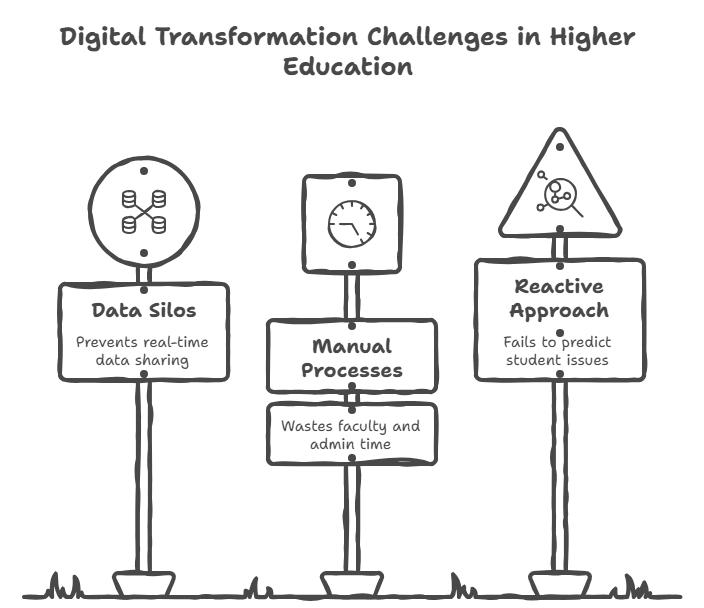
Look at your student records, your financial aid office, and your alumni relations. If they aren’t sharing data in real-time, you have a silo problem. A unified Higher Education ERP is the only fix.

Step 2: Automate the Mundane

Stop letting your faculties & admin officials do data entry. Automate attendance, fee collection, and basic student queries. Give your faculty their time back so they can actually teach.

Step 3: Shift from Reactive to Predictive Intelligence

The final stage is moving from record-keeping to forecasting. Your system must analyse student data to flag “at-risk” behaviours before they lead to withdrawals. 

In the 2026 climate, retention is your most profitable recruitment strategy; using predictive analytics to intervene early is the only way to protect your bottom line.

Frequently Asked Questions (FAQ)

What is a Student Information System?

A Student Information System is a centralised software platform that integrates all administrative and academic functions of a higher education institution—from admissions and billing to grading and alumni management—into a single database.

How does a Higher Education ERP improve student retention?

By using predictive analytics, an ERP can flag “at-risk” behaviours (like missed classes or unpaid fees) early, allowing advisors to intervene before a student decides to withdraw.

Why is 2026 a critical year for US Higher Education?

2026 marks a significant demographic shift often called the “enrollment cliff,” combined with major regulatory changes in student lending and an increased demand for AI-driven operational efficiency.

What are the benefits of a Student Information System?

A Student Information System (SIS) significantly boosts institutional efficiency by automating administrative workflows, reducing manual errors, and providing real-time data insights. The primary benefits include improved student engagement through self-service portals, streamlined enrollment processes, and enhanced financial transparency—ultimately leading to a higher ROI and better resource allocation.

The Choice is Yours

You can keep patching up your 20-year-old system, hoping it lasts another semester. Or, you can acknowledge that the landscape has shifted forever.

The institutions that will be here in 2030 are the ones making the switch today. They are moving away from friction and toward flow.

This isn’t just about software; it’s about the future of your institution. This is where Academia comes in. As a leader in the Higher Education ERP space, Academia provides a robust, AI-powered Student Information System designed specifically for the unique pressures of the modern academic environment.

Don’t wait until the “cliff” claims another victim.

Book a Free Demo with Academia today and see how we can future-proof your campus.

Is your institution ready for the digital transformation era in 2026?

If you are still relying on spreadsheets or ageing servers, you aren’t just behind, you’re at risk.

Across the Middle East and Southeast Asia, the “Digital Transformation or Decline” era has arrived. With international institutions expanding and regulatory bodies demanding real-time transparency, the manual “old way” of doing things is officially a liability.

Overview: Solving the 2026 Institutional Crisis

Before we dive into the strategy, ask yourself these three questions:

  • Can your staff pull a multi-year compliance report for the Ministry of Education in under 60 seconds?
    If not, your administrative overhead is draining your profit margins.
  • Is your student data siloed across three different platforms?
    Fragmentation is the #1 cause of enrollment leakage and billing errors.
  • Are you losing students to modern competitors simply because your parent-teacher communication feels like 2010?
    In 2026, user experience is your strongest brand asset.

The Cost of Hesitation: Why Your Legacy System is a Ticking Time Bomb

Let’s be real. Running an institution or university today is harder than it was five years ago. Expectations have skyrocketed. Parents want instant mobile updates, and governments want precise data on learning outcomes.

If you are still using a fragmented Student Info System, you are likely dealing with “Data Debt.” This is the hidden cost of manual entry, duplicated records, and the constant fear that a single spreadsheet error could ruin your accreditation.

In emerging markets, the competition is no longer local; it’s global. If you don’t modernise your Student Management System now, you are essentially handing your market share to the institution down the street that did.

3 Pillars of a Modern Student Management System

3 Pillars of a Modern Student Management System

To win in 2026, your tech stack needs to be more than a digital filing cabinet. It needs to be an engine for growth.

Unified Data Architecture

Stop jumping between tabs. A world-class Student Info System integrates everything: admissions, fee management, examinations, and alumni relations. When your data lives in one place, you eliminate errors and gain the “single source of truth” required for AI-driven decision-making.

Automation That Scales

Why is your registrar still manually verifying documents? Modern automation can handle 80% of the admissions workflow. This doesn’t just save time; it ensures that your best people are focused on student success, not paperwork.

The “Mobile-First” Parent Experience

Engagement is the secret sauce for retention. If your Student Management System doesn’t offer a high-fidelity mobile app for parents and students, you are invisible. Real-time fee alerts, digital report cards, and instant messaging aren’t “extra” anymore; they are expected.

How to Choose the Right Student Info System Without Losing Your Mind

Choosing software is stressful. You’ve probably seen dozens of demos that look the same. But here is the secret: Look for a partner, not just a provider.

Your institution is unique. You need a platform that is flexible enough to handle local regulatory requirements (such as regional compliance or multilingual interfaces) while being robust enough to scale with your growth. A stagnant system is a dead-end investment.

“In 2026, EdTech isn’t an add-on; it is the infrastructure. institutions that fail to integrate will find themselves operationally paralysed within 24 months.”

Don’t Get Left Behind

The window for “gradual” transition has closed. The 2026 academic year is going to be the most competitive on record. If your administration is bogged down by manual processes, you won’t have the bandwidth to innovate.

This is where Academia comes in. As a global leader in educational ERP solutions, we’ve helped hundreds of institutions move from chaos to clarity. Our platform isn’t just a Student Management System; it’s a growth catalyst designed for the demands of the modern era.

The clock is ticking. Your competitors are already upgrading. Will you be ready to lead, or will you be playing catch-up?

[Book a Free Demo with Academia Today] and see how we can future-proof your institution before the next semester begins.

Why Middle East Universities Can’t Afford to Ignore a Student Information System in 2026

Key Highlights

  • A Student Information System (SIS) centralises admissions, enrolments, marksheets, and communication, eliminating manual bottlenecks.
  • Universities across the UAE and Saudi Arabia are scaling rapidly, and outdated Education ERP systems are creating dangerous operational gaps.
  • Institutions still on manual processes risk compliance failures, data loss, and poor student experience, all of which damage regional and global rankings.
  • Agentic AI-powered platforms can automate report generation, offer letters, and query resolution without human intervention.
  • Upgrading to a modern Student Information System in 2026 is no longer optional, it’s a strategy to sustain.

Let’s be brutally honest.

The Middle East is in the middle of an education revolution. Saudi Arabia’s Vision 2030 has made world-class higher education a national priority. The UAE is aggressively positioning itself as a global academic hub, with Dubai and Abu Dhabi attracting international branch campuses at an unprecedented rate.

Enrolment numbers are climbing. Student expectations are higher than ever. Regulators are demanding more transparency and accountability.

And yet, too many universities in the region are still running their operations on disconnected systems, outdated software, and manual processes that were simply never built for this scale.

The cost of inaction? Lost students. Accreditation risks. Staff burnout. And a reputation that takes years to rebuild.

If your institution doesn’t have a robust Student Information System in place right now, you’re already falling behind.

The Middle East Higher Ed Boom, Is Your Student Information System Ready for It?

Saudi Arabia alone is targeting a significant increase in its university enrolment rate as part of Vision 2030’s human capital agenda. The UAE’s higher education sector has grown exponentially, with the Ministry of Education pushing institutions toward full digital compliance.

More students mean more admissions queries, more enrolment cycles, more marksheet requests, more offer letters, more compliance reports, more of everything.

Manual systems don’t scale. When your administrative staff is buried in repetitive tasks, two things happen: errors creep in, and the student experience suffers. Neither is acceptable in a region where students have abundant choices, local, international, and online.

A modern Student Information System is the operational backbone that holds your institution together as it grows, automating the repetitive, surfacing the critical, and freeing your team to focus on what actually matters: education.

What a Real Education ERP Should Actually Do For You

Too many institutions in the UAE and Saudi Arabia confuse basic digital tools with a true Education ERP. Here’s what a real system should be handling automatically:

  • Admissions Management — From inquiry to acceptance, every step is tracked and automated.
  • Student Enrolments — Seamless processing without staff manually entering data row by row.
  • Marksheet & Result Management — Accurate, auto-generated, tamper-proof academic records.
  • Offer Letter Generation — Issued automatically the moment conditions are met.
  • Query Resolution — AI-powered responses to student queries, available 24/7.
  • Compliance Reporting — Auto-generated reports aligned with CAA, KHDA, and NCAAA requirements.

If your current Education ERP isn’t doing all of this, without constant human intervention, it’s not really an ERP. It’s a liability.

The Hidden Cost of Delaying Your Student Information System Upgrade

Here’s what most administrators never calculate: the cost of NOT upgrading.

Every hour your staff spends generating manual reports is an hour not spent on student success. Every admission query that goes unanswered for 48 hours is a prospective student evaluating a competitor. Every compliance document filed late is a reputational risk that undermines years of hard-earned accreditation standing.

Regional accreditation bodies, including NCAAA in Saudi Arabia and CAA in the UAE, are tightening governance benchmarks. Institutions with streamlined, data-driven systems demonstrate a stronger compliance posture. 

A reliable Student Information System isn’t just an operational upgrade; it’s your accreditation shield.

The Rise of Agentic AI in Education ERP: Why 2026 Is the Tipping Point

We’re no longer talking about basic automation. The next generation of Education ERP platforms is powered by Agentic AI, systems that don’t just execute commands but independently complete complex, multi-step workflows.

Think about it this way: your Registrar is at a conference in Riyadh. Your admissions head is on leave during Eid. Yet enrolments are still being processed, offer letters are going out, and student queries are being answered, intelligently, accurately, without anyone lifting a finger.

That’s not science fiction. That’s what a modern, AI-driven Student Information System delivers today. The institutions that move now will have a decisive operational edge over those that keep waiting.

What to Look For When Choosing a Student Information System

What to Look For When Choosing a Student Information System

Not all platforms are built equal. When evaluating your options, prioritise:

  • End-to-end automation — From admissions through alumni management.
  • AI-powered capabilities — Automated AI-driven enrolments, report generation, query resolution, and more. 
  • Seamless integrations — With your existing HRMS, finance, and LMS platforms.
  • Compliance-ready reporting — Pre-built templates for CAA, KHDA, and NCAAA frameworks.
  • Scalability — Can it handle rapid enrolment growth without performance drops?
  • Multilingual support — Arabic and English interface capability is non-negotiable in this region.

The Clock Is Already Ticking

Every academic cycle you run on an outdated system is another cycle where errors compound, staff burn out, and students choose institutions that simply offer a smoother experience.

Academia is purpose-built for higher education institutions serious about operational excellence. From intelligent admissions workflows to automated marksheet management and AI-driven student query resolution, Academia acts as the always-on backbone your institution needs, so your team can focus on what they do best.

If you’re ready to see what a truly modern Student Information System looks like in action, built for the pace and ambition of Middle East higher education in 2026, it’s time to take the next step.

Book your free demo of Academia today. See how institutions across the UAE and Saudi Arabia are transforming their operations — one automated workflow at a time.

Your Competitors Already Switched to a Campus Management System — Here’s What You’re Losing Every Single Day You Don’t

Key Takeaways — Read This Before Your Rivals Do

  • Universities without a campus management system are bleeding hours, revenue, and student trust, silently.
  • Leading institutions in 2026 run on a Higher Education ERP that unifies admissions, academics, finance, and compliance.
  • A modern Student Information System reduces manual reporting time by up to 60% in the first semester.
  • 5 brutal signs your institution has already fallen behind, and what to do right now.
  • The exact features top-ranked universities look for before signing any university management system deal.
  • Academia is the platform smart institutions are choosing, grab a free demo before your seat fills up.

Here’s a truth nobody in higher education wants to say out loud: while your team is still chasing data across five different spreadsheets, forwarding emails to track admissions, and manually compiling accreditation reports, other universities have already automated all of it.

And they’re using that saved time to recruit better students, respond faster, and outperform you on every metric that matters.

This is the hidden cost of not having a modern campus management system. It doesn’t show up as a line item in your budget. It shows up as lost students, burnt-out staff, and ranking stagnation.

The question in 2026 is no longer “do we need this?” It’s “how much longer can we afford to wait?”

The Institutions Pulling Ahead Right Now Are All Running a Campus Management System

Top-ranked universities aren’t pulling ahead because they have bigger budgets. They’re pulling ahead because they’ve eliminated the administrative drag that slows everyone else down.

A campus management system is the single platform that connects every moving part of a university, student enrolment, timetabling, fee management, faculty records, exam scheduling, and accreditation reporting, under one roof.

The result? 

Decisions that used to take days happen in hours. Reports that used to require a team working overtime are generated automatically. And students get the seamless digital experience they now expect as a baseline, not a bonus.

40% — Drop in admin overhead after ERP implementation 

3x — Faster student grievance resolution 

60% — Less time wasted on manual compliance reporting

5 Painful Signs Your Institution Is Already Falling Behind, Don’t Ignore These

5 Painful Signs Your Institution Is Already Falling Behind, Don't Ignore These


  1. Your staff dreads accreditation season

If the words “NAAC audit” send your admin team into panic mode, that’s not a people problem; it’s a systems problem. A modern Higher Education ERP generates compliance reports automatically, pulling live data across departments the moment you need it. No all-nighters. No scrambling.

  1. Students are complaining and then leaving

Gen Z students in 2026 won’t wait in a queue or call an office to check their attendance or fees. If your institution can’t offer self-service access through a proper Student Information System, they’ll find one that can, at the time of choosing a college, and sometimes after already enroling.

  1. Your data lives in 10 different places

When finance has one enrolment number, academics has another, and the registrar has a third, nobody actually knows what’s true. That’s not a data problem. That’s the absence of a university management system that enforces a single source of truth.

  1. You’re making leadership decisions on last month’s numbers

Real-time dashboards aren’t a luxury anymore; they’re a survival tool. Institutions with a campus management system can see live fee collection rates, semester-wise enrolment trends, and faculty load data without requesting a report from IT and waiting three days.

  1. Onboarding a new batch feels like starting from zero every year

If your admissions and onboarding process involves reinventing the wheel each cycle, manual document collection, disconnected communication, and zero visibility into where each applicant stands, you’re wasting time that compounds every single year.

What the Best Higher Education ERP Actually Looks Like in 2026

Not all platforms are created equal. Here’s what genuinely high-performing institutions demand before committing to any Higher Education ERP:

AI-driven capabilities that actually save time. The best platforms in 2026 don’t just store data — they act on it. From automating repetitive admin tasks like attendance tracking and fee reminders to flagging at-risk students before they disengage, AI frees your faculty from busywork and gives them back the minutes that matter — the ones spent mentoring, guiding, and actually teaching.

One unified database — not 10 integrations pretending to be one. Every module from admissions to alumni must share data natively. Patchwork API connections are a support ticket waiting to happen.

Accreditation-ready reporting. Built-in frameworks for NAAC, NBA, NIRF, and UGC compliance — with automated report generation that doesn’t require IT intervention.

Mobile-first for students and faculty. In 2026, a campus management system without a mobile interface will be obsolete. Period.

Configurable workflows. No two universities operate identically. Your system should adapt to you, not force you to redesign your institution around its limitations.

Scalability built in. Whether you’re managing 3,000 students today or planning to scale to 30,000, your platform should grow with you, not become the bottleneck that holds you back.

The ROI Your Finance Committee Will Actually Care About

Let’s talk numbers. 

Institutions that implement a full-suite campus management system typically report: a 40% drop in administrative costs within the first year, significantly improved fee collection compliance, and a measurable lift in student satisfaction scores that directly impacts retention.

But the metric nobody talks about enough? Speed. When a prospective student submits an inquiry and gets a response in hours instead of days, because your Student Information System automated the follow-up, your conversion rate goes up. That’s revenue, not just efficiency.

The institutions that invest in a university management system today aren’t just buying software. They’re buying a competitive advantage that compounds every semester.

The Institutions Moving Fast Are Already Talking to Academia, Will You Be Next?

Academia is a purpose-built campus management system designed for universities and colleges that refuse to be left behind. One platform. Every function. Zero chaos.

From admissions and academics to fee management and accreditation reporting — Academia gives your institution the operational edge it needs to lead in 2026 and beyond.

Book Your Free Demo Today →

30 minutes. No commitment. Just clarity on what your institution has been missing.

Is Your University Bleeding Money? What a Campus Management System Can Fix Before It’s Too Late

Key Takeaways

  • Universities still relying on disconnected, legacy systems are losing revenue, students, and staff productivity every single day.
  • A modern campus management system unifies every institutional function, admissions, finance, and academics into one intelligent platform.
  • A purpose-built campus management system/higher education ERP dramatically reduces manual workloads, improves compliance readiness, and boosts student retention.
  • Institutions that delay digital transformation are already falling behind competitors who’ve made the switch.
  • The right campus management system pays for itself through recovered revenue, reduced admin costs, and stronger enrolment outcomes.

Let’s not sugarcoat it.

Right now, somewhere in your university, a member of staff is manually updating an attendance register. Another is chasing overdue fee payments through a spreadsheet. Your admissions team is toggling between three different tools trying to track a single applicant’s journey.

And while all of this is happening, a prospective student just abandoned your enrolment form because the process felt outdated & time consuming. 

This is the quiet crisis that most institutions refuse to talk about. But ignoring it doesn’t make it cheaper. It makes it catastrophic.

The good news? It’s entirely fixable, and faster than you think. Indeed.

Let’s figure out how.

The Real Cost of “We’ll Deal With It Later”

Here’s what most university leaders underestimate: operational inefficiency isn’t just an inconvenience. It has a direct, measurable impact on your institution’s bottom line and reputation.

Every manual process is a liability. Every disconnected system is a data breach waiting to happen. Every frustrated student is an enrolment you’re about to lose to a competitor who made technology a priority three years ago.

The global higher education ERP market is projected to surpass $15 billion by 2027. Institutions worldwide aren’t investing at that scale because it’s trendy. They’re doing it because the cost of inaction is now greater than the cost of transformation.

The institutions winning today, growing enrolment, retaining students longer, and running leaner operations, made one decisive move: they invested in a proper campus management system. The ones still hesitating are watching their rankings, revenue, and reputation erode in real time.

You’re either ahead of this curve or behind it. There is no middle ground.

What a Modern Campus Management System Actually Solves

What a Modern Campus Management System Actually Solves

A campus management system isn’t software for software’s sake. When implemented correctly, it is the single most impactful operational decision a university can make.

Here’s where it changes everything.

Enrolment and admissions leakage. Leads arrive through multiple channels, website forms, education fairs, and social media campaigns. Without centralised tracking, your admissions team is flying blind. Universities that integrate a CRM-linked campus management system have reported up to 30% improvement in application-to-enrolment conversion. That’s not a marginal gain. That’s transformational.

Fee collection and revenue recovery. Chasing outstanding dues manually is time-consuming and embarrassing for both staff and students. A well-configured higher education ERP automates payment reminders, generates real-time financial reports, and flags overdue accounts, so your finance team focuses on strategy, not chasing invoices.

Faculty time and morale. When academic staff spend hours on attendance registers, mark sheets, and administrative paperwork, it chips away at the quality of teaching. That’s a student experience problem disguised as an admin problem. Automate the routine, and you give your faculty back their most valuable asset, time.

Compliance and accreditation readiness. Regulatory bodies do not accept “our systems don’t talk to each other” as an excuse during audits. A centralised campus management system makes accreditation reporting accurate, consistent, and virtually effortless.

What Separates a Great Higher Education ERP From a Costly Mistake

Not every platform deserves your budget. Here’s how to tell the difference before you commit.

It must be purpose-built for academia. Generic ERP tools retrofitted for higher education miss critical nuances, credit systems, examination workflows, grade schemes, accreditation data structures. A dedicated higher education ERP handles all of this natively, saving months of painful customisation.

Real-time analytics, not stale reports. Leadership needs live data, enrolment trends, attendance patterns, and fee collection rates, not a PDF summary from a fortnight ago. If your platform can’t surface actionable insights on demand, it’s a limitation you’ll feel every single day.

Seamless integration across your tech stack. Your learning management system, biometric attendance tools, payment gateways, and communication platforms must work in harmony. Siloed software is an expensive relic of a previous decade.

A mobile-first experience. Today’s students expect everything on their smartphones. A campus management system without a polished mobile interface isn’t just inconvenient; it’s a signal to students that your institution is behind the times.

Dedicated implementation and adoption support. The best software in the world fails without proper onboarding. Insist on a vendor who partners with you through go-live and beyond, not one who hands you a user manual and disappears.

The Window to Act Is Closing

Every semester you delay is a semester of revenue lost, students underserved, and staff burnt out on processes that should have been automated years ago.

Your competitors are not waiting. They are actively upgrading their infrastructure, their student experience, and their operational efficiency right now. The question isn’t whether your institution needs a modern campus management system; it’s whether you act before the gap becomes impossible to close.

This is precisely where Academia comes in. Built exclusively for higher education institutions, Academia brings your entire campus ecosystem, admissions, academics, finance, examinations, and alumni onto one powerful, intelligent platform. Hundreds of universities across the region trust Academia to run smarter, scale faster, and deliver the student experience that today’s learners demand.

Don’t let another semester pass with systems that are costing you more than you realise. 

Book your free demo with Academia today — and see exactly what your institution has been missing.

Is Your University Built to Last? Why Middle East Higher Ed Institutions Can’t Wait Any Longer for Digital Transformation

Quick Answers Before You Dive In

Q: What is a Student Information System, and do we actually need one?
A Student Information System (SIS) is a centralised platform managing the full student lifecycle, admissions, academics, finance, and beyond. If your team is still relying on spreadsheets, manual registers, or disconnected tools, you need one more than you realise.

Q: Is this really the right time to think about digital transformation, given regional instability?
It’s the most important time. Institutions with strong digital infrastructure are the ones that kept students enrolled and operations running when physical access became restricted. Waiting for “the right time” is the most expensive decision a university can make.

Let’s Be Honest About What’s Happening

The Middle East’s higher education sector carries extraordinary ambition. World-class institutions, rising enrolment targets, and a generation of learners who expect a seamlessly connected campus experience.

And right now, it’s also carrying real weight. Regional conflict, displacement, and operational uncertainty are realities that higher education leaders are navigating every single day.

This blog acknowledges that, and it’s precisely because of that pressure that this conversation matters.

Because the institutions that will come through this period stronger are not necessarily the largest or the best-funded. They’re the ones that built a digital foundation strong enough to keep functioning when everything else is uncertain. 

A Student Information System is that foundation.

4 Signs Your Institution Is Already Falling Behind

4 Signs Your Institution Is Already Falling Behind

You don’t need to be in an active crisis to feel the impact of outdated infrastructure. Here’s where it quietly shows up:

  • Students Are Leaving, and You’re Not Catching It Early Enough: Delayed fee processing, unclear grade communication, inaccessible student support, each of these is a reason a student considers transferring. A modern Student Information System gives students 24/7 self-service access to what they need, eliminating friction before it becomes a decision to leave.
  • Leadership Is Making Decisions Without Real-Time Data: If your Vice Chancellor’s weekly report is pieced together from department emails and spreadsheets, your institution is already running behind. In a stable environment, that’s inefficient. In an unstable one, it’s a liability. A student ERP delivers live dashboards, enrolment, finance, and academic outcomes — so decisions are grounded in facts, not estimates.
  • Compliance Is Consuming Your Best People: Across the GCC and broader MENA region, accreditation requirements are growing more rigorous. Institutions without centralised data spend weeks preparing audit documentation manually. Institutions with a student ERP generate those reports in minutes, freeing your people to focus on what they were actually hired to do.
  • You’re Losing the Admissions Race to Digital-First Universities: When a prospective student compares your institution to one offering a seamless online application, real-time admission status, and instant digital communication, and yours asks them to visit the office with physical documents, the decision is already made. 

A Student Information System is no longer just an operational tool. It’s a brand signal.

What Resilience Actually Looks Like for a University in Crisis

Resilience doesn’t mean being unaffected. It means continuing your mission, educating students, supporting faculty, and maintaining institutional integrity when the environment around you is disrupted.

With the right student ERP, that looks like this:

Operations continue remotely: Cloud-based systems mean your team keeps working even when campus access is limited. Admissions don’t stop. Student communications don’t go dark.

At-risk students get flagged automatically: Declining attendance, unresolved financial holds, and academic performance drops. A modern Student Information System surfaces these patterns without someone having to run a report. In a period of regional stress, that early warning system is invaluable.

Leadership stays confident: When your Board asks, “What is the current state of the institution?” — the answer should take 30 seconds. A student ERP makes that possible.

“We’ll Do It Next Year” Is the Most Expensive Sentence in Higher Education

Every year of delay compounds. 

Students who transferred because the experience didn’t meet expectations are gone, along with their tuition revenue. Accreditation audits that required weeks of manual work, time your staff won’t get back. Competitive ground ceded to international branch campuses in the region that already invested in digital infrastructure and are actively winning enrolment.

Digital transformation in Middle East higher education is not a question of if. It is already happening. The only question is whether your institution leads it or gets left behind by it.

Conclusion: The Right Infrastructure Changes Everything

At Academia by Serosoft, we’ve built a higher education ERP designed specifically for institutions like yours. 

We know the leaders reading this are carrying more than operational responsibility. You’re carrying the futures of thousands of students, many navigating some of the most challenging circumstances of their lives. They deserve an institution that is digitally ready to support them — no matter what the environment demands.

If you want to see what a purpose-built Student Information System looks like for your institution, not in theory, but built around your actual workflows and challenges, let’s talk.

[Book Your Free Demo →]

Back to top