

Amit Malviya
Estd. Reading Time : 4 Min.
11th Aug, 2026
Share On:
Implementing a Student Information System (SIS) is one of the most significant digital transformation initiatives a university can undertake. A well-executed implementation connects admissions, academics, examinations, finance, student services, and institutional reporting into one unified platform, improving operational efficiency and enhancing the student experience.
However, technology alone doesn’t guarantee success. Many SIS implementations face delays, budget overruns, low user adoption, or fail to deliver the expected outcomes due to avoidable planning and execution mistakes.
In this guide, we’ll explore the seven most common Student Information System implementation mistakes universities make, why they occur, and how institutional leaders, IT teams, and student administration professionals can avoid them. Whether you’re replacing a legacy system or implementing a cloud-based SIS for the first time, these best practices will help lay the foundation for a successful and future-ready implementation.
Student Information System implementations typically fail due to poor planning, disconnected stakeholders, weak data governance, and inadequate change management, not because of technology limitations.
An SIS touches nearly every department within a university. If institutional goals, workflows, and responsibilities aren’t aligned before implementation begins, delays, budget overruns, and low user adoption become far more likely. Successful implementations start with a clear roadmap, cross-functional collaboration, and well-defined success metrics.
According to the Higher Ed Innovation Index 2025 by Transact + CBORD, 49% of higher education institutions are accelerating technology investments, while 44% identify implementation as their biggest digital transformation challenge.
These findings reinforce an important reality: selecting the right technology is only the first step. Long-term success depends on how effectively institutions plan, implement, and manage change.
Universities that begin SIS implementation without a clear roadmap are more likely to experience delays, budget overruns, and scope changes.
Implementation planning should define institutional objectives, project governance, timelines, responsibilities, and measurable outcomes before configuration begins. Without this foundation, departments often work in silos, priorities become unclear, and implementation decisions become reactive instead of strategic.
Before launching an SIS project, universities should answer:
A structured implementation roadmap reduces uncertainty and creates accountability throughout the project lifecycle.
A Student Information System should improve institutional processes, not simply digitise inefficient ones.
Many universities focus on software capabilities before reviewing how work is actually performed. As a result, outdated workflows, duplicate approvals, and manual processes are transferred into the new system, limiting its impact.
Before configuring an SIS, institutions should simplify workflows, eliminate redundant tasks, standardise approvals, and identify opportunities for automation. Optimising processes first ensures the technology supports institutional goals rather than reinforcing legacy inefficiencies.
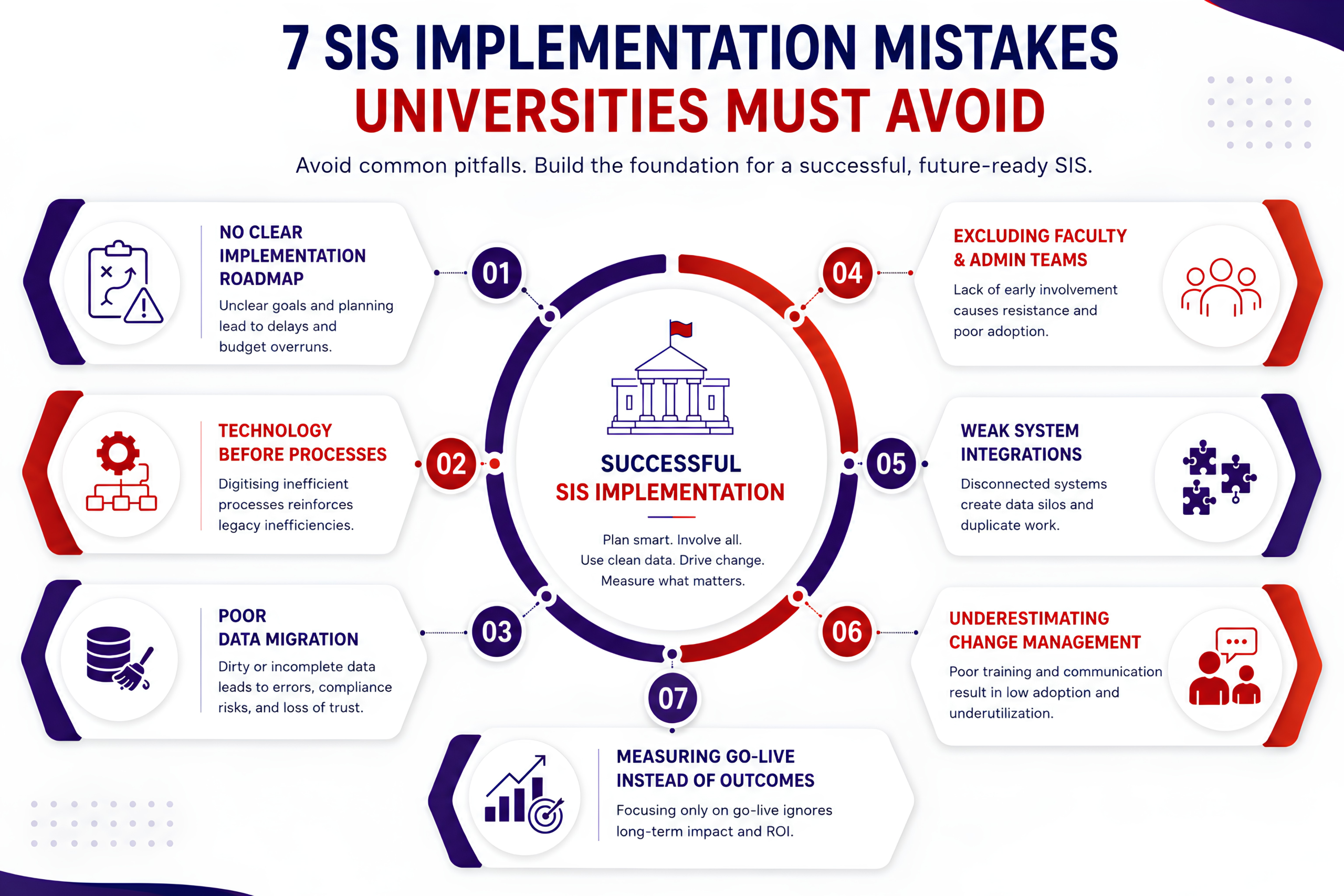
Clean, accurate data is essential for a successful SIS implementation. Migrating duplicate, outdated, or incomplete records can lead to reporting errors, compliance risks, and reduced confidence in the new system.
Rather than transferring legacy data as-is, universities should:
Reliable data enables better reporting, stronger decision-making, and a smoother transition to the new platform.
An EDUCAUSE QuickPoll (2025) found that 68% of higher education institutions are actively modernising their data systems, yet only 1% believe they have fully modernised their data management strategy. Additionally, 51% cited siloed institutional data as a major challenge, highlighting why data quality and governance should be prioritised before implementing a new Student Information System.
A Student Information System implementation succeeds when it has institution-wide ownership, not just IT support. Universities that exclude faculty, admissions, finance, registrar, or student services teams from the implementation process often face resistance, poor adoption, and workflows that fail to meet operational needs.
Every department interacts with the SIS differently. Involving key stakeholders early helps identify functional requirements, resolve process gaps, and build confidence before go-live.
To encourage collaboration, universities should establish a cross-functional implementation team that includes academic leadership, admissions, registrar, finance, student services, and IT. Early engagement reduces rework, improves adoption, and ensures the system supports institutional goals from day one.
No. A modern Student Information System delivers the greatest value when it integrates seamlessly with the university’s digital ecosystem.
An SIS should exchange data with platforms such as Learning Management Systems (LMS), finance and ERP software, HR systems, payment gateways, library solutions, and communication tools. Without these integrations, universities often struggle with duplicate data entry, inconsistent records, and fragmented reporting.
Before implementation, institutions should identify:
A connected technology ecosystem enables better collaboration, improves data accuracy, and provides leadership with a single source of institutional truth.
Based on Academia’s experience working with higher education institutions, universities that align academic, administrative, and technology teams before implementation are better positioned to reduce project risks, improve user adoption, and achieve faster time-to-value. Implementation becomes significantly smoother when people, processes, and technology evolve together.
Even the best Student Information System cannot succeed if users don’t adopt it.
Many institutions invest heavily in technology but overlook communication, training, and user readiness. As a result, staff continue using manual processes, adoption slows, and the expected benefits of the implementation are never fully realised.
Successful universities support change by:
Treating implementation as a continuous improvement initiative, not a one-time deployment, helps maximise long-term success.
A successful implementation is measured by business outcomes, not just a successful go-live.
Universities should define measurable KPIs before implementation begins to evaluate long-term impact.
| KPI | Expected Outcome |
|---|---|
| Admissions processing time | Faster application processing |
| Manual data entry | Reduced administrative workload |
| Data accuracy | Improved reporting quality |
| User adoption | Higher staff utilisation |
| Executive reporting | Faster access to institutional insights |
Monitoring these metrics helps universities continuously optimise processes and maximise their return on investment.
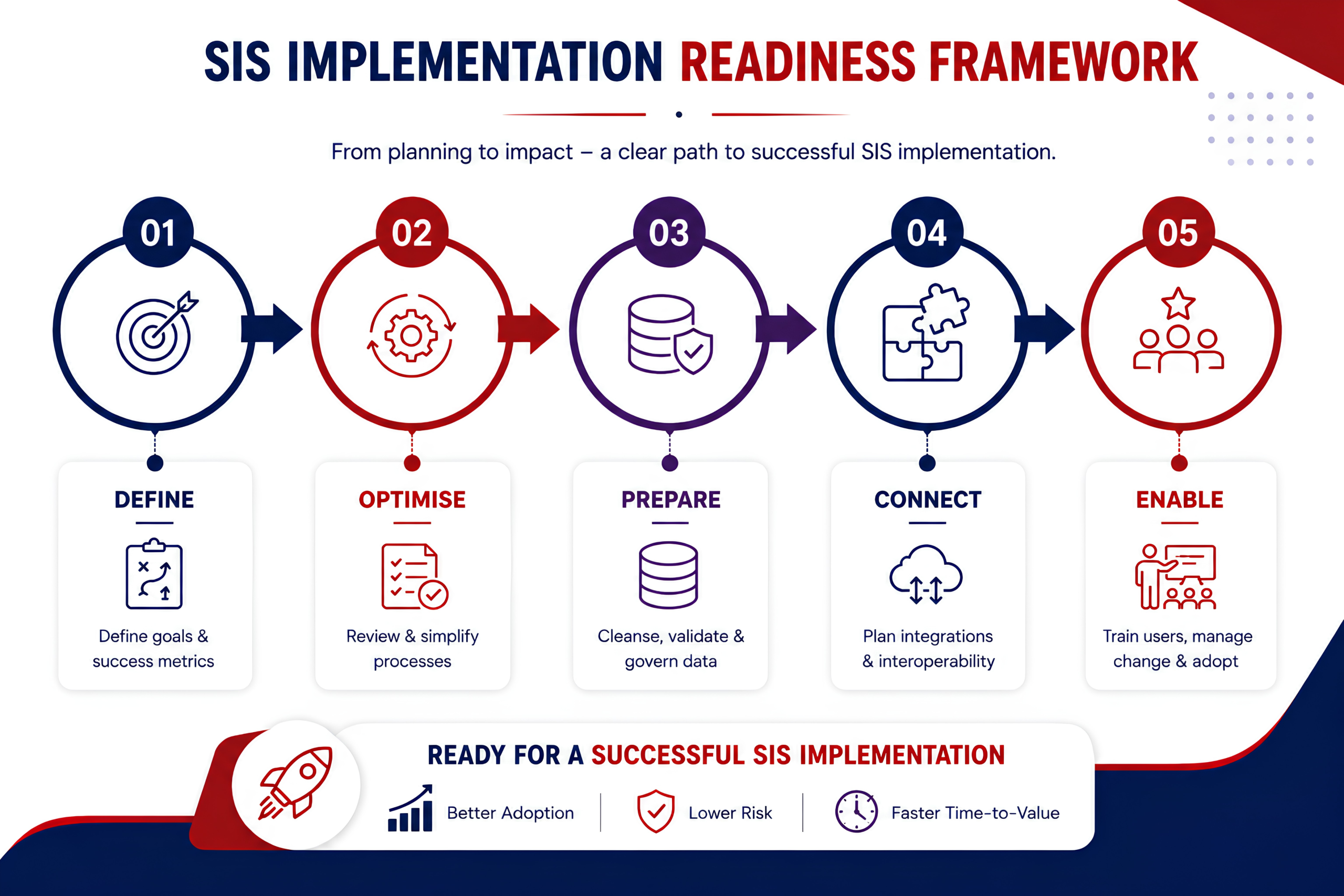
Before evaluating vendors, universities should assess their implementation readiness. Completing the following checklist helps reduce implementation risks and ensures the institution is prepared for long-term success.
✔ Define institutional goals and success metrics.
✔ Review and optimise existing business processes.
✔ Assess data quality and migration readiness.
✔ Identify integration requirements.
✔ Establish project governance and ownership.
✔ Develop a change management and training plan.
✔ Define KPIs to measure implementation success.
Universities that complete these steps before selecting an SIS are more likely to achieve a smoother implementation, stronger user adoption, and greater long-term value from their investment.
A successful Student Information System implementation requires more than software; it requires higher education expertise, proven implementation practices, and a long-term digital transformation strategy.
Academia by Serosoft is an AI-powered Student Information System built exclusively for higher education. It supports the complete student lifecycle from admissions and enrolment to academics, examinations, finance, graduation, and alumni management through a unified cloud platform.
With configurable workflows, seamless integrations, AI-powered analytics, and real-time executive dashboards, Academia helps universities modernise operations, improve decision-making, and create connected digital campuses that are ready to scale.
Universities are increasingly looking beyond automation. The next generation of Student Information Systems is expected to provide predictive insights, workflow intelligence, and real-time analytics that support faster, data-driven decision-making. Institutions that combine automation with AI-powered insights will be better positioned to improve operational efficiency, student success, and institutional agility.
The future of Student Information Systems lies in intelligence, not just digitisation.
AI-powered SIS platforms are enabling universities to move beyond managing records to proactively improving institutional performance. By combining automation with predictive analytics, institutions can identify enrollment trends, support at-risk students, automate repetitive processes, and provide leadership with real-time operational insights.
Future-ready universities will prioritise Student Information Systems that are scalable, connected, AI-enabled, and capable of adapting to evolving student and institutional needs.
A successful Student Information System implementation is built on strategic planning, stakeholder collaboration, quality data, and continuous improvement, not technology alone. Universities that avoid these seven common implementation mistakes are better equipped to reduce project risks, improve adoption, and maximise the long-term value of their investment.
As higher education continues to evolve, institutions need Student Information Systems that not only streamline operations but also enable smarter, data-driven decision-making. Choosing the right implementation approach today creates a stronger foundation for tomorrow’s digital campus.
Whether you’re replacing a legacy system or planning your first Student Information System implementation, the right strategy can make all the difference.
Discover how Academia by Serosoft helps universities implement AI-powered Student Information Systems that streamline operations, improve institutional visibility, and support the complete student lifecycle.
Request Demo | Speak with an SIS Expert
Student Information System implementation is the process of planning, configuring, integrating, migrating data, and deploying an SIS to manage student information and academic operations across a university.
Poor planning, disconnected stakeholders, weak data governance, and inadequate change management are the most common reasons universities struggle during implementation.
Yes. Modern Student Information Systems integrate with Learning Management Systems (LMS), ERP, finance, HR, payment, and communication platforms to create a connected digital ecosystem.
Universities should establish clear objectives, optimise processes, involve stakeholders early, prioritise data quality, plan integrations, invest in user training, and measure success using defined KPIs.

Experience Academia – Your partner in transforming campus operations, a trusted all-in-one ERP/SIS solution.
Get the latest insights, trends, and updates delivered straight to your inbox!