Academia Higher-Ed Executive Roundtable in Uzbekistan | 14 October 2026 — Shaping the Future of Higher Education Together
X
Academia Higher-Ed Executive Roundtable in Uzbekistan | 14 October 2026 — Shaping the Future of Higher Education Together
Consider it’s the first week of admissions season, and thousands of student applications are flowing in. Faculty members are preparing schedules. Finance teams are handling fee payments. Administrators are responding to endless requests from students and parents.
Now imagine trying to manage all of this using disconnected systems, spreadsheets, emails, and software hosted on servers sitting in a campus data room.
For many institutions, this is still a reality.
As universities grow, the complexity of managing student data grows with them. What worked for 2,000 students often struggles when the institution reaches 20,000 or 50,000 students. Delays increase. Errors become common. Reporting takes longer. Decision-making becomes reactive rather than strategic.
This is why institutions around the world are moving toward cloud-based Student Information Systems (SIS).
But what exactly is a cloud-based SIS, and why has it become a critical technology investment for modern higher education?
The answer matters more than most institutions realise.
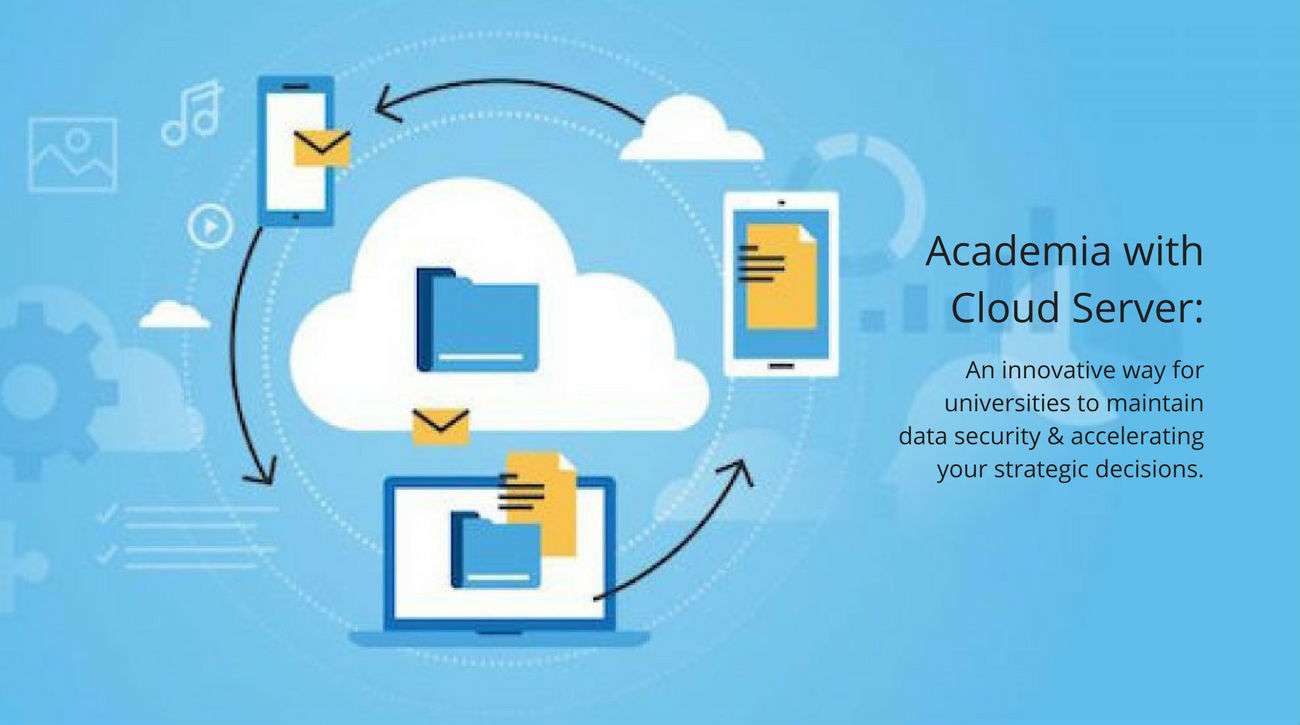
A cloud-based Student Information System is a centralised digital platform that manages student data, academic processes, administrative operations, and institutional workflows through secure cloud infrastructure.
Unlike traditional on-premise systems that require universities to maintain physical servers and IT infrastructure, cloud-based SIS solutions are hosted and managed in the cloud. Users can access the platform securely from anywhere using an internet connection.
A modern cloud-based SIS supports the entire student lifecycle, including:
In simple terms, it becomes the Central platform of the institution.
Consider a student.
She applies online, uploads documents, pays her application fee, receives admission confirmation, registers for courses, checks attendance, views grades, requests transcripts, and eventually graduates.
Behind every one of these interactions are multiple departments working together.
Admissions reviews applications. Finance verifies payments. Academic departments manage course registrations. Faculty record attendance and grades. Student services handle support requests.
When these departments operate on separate systems, information becomes fragmented.
When they operate on a unified cloud-based SIS like Academia, all stakeholders work from the same source of truth.
The result is faster processes, fewer errors, and a significantly better student experience.
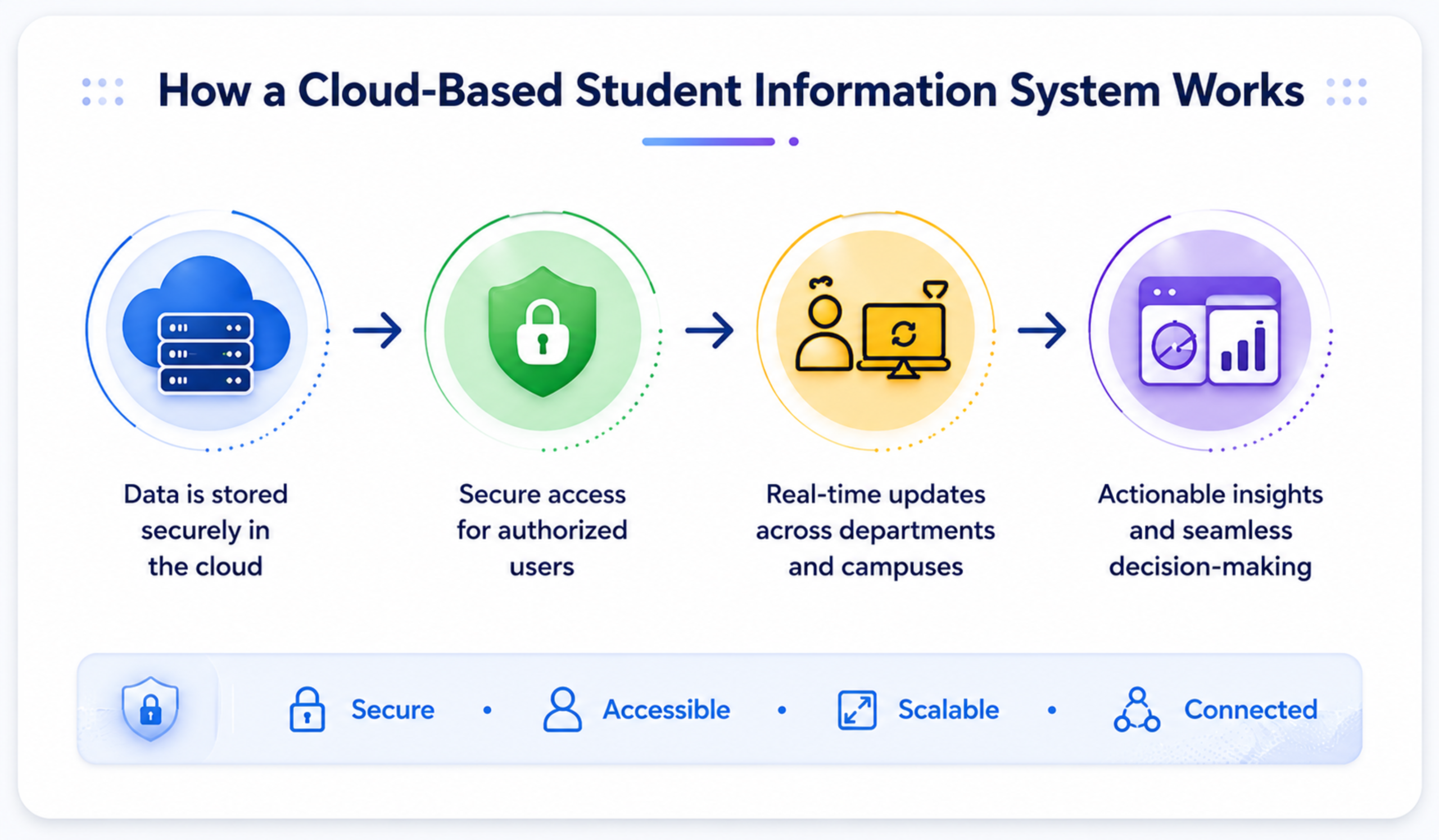
A cloud-based SIS stores institutional data on secure cloud servers rather than local campus infrastructure.
Authorised users can access information through web browsers or mobile devices.
For example:
Because data updates in real time, everyone works with the most current information available.
This eliminates duplicate records, manual reconciliations, and reporting delays.
University operations no longer stop when staff leave campus.
Whether administrators are travelling, faculty are teaching remotely, or students are studying abroad, a cloud-based SIS ensures secure access from anywhere.
This flexibility has become essential in today’s hybrid learning environment.
Students increasingly expect digital experiences similar to online banking, e-commerce, and social media platforms.
They want instant access to:
A cloud-based SIS delivers these experiences through self-service portals and mobile access.
Traditional systems require institutions to maintain servers, upgrades, backups, and security infrastructure.
Cloud-based platforms shift much of this responsibility to the technology provider.
This allows university IT teams to focus on innovation rather than maintenance.
Institutional leaders need answers quickly.
Questions such as:
A cloud-based SIS provides real-time dashboards and analytics that support faster, data-driven decisions.
Growth should be exciting, not stressful.
Whether an institution serves 5,000 students or 100,000 students, cloud infrastructure can scale to support increasing demand without major hardware investments.
Student data is one of a university’s most valuable assets.
Modern cloud-based SIS platforms provide:
This often results in stronger security than many institutions can achieve independently.
Perhaps the greatest advantage is institutional alignment.
Admissions, academics, finance, examinations, HR, and student services operate on a single platform.
Instead of departments working in silos, everyone works together using shared information.
Many universities delay modernisation because their existing system still “works.”
However, the real cost often remains invisible.
Consider the impact of:
Over time, these inefficiencies lead to high operational and financial costs.
The question is no longer whether institutions can afford to modernise.
It is whether they can afford not to.
For institutions ready to make that transition, choosing the right technology partner becomes just as important as choosing the right technology. That’s where Academia comes in.
Academia by Serosoft is a comprehensive cloud-based Student Information System designed specifically for higher education institutions.
Rather than focusing on isolated processes, Academia connects the entire student journey on a unified platform.
With Academia by Serosoft, institutions can manage:
Automate application management, document verification, communication workflows, and enrollment processes.
Track and support students from their first inquiry through graduation and alumni engagement.
Manage curriculum structures, course registrations, attendance, assessments, examinations, and grading from a single platform.
Streamline billing, fee collection, financial reporting, and student account management.
Deliver faster support through self-service portals and digital workflows.
Transform institutional data into actionable intelligence that supports strategic planning and student success initiatives.
By bringing every function together, Academia by Serosoft helps institutions operate more efficiently while delivering exceptional experiences for students, faculty, and staff.
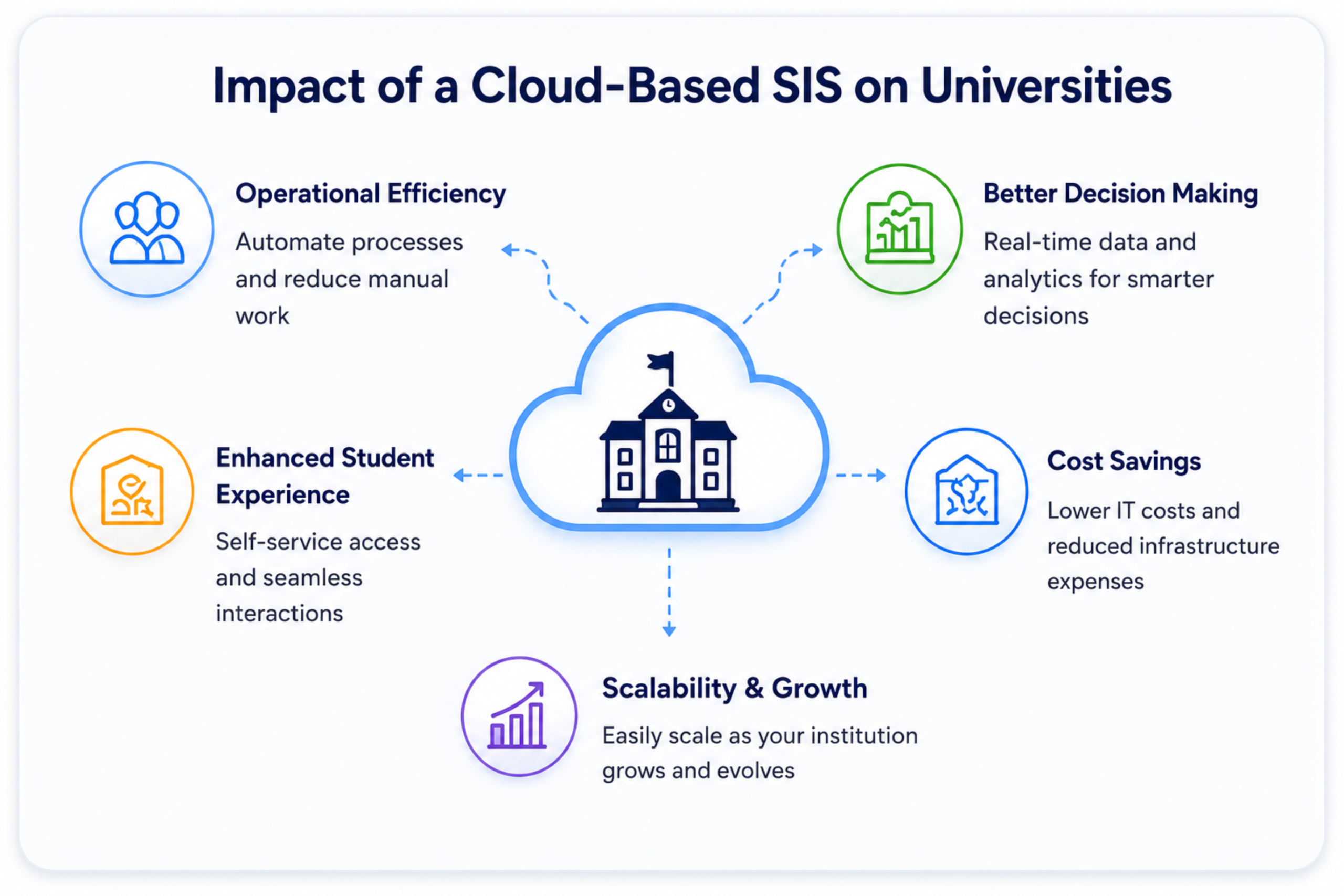
Imagine a university with more than 50,000 students spread across multiple campuses.
Without a unified cloud-based system, every department might maintain its own records and processes.
Generating a simple enrollment report could require data collection from several teams.
Within Academia, enrollment data, financial information, academic records, attendance, and student engagement metrics exist within a single ecosystem.
Leadership gains visibility.
Faculty gain efficiency.
Students gain convenience.
The entire institution becomes more connected.
Higher education is evolving rapidly.
Student expectations are rising. Competition is increasing. Data volumes continue to grow. Institutional leaders need greater visibility and agility than ever before.
A cloud-based Student Information System is no longer simply an operational tool. It has become a strategic platform for institutional growth, student success, and digital transformation.
Universities that embrace modern cloud technologies position themselves to innovate faster, serve students better, and make smarter decisions.
And with Academia, they can do it all from one connected platform.
Yes. Modern cloud-based SIS platforms typically offer advanced security features, including encryption, access controls, automated backups, and disaster recovery capabilities.
Absolutely. Cloud infrastructure is designed to scale efficiently, making it suitable for institutions of all sizes.
By centralising data and providing real-time insights, institutions can identify challenges earlier, improve engagement, and deliver more personalised student support.
Key considerations include scalability, security, integration capabilities, analytics, student experience features, and vendor expertise in higher education.
Yes. A modern cloud-based Student Information System is designed to integrate with a university’s existing technology ecosystem, including Learning Management Systems (LMS), finance and accounting software, HR systems, library management systems, payment gateways, CRM platforms, and third-party applications. These integrations help eliminate data silos, reduce manual work, and ensure information flows seamlessly across departments.

Experience Academia – Your partner in transforming campus operations, a trusted all-in-one ERP/SIS solution.
Get the latest insights, trends, and updates delivered straight to your inbox!