

Pankaj Joshi
Estd. Reading Time : 4 Min.
13th Aug, 2026
Share On:
Choosing a Student Information System (SIS) is no longer simply an IT decision for UAE universities. It affects how institutions manage admissions, academics, student services, data, reporting, and decision-making.
As universities modernise their digital infrastructure and explore AI, one question is becoming increasingly important:
Is your current SIS ready for the next generation of higher education?
A legacy SIS may still manage student records effectively. But modern universities increasingly need connected data, intelligent workflows, real-time analytics, cloud scalability, AI capabilities, and better digital experiences.
So, what should UAE universities look for in an SIS in 2026, and when does it make sense to move beyond a legacy platform?
A Student Information System is a central platform that manages student, academic, and administrative information throughout the student lifecycle.
A comprehensive SIS can support:
The role of an SIS, however, is changing.
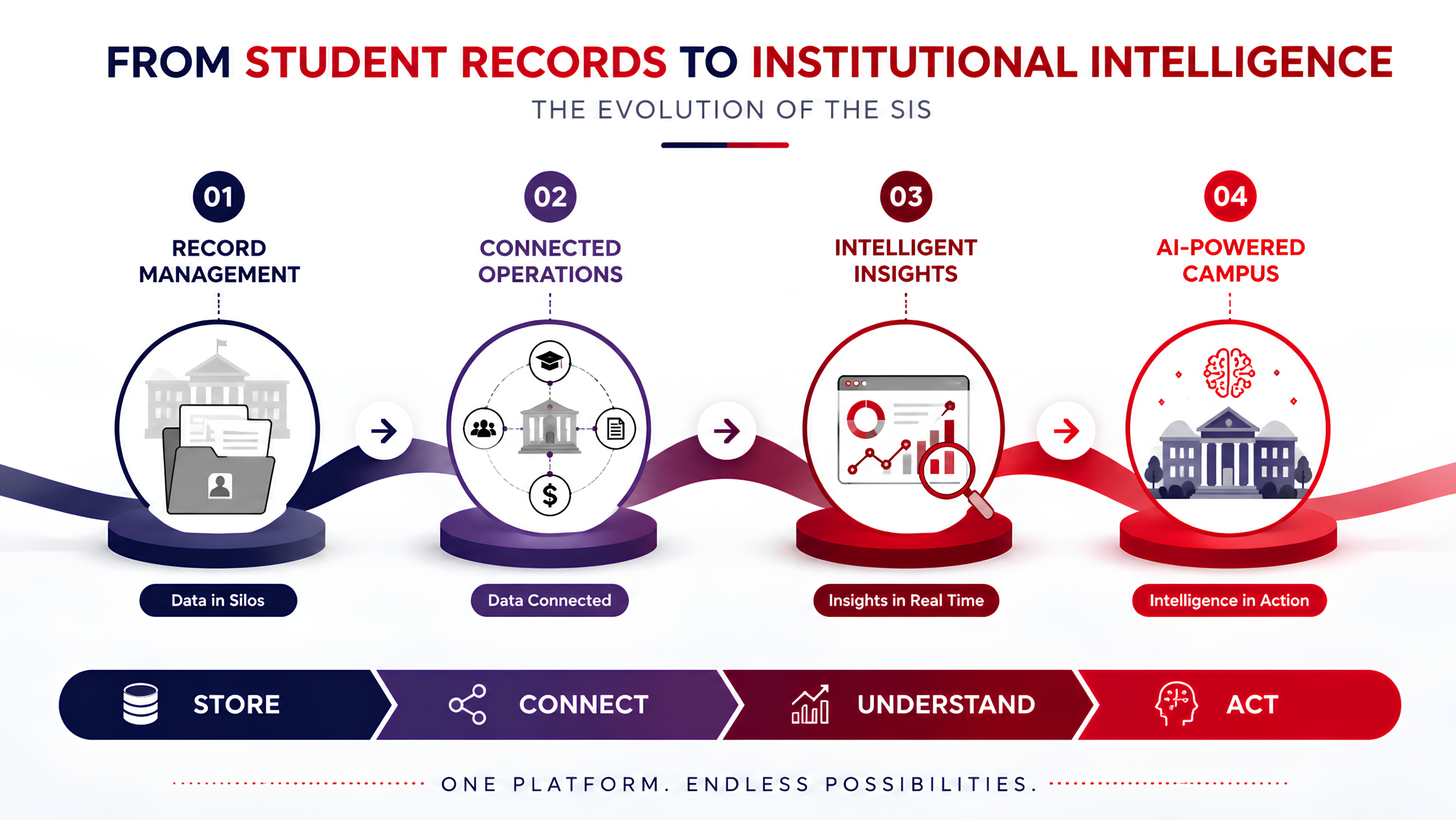
Traditional systems were primarily designed to store and process information. Modern SIS platforms increasingly need to connect information, automate processes, generate insights, and support institutional decision-making.
Legacy SIS platforms can continue to perform core administrative functions, but fragmented data, manual workflows, and difficult integrations can limit institutional digital transformation.
A university may have separate systems for admissions, finance, academics, LMS, HR, and student services. When these systems operate in silos, staff may rely on spreadsheets, manual exports, duplicate data entry, and reconciliation.
The result is a fundamental problem:
The university has data, but not necessarily a unified view of the institution.
EDUCAUSE’s 2025 QuickPoll found that 68% of respondents were in the process of data modernisation, while only 1% felt their institution had fully modernised its data management and strategy. Overall, 92% were either discussing modernisation or already had some systems modernised.
The leading drivers included operational efficiency (58%), student success and retention (46%), and data visualisation and decision support (43%). Siloed data was identified as a challenge by 51% of respondents.
For UAE universities, the implication is clear: an SIS should be evaluated not only on what it manages, but on how effectively it connects and uses institutional data.
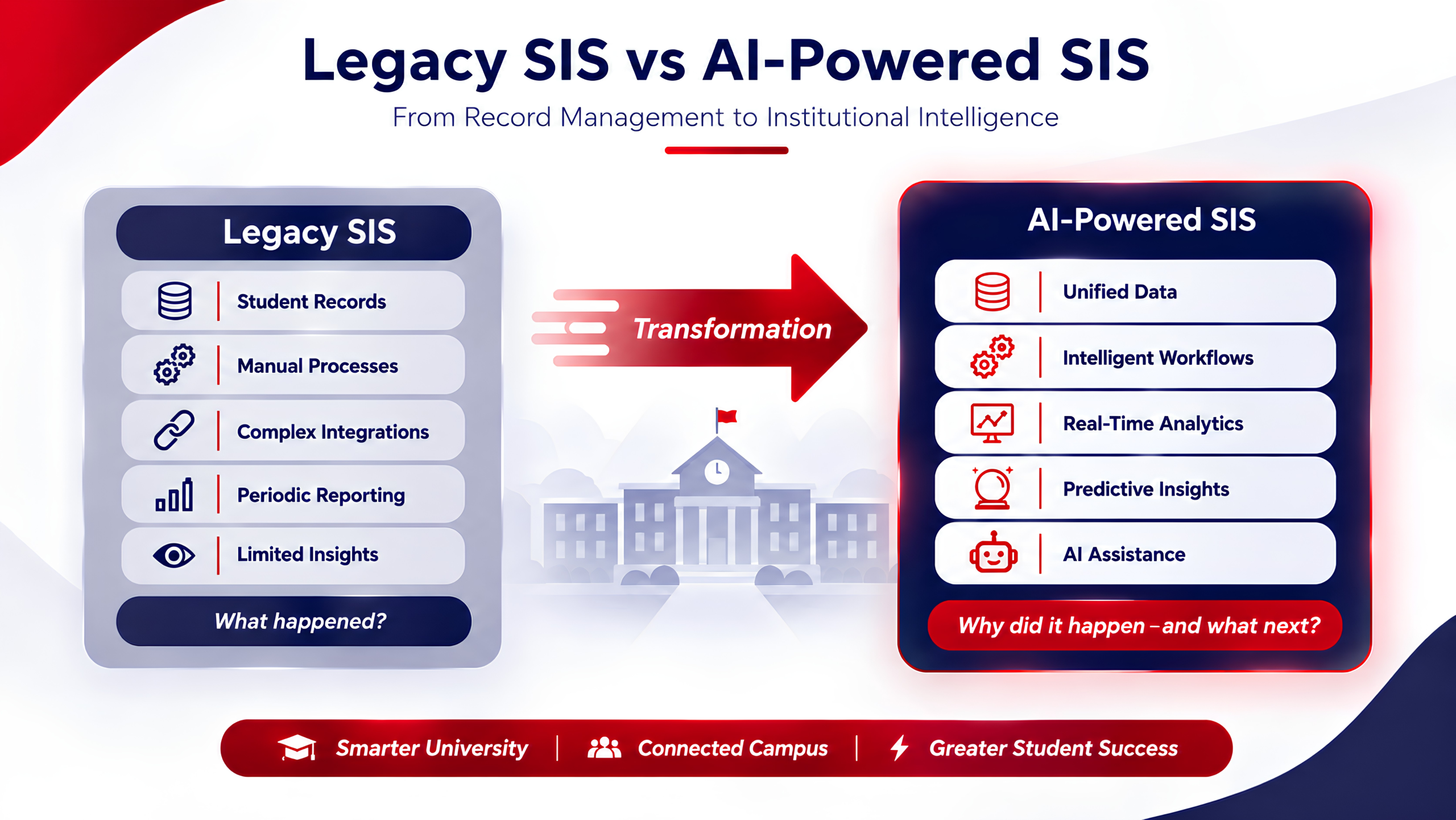
A legacy SIS primarily manages records and processes, while an AI-powered SIS extends those capabilities with automation, analytics, intelligent assistance, and predictive insights.
| Capability | Legacy SIS | AI-Powered SIS |
|---|---|---|
| Student records | ✓ | ✓ |
| Admissions | ✓ | ✓ |
| Academic management | ✓ | ✓ |
| Examinations | ✓ | ✓ |
| Finance | ✓ | ✓ |
| Workflow automation | Limited | Advanced |
| Real-time analytics | Limited | ✓ |
| Predictive insights | Limited | ✓ |
| AI assistance | Limited/add-on | Integrated |
| Integrations | Often complex | API-enabled |
| Cloud scalability | Varies | ✓ |
The real comparison is therefore not simply old technology versus new technology.
It is:
Record management versus institutional intelligence.
AI is becoming an important SIS consideration because universities are increasingly using AI across teaching, research, administration, and student services.
UNESCO’s 2025 global survey received 400 responses from UNESCO Chairs and UNITWIN Networks across 90 countries. It found that 19% of institutions already had a formal AI policy and another 42% were developing AI guidance, meaning 61% had either established or were developing institutional guidance.
The survey also found that 90% of respondents were using AI tools professionally, while nearly half were experimenting with AI in teaching. One in four reported that their university had already encountered ethical issues related to AI.
This makes AI governance part of SIS evaluation.
Universities should ask:
“Does this SIS have AI?”
But also:
“Can AI operate securely and responsibly using governed institutional data?”
Yes. AI-powered analytics can help universities move from periodic reporting towards faster, data-informed decision-making.
Consider enrolment management. A traditional report may show that enrolment is below target. Understanding why may require separate analysis of applications, offers, acceptance rates, programme demand, fees, and historical trends.
A connected SIS can bring these information sources together and make institutional patterns easier to identify.
Academia’s published analysis reports that institutions using AI-powered analytics can achieve up to 30–40% improvement in decision-making speed, while automation across admissions, examinations, and reporting can reduce manual workload by nearly 50%.
The larger opportunity is moving from:
“What happened?”
to:
“Why did it happen, and what should we do next?”
A modern SIS can reduce routine administrative work by automating repetitive processes and connecting workflows across departments.
Potential areas include:
Academia’s published analysis states that more than 60% of higher education administrators spend more than half their workday on tasks that add zero academic value. It also estimates that workflow automation can reduce routine administrative effort by 25–40%. The value of automation is therefore not simply fewer manual steps.
It is giving staff more time for work that requires human judgement and student interaction.
UAE universities should evaluate an SIS across data, automation, AI, integration, scalability, security, and student experience.
A trusted source of student and academic information should replace disconnected records wherever possible.
Admissions, academics, finance, examinations, and student services should support configurable workflows.
Look for real-time dashboards, predictive analytics, AI-powered reporting, and intelligent assistance, not simply an AI label.
The SIS should connect with LMS, finance, HR, CRM, payment gateways, identity systems, and other institutional applications.
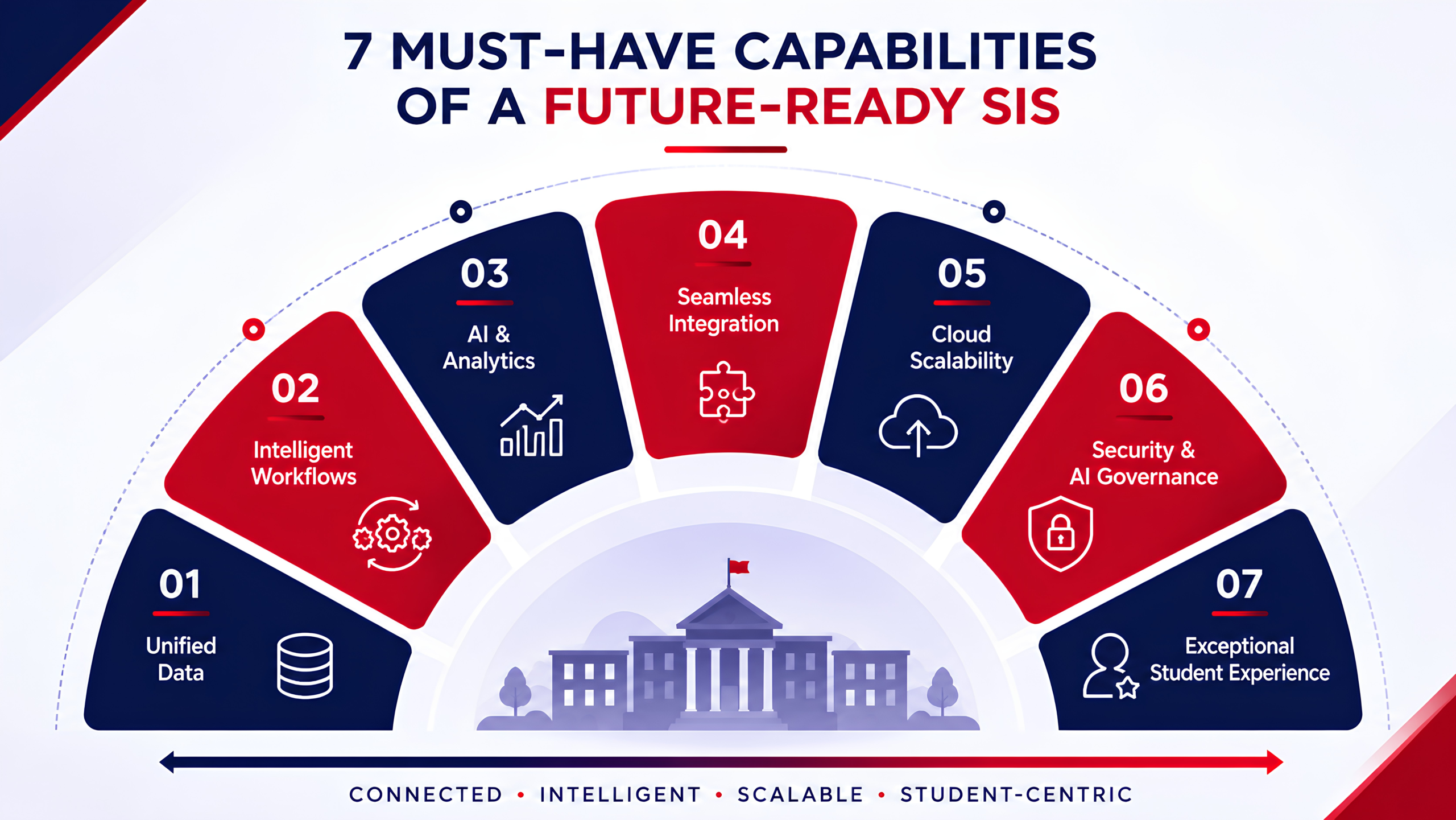
The platform should support growing enrolment, new programmes, multiple campuses, and changing institutional requirements.
Universities should assess permissions, privacy, audit trails, security controls, and responsible AI practices.
Students should be able to apply, register, view academic information, make payments, submit requests, and receive notifications through connected digital channels.
No. A legacy SIS is not automatically a bad system simply because it is older.
The real question is whether it can support the university’s future requirements.
University leaders should ask:
If several answers are no, modernisation or replacement deserves serious consideration.
Academia by Serosoft positions its platform as an AI-powered Student Information System designed specifically for higher education, combining student lifecycle management with workflow automation, analytics, integrations, and AI capabilities.
Academia supports areas including admissions, academics, examinations, fees, student services, graduation, alumni management, and institutional reporting. Its AI capabilities include SERA AI, AI-driven analytics, intelligent workflows, and AI-supported academic and operational insights.
For a university evaluating legacy SIS replacement, the important question is not simply how many modules a platform has.
It is whether the platform can connect:
Unified Data + Intelligent Workflows + Institutional Intelligence
The future of SIS is moving from digital record management towards intelligent institutional operations.
The next generation of platforms will increasingly help universities connect data, automate repetitive tasks, identify patterns, support students, and make decisions faster.
EDUCAUSE’s research shows that higher education institutions are already actively modernising their data environments, while UNESCO’s research shows that institutional AI guidance is becoming increasingly common.
For UAE universities, the strategic question is therefore no longer simply:
“Do we need an SIS?”
It is:
“Is our SIS ready for an AI-driven, data-connected university?”
The best Student Information System for a UAE university in 2026 is not necessarily the platform with the longest feature list.
It is the platform that best connects students, data, processes, systems, and decisions.
Legacy SIS platforms can continue to perform essential functions. But as universities modernise their data infrastructure and adopt AI, they increasingly need platforms that provide automation, interoperability, analytics, scalability, and responsible AI capabilities.
The evidence points towards a broader transformation: 68% of EDUCAUSE respondents were in the process of data modernisation, while only 1% considered their institution fully modernised. UNESCO also found that 61% either had an institutional AI policy or were developing AI guidance.
For UAE universities, the question is simple:
Is your current SIS helping you build the university of tomorrow or simply managing the university of today?
Whether you’re replacing a legacy system, modernising your existing SIS, or planning your university’s next phase of digital transformation, the right technology foundation can make all the difference.
Discover how Academia by Serosoft helps universities implement AI-powered Student Information Systems that streamline operations, improve institutional visibility, connect the complete student lifecycle, and support smarter decision-making.
Request Demo | Speak with an SIS Expert
The best SIS depends on each university’s requirements. Institutions should evaluate student lifecycle coverage, integration, AI, analytics, scalability, security, configurability, and student experience.
Universities may need to modernise when legacy technology creates fragmented data, manual workflows, difficult integrations, slow reporting, limited scalability, or inadequate AI readiness.
Yes. Universities should evaluate practical AI capabilities alongside data governance, security, permissions, transparency, and human oversight.
Yes. Modern SIS platforms can integrate with LMS, finance, HR, CRM, payment, identity, and other institutional systems through APIs and integration frameworks.
Academia by Serosoft provides an AI-powered higher education SIS combining student lifecycle management, workflow automation, analytics, integrations, and AI-enabled capabilities.

Experience Academia – Your partner in transforming campus operations, a trusted all-in-one ERP/SIS solution.
Get the latest insights, trends, and updates delivered straight to your inbox!