

Anjali Gupta
Estd. Reading Time : 4 Min.
18th Sep, 2026
Share On:
A student may see university life as a series of simple steps: apply, register, attend classes, pay fees, take exams and graduate. But behind every one of these moments is a growing trail of information. An application becomes an admission record, admission leads to registration, registration connects to courses, attendance and fees, and those records eventually feed into examinations, results, transcripts and graduation. The student experiences one journey; the university manages hundreds of connected data points along the way.
When these processes sit in separate systems, even simple requests can become complicated. A staff member looking for a student’s information may have to check multiple systems, spreadsheets or departmental records, while students may be asked to submit the same information more than once or follow up with different teams. A connected Student Information System (SIS) brings these processes into a shared digital environment, allowing information to move from admissions to registration, academics, fees, examinations and records with less manual intervention.
The impact goes beyond administrative efficiency. For students, connected processes can mean fewer forms, fewer follow-ups and faster access to services. For staff, it can mean less repetitive data entry, fewer reconciliation tasks and easier access to complete student information. For university leadership, connected data can provide greater visibility into enrolment, academic performance, finances and other institutional activities, creating a stronger foundation for informed decision-making.
This shift is also reflected in higher-education technology research. Gartner’s 2026 research highlights growing investment in data and analytics, AI outcomes and reducing technical debt, while its research on Student Information Systems points towards modernisation that supports student experience and measurable institutional outcomes. The important question, therefore, is not simply how many modules an SIS has, but how well those modules work together to turn individual student interactions into one connected, reliable record.
Student Information System modules are functional components that help universities manage specific areas of the student lifecycle, including admissions, registration, academics, attendance, examinations, fees, student records and reporting.
Think of them as connected chapters rather than separate systems:
Admissions → Registration → Academics → Attendance → Fees → Examinations → Records → Graduation
When these chapters share information, universities spend less time moving data between departments and more time using it.
The admissions module manages the first major interaction between a prospective student and the university.
It can support:
Imagine an applicant submitting their documents late at night. In a fragmented process, the application may sit in an inbox until someone manually checks it.
A structured admissions workflow can capture the application, update its status and route the next action to the appropriate team.
Admissions is therefore not simply about collecting applications. It creates the foundation of the student’s institutional record.
After admission comes registration, the point where an applicant becomes an active student.
A registration module can manage:
Consider a student who changes programmes after the first semester.
In a disconnected environment, staff may have to update academic records, finance information and other departmental systems separately.
With connected workflows, the relevant information can move through the appropriate processes without repeatedly recreating the same student record.
This is where a single source of truth starts to have real operational value.
Examinations are more than scheduling rooms and entering marks.
An examination and results module can support:
Think about results day from a student’s perspective. Results can determine whether they progress, graduate, retain a scholarship, or meet a requirement for their next opportunity.
That makes accuracy essential.
The journey becomes:
Assessment → Marks → Results → Transcript → Student Record
A connected examination module helps reduce the manual movement of information between these stages.
Fees are another part of the student journey that cannot exist in isolation.
A fees module can manage:
Imagine a student paying their semester fees online.
The important question is not only whether the payment was received. The university also needs the student’s financial status accurately reflected in relevant administrative and academic workflows.
The more connected the process, the fewer times staff have to reconcile the same information manually.
The student records module sits at the heart of the entire lifecycle.
It can bring together:
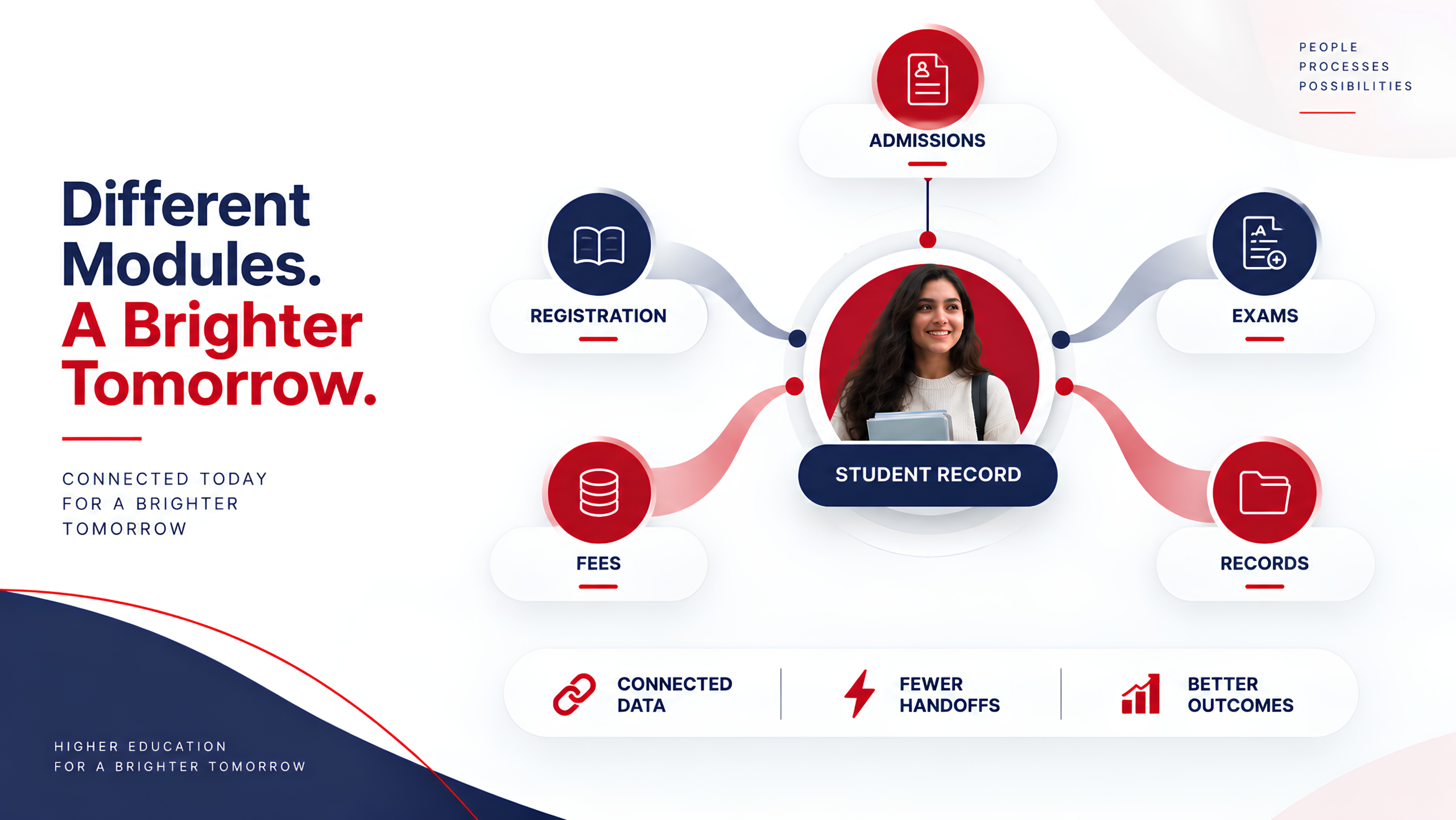
A transcript, for example, should not be viewed as a document someone creates at the end of a student’s journey. It is the visible outcome of years of information captured and maintained throughout that journey.
That is why the quality of the student record matters at every stage, not just at graduation.
This is where the difference between having modules and having a connected SIS becomes clear.
A typical connected flow looks like this:
CAPTURE → CONNECT → UPDATE → AUTOMATE → REPORT
For example:
Application submitted
↓
Student record created
↓
Registration completed
↓
Academics, attendance and fees updated
↓
Examination results added
↓
Transcript and institutional reports generated
The real question is therefore not:
“Does the SIS have an admissions module?”
It is:
“What happens to the information after the admissions module captures it?”
| Fragmented Environment | Connected SIS |
|---|---|
| Repeated data entry | One consistent student record |
| Spreadsheet reconciliation | Connected workflows |
| Delayed reporting | Faster access to information |
| Manual status updates | Automated processes |
| Students depend on staff | Greater self-service |
| Data silos | Connected institutional insights |
This emphasis on connected data reflects a wider shift in higher education technology. The 2025 EDUCAUSE Horizon Report on Data and Analytics describes data and analytics as a critical foundation for institutional strategy, decision-making and student success. It also highlights the increasing complexity created by the rapid growth of AI.
For universities, digital transformation therefore cannot stop at putting forms online. The underlying data must also be reliable, connected and usable.
AI becomes more useful when the data beneath it is connected.
A modern SIS can use AI and analytics to support:
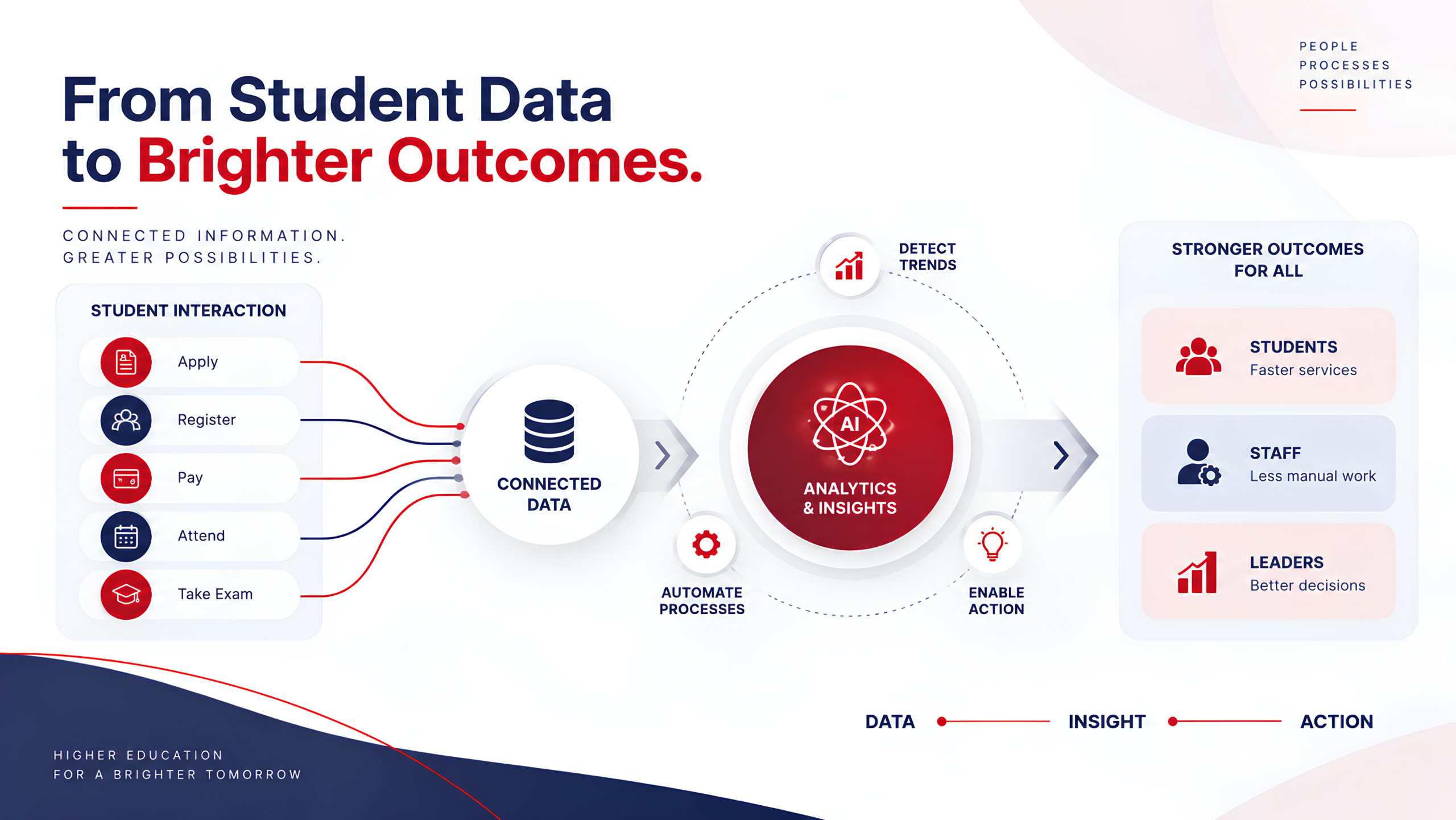
Academia’s published analysis reports that more than 60% of higher-education administrators spend over half their workday on tasks that add zero academic value, while its analysis estimates that workflow automation can reduce routine administrative effort by 25–40%. These are Academia’s published figures rather than independent sector-wide benchmarks.
The point is bigger than automation.
If staff spend less time searching, compiling and reconciling information, they have more time for work that requires judgement and human interaction.
An SIS should not be evaluated only by the number of modules it offers.
Universities can measure impact through practical indicators such as:
Academia provides 800+ standard reports and dashboards and 400+ AI-powered reports, giving institutions tools to analyse academic and operational information across the university. These are Academia’s published platform figures.
The important step is to compare these capabilities with the university’s own baseline and define measurable outcomes before implementation.
Instead of asking only whether an SIS has every individual module, universities should ask whether those modules can work together.
Look for:
One question can reveal a great deal during a vendor evaluation:
“Can you demonstrate how our actual university workflow would work in your system?”
A product presentation shows features. A workflow demonstration shows how those features come together.
Academia by Serosoft brings key higher-education processes including admissions, student records, academics, attendance, examinations, fees, student services and reporting into a connected digital environment.
Its platform provides 800+ standard reports and dashboards alongside 400+ AI-powered reports, helping institutions move from manually compiling information towards more accessible institutional intelligence.
The goal is not simply to give universities more software.
It is to help different departments work from connected information and shared processes.
When admissions, registration, academics, examinations, fees and student records operate as connected parts of the same ecosystem, universities can reduce unnecessary administrative handoffs while gaining greater visibility across the student journey.
Request Demo of Academia and explore how a connected Student Information System can support your institution’s workflows.
The main SIS modules commonly include admissions, registration and enrolment, academics, attendance, examinations, fees, student records, student services and reporting.
An admissions module manages applications, documents, eligibility, admission decisions, communication and related workflows.
A student records module maintains student information, academic history, documents, results, progression and graduation records.
Connected SIS modules allow relevant information to move between university processes, reducing duplicate data entry and manual reconciliation.
Yes. Modern SIS platforms can use AI for reporting, analytics, workflow automation, natural-language queries and identifying patterns in institutional data.

Experience Academia – Your partner in transforming campus operations, a trusted all-in-one ERP/SIS solution.
Get the latest insights, trends, and updates delivered straight to your inbox!