


Pankaj Joshi
Estd. Reading Time : 4 Min.
25th Jan, 2026
University Management Software
Share On:
“The best way to predict the future is to create it.” — Peter Drucker
This quote resonates strongly with universities across the Middle East. Higher education institutions in the Gulf are not just responding to change, they are actively shaping the future of education. However, ambition alone is not enough. Without the right digital foundation, even the most forward-looking institutions struggle to scale efficiently.
Consider a growing university in the UAE or Saudi Arabia. Student enrollments are increasing, programs are expanding, and regulatory expectations are becoming more structured. Yet, academic data is spread across departments, reporting cycles are stressful, and leadership lacks real-time visibility. This is where the need for a robust university management system becomes critical.
A university management system is a centralized digital platform that connects every core academic function of a higher education institution into one unified ecosystem. It brings admissions, student records, attendance, assessments, examinations, and academic reporting onto a single source of truth. Instead of departments operating in silos, data flows seamlessly across teams, campuses, and leadership levels.
For higher education institutions in the UAE and Saudi Arabia, this means structured academic execution, real-time visibility into institutional performance, and the ability to meet regulatory and accreditation requirements with confidence—without relying on manual coordination or last-minute reporting.
Result-oriented strategies unfolding ahead. Keep reading the blog to learn more.
Universities across the Gulf countries operate in a unique environment. Rapid infrastructure development, international collaborations with other universities for joint degree programs, and government-led education reforms are accelerating institutional growth. At the same time, compliance, transparency, and data accuracy are non-negotiable.
As institutions scale across campuses and programs, manual coordination and disconnected systems quickly become bottlenecks. Academic teams feel the pressure, and leadership struggles to gain a consolidated view of institutional performance.
This growing complexity is why many institutions in the Middle East are re-evaluating their digital backbone and moving toward a centralized university management system.
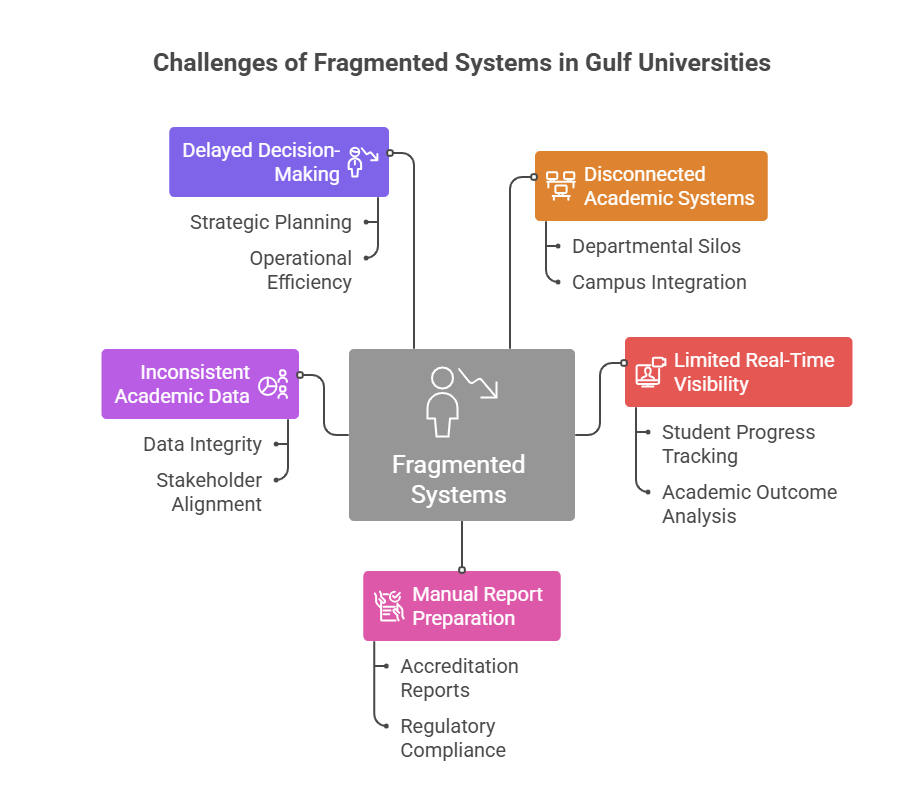
What once worked for smaller institutions is no longer sufficient for universities aiming to compete regionally and globally. Common challenges faced by Gulf universities include:
Individually, these challenges slow operations. Collectively, they restrict institutional growth and credibility. In a region where education quality is closely tied to national vision, this risk cannot be ignored.
When universities in the UAE, Saudi Arabia, Qatar, and across the Gulf face fragmented data and manual processes, Academia’s AI-powered university management system (UMS) steps in as the strategic backbone for campus operations.
Built for institutions scaling rapidly and operating across multiple colleges and programs, Academia unifies every academic and administrative function on a single intelligent platform. It automates core processes, from admissions and enrollment to exams, attendance tracking, curriculum, and curriculum completion, so that academic teams no longer juggle spreadsheets or disconnected systems, and leadership can rely on a single source of truth for institutional data.
With more than 40+ configurable modules, dedicated web portals, mobile apps, and real-time interoperability, Academia ensures every stakeholder, students, faculty, and administrators work in harmony, saving time and reducing operational friction across departments.
Across the Middle East, universities are at an inflection point. Growth is accelerating, but expectations are rising even faster.
Institutions that delay digital transformation risk operational inefficiencies and reputational impact. In contrast, universities that invest in a scalable university management system are positioning themselves as future-ready education leaders.
Adopting an academic ERP is no longer about operational convenience. It is a strategic decision that defines how institutions compete, comply, and grow in the Gulf region.
The Middle East has a clear vision for higher education excellence. To realize this vision, universities need systems that support scale, governance, and innovation.
A unified university management system, like Academia, transforms complexity into clarity. It enables institutions to move faster, operate smarter, and lead with confidence.
For Gulf universities, the real advantage lies not just in adopting technology, but in choosing a system that aligns with regional realities and long-term growth goals.
The future of higher education in the Middle East will belong to institutions that act today.
Get in touch with our team of experts and get your free demo today!

Experience Academia – Your partner in transforming campus operations, a trusted all-in-one ERP/SIS solution.
Get the latest insights, trends, and updates delivered straight to your inbox!