

Michele Du Rand
Estd. Reading Time : 4 Min.
14th Aug, 2026
Share On:
Choosing a Student Information System (SIS) is becoming a strategic decision for South African universities. It influences how institutions manage admissions, enrolment, academic records, examinations, fees, reporting, student services, and institutional data.
South Africa’s public higher education institutions recorded 1,115,580 enrolments in 2024, a 4.1% increase from 2023. With growing student numbers, multiple learning modes, regulatory reporting, and rising expectations for digital services, universities need more than a system that simply stores student records.
This guide explores what South African universities should look for in an SIS in 2026, from student lifecycle management and HEMIS reporting to NSFAS workflows, POPIA-aligned data protection, automation, AI-powered analytics, integrations, scalability, and implementation support. It also covers the key questions universities should ask when evaluating SIS vendors and choosing a platform that can support their institution today and scale with it tomorrow.
The real question is:
What should South African universities look for when choosing an SIS that can support their institution today and scale with it tomorrow?
A Student Information System acts as the digital foundation for university operations, connecting admissions, enrolment, academics, examinations, fees, student services, and institutional reporting. This becomes increasingly important as institutions manage growing volumes of student data. DHET’s latest available statistics, based on HEMIS data, recorded 1.07 million students across South African public higher education institutions in 2023, with overall public and private higher education enrolment reaching 1.36 million.
With this scale of data, universities need an SIS that can maintain accurate records, connect workflows, reduce duplication, and provide reliable institutional reporting. The goal is not simply to digitise processes, but to create a connected university where data, people, and systems work together.
Before evaluating vendors, universities should identify where their current systems create friction, such as fragmented student data, spreadsheet-based reporting, duplicate data entry, manual workflows, or limited digital student services. This challenge is becoming more relevant as institutions modernise their data environments. EDUCAUSE’s 2025 Data Modernisation QuickPoll found that 68% of respondents were already in the process of modernising institutional data, with operational efficiency, student success, and data-driven decision-making among the key drivers.
A modern SIS should address these gaps by connecting data, automating routine processes, and providing a unified view of the student lifecycle, helping universities move from fragmented administration to more efficient, data-driven operations.
The SIS should support the student journey from application and admission to registration, academics, examinations, graduation, and alumni engagement.
Universities should evaluate how the platform supports local reporting requirements and institutional data structures, including DHET and HEMIS-related processes.
Student funding is an important operational area. Universities should assess whether the SIS can support relevant funding workflows, student financial information, notifications, and reconciliation processes.
Student information is sensitive institutional data. Universities should evaluate role-based access, permissions, audit trails, data security, privacy controls, and how the vendor approaches POPIA-aligned data governance.
Admissions, approvals, registration, examinations, fee notifications, student requests, and reporting should not depend unnecessarily on manual processes.
A modern SIS should help institutions move beyond static reports towards dashboards, intelligent reporting, pattern identification, and faster decision-making.
The SIS should connect with LMS platforms, finance systems, HR, CRM, payment gateways, identity systems, and other university applications through appropriate integration frameworks and APIs.
The platform should support growing enrolment, new programmes, multiple campuses, distance learning, and changing institutional requirements without creating additional silos.
Cloud-based SIS platforms can provide advantages such as scalability, accessibility, easier updates, and integration capabilities.
However, cloud versus on-premise should not be treated as a simple technology preference.
Universities should evaluate:
The right choice depends on the institution’s infrastructure, strategy, security requirements, and long-term digital roadmap.
A feature list alone is not enough to select an SIS.
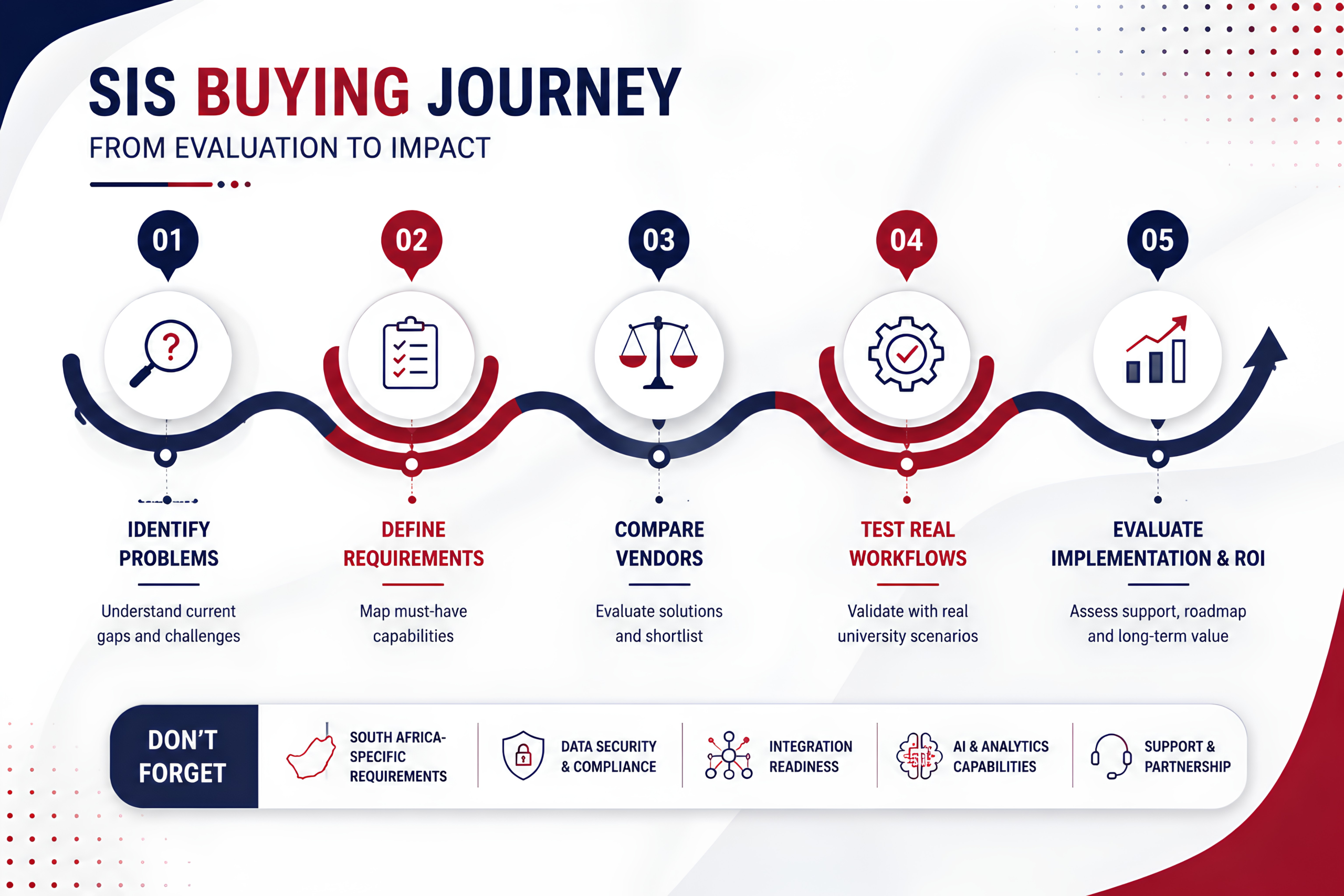
Universities should compare vendors across five areas:
| Evaluation Area | What to Check |
|---|---|
| Functionality | Student lifecycle, academics, admissions, examinations, fees |
| South African Requirements | DHET, HEMIS, NSFAS and local reporting needs |
| Technology | Cloud, APIs, integrations, scalability and security |
| Intelligence | Analytics, dashboards, AI and automation |
| Implementation | Migration, configuration, training, support and roadmap |
The strongest vendor evaluation is based on real institutional workflows.
Instead of asking a vendor to show every feature, ask them to demonstrate how the platform would handle a real admission cycle, registration process, examination workflow, student request, or reporting requirement.
Before signing a contract, decision-makers should ask:
These questions help universities evaluate not only what an SIS does today, but whether it can remain relevant over the next five to ten years.
Academia by Serosoft is an AI-powered Student Information System designed for higher education institutions, bringing student lifecycle management, automation, analytics, and institutional reporting together on a unified platform.
For the South African market, Academia highlights capabilities including NSFAS management, NSC results integration, HEMIS and TVET MIS reporting, along with admissions, academics, examinations, fees, and student services.
The platform also provides AI-powered analytics and reporting through SERA AI, helping institutions move from manual reporting towards more accessible institutional insights.
Academia’s South African experience includes institutions such as False Bay TVET College, where its platform has supported digital processes across admissions, applications, reporting, and institutional operations.
Academia’s published analysis reports that AI-powered analytics can deliver up to 30–40% improvement in decision-making speed, while automation across areas such as admissions, examinations, and reporting can reduce manual workload by nearly 50%.
These figures are Academia’s own published analysis rather than independent South African research, so universities should use them as vendor-reported benchmarks rather than guaranteed outcomes.
A separate Academia analysis estimates that workflow automation can reduce routine administrative effort by 25–40%.
The larger opportunity is to shift administrative teams away from repetitive data work and towards activities that require human judgement and student interaction.
The future of SIS is moving from record management to institutional intelligence.
A future-ready platform should connect data across departments, automate routine processes, provide real-time visibility, support local reporting requirements, and create better digital experiences for students and staff.
AI is also becoming part of this conversation. UNESCO’s 2025 global survey received 400 responses across 90 countries and found that nine in ten respondents were using AI tools professionally. The survey also highlighted the growing need for institutional guidance around responsible AI use.
For South African universities, this means AI capabilities should be evaluated alongside security, governance, transparency, and human oversight.
Choosing a Student Information System in 2026 is about more than selecting software with the largest number of modules.
South African universities need to consider local reporting requirements, student lifecycle management, data governance, integrations, automation, analytics, AI, scalability, and implementation support.
The right SIS should help an institution answer three fundamental questions:
Do we have the right data?
Can we access it when we need it?
Can we use it to make better decisions?
As South African higher education continues to grow and modernise, the SIS can become more than an administrative platform.
It can become the digital foundation for a more connected, efficient, data-driven university.
Higher education is becoming more connected, data-driven, and AI-enabled. The right SIS can help your institution move beyond fragmented processes and build a stronger digital foundation for growth.
See how Academia by Serosoft brings student data, academic operations, reporting, automation, and AI-powered insights together to help South African universities operate smarter and serve students better.
Request Demo | Talk to Our SIS Experts
A Student Information System is a central platform used by universities to manage student, academic, administrative, financial, and institutional information throughout the student lifecycle.
Universities should evaluate student lifecycle coverage, DHET and HEMIS-related reporting, NSFAS workflows, POPIA-aligned data governance, integrations, automation, analytics, AI, scalability, security, and implementation support.
This depends on the platform. Universities should specifically ask vendors to demonstrate how their solution manages HEMIS-related data, validation, reporting workflows, and institutional requirements.
An SIS handles significant amounts of personal and student information. Universities should therefore assess privacy controls, access management, security, auditability, and the vendor’s approach to POPIA-aligned data governance.
AI is not valuable simply because it is included as a feature. Universities should evaluate whether AI can provide practical benefits through reporting, analytics, automation, assistance, and decision support while maintaining appropriate governance.
Yes, cloud-based platforms can be designed to support multiple campuses and growing enrolment. However, universities should evaluate scalability, configuration, security, integrations, and performance before selecting a platform.
Academia provides an AI-powered higher education SIS covering admissions, academics, examinations, fees, student services, analytics, automation, and reporting. Its South African capabilities include support for NSFAS management, NSC results integration, HEMIS and TVET MIS reporting.

Experience Academia – Your partner in transforming campus operations, a trusted all-in-one ERP/SIS solution.
Get the latest insights, trends, and updates delivered straight to your inbox!