

Gaurav Koriya
Estd. Reading Time : 4 Min.
17th Jan, 2026
Campus Management System
Share On:
Every admission season in India tells the same story. Campuses buzz with activity, teams work overtime, and leadership expects seamless execution.
Yet behind the scenes, administrators juggle spreadsheets, departments chase missing data, and reports are stitched together at the last moment. The ambition is digital transformation, but the reality often feels anything but digital.
As Indian institutions expand student intake, launch new programs, and respond to regulatory bodies, operational complexity increases. This is exactly where erp for colleges becomes a necessity rather than a long-term plan.
India’s higher education ecosystem is evolving rapidly. Institutions are expected to scale without compromising academic quality, compliance, or student experience. However, many colleges still rely on disconnected systems that were never designed to work together.
Admissions data may sit in one tool, academics in another, and examinations somewhere else entirely. As a result, leadership lacks real-time visibility, teams depend on manual effort, and compliance reporting becomes stressful instead of structured. Without a unified campus management system software, operational efficiency remains a challenge, no matter how experienced the staff may be.
Legacy systems often solve isolated problems but fail to support the institution as a whole. Over time, this leads to duplicated work, inconsistent data, and delayed decisions. Moreover, regulatory reporting, NAAC preparation, and internal audits demand accuracy and traceability, something manual processes struggle to deliver consistently.
This is where a modern erp for colleges plays a transformative role, acting as a single operational backbone rather than just another system.
For Indian colleges, the expectation from technology has changed. Institutions now look for systems that reduce workload, improve coordination, and support long-term growth, not just automate tasks.
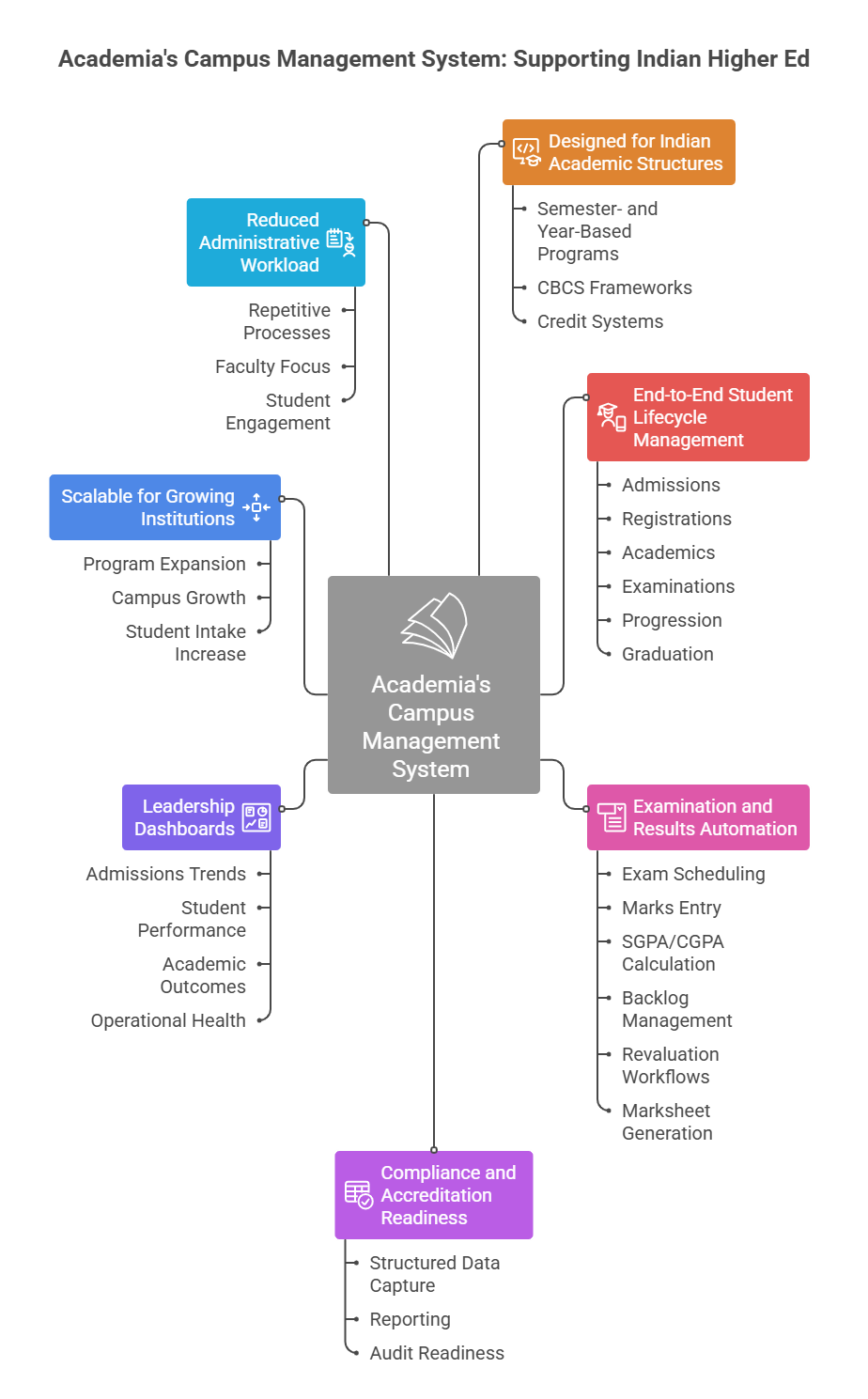
A purpose-built campus management system software enables institutions to standardize workflows, centralize data, and create transparency across departments. When data flows seamlessly from admissions to academics to examinations, reporting becomes reliable and decision-making improves significantly.
These capabilities ensure that daily operations support strategic goals rather than slowing them down.
Once implemented effectively, erp for colleges changes how institutions operate at every level. Administrative teams spend less time reconciling data. Faculty benefit from structured academic processes. Leadership gains confidence in reports and analytics used for planning and governance.
Most importantly, students experience smoother journeys, from application to graduation, without being affected by internal inefficiencies. This is the tangible impact of adopting the right campus management system software.
With increasing competition, stricter accreditation norms, and higher expectations from students and parents, institutions can no longer afford fragmented operations. Colleges that delay modernization often find themselves constrained by systems that cannot scale or adapt.
In contrast, institutions that invest early in erp for colleges build resilience, improve institutional credibility, and position themselves for sustainable growth in a dynamic education landscape.
Digital transformation is no longer about adding tools; it’s about building a connected operational ecosystem. A well-implemented campus management system software like Academia allows Indian institutions to move from reactive administration to proactive governance.
Keen to know more about Academia’s efficiency-enabling features and capabilities? Reach out to our team of experts, as they will be happy to assist you.

Experience Academia – Your partner in transforming campus operations, a trusted all-in-one ERP/SIS solution.
Get the latest insights, trends, and updates delivered straight to your inbox!