Universities across the world are asking the same critical questions:
Why are compliance audits becoming more difficult despite having multiple systems?
Why does regulatory reporting take weeks of manual effort?
Why do data discrepancies keep appearing across admissions, academics, and examinations?
The root cause, in most cases, is not a lack of effort or intent; it is the presence of fragmented, disconnected systems operating without a unified governance framework.
This blog examines why fragmented digital ecosystems pose one of the biggest compliance risks for universities today, and why relying on standalone tools, legacy platforms, and manual reconciliation is no longer sustainable.
It explores how disconnected data flows weaken audit trails, increase data governance risks, and place CIOs under constant operational pressure. More importantly, it explains why modern institutions are moving toward a unified University Solution.
If your institution is struggling with reporting accuracy, audit readiness, or system sprawl, this analysis will help you understand the risk and the strategic path forward.
If you’re a CIO or IT leader in higher education, compliance is not an annual task. It’s a continuous obligation.
Accreditation audits.
Data protection regulations.
Funding disclosures.
Student record accuracy.
Assessment traceability.
Yet the biggest compliance risk today isn’t negligence.
It’s fragmentation.
Across universities globally, institutions operate with disconnected admissions systems, standalone LMS platforms, finance tools, examination modules, and countless spreadsheets stitched together with manual effort.
Even a single spreadsheet can be misplaced, and you lose part of your data.
Isn’t that scary? Indeed, it is.
Before we move ahead in this blog, have a quick look at what industry figures reveal.
Academia Insight:
According to Gartner, poor data quality costs organizations an average of $12.9 million annually. In higher education, that cost manifests as audit findings, funding risks, and reputational damage.
Fragmented systems are not just inefficient.
They are structurally non-compliant.
This is why institutions are shifting toward a unified University Solution built on an integrated architecture.
Let’s break this down practically.
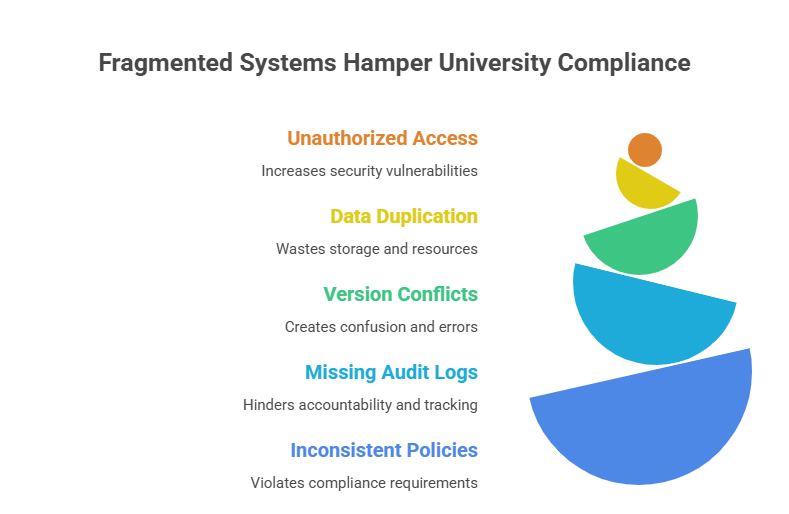
When systems don’t talk to each other, the information flow remains interrupted:
Compliance requires traceability, and traceability demands accessibility.
If your institution cannot produce a full academic lifecycle trail, from application to graduation, within hours, not weeks, you are exposed.
A study by Deloitte found that organizations with siloed systems experience significantly higher reporting delays and compliance risk due to inconsistent data governance structures.
For universities, this translates to:
Fragmentation doesn’t fail loudly.
It fails slowly until audit season arrives.
Most CIOs I speak with don’t lack systems.
They lack confidence in their data.
You may have:
But when the regulator asks for:
Can your systems provide a unified, verifiable dataset?
Or does your team manually reconcile across platforms?
Compliance isn’t about having tools.
It’s about having a structured, governed University Solution that ensures data consistency by design.
Manual processes are still deeply embedded in universities.
Spreadsheets for grade moderation.
Email-based approvals.
Offline attendance uploads.
Manual transcript corrections.
Academia Insight:
According to IBM, the global average cost of a data breach reached $4.45 million in recent reports, with poor data governance being a key contributing factor.
In universities, fragmented systems introduce multiple operational challenges like:
However, the key foundations of compliance frameworks are:
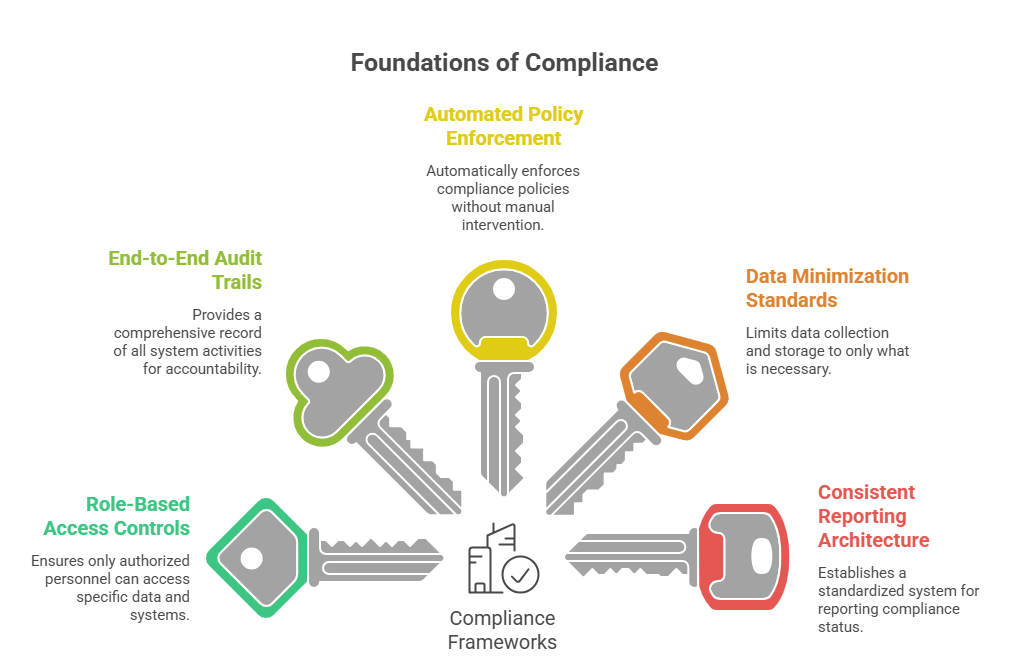
Only an integrated University ERP can enforce governance at the architectural level.
The Window for Delaying ERP Migration Is Closing Fast
Many institutions delay ERP migration because:
But here’s the strategic reality:
Maintaining fragmented systems increases long-term operational risk exponentially.
Every year you delay modernization:
Migration is not a technology upgrade.
It is a governance reset.
If you are evaluating modernization, your University Solution must include:
All admissions, academics, attendance, assessments, and reporting within a single system.
Compliance is enforced at the permission level—not through policy documents alone.
Digitized approvals, moderation trails, attendance validations, and progression checks.
Real-time dashboards replacing spreadsheet consolidation.
API-enabled integration without compromising centralized governance.
A properly designed University ERP doesn’t just connect systems.
It eliminates silos.
Ask yourself:
If a regulator conducted a surprise compliance review tomorrow, could your institution:
If the answer involves manual effort, disconnected exports, or data reconciliation…
Fragmentation is already your biggest compliance risk.
The future of higher education IT is not system accumulation.
It is an architectural consolidation.
A unified University Solution like Academia ensures that compliance is embedded into operations, not retrofitted during audits.
For CIOs, this isn’t about modernization trends.
It’s about institutional resilience.
Because in today’s regulatory climate, fragmentation is no longer inefficiency.
It is a liability.

Experience Academia – Your partner in transforming campus operations, a trusted all-in-one ERP/SIS solution.
Get the latest insights, trends, and updates delivered straight to your inbox!