Q1. Is a campus management system only for large universities?
No. It is arguably more critical for mid-sized institutions. Universities scaling across cities in Thailand, Vietnam, Kazakhstan, or Uzbekistan face the same operational complexity as large institutions, often without the same IT resources. A campus management system unifies admissions, academics, fees, attendance, and exams on one platform, eliminating silos and manual errors that stall growth at every scale.
Q2. How is an Education ERP different from the HR or finance software we already use?
Standard ERP tools are built for businesses. An Education ERP is purpose-built for the academic lifecycle; it understands semesters, CGPA calculations, OBE reporting, accreditation workflows, and student progression. Institutions that patch together general business software end up with fragmented data, frustrated faculty, and students who fall through the cracks.
Q3. How long does a campus ERP implementation take?
A well-guided campus ERP implementation typically takes 8 to 16 weeks, depending on campus count and data migration complexity. Modules are activated in phases so live operations continue uninterrupted. Most institutions report measurable efficiency gains within the first semester of go-live.
Southeast Asia is experiencing one of the most significant expansions in higher education globally. Enrollment is rising sharply across Thailand, Vietnam, Singapore, Kazakhstan, and Uzbekistan, driven by a young population and growing government investment in tertiary education.
The Southeast Asia EdTech market reached USD 10.7 billion in 2024 and is projected to grow at a CAGR of 14.7%, reaching USD 41.5 billion by 2033. (Source: IMARC Group)
Yet growth alone does not guarantee readiness. As student populations increase, the complexity of running a university multiplies.
Admissions backlogs, fragmented academic records, and manual attendance tracking are the everyday reality at hundreds of universities still relying on spreadsheets and outdated legacy systems.
A modern campus management system is the operational backbone that makes sustainable growth possible.
Universities in Almaty and Astana are under pressure to meet international accreditation standards and support OBE reporting. The best ERP for higher education here must handle multi-language interfaces and compliance with national qualification frameworks, both core to Academia ERP for universities and colleges.
Uzbekistan is not just adopting digital transformation; it is formalizing it through a national AI strategy and regulatory framework aimed at 2030. With clear mandates to build AI capabilities across higher education, institutions are now expected to move beyond basic digitization toward intelligent, data-driven systems.
As a result, universities in Tashkent need Education ERP platforms that are AI-ready.
Thailand’s diverse higher education ecosystem, from large public universities in Bangkok to private international colleges in Chiang Mai, requires precise credit transfer management, multilingual workflows, and compliance documentation. Academia ERP for colleges and universities supports these cross-program complexities natively.
Singapore institutions already operate at high digital maturity. The focus is predictive analytics for student retention, seamless integration with industry partners, and real-time institutional dashboards. Academia ERP’s analytics and API-ready architecture align with this smart campus vision.
Vietnam’s sector has seen explosive growth over the past decade. Many institutions still manage operations through local tools and manual processes. The need for a centralised campus management system is acute, especially for admissions and enrollment management software that can reflect real-time applicant status to digitally savvy prospective students.
The Asia-Pacific EdTech market generated USD 59.8 billion in 2024 and is projected to reach USD 285.1 billion by 2034, with a CAGR of 16.9%, driven by higher education technology adoption.
Five Pain Points a Campus Management System Directly Resolves
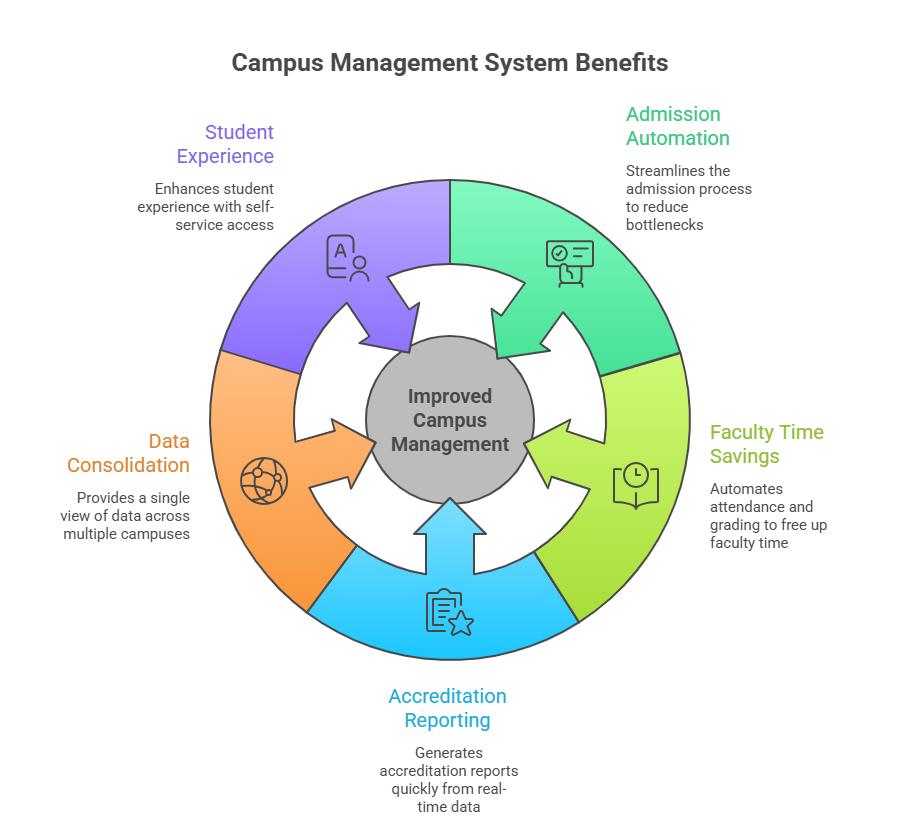
When applicants receive no updates for days, they enroll elsewhere. Admissions and enrollment management software automates the entire funnel, intake, verification, shortlisting, communication, and automatic offer letter issuance, cutting processing time from weeks to hours.
Automated attendance, biometric or QR-based, feeds directly into the campus management system, triggering alerts to students and counselors. This eventually frees faculty members to dedicate that time to teaching.
AI-driven reporting and analytics within a higher education ERP transform accreditation from a manual, time-intensive process into a continuous, intelligent workflow, generating compliance-ready reports from real-time data in days, not months.
A centralised Education ERP gives leadership a single consolidated view of enrollment, finance, and academic performance across every campus, while each campus retains its own operational configuration.
Students expect self-service access to results, timetables, and fee statements from their phones. Academia ERP’s student portal and mobile app deliver this seamlessly, improving student experience and reducing dropout risk.
The universities that will lead Southeast Asia’s next decade are making the right technology decisions today. A modern campus management system is not a back-office tool; it is the foundation for growth, quality, and competitive standing.
Whether you lead a university in Tashkent, a college in Bangkok, a polytechnic in Singapore, or a new institution in Hanoi, the question is not whether you need an Education ERP.
It is how much longer you can afford to operate without one.

Experience Academia – Your partner in transforming campus operations, a trusted all-in-one ERP/SIS solution.
Get the latest insights, trends, and updates delivered straight to your inbox!