

Amit Kulkarni
Estd. Reading Time : 4 Min.
13th Mar, 2026
Share On:
The Data, the Disruption, and the Decision Every University Leader Must Make
Quick Overview: Your Questions Answered
Q1: What is an Education ERP?
An Education ERP (Enterprise Resource Planning) is an integrated software platform built specifically for educational institutions. It connects all operations — admissions, academics, finance, HR, hostel, library, and more- into a single unified system, eliminating data silos and manual processes.
Q2: Who needs an Education ERP?
Any school, college, or university managing 500+ students, multiple departments, or complex administrative workflows can benefit. It’s especially critical for institutions running disconnected legacy systems, experiencing rapid enrollment growth, or preparing for accreditation.
Q3: How is a Higher Education ERP different from a school ERP?
A Higher Education ERP is designed for universities, colleges, and polytechnics with added complexity — multiple campuses, autonomous departments, research management, alumni tracking, regulatory compliance (NAAC, NBA, UGC), and advanced analytics. It goes beyond basic school management into institutional intelligence.
Q4: What does an Education ERP typically cost?
Costs vary widely based on institution size, modules, and deployment model (cloud vs. on-premise). Most institutions find that the ROI from reduced manual work, fewer errors, improved collections, and better compliance far outweighs the investment within 12–24 months.
There’s a problem hiding in plain sight inside most educational institutions today.
It doesn’t appear in the annual report. It doesn’t come up in faculty senate meetings. But it costs institutions hundreds of hours every week, contributes to student frustration, delays critical decisions, and quietly erodes competitive advantage.
The problem is fragmentation.
Admissions run on one system. Finance runs on spreadsheets. The academic office uses a legacy SIS. HR has its own database. The exam cell? A combination of email chains and printed registers.
And somewhere in between all of this, a student is waiting three days for a No Objection Certificate that should take three minutes.
Academia Insight:
According to a 2024 survey by the Education Technology Alliance, over 67% of university administrators report spending more than 30% of their workweek on tasks that could be automated, tasks like data re-entry, report compilation, and manual approvals.
That’s one-third of your team’s time. Every week. Year after year.
This is the institutional cost of not having a unified Education ERP. In 2026, with enrollment competition at an all-time high and accreditation bodies raising the bar, it’s a cost institutions can no longer afford to absorb.
Let’s ground this conversation in data, because the scale of the opportunity becomes impossible to ignore once you see it.
These aren’t abstract figures. They represent real students who feel let down, real staff members burning out on avoidable work, and real institutional reputations at stake.
Academia Insight
A 2024 McKinsey Education Report found that institutions that adopted integrated ERP solutions saw a 34% improvement in administrative efficiency within the first year of implementation.
Additionally, 58% of higher education CIOs ranked ‘system integration’ as their top technology priority, ahead of AI tools and cybersecurity.
Source: McKinsey Global Education Survey 2024 | EdTech Alliance Annual Report 2024
The message is clear: the institutions investing in unified systems are pulling ahead, and the gap is widening every academic year.
Let’s clear up a common misconception first.
An Education ERP is not just a student management system. It’s not a fee collection app or a digital attendance register dressed up in a fancy interface.
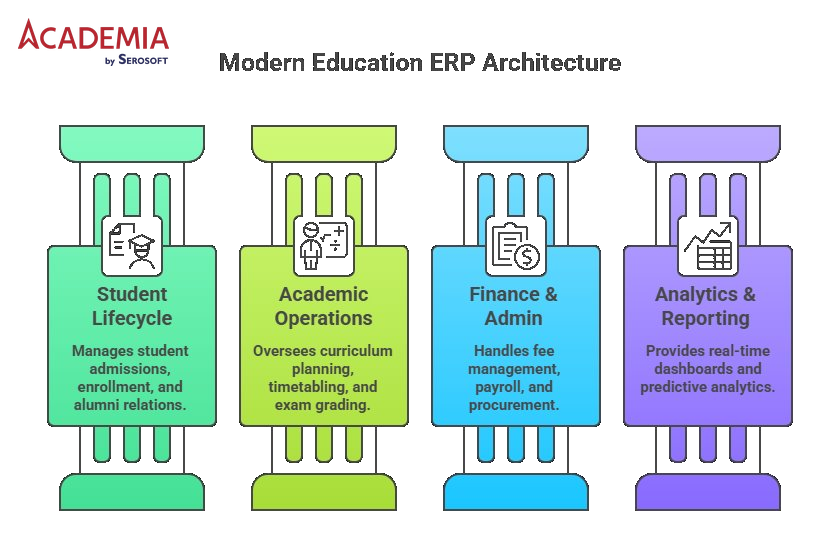
A true Education ERP is an institution-wide operating system, one that integrates every functional area of your institution into a single, interconnected platform with real-time data flow, automated workflows, and role-based access for every stakeholder.
Here’s what a robust Education ERP architecture looks like:
 The Student Experience Crisis You Might Not Know You Have
Here’s something that doesn’t appear on any administrative dashboard in most institutions: student frustration with admin processes.
And it’s costing institutions more than they realize.
Academia Insight
Salesforce’s 2024 Connected Student Report surveyed 3,100 students across 14 countries.
41% said poor administrative processes negatively affected their overall satisfaction with their institution.
29% said they would consider transferring to another institution that offered better digital services.
Only 34% of students said they could complete common admin tasks (enrollment changes, fee queries, certificate requests) without visiting a physical office.
Think about that. Nearly one in three of your students is at risk of leaving, not because of academics, not because of faculty quality, but because the administrative experience is broken.
In an era of rising competition, word-of-mouth matters enormously. The student who waits in line for 45 minutes to get a transcript issues a signed document, they’ll tell their story on social media, on college rating platforms, and to every junior in their network considering where to apply.
A well-implemented Education ERP flips this entirely. Students can view their grades, pay fees, request documents, check exam schedules, and communicate with advisors, all from a single mobile-friendly portal, at 2 AM if they want to.
That’s not a luxury feature. In 2025, that’s the baseline expectation.
Ask any Registrar who has gone through an accreditation review cycle how they felt in the months leading up to the visit. The answer is almost always the same: overwhelmed, understaffed, and swimming in data that wasn’t ready to present.
Accreditation has become one of the most demanding institutional exercises, and it’s getting more complex with every cycle. Modern accreditation frameworks now require more granular data, stronger evidence of learning outcomes, and deeper visibility into institutional governance and performance.
What an Education ERP Does for Accreditation
→ Maintains continuous, audit-ready data across all accreditation parameters
→ Auto-generates NAAC, NBA, IQAC, and UGC reports at the click of a button
→ Tracks Outcome-Based Education (OBE) metrics in real time
→ Logs all governance activities, meeting minutes, and compliance actions
→ Provides a clean digital trail for every administrative decision
→ Reduces accreditation data preparation time by an estimated 60–70%
One of the most underappreciated benefits of an Education ERP is what it does for institutional leadership, not just administration.
Most university leaders today make strategic decisions with a significant data lag. By the time enrollment data is compiled, formatted, and presented, it may be six to eight weeks old. By the time fee collection trends are analyzed, the window for intervention has passed. By the time faculty performance data is compiled, it’s time for the next appraisal cycle.
This isn’t a people problem. It’s a systems problem.
Leading ERP platforms now include embedded analytics and AI-powered dashboards that give institutional leaders a real-time view of:
This transforms leadership from reactive to proactive. Instead of finding out that first-year dropout rates have increased after the academic year ends, you identify at-risk students in week three of the semester and intervene.
That’s not just better management, it’s better education.
Let’s be honest about where we are.
The institutions that will thrive in the next decade of higher education are not necessarily the ones with the biggest campuses or the most famous alumni. They’re the ones that make smart, decisive infrastructure investments today, investments that compound in value over the years as data accumulates, processes improve, and institutional intelligence grows.
An Education ERP like Academia is purpose-built for higher education institutions, with deep compliance support and a mobile-first student experience.
From admissions to alumni, from fee management to accreditation reporting, Academia brings your entire institution onto one intelligent platform — without the chaos of a big-bang implementation.
Book a Free Demo Today, See exactly how Academia can transform your institution’s operations in under 60 minutes. No commitment. No generic pitch. Just a live walkthrough of your actual use cases.

Experience Academia – Your partner in transforming campus operations, a trusted all-in-one ERP/SIS solution.
Get the latest insights, trends, and updates delivered straight to your inbox!