Type your keyword below

Impact of Privatization in The Indian Education Sector

Education plays an important role in our lives. It shapes and molds us to take on the challenges and opportunities coming our way and prepares us for life itself. Education defines our employability, income, standard of living, social status, and professional life. Hence, the demand for education in the world will always be high. 

Unfortunately, when the demand for education in post-independence India rose, the state and central governments lacked the resources to meet it. It lacked funds, resources, infrastructure, and teachers, which increased the cost of education, making it a luxury for people from different walks of life. And hence, the government encouraged individuals and organizations to establish colleges and deemed universities, resulting in the rise of many self-financed arts and science, engineering, and medical colleges. 

This helped in meeting the growing demand for education, and also the availability of education institutes increased the demand further, causing the institute to apply for additional seats to meet the ever-increasing demand for education. However, there are both negative and positive impacts of the privatization of the Indian education sector. 

How is the privatization of the Indian education sector impacting society? 

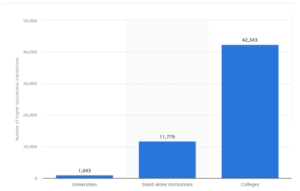
In a 2022 report by Statista, it was drawn that as of 2020, there were 1043 universities, 11,779 stand-alone institutes, and 42,343 colleges in India. 
Statistics published in LiveMint also suggest that the share of unaided private education institutes to the total number of education institutes has raised from 42.6% to 78.6% between 2001 to 2020. More than half of the institutes in India are privately owned and financed by private individuals. 

Positive Impact of Privatisation in the Indian Education Sector

In an over-populated country like India, privatization has helped reduce the gap between resources and made education accessible to all. A provider of education is a government responsibility, and a primary goal is to build a skillful population; without the availability of private higher education institutes, the government would have failed miserably at it.  

Also, since education requires more and more investment which may evade the fiscal power of the government, having private players in the industry helps them meet the growing demand for education and a variety of programs and courses. Economically speaking, privatization in the education sector of India has made a positive impact. 

Some of the few positives are: 

  • Increased accessibility of education even in the remotest locations. 
  • Decreased financial burden on state and central government. 
  • Generation of employment and income opportunities to educate youth. 
  • Teaching skills that are highly demanded in the current job market. 

Negative Impact of Privatisation in the Indian Education Sector

Although the privatization of the Indian education sector has relieved the government of its spending in the education sector, and the same cannot be said for the population. About 33.5% of respondents in the research responded privatization increased the cost of higher education. 

Private institutes are found to charge different fees to increase their income. Adding to the cause is systemic corruption in the government, allowing providing institutes to increase their fees, making higher education more and more unreachable to the poor and middle-income population. 

Quality of education is also under question, as most private education institutes are found to employ unqualified, inexperienced people based on caste, religion, and region. Inproficiencies such as poor language, subject, and character are very common in private institutes. 

Some of the few negatives are 

  • Poor infrastructure facilities lack basic amenities such as clean drinking water, hygienic toilets, labs, hostel, dormitories, libraries, etc.
  • Turned education into a business and profit-making commercial good in a materialistically-driven society. 
  • Turned education into a restless service, wherein exams, classes, and tests are held during holidays. Assignments and projects are an addition to the quality of education but a customary process. 
  • Cramming, assignments, and test writing do not give way to innovation and lifelong learning. 
  • Bad academic environment due to lack of support and cooperation from the management, staff, non-teaching staff, and subordinates.  
  • Partiality towards the students and favoritism are common in private education institutes. 

Concluding

There are both positives and negatives to privatization in the Indian education sector. The government’s initiative to promote privatization in higher education has helped increase access to education and was an economically viable option. But quality cannot be compromised in any way. It is important for the government to make strict rules about the infrastructure, facilities, staff, environment, accountability, results, and curriculum to ensure students get access to quality education and are growing vocationally, socially, mentally, and skill-wise.

Take a free demo session now!

Significance of Campus Management System in Education

Growth and expansion in the technology domain are positively impacting the education industry. It is allowing colleges to become more sensitive toward the needs of the student and increase their outreach to improve profitability. 

In this blog, we would be discussing the role of college/campus management software and why you must consider getting one for your university. 

Campus management system

Rather than seeing tech adaptation as a choice, it is important to make it mandatory. The reason is the low efficiency, and opaqueness found in the system. Education being one of the oldest sectors, it is still governed in the traditional ways, meanwhile, other industries are thriving through technological innovations. After COVID-19, the perception towards technology has changed and now more and more institutes are adapting to it. 

Campus management software is an advanced technology toolset that allows you to digitally transform your college. It allows the monitoring and management of all internal and external tasks digitally through web and mobile applications. 

This allows you to improve transparency in the operations and improve efficiency across the college. Similarly, we cannot ignore the ease it brings to the lives of students and faculty. With dedicated web and mobile applications, they can perform academic and non-academic tasks easily. 

Significance of Campus Management Software in a College

A campus management system vigorously transforms all the operations and processes in your college. The main objective of Campus ERP software is to make operations speedy and bring down operational costs significantly. 

The software is loaded with features and functionalities that bring automation and transparency to all operations, be it – admissions, attendance, examinations, resource management, fees and receipt management, or even student record management. 

Some of the most significant features of the software solution are: 

  • A centralized database of student information

This allows easy sharing of student information in academic and administrative departments to perform various operations. The efficient database gives real-time updates if there is any change in the information and boosts decision-making. 

  • User-friendly and needs the least training

Although technology is usually confused as something complicated, these advanced technology tools are highly user-friendly. The modern solutions guide a user throughout the application and communicate to them at every point with in-app notifications to uncomplicate digital operations. 

Also, AI-driven chatbots, multi-language tools, and other solutions help a user shorten the learning curve and familiarize themselves with the software faster.

  • No communication gaps

Communication gaps between parents and teachers are huge. People cannot wait for a monthly or bi-monthly meeting to know the progress of their children. With parent mobile applications and dedicated parent web portals, there can be direct and faster communication between the two stakeholders. 

Also, communication is omnichannel. Meaning, you can communicate through SMS, in-app chat options, emails, etc. 

  • Profits and higher return on investment

Besides providing you with qualitative results, the software solution is a proven solution to reduce the cost of operations. This helps you in gaining more profit and improved return on investments. 

Concluding

College ERP software is one of the best things to happen to universities. Given the challenges after COVID-19, you can easily plan for countermeasures and execute profitable strategies to revive your business in the market. 

Education Is Wisdom And Wisdom Is Required To Modernize Education

Education is one of the greatest needs of the day. An upgraded and student-friendly curriculum which is also closely connected with the practical needs of the day is indispensable for the survival of the fittest.

The scenario of education has broadened in the past few years. Now…..it is no longer confined to the four walls of the classroom or for that matter four walls of the school itself. The education has evolved from the primitive times beyond leaps and bounds. From the era of Gurukul to the current era of international schools, education has gone through different phases of revolution. When we talk in the context of India, the transformation is quite evident. We earlier had only state-boards, ICSE and CBSE boards. Gradually the idea of public schools set in. The Gurukul evolved into day cum boarding schools where students experienced overall and holistic development. Globalization entered into the education industry as well. Foreign exchange programs, the Cambridge board, and the International Baccalaureate bridged the gap that existed on account of cultural differences. Education is another term for integration, an integration of thoughts, morals, cultures, and passions thereby making the world a better place to live in.

Education Modernization through ERP

Change as they say is the law of nature and henceforth this law is equally applicable to academics and education. It is for this reason that it has changed significantly with the change in time. The idea of education is not to make the students book smart thereby enabling them to earn a living but to make them street smart thereby preparing them to fit for life.

In the thoughts of Robert Frost, “vocation and avocation must be combined”. Vocation refers to the job and avocation is the hobby. The present-day education system intends to do the same. It enables the student to identify their latent potentials and passion for which they have a flair culminating them to integrate those passions into professions, which is what we call vocational education.

Being educated and being literate are two different things, although literacy being a part of education. When one gets literate, he safeguards himself, whereas when one gets educated, he safeguards others thriving in the same society. Education is a dynamic phenomenon where stagnation must never set in if we want to evolve over time. Modernization and up gradation are two accompaniments of education without which the academics would perish.

The success of any major phenomenon is evaluated in terms of the quality of output it generates. The same happens in education too. The number of students that have been successful in their endeavors has been consistently on a rise. So many new avenues of professions have been generated. One major branch for say engineering has emerged into so many branches further and the same has happened with other professions too. This is what we call specialization and it has created a buffet of professions where one makes his own choice. This is how education has helped and fostered the young generation to make wise choices. Education is wisdom and wisdom is required to modernize education.

Back to top