
Type your keyword below

The Indispensable Role of an ERP in Making Educational Institutions Future-Ready

Educational institutions constantly evolve, seeking more efficient ways to manage their diverse operations. This quest has led to the adoption of Education ERP software. Education ERP, or Enterprise Resource Planning software, is a suite of integrated applications an institution can use to collect, store, manage, and interpret data from various activities. It’s a unified system streamlining academic and administrative tasks, enhancing efficiency and effectiveness. With the advent of Cloud Education ERP, these benefits have only become more profound. So, how does an ERP contribute to making educational institutions future-ready? Let’s explore.

A Comprehensive Solution to Data Management

Educational institutions deal with vast amounts of data, ranging from student and teacher information to financial details and academic records. Managing this data manually is not only cumbersome but also prone to errors. Education ERP software is a comprehensive solution, providing a central database for easy and efficient data management. This method leads to improved decision-making, a vital attribute for institutions aiming to be future-ready.

Promoting Collaborative Learning Environment

One of the critical characteristics of future-ready institutions is a collaborative learning environment. A cloud education ERP helps to foster this by providing communication and collaboration tools. These tools facilitate real-time communication between students, teachers, parents, and administrators, promoting a more collaborative and inclusive learning environment. These features also ensure transparency, a key component for building trust in any educational institution.

Efficient Resource Management

Efficient resource management is another critical aspect of future-ready educational institutions. Education ERP software helps schools and colleges to manage their resources more effectively. This approach includes financial, inventory, human resources, and even transportation management. With all these operations streamlined, institutions can focus more on their core task – imparting education.

Enhancing Accessibility with Cloud Education ERP

Cloud-based Education ERP software is a game-changer in the realm of education. It ensures that data and applications are accessible from anywhere, anytime, and on any device with an internet connection. This feature is significant in today’s world, where remote learning has become a crucial aspect of education. By adopting a cloud education ERP, institutions can ensure they are well-equipped to handle future educational landscape changes.

Scalability for Future Growth

Scalability is a crucial factor for educational institutions planning for the future. As institutions grow, the amount of data they handle and the complexity of their operations also increase. Education ERP software offers scalability, allowing institutions to quickly expand their operations without significant infrastructure investments. This future-proofs the institutions, ensuring they can comfortably accommodate growth.

Ensuring Data Security

Data security is a primary concern for educational institutions, especially with the increasing amount of sensitive information they handle. A breach can have serious consequences, both legally and reputationally. Education ERP software has robust security measures, ensuring all data is securely stored and accessed. As we move towards an increasingly digital future, this aspect of ERP systems is invaluable.

Driving Innovation through Analytics

Innovation is a crucial trait of future-ready institutions. Education ERP software provides analytics tools to help institutions identify trends and patterns, providing insights that drive innovation. Whether it’s enhancing teaching methods, improving student performance, or optimizing resource usage, these insights can be instrumental in pushing the boundaries of what’s possible in education.

In conclusion, Education ERP software is pivotal in making educational institutions future-ready. It offers an efficient, comprehensive, scalable solution for managing operations, promoting collaboration, enhancing accessibility, ensuring data security, and driving innovation. With the added benefits of cloud technology, these systems are set to become the cornerstone of future education infrastructure, paving the way for a more efficient, inclusive, and innovative learning environment.

Unveiling the Essential Components of a School Management System

The world has witnessed exponential technological growth in the last few decades, and education has not been left out. School management systems have transformed the traditional management method of educational institutions, making the process more efficient, accurate, and effective.

A school management system (SMS) is an all-encompassing software designed to automate a school’s diverse operations, from student databases, teacher databases, staff, courses, and classes to academic announcements. With a myriad of offerings, each component of an SMS plays a vital role in providing a seamless and efficient learning environment. Let’s delve into these components.

  1. Student Information Management

An essential component, student information management, handles all student-related data. This component includes admission processes, attendance records, grades, report cards, disciplinary records, and health records. Having all this data in one place allows for easy tracking and updating, ensuring a smooth academic journey for each student.

  1. Teacher Management

Teacher management functions much like student information management but focuses on faculty. This component includes teacher profiles, class schedules, subject allocation, and performance reports. This feature helps keep track of teachers’ activities and contributions, which ultimately helps in enhancing the teaching quality.

  1. Course and Curriculum Management

This component aids in designing and managing curriculum, courses, and lesson plans for each academic year. It also helps track the progression of each class and subject throughout the year. With an entire course and curriculum management system, schools can ensure they offer comprehensive and up-to-date educational content.

  1. Communication and Collaboration Tools

Communication and collaboration tools have become more critical in today’s digital world. These tools facilitate practical and real-time communication between teachers, students, parents, and school administrators. They can include email systems, chat platforms, announcement boards, etc. These tools promote a collaborative learning environment and ensure transparency in school operations.

  1. Fee Management and Financial Accounting

An efficient school management system should also incorporate a comprehensive financial module to manage student fees, staff payroll, and other school expenses. This component should provide secure payment gateways, generate receipts, and deliver financial reports to ensure transparency and accuracy in all financial transactions.

  1. Exam and Assessment Management

This component helps schedule examinations, manage assessment processes, grade, and generate report cards. It provides an efficient and accurate platform for evaluating students’ academic performance. Some advanced systems even offer analytical tools to identify areas of improvement for each student.

  1. Library Management

Library management is an often overlooked but crucial component of a school management system. It helps manage the school library’s inventory, issue, and return books, and track overdue books. It saves time and encourages students to utilize library resources efficiently.

  1. Transport and Hostel Management

For schools that offer transportation and hostel services, this component is vital. It manages routes, vehicle maintenance, driver details, hostel room allocation, and other related tasks. It ensures the safety and smooth operation of these facilities.

School management systems and their components are the backbone of the modern educational infrastructure. They integrate all essential components under one roof, providing a comprehensive, streamlined, and efficient platform for managing school operations. As we move further into the 21st century, their role is set to become even more critical, helping to shape the future of education.

How does student tracking software help students & educators improve performance?

Student success is one of the most important metrics for determining the quality of education education institutes provide. Meanwhile, attaining a higher student success rate is not as problematic in colleges, and K-12 segment struggle a lot. 

In this course, a college can use modern-day technology to ensure a higher student success rate and provide the right tools to the academic staff to identify students that are at risk. 

One tool that can help you in assuring a higher student success rate is student tracking software. Most student tracking software comes in-built with education ERP software. Additional functionality allows optimal student progress tracking and measuring performance improvements. 

Key characteristics of a student tracking software

Student tracking software is generally an online system that enables educators to manage attendance, track students’ progress, upload and share assignments, organize exams and assign grades, and more. 

Student tracking helps an institute, academic staff, students, and parents. When done right, students can see their progress and understand how to improve. It helps them strategize better for their studies, gain long-term success, and choose the right career path. 

As for teachers, the tool helps them collate information from various aspects that indicate a student is at risk. This tool gives them a comprehensive report on what students are more likely to be at risk. Using the information, a teacher can prepare interventional programs to help students cope with their condition and return to the right path.

Benefits of student tracking software 

  • Accurate attendance tracking

Research indicates that attendance drops when students are less motivated or see classes or courses chosen as less relevant to their career path. 

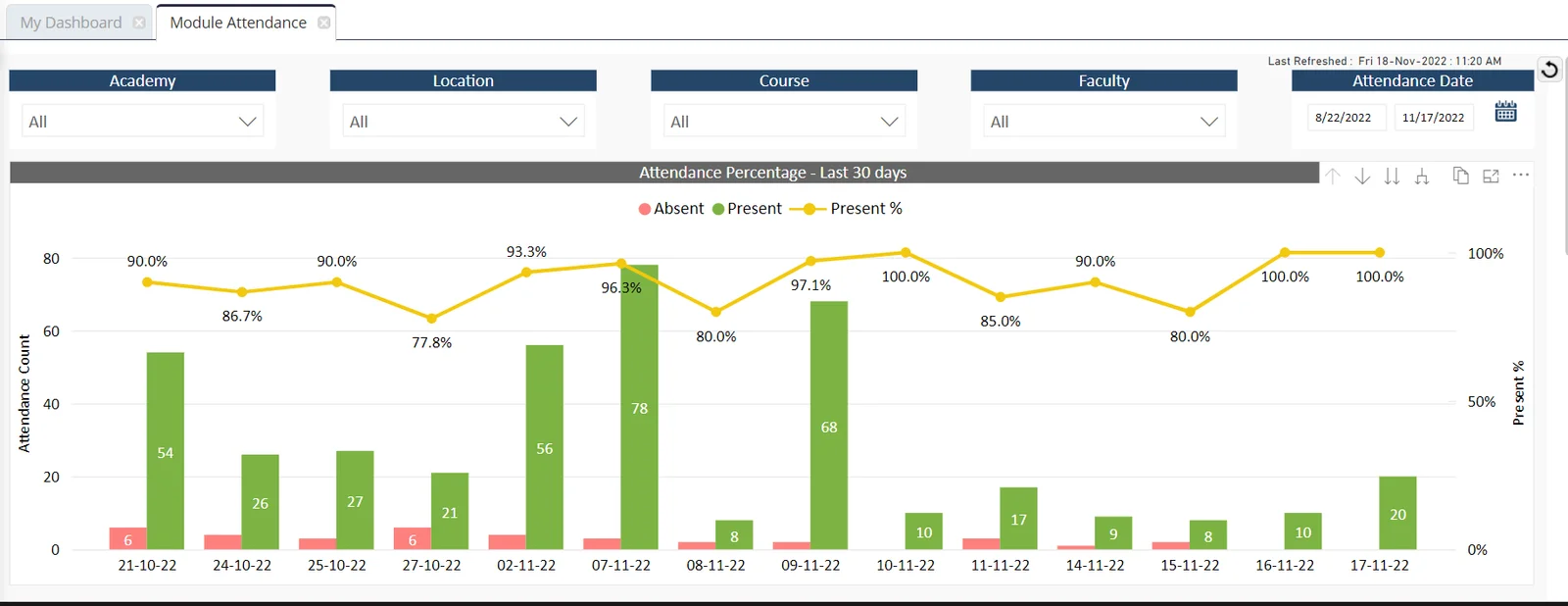
Poor attendance is one way to identify students that are at risk. A student tracking system would allow a teacher to take day-wise and course-wise attendance of a student and generate reports. This system helps a teacher determine what students are falling behind, and they can change their teaching methodology and help students better.


  • Digital processes

Statistics is a powerful tool that helps you see the hidden patterns in the data and provide helpful information. Manually performing various operations and processes does not give scope to generate meaningful information, as it is difficult to collate the data in one place and process it to find information. 

But a student tracking software keeps a centralized database of all the student-related data. This process would allow teachers access to information faster and ensure higher productivity. This means more time can be spent with students rather than wasting on repetitive tasks.

  • Reporting and Analysis

Student tracking software makes in-depth analysis simpler and faster. Since all the data is centralized, a teacher can run various operations to generate reports to identify a student’s weaknesses, strengths, and more. It also provides reports on students’ participation in academic and non-academic activities. 

A student information system infused with AI can help you form a better understanding of your students as a group and as an individual. 

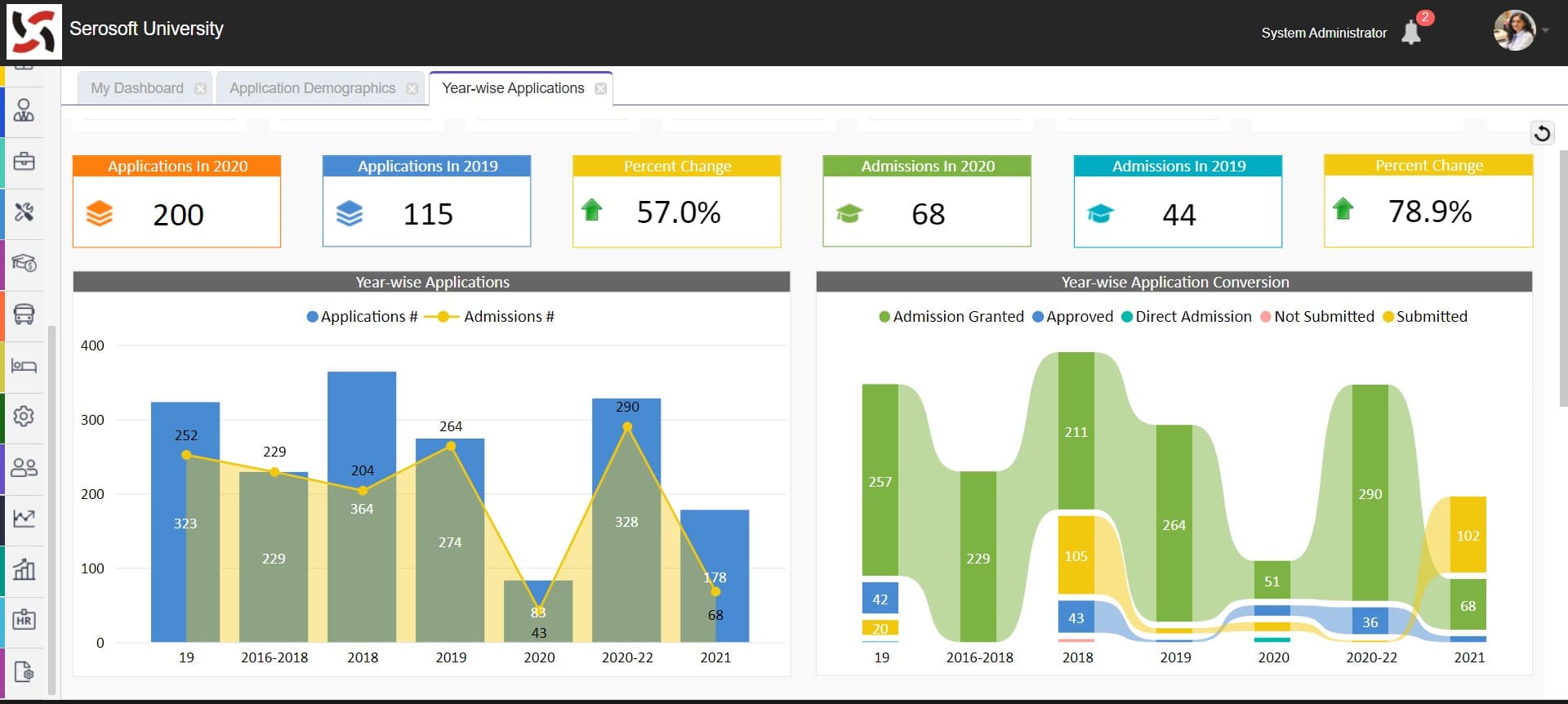
Year-Wise Application Analysis

                                                                                                         Year-Wise Application Analysis

Get the best student tracking software here! 

Academia ERP is an advanced education ERP system that can be integrated with your existing digital infrastructure. The software helps you undergo digital transformation through its 40+ modules, which include admissions, attendance, examination, fees & finances, and more. 

Back to top