
Type your keyword below

Data to Decisions: How Real-Time Academic Analytics Are Reshaping Southeastern University Leadership

Introduction: When Data Delays Become Leadership Risks

In today’s fast-evolving higher education landscape, decisions can no longer wait for end-of-semester reports.

According to recent higher education studies, universities that leverage real-time analytics are 3x more likely to improve student outcomes and operational efficiency compared to institutions relying on static or delayed data.

Yet, many Southeastern universities still operate with fragmented systems, attendance data in one tool, academic performance in another, and compliance reports buried in spreadsheets. Leadership teams are often forced to make strategic decisions based on outdated, incomplete, or inconsistent information.

This is where a modern student ERP/Education management system becomes a game-changer, turning raw institutional data into real-time, decision-ready insights.

The Leadership Challenge: Too Much Data, Too Little Clarity

University leaders today face increasing pressure from all sides:

  • Regulatory bodies demand real-time compliance visibility
  • Students expect personalized academic experiences
  • Faculty want actionable insights, not admin overload
  • Governing boards expect data-backed decisions

However, without a unified student ERP, most institutions struggle with:

  • Disconnected academic and administrative data
  • Manual reporting cycles that delay decisions
  • Limited visibility into student performance trends
  • Inconsistent data accuracy across departments

As a result, leadership decisions are often reactive instead of proactive.


The Questions That Keep University Leaders Guessing

Legacy systems were designed for record-keeping, not decision-making. While they store information, they rarely answer leadership-level questions such as:

  • Which programs are seeing declining engagement right now?
  • Which students are at academic risk this month, not last semester?
  • How are faculty workloads impacting learning outcomes?

Without real-time dashboards and predictive analytics, leaders are forced to rely on intuition rather than intelligence.

This is exactly where an integrated education management system powered by real-time academic analytics steps in.


From Static Reports to Real-Time Academic Intelligence

Modern university leadership is shifting from report consumption to insight-driven action.

A cloud-based student ERP centralizes data across admissions, academics, attendance, assessments, and student engagement, creating a single source of truth. When paired with real-time analytics, it enables leaders to:

  • Monitor ongoing academic performance
  • Identify risk patterns before they escalate
  • Evaluate program effectiveness continuously
  • Align institutional goals with measurable outcomes

Instead of waiting weeks for reports, leadership teams can access live dashboards that reflect the institution’s current academic health.
Academia ERP

How Academia’s Real-Time Reports Allow Faster Decision Making

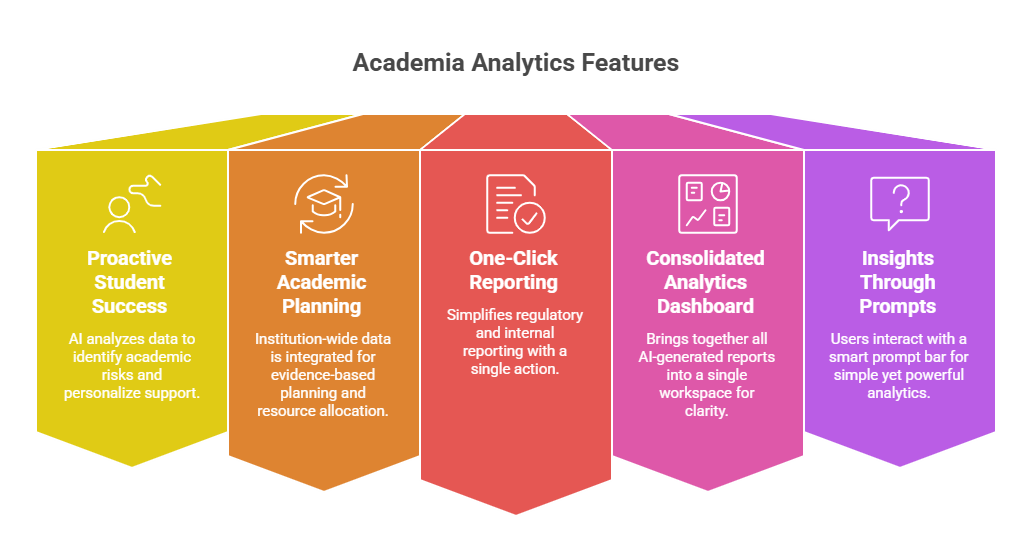
Modern university leadership doesn’t just need data; it needs instant clarity. Academia’s AI-powered Reports and Analytics feature is purpose-built to help institutions move from information overload to confident, real-time decision-making.

Designed as a unified analytics workspace, Academia turns complex academic and administrative data into actionable insights on demand.

1. From Reactive Decisions to Proactive Program Success

With Academia, leadership teams no longer have to wait for periodic reports to identify academic risks. Its AI-powered analytics continuously analyze data across attendance, assessments, engagement, and performance.

Using the built-in prompt-based insight system, faculty and administrators can simply ask:

  • Which students are showing early risk indicators?
  • Which courses have declining engagement trends?
  • Which cohorts need immediate academic intervention?

Within seconds, Academia generates visual, easy-to-understand reports, helping institutions intervene early, personalize support, and improve retention outcomes.

Faculty can even drill down to individual student-level insights, ensuring no learner slips through the cracks.

2. Smarter Academic Planning Backed by AI Insights

Academic planning often suffers from fragmented data and delayed analysis. Academia eliminates this challenge by bringing institution-wide data into one intelligent analytics layer.

Through default AI-generated prompts or custom queries via the prompt bar, leadership can instantly view:

  • Program-wise enrollment trends
  • Course demand vs. capacity insights
  • Faculty workload distribution
  • Academic performance patterns across terms

All insights are presented as dynamic graphical reports, including bar charts, line graphs, pie charts, and more, making complex data instantly digestible for decision-makers.

This enables leadership to plan programs, allocate resources, and refine academic strategies with real evidence, not assumptions.


3. One-Click Reporting for Governance and Compliance

When regulatory or internal reporting demands arise, time is often the biggest constraint. Academia simplifies this entirely with its single-click “Generate Reports” capability.

With one action, institutions can:

  • Generate reports using massive student datasets
  • Maintain data accuracy and consistency
  • Reduce manual effort and reporting delays

Whether it’s accreditation, audits, or internal reviews, Academia ensures leadership always has ready-to-share, insight-rich reports, without scrambling across departments or systems.


4. A Consolidated Analytics Dashboard for Leadership Clarity

Academia offers a dedicated analytics dashboard view that brings together all AI-generated reports into a single, consolidated workspace.

Leadership teams can:

  • Track institutional performance at a glance
  • Compare trends across departments and programs
  • Access historical and real-time insights in one place

This centralized visibility empowers leaders to make faster, more confident decisions, backed by consistent, AI-driven intelligence.

5. Insights Through Prompts, Not Complex Tools

What truly sets Academia apart is how simple yet powerful its analytics experience is.

Instead of navigating complex filters or spreadsheets, users interact with:

  • A smart prompt bar
  • Pre-built AI-generated prompts
  • Custom insight queries

Academia does the heavy lifting in the background, analyzing data across the institution and instantly delivering the exact insight the user needs to see.

Breaking Data Silos: The Foundation of Smart Leadership

The true power of academic analytics lies in integration. When admissions, academics, assessments, and student lifecycle data live inside one education management system, leadership can finally see the full picture.

This integrated approach ensures:

  • No duplicate data entry
  • No conflicting reports
  • No blind spots in decision-making

For leadership teams, this means confidence, knowing every decision is backed by reliable, real-time data.

Why Southeastern Universities Are Adopting Student ERP Faster Than Ever

The region’s higher education institutions are expanding rapidly, with increasing student diversity, program variety, and regulatory oversight.

To scale effectively, universities are adopting a student ERP platform like Academia that offers:

  • Real-time dashboards for leadership
  • AI-driven academic analytics
  • Configurable reporting for regional compliance needs
  • Cloud scalability without infrastructure burden

The Path Forward: From Data Overload to Decision Confidence

University leadership doesn’t suffer from a lack of data; it suffers from a lack of actionable insights.

A next-generation student ERP transforms institutional data into a strategic asset, while a robust education management system ensures that insights flow seamlessly across leadership, faculty, and administrators.

If your institution is still making decisions based on delayed reports or disconnected systems, it’s time to rethink how data supports leadership.

Ready to Experience Data-Driven Leadership?

Imagine having real-time visibility into your institution’s academic performance, student success metrics, and compliance readiness, all within a single, intelligent dashboard.

This is exactly how Academia helps universities turn everyday academic data into leadership-ready insights, through a modern student ERP designed for clarity, speed, and informed decision-making.

If your leadership team is ready to move faster, plan smarter, and lead with confidence, 

Request Demo and see how Academia’s real-time academic analytics make it possible.

Navigating the Maze: Why College ERP Feels Like a New Labyrinth for Many Institutions

Higher education institutions today are under more pressure than ever, growing student volumes, tighter regulatory oversight, rising expectations for digital experiences, and limited administrative bandwidth. Yet many colleges are still running their operations on fragmented systems that were never designed to work together.

Admissions data sits in one tool, academic records in another, examinations in spreadsheets, and reporting becomes a manual scramble every time compliance deadlines approach. Over time, these disconnected systems create inefficiencies, data gaps, and decision blind spots that slow institutions down instead of helping them scale.

This is why the conversation around “College ERP” has become increasingly complex. It’s no longer about choosing software; it’s about finding a system that can bring academic operations, data, and decision-making into a single, reliable framework. And that’s where clarity begins.

The Two Biggest Challenges Modern Colleges Face Today

1. Fragmented Systems, Frustrated Teams

It’s common to find a college running: separate admission software, different platforms for attendance, yet another tool for fee management. 

Teams struggle with multiple logins, duplicate data entry, and inconsistent student experience. While many solutions are labelled as a “college ERP system,” institutions frequently end up with disconnected tools instead of one truly unified platform.

2. Rising Expectations & Legacy Drag

The market for education management solutions is booming. According to recent research, the global education ERP market was valued at around USD 16.42 billion in 2023 and is projected to reach over USD 61 billion by 2030. 

Meanwhile, students increasingly expect real-time mobile access, self-service portals, and seamless digital experiences. Many older “college software” platforms simply can’t keep up.

Adding to that, regulators demand greater data security, audit trails, and analytics for decision-making.

Why “One System” Matters: The Solution to the Maze

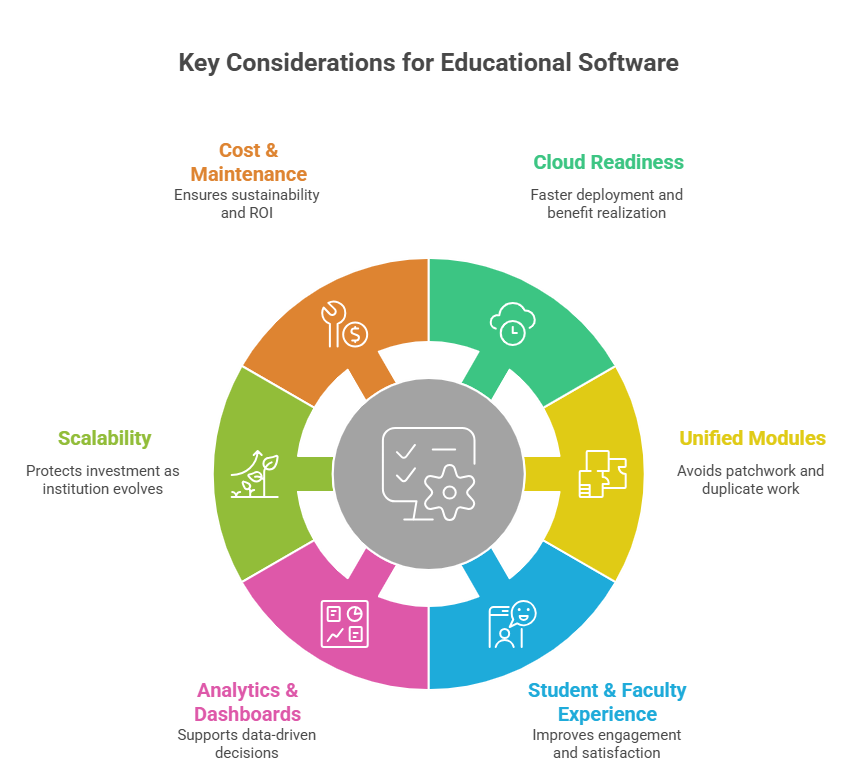
Instead of wandering through fragmented corridors, the solution is a fully-integrated education ERP, one that brings together admissions, student information, finance, exam scheduling, and analytics under a single roof. Here’s why it matters:

  • Unified student journey: From registration to graduation, one platform means no more duplicate entries, fewer errors, and better student-faculty interaction.
  • Cloud advantages: Cloud-based systems mean faster deployment (often weeks instead of months), lower IT burden, and accessibility from anywhere, a real must as education becomes hybrid.
  • Data-driven decision-making: Modern systems come with built-in dashboards and analytics, offering insights into enrolments, fee trends, student performance, and more.
  • Better student experience: When students can access portals, pay fees, track results and receive notifications, all from their mobile, they feel empowered, and you retain better engagement.
  • Cost and resource efficiency: A well-implemented college ERP system ultimately reduces administrative overhead, manual work, and errors, freeing up staff to focus on student success.

Comparing the Terrain: What to Look For in a College ERP

college erp

Why Acting Now Matters

  • With the education ERP market growing rapidly, the longer you delay, the more likely your institution will fall behind.
  • A cloud system lets you scale as student numbers grow, rather than being locked into rigid, outdated software.
  • Modern students expect digital access; your institution’s reputation depends on it.

Conclusion:
The search for the best college ERP software doesn’t have to feel like navigating a vast maze. You’ve learned the challenges—fragmented tools, rising expectations, and legacy drag. And you’ve seen the solution: a unified, cloud-based system designed for modern education workflows.

This is exactly where Academia steps in. Built exclusively for higher education, Academia brings student data, academic processes, and institutional intelligence onto a single, intuitive platform—helping institutions simplify operations, gain real-time insights, and deliver meaningful student experiences.

If you’re ready to leave behind the confusion, reduce administrative burden, and elevate student experience, take the next step. Book a demo, see Academia in action, and move your institution from “maze runner” to “maze master.”

AI in Higher Education: How Modern Student Information Systems Are Redefining Campus Intelligence

Higher education institutions are no longer operating in a predictable, slow-moving environment. Today’s universities face rising enrollment volumes, increasing regulatory scrutiny, complex academic models, and heightened expectations from digitally native students

Managing all this with legacy systems or fragmented software is no longer sustainable.

This is where the modern Student Information System (SIS), powered by Artificial Intelligence (AI), is becoming a strategic necessity rather than an operational upgrade. 

AI is transforming how institutions manage data, make decisions, engage students, and scale operations efficiently. In many ways, ERP in education is evolving into an intelligent digital governance layer for universities.

The real question institutions must ask today is not whether to adopt AI-powered SIS—but how long they can afford to wait.

The Growing Role of AI in Higher Education

AI adoption in higher education is accelerating rapidly:

  • According to industry studies, over 60% of universities globally are already investing in AI-driven administrative systems. 
  • Institutions using AI-powered analytics report up to 30–40% improvement in decision-making speed. 
  • Automation across admissions, examinations, and reporting can reduce manual workload by nearly 50% for administrative teams. 

AI is no longer limited to experimental use cases or academic research. It is now embedded deeply into core institutional operations, particularly within the student information system, where data volume, complexity, and compliance demands converge.

Why Traditional SIS Models Are No Longer Enough

Most legacy SIS platforms were designed for record-keeping, not intelligence. They store data but do little to interpret it, connect it, or act on it. As institutions grow, this leads to:

  • Delayed reporting and compliance risks 
  • Manual dependencies across admissions, academics, and exams 
  • Limited visibility for leadership 
  • Poor student experience due to slow, reactive processes 

Modern ERP in education must move beyond digitization and toward automation, prediction, and proactive governance, and AI makes this possible.

How AI Is Transforming the Modern Student Information System

A modern, AI-powered SIS doesn’t just manage information; it learns from it, identifies patterns, and supports smarter decision-making across the institution.

Here’s how AI is redefining SIS capabilities:

1. From Reactive Processes to Intelligent Automation

AI automates repetitive, high-volume tasks such as enrollment processing, exam evaluations, and reporting—reducing errors and speeding up operations.

2. From Static Data to Actionable Insights

AI-driven analytics convert raw institutional data into dashboards and insights that leadership teams can act on in real time.

3. From Fragmented Operations to Connected Governance

AI enables centralized oversight across departments, campuses, and academic cycles, critical for scaling institutions.

Why Institutions Can’t Afford to Stay Behind

Universities that delay AI adoption in their SIS risk falling behind on multiple fronts:

  • Slower admissions cycles while competitors enroll faster 
  • Increased compliance risks due to manual reporting 
  • Leadership decisions based on outdated or incomplete data 
  • Lower student satisfaction due to inefficient services 

As SIS platforms become smarter, the gap between AI-enabled institutions and traditional ones is widening rapidly. Digital maturity is now a competitive advantage.

Where Academia SIS Fits into This Transformation

At this point, the conversation naturally shifts from why AI matters to how institutions can apply it practically.

Academia by Serosoft is a next-generation, AI-powered Student Information System and ERP in education, designed specifically for the operational realities of higher education institutions globally.

Academia embeds AI directly into day-to-day academic and administrative workflows—ensuring intelligence is not an add-on, but a core capability.

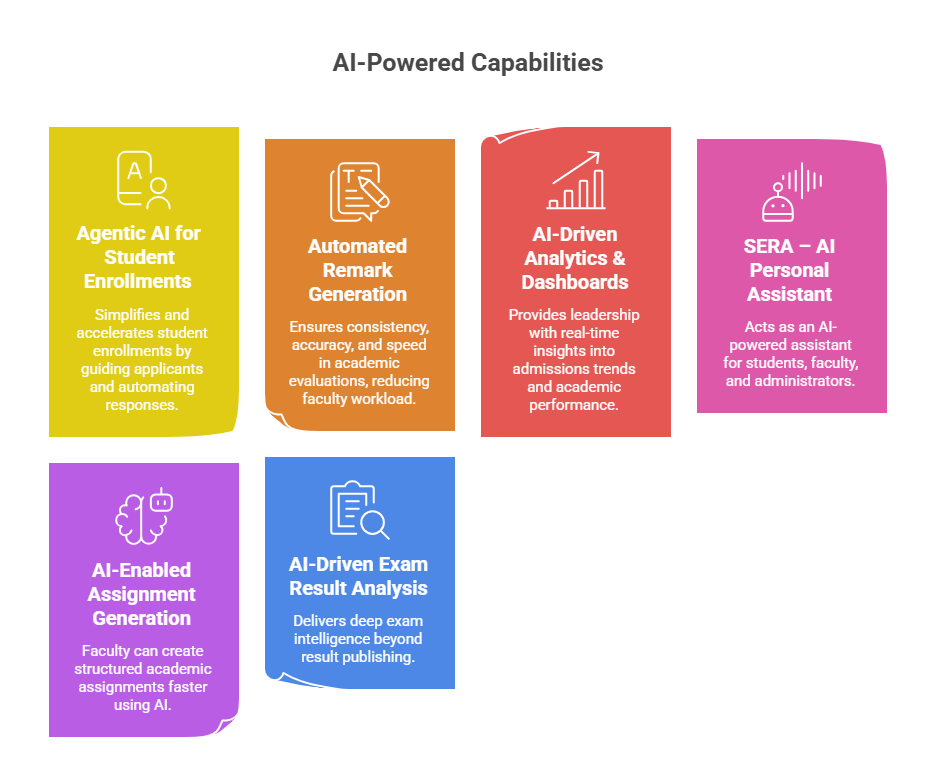
AI-Powered Capabilities Within Academia SIS

Below are some of the key AI-driven functionalities that set Academia apart as a future-ready SIS:

AI-Powered Capabilities Within Academia SIS - visual selection

Academia’s Agentic AI simplifies and accelerates student enrollments by guiding applicants, automating responses, and reducing manual intervention, helping institutions manage scale without chaos.

Automated Remark Generation

AI-generated marksheet remarks ensure consistency, accuracy, and speed in academic evaluations, while reducing faculty workload during result cycles.

AI-Driven Analytics & Dashboards

Academia delivers intelligent reports and dashboards that provide leadership with real-time insights into admissions trends, academic performance, and institutional health, supporting faster, data-backed decisions.

SERA – AI Personal Assistant

SERA acts as an AI-powered assistant for students, faculty, and administrators, answering queries, guiding workflows, and improving service responsiveness across the campus.

AI-Enabled Assignment Generation

Faculty can create structured academic assignments faster using AI, reducing preparation time while maintaining academic quality and consistency.

AI-Driven Exam Result Analysis

Academia goes beyond result publishing to deliver deep exam intelligence:

  • Exam Result Analytics:
    Analyze result data across time periods, classes, or individual students.
    Key metrics include overall pass rates, daily averages, and performance patterns. 
  • Comparison & Benchmarking:
    Compare results across academies, divisions, or cohorts, and benchmark performance against targets and historical trends—enabling continuous academic improvement. 

AI, SIS, and the Future of Digital Governance

What institutions are truly adopting when they implement an AI-powered SIS is digital governance, a model where data is governed, insights are real-time, and decisions are proactive.

With AI embedded into ERP in education:

  • Compliance becomes continuous, not last-minute 
  • Leadership gains institution-wide visibility 
  • Growth is managed without losing control 
  • Student experience improves across the lifecycle 

This is no longer about replacing software; it’s about redefining how institutions operate.

Final Thoughts: Why the Time to Act Is Now

AI is already reshaping higher education operations. Student information systems are becoming smarter, faster, and more predictive every year. Institutions that delay modernization risk being constrained by inefficiency, compliance challenges, and limited visibility.

The institutions that lead tomorrow are the ones adopting intelligent SIS platforms today.

Academia SIS enables universities to move from fragmented systems to a connected, AI-driven campus ecosystem—without disruption.

Book a free demo today to see how Academia’s AI-powered SIS delivers practical, real-world impact across admissions, academics, examinations, and governance.

Back to top