Higher education across the Middle East is not evolving gradually; it is accelerating.
National transformation agendas across the GCC, expanding transnational campuses, regulatory modernization, and digitally native student expectations are redefining how universities must operate. On the other hand, institutions are under pressure to be faster, more transparent, more compliant, and more student-centric.
Yet many campuses still operate on fragmented systems that have been layered over the years.
The conversation around AI in Education ERP often becomes overly futuristic, with predictive engines, algorithmic forecasting, and autonomous decision systems. But for most universities in the Middle East, the more urgent question is simpler:
Is your institution structurally ready for the future?
This is where Academia positions its AI-driven Higher Education ERP System, not as a prediction engine, but as a future-readiness platform that strengthens institutional agility, data clarity, and operational intelligence.
Fact Check with Academia:
Global research from Gartner indicates that digital maturity, not isolated automation, is the strongest indicator of long-term institutional resilience.
Meanwhile, McKinsey & Company notes that organizations integrating AI into workflow optimization and decision support see measurable improvements in operational speed and governance transparency.
For universities in the Middle East, future-readiness means:
An advanced Education ERP must therefore do more than just digitize records and storage. It must serve asact like a complete digital infrastructure, that is strong enough to support growth, audits, partnerships, and evolving academic models.
Academia’s AI-driven framework focuses on enabling institutions to respond faster, act smarter, and operate with clarity, without relying on speculative prediction engines.
Many institutions in the region have already digitized processes. Admissions portals exist. Attendance is captured digitally. Examinations are system-managed.
But digitization alone does not equal transformation.
The next phase is maturity, where systems are interconnected, workflows are intelligent, and leadership has unified dashboards instead of departmental silos.
A modern Higher Education ERP System must provide:
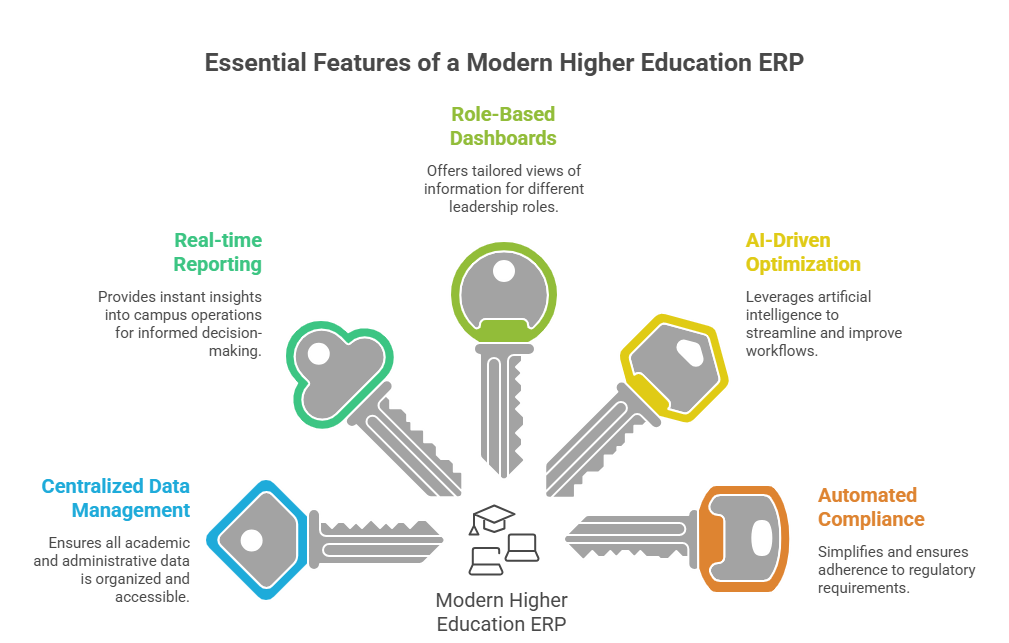
This is the layer where Academia’s AI capabilities contribute, not by forecasting uncertain futures, but by making the present structurally strong and strategically aligned.
In Academia’s architecture, AI functions as an intelligent accelerator embedded within the Education ERP, enhancing how processes operate and how information flows.
For example:
Academia Insight:
According to Deloitte, institutions that unify operational data and apply intelligent automation improve administrative efficiency by up to 20–30%. The advantage is not in predicting distant outcomes but in eliminating structural inefficiencies that slow leadership today.
This is where Academia differentiates itself, focusing on operational intelligence, governance readiness, and structured scalability.
Future-readiness is not abstract. It is architectural.
A robust Higher Education ERP System must provide a stable digital foundation that allows institutions to:
Academia’s AI-enabled Education ERP supports institutions by strengthening three critical pillars:
Leadership today cannot afford fragmented data. Academia consolidates admissions, attendance, academics, and performance metrics into structured, real-time dashboards accessible through role-based views.
What strengthens this visibility layer is AI-enabled intelligence:
Instead of departments manually compiling spreadsheets, decision-makers gain immediate clarity through structured, system-generated intelligence inside the Education ERP.
Operational speed defines institutional responsiveness. Academia enhances workflows through AI-driven automation embedded within daily academic processes.
Key AI-powered capabilities include:
These embedded capabilities transform the Higher Education ERP System from a transactional platform into an intelligent operational accelerator, without overcomplicating institutional workflows.
For universities operating across cities or countries in the Middle East, governance consistency is critical.
Academia centralizes data architecture across campuses, ensuring:
While policies remain standardized, campuses retain operational flexibility within the same Education ERP environment.
This combination does not predict the future.
It prepares institutions to handle it confidently.
University boards in the Middle East are increasingly asking sharper questions:
A traditional ERP answers operational questions.
A future-ready Higher Education ERP System answers governance questions.
Academia is a digital campus partner, helping institutions modernize their infrastructure with AI-driven enhancements that improve clarity, speed, and scalability.
The competitive advantage lies in readiness:
In a region investing aggressively in higher education innovation, this readiness becomes institutional leverage.
Behind every ERP migration is a leadership team balancing pressure and ambition.
Vice Chancellors want stronger rankings.
Registrars want cleaner data.
CIOs want system stability.
Academic Deans want visibility into performance.
An AI-driven Education ERP must reduce complexity, not introduce it.
Academia’s approach is grounded in strengthening the operational core so leadership can focus on strategy, partnerships, and academic excellence rather than administrative firefighting.
Future-readiness is ultimately about confidence, knowing your institutional backbone can support what comes next.
In the Middle East, higher education institutions are scaling faster than ever. The question is not whether AI belongs in your Education ERP. The question is how intelligently it is embedded.
A modern Higher Education ERP System should:
Academia’s AI-driven platform is designed to do exactly that, not by predicting uncertain futures, but by building structurally resilient, digitally mature institutions prepared for change.
Because in today’s higher education landscape, the institutions that thrive are not the ones that chase futuristic trends.
They are the ones that become future-ready, strategically, and confidently.

Experience Academia – Your partner in transforming campus operations, a trusted all-in-one ERP/SIS solution.
Get the latest insights, trends, and updates delivered straight to your inbox!