
Type your keyword below

Data to Decisions: How Real-Time Academic Analytics Are Reshaping Southeastern University Leadership

Introduction: When Data Delays Become Leadership Risks

In today’s fast-evolving higher education landscape, decisions can no longer wait for end-of-semester reports.

According to recent higher education studies, universities that leverage real-time analytics are 3x more likely to improve student outcomes and operational efficiency compared to institutions relying on static or delayed data.

Yet, many Southeastern universities still operate with fragmented systems, attendance data in one tool, academic performance in another, and compliance reports buried in spreadsheets. Leadership teams are often forced to make strategic decisions based on outdated, incomplete, or inconsistent information.

This is where a modern student ERP/Education management system becomes a game-changer, turning raw institutional data into real-time, decision-ready insights.

The Leadership Challenge: Too Much Data, Too Little Clarity

University leaders today face increasing pressure from all sides:

  • Regulatory bodies demand real-time compliance visibility
  • Students expect personalized academic experiences
  • Faculty want actionable insights, not admin overload
  • Governing boards expect data-backed decisions

However, without a unified student ERP, most institutions struggle with:

  • Disconnected academic and administrative data
  • Manual reporting cycles that delay decisions
  • Limited visibility into student performance trends
  • Inconsistent data accuracy across departments

As a result, leadership decisions are often reactive instead of proactive.


The Questions That Keep University Leaders Guessing

Legacy systems were designed for record-keeping, not decision-making. While they store information, they rarely answer leadership-level questions such as:

  • Which programs are seeing declining engagement right now?
  • Which students are at academic risk this month, not last semester?
  • How are faculty workloads impacting learning outcomes?

Without real-time dashboards and predictive analytics, leaders are forced to rely on intuition rather than intelligence.

This is exactly where an integrated education management system powered by real-time academic analytics steps in.


From Static Reports to Real-Time Academic Intelligence

Modern university leadership is shifting from report consumption to insight-driven action.

A cloud-based student ERP centralizes data across admissions, academics, attendance, assessments, and student engagement, creating a single source of truth. When paired with real-time analytics, it enables leaders to:

  • Monitor ongoing academic performance
  • Identify risk patterns before they escalate
  • Evaluate program effectiveness continuously
  • Align institutional goals with measurable outcomes

Instead of waiting weeks for reports, leadership teams can access live dashboards that reflect the institution’s current academic health.
Academia ERP

How Academia’s Real-Time Reports Allow Faster Decision Making

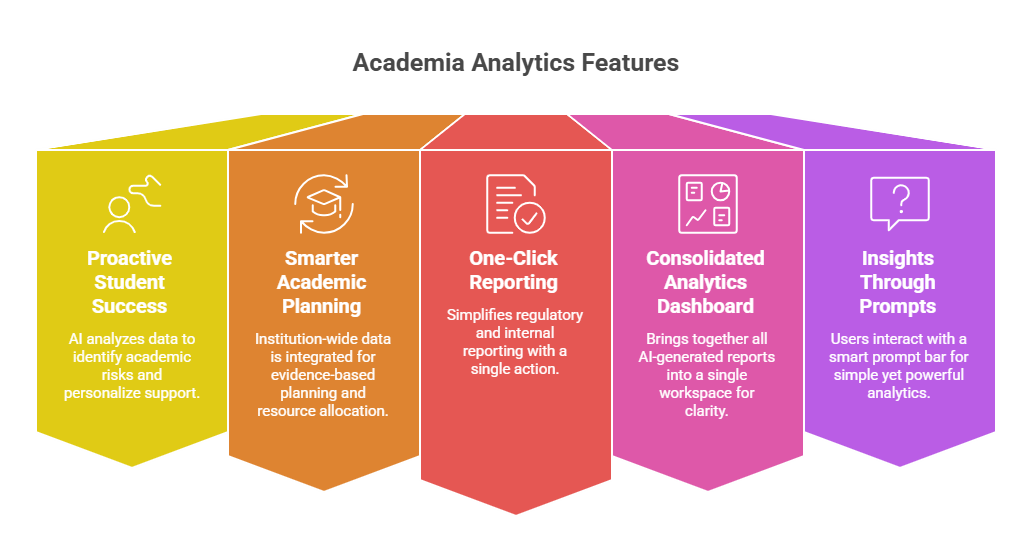
Modern university leadership doesn’t just need data; it needs instant clarity. Academia’s AI-powered Reports and Analytics feature is purpose-built to help institutions move from information overload to confident, real-time decision-making.

Designed as a unified analytics workspace, Academia turns complex academic and administrative data into actionable insights on demand.

1. From Reactive Decisions to Proactive Program Success

With Academia, leadership teams no longer have to wait for periodic reports to identify academic risks. Its AI-powered analytics continuously analyze data across attendance, assessments, engagement, and performance.

Using the built-in prompt-based insight system, faculty and administrators can simply ask:

  • Which students are showing early risk indicators?
  • Which courses have declining engagement trends?
  • Which cohorts need immediate academic intervention?

Within seconds, Academia generates visual, easy-to-understand reports, helping institutions intervene early, personalize support, and improve retention outcomes.

Faculty can even drill down to individual student-level insights, ensuring no learner slips through the cracks.

2. Smarter Academic Planning Backed by AI Insights

Academic planning often suffers from fragmented data and delayed analysis. Academia eliminates this challenge by bringing institution-wide data into one intelligent analytics layer.

Through default AI-generated prompts or custom queries via the prompt bar, leadership can instantly view:

  • Program-wise enrollment trends
  • Course demand vs. capacity insights
  • Faculty workload distribution
  • Academic performance patterns across terms

All insights are presented as dynamic graphical reports, including bar charts, line graphs, pie charts, and more, making complex data instantly digestible for decision-makers.

This enables leadership to plan programs, allocate resources, and refine academic strategies with real evidence, not assumptions.


3. One-Click Reporting for Governance and Compliance

When regulatory or internal reporting demands arise, time is often the biggest constraint. Academia simplifies this entirely with its single-click “Generate Reports” capability.

With one action, institutions can:

  • Generate reports using massive student datasets
  • Maintain data accuracy and consistency
  • Reduce manual effort and reporting delays

Whether it’s accreditation, audits, or internal reviews, Academia ensures leadership always has ready-to-share, insight-rich reports, without scrambling across departments or systems.


4. A Consolidated Analytics Dashboard for Leadership Clarity

Academia offers a dedicated analytics dashboard view that brings together all AI-generated reports into a single, consolidated workspace.

Leadership teams can:

  • Track institutional performance at a glance
  • Compare trends across departments and programs
  • Access historical and real-time insights in one place

This centralized visibility empowers leaders to make faster, more confident decisions, backed by consistent, AI-driven intelligence.

5. Insights Through Prompts, Not Complex Tools

What truly sets Academia apart is how simple yet powerful its analytics experience is.

Instead of navigating complex filters or spreadsheets, users interact with:

  • A smart prompt bar
  • Pre-built AI-generated prompts
  • Custom insight queries

Academia does the heavy lifting in the background, analyzing data across the institution and instantly delivering the exact insight the user needs to see.

Breaking Data Silos: The Foundation of Smart Leadership

The true power of academic analytics lies in integration. When admissions, academics, assessments, and student lifecycle data live inside one education management system, leadership can finally see the full picture.

This integrated approach ensures:

  • No duplicate data entry
  • No conflicting reports
  • No blind spots in decision-making

For leadership teams, this means confidence, knowing every decision is backed by reliable, real-time data.

Why Southeastern Universities Are Adopting Student ERP Faster Than Ever

The region’s higher education institutions are expanding rapidly, with increasing student diversity, program variety, and regulatory oversight.

To scale effectively, universities are adopting a student ERP platform like Academia that offers:

  • Real-time dashboards for leadership
  • AI-driven academic analytics
  • Configurable reporting for regional compliance needs
  • Cloud scalability without infrastructure burden

The Path Forward: From Data Overload to Decision Confidence

University leadership doesn’t suffer from a lack of data; it suffers from a lack of actionable insights.

A next-generation student ERP transforms institutional data into a strategic asset, while a robust education management system ensures that insights flow seamlessly across leadership, faculty, and administrators.

If your institution is still making decisions based on delayed reports or disconnected systems, it’s time to rethink how data supports leadership.

Ready to Experience Data-Driven Leadership?

Imagine having real-time visibility into your institution’s academic performance, student success metrics, and compliance readiness, all within a single, intelligent dashboard.

This is exactly how Academia helps universities turn everyday academic data into leadership-ready insights, through a modern student ERP designed for clarity, speed, and informed decision-making.

If your leadership team is ready to move faster, plan smarter, and lead with confidence, 

Request Demo and see how Academia’s real-time academic analytics make it possible.

Navigating the Maze: Why College ERP Feels Like a New Labyrinth for Many Institutions

Higher education institutions today are under more pressure than ever, growing student volumes, tighter regulatory oversight, rising expectations for digital experiences, and limited administrative bandwidth. Yet many colleges are still running their operations on fragmented systems that were never designed to work together.

Admissions data sits in one tool, academic records in another, examinations in spreadsheets, and reporting becomes a manual scramble every time compliance deadlines approach. Over time, these disconnected systems create inefficiencies, data gaps, and decision blind spots that slow institutions down instead of helping them scale.

This is why the conversation around “College ERP” has become increasingly complex. It’s no longer about choosing software; it’s about finding a system that can bring academic operations, data, and decision-making into a single, reliable framework. And that’s where clarity begins.

The Two Biggest Challenges Modern Colleges Face Today

1. Fragmented Systems, Frustrated Teams

It’s common to find a college running: separate admission software, different platforms for attendance, yet another tool for fee management. 

Teams struggle with multiple logins, duplicate data entry, and inconsistent student experience. While many solutions are labelled as a “college ERP system,” institutions frequently end up with disconnected tools instead of one truly unified platform.

2. Rising Expectations & Legacy Drag

The market for education management solutions is booming. According to recent research, the global education ERP market was valued at around USD 16.42 billion in 2023 and is projected to reach over USD 61 billion by 2030. 

Meanwhile, students increasingly expect real-time mobile access, self-service portals, and seamless digital experiences. Many older “college software” platforms simply can’t keep up.

Adding to that, regulators demand greater data security, audit trails, and analytics for decision-making.

Why “One System” Matters: The Solution to the Maze

Instead of wandering through fragmented corridors, the solution is a fully-integrated education ERP, one that brings together admissions, student information, finance, exam scheduling, and analytics under a single roof. Here’s why it matters:

  • Unified student journey: From registration to graduation, one platform means no more duplicate entries, fewer errors, and better student-faculty interaction.
  • Cloud advantages: Cloud-based systems mean faster deployment (often weeks instead of months), lower IT burden, and accessibility from anywhere, a real must as education becomes hybrid.
  • Data-driven decision-making: Modern systems come with built-in dashboards and analytics, offering insights into enrolments, fee trends, student performance, and more.
  • Better student experience: When students can access portals, pay fees, track results and receive notifications, all from their mobile, they feel empowered, and you retain better engagement.
  • Cost and resource efficiency: A well-implemented college ERP system ultimately reduces administrative overhead, manual work, and errors, freeing up staff to focus on student success.

Comparing the Terrain: What to Look For in a College ERP

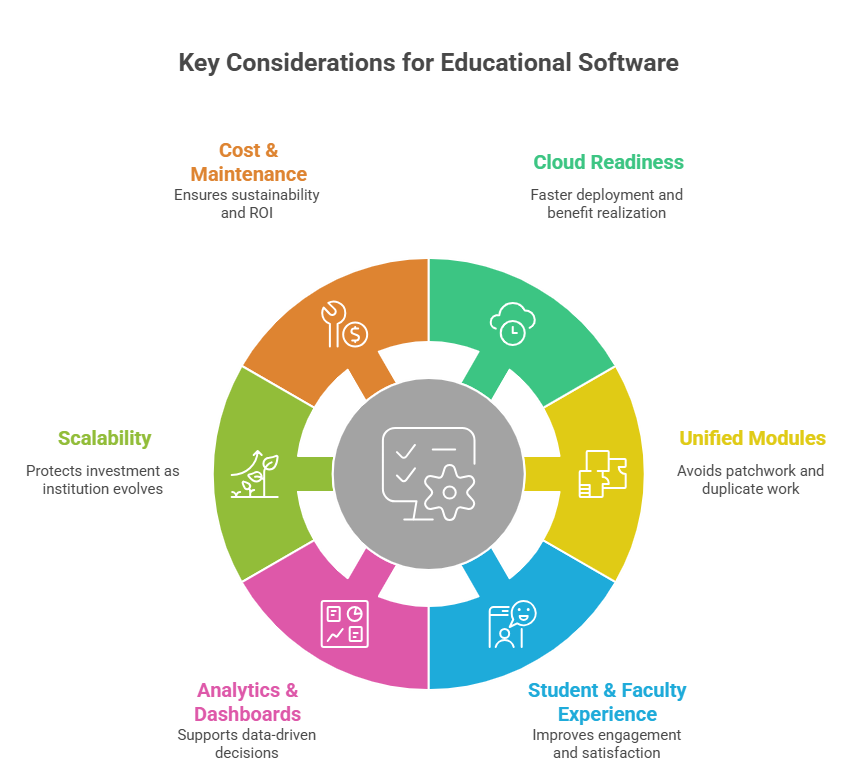
college erp

Why Acting Now Matters

  • With the education ERP market growing rapidly, the longer you delay, the more likely your institution will fall behind.
  • A cloud system lets you scale as student numbers grow, rather than being locked into rigid, outdated software.
  • Modern students expect digital access; your institution’s reputation depends on it.

Conclusion:
The search for the best college ERP software doesn’t have to feel like navigating a vast maze. You’ve learned the challenges—fragmented tools, rising expectations, and legacy drag. And you’ve seen the solution: a unified, cloud-based system designed for modern education workflows.

This is exactly where Academia steps in. Built exclusively for higher education, Academia brings student data, academic processes, and institutional intelligence onto a single, intuitive platform—helping institutions simplify operations, gain real-time insights, and deliver meaningful student experiences.

If you’re ready to leave behind the confusion, reduce administrative burden, and elevate student experience, take the next step. Book a demo, see Academia in action, and move your institution from “maze runner” to “maze master.”

AI in Higher Education: How Modern Student Information Systems Are Redefining Campus Intelligence

Higher education institutions are no longer operating in a predictable, slow-moving environment. Today’s universities face rising enrollment volumes, increasing regulatory scrutiny, complex academic models, and heightened expectations from digitally native students

Managing all this with legacy systems or fragmented software is no longer sustainable.

This is where the modern Student Information System (SIS), powered by Artificial Intelligence (AI), is becoming a strategic necessity rather than an operational upgrade. 

AI is transforming how institutions manage data, make decisions, engage students, and scale operations efficiently. In many ways, ERP in education is evolving into an intelligent digital governance layer for universities.

The real question institutions must ask today is not whether to adopt AI-powered SIS—but how long they can afford to wait.

The Growing Role of AI in Higher Education

AI adoption in higher education is accelerating rapidly:

  • According to industry studies, over 60% of universities globally are already investing in AI-driven administrative systems. 
  • Institutions using AI-powered analytics report up to 30–40% improvement in decision-making speed. 
  • Automation across admissions, examinations, and reporting can reduce manual workload by nearly 50% for administrative teams. 

AI is no longer limited to experimental use cases or academic research. It is now embedded deeply into core institutional operations, particularly within the student information system, where data volume, complexity, and compliance demands converge.

Why Traditional SIS Models Are No Longer Enough

Most legacy SIS platforms were designed for record-keeping, not intelligence. They store data but do little to interpret it, connect it, or act on it. As institutions grow, this leads to:

  • Delayed reporting and compliance risks 
  • Manual dependencies across admissions, academics, and exams 
  • Limited visibility for leadership 
  • Poor student experience due to slow, reactive processes 

Modern ERP in education must move beyond digitization and toward automation, prediction, and proactive governance, and AI makes this possible.

How AI Is Transforming the Modern Student Information System

A modern, AI-powered SIS doesn’t just manage information; it learns from it, identifies patterns, and supports smarter decision-making across the institution.

Here’s how AI is redefining SIS capabilities:

1. From Reactive Processes to Intelligent Automation

AI automates repetitive, high-volume tasks such as enrollment processing, exam evaluations, and reporting—reducing errors and speeding up operations.

2. From Static Data to Actionable Insights

AI-driven analytics convert raw institutional data into dashboards and insights that leadership teams can act on in real time.

3. From Fragmented Operations to Connected Governance

AI enables centralized oversight across departments, campuses, and academic cycles, critical for scaling institutions.

Why Institutions Can’t Afford to Stay Behind

Universities that delay AI adoption in their SIS risk falling behind on multiple fronts:

  • Slower admissions cycles while competitors enroll faster 
  • Increased compliance risks due to manual reporting 
  • Leadership decisions based on outdated or incomplete data 
  • Lower student satisfaction due to inefficient services 

As SIS platforms become smarter, the gap between AI-enabled institutions and traditional ones is widening rapidly. Digital maturity is now a competitive advantage.

Where Academia SIS Fits into This Transformation

At this point, the conversation naturally shifts from why AI matters to how institutions can apply it practically.

Academia by Serosoft is a next-generation, AI-powered Student Information System and ERP in education, designed specifically for the operational realities of higher education institutions globally.

Academia embeds AI directly into day-to-day academic and administrative workflows—ensuring intelligence is not an add-on, but a core capability.

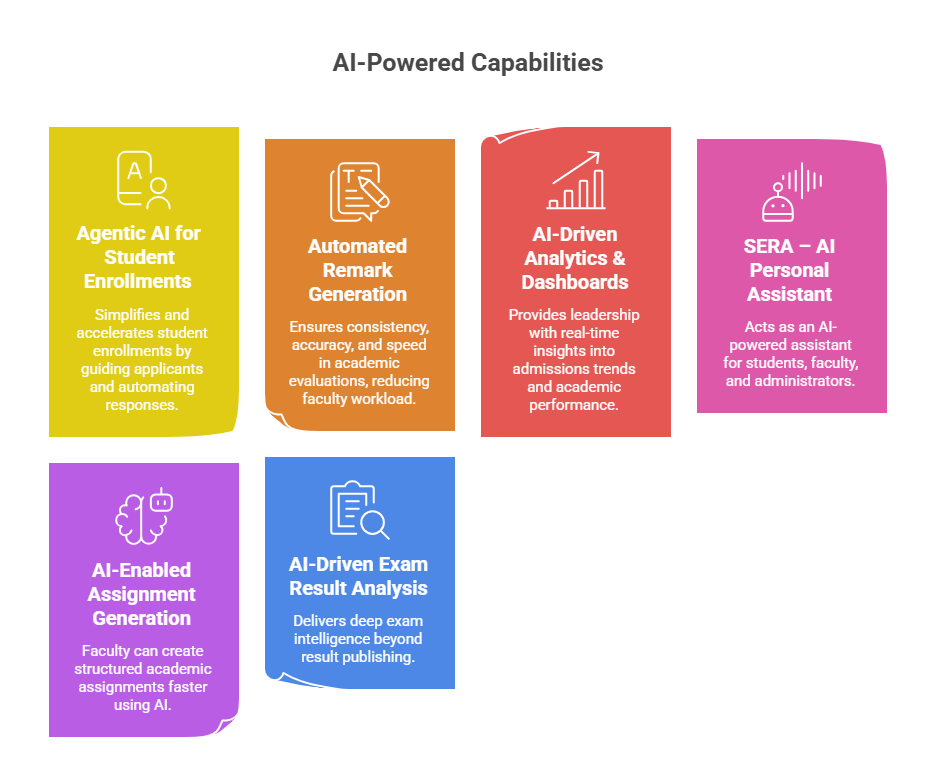
AI-Powered Capabilities Within Academia SIS

Below are some of the key AI-driven functionalities that set Academia apart as a future-ready SIS:

AI-Powered Capabilities Within Academia SIS - visual selection

Academia’s Agentic AI simplifies and accelerates student enrollments by guiding applicants, automating responses, and reducing manual intervention, helping institutions manage scale without chaos.

Automated Remark Generation

AI-generated marksheet remarks ensure consistency, accuracy, and speed in academic evaluations, while reducing faculty workload during result cycles.

AI-Driven Analytics & Dashboards

Academia delivers intelligent reports and dashboards that provide leadership with real-time insights into admissions trends, academic performance, and institutional health, supporting faster, data-backed decisions.

SERA – AI Personal Assistant

SERA acts as an AI-powered assistant for students, faculty, and administrators, answering queries, guiding workflows, and improving service responsiveness across the campus.

AI-Enabled Assignment Generation

Faculty can create structured academic assignments faster using AI, reducing preparation time while maintaining academic quality and consistency.

AI-Driven Exam Result Analysis

Academia goes beyond result publishing to deliver deep exam intelligence:

  • Exam Result Analytics:
    Analyze result data across time periods, classes, or individual students.
    Key metrics include overall pass rates, daily averages, and performance patterns. 
  • Comparison & Benchmarking:
    Compare results across academies, divisions, or cohorts, and benchmark performance against targets and historical trends—enabling continuous academic improvement. 

AI, SIS, and the Future of Digital Governance

What institutions are truly adopting when they implement an AI-powered SIS is digital governance, a model where data is governed, insights are real-time, and decisions are proactive.

With AI embedded into ERP in education:

  • Compliance becomes continuous, not last-minute 
  • Leadership gains institution-wide visibility 
  • Growth is managed without losing control 
  • Student experience improves across the lifecycle 

This is no longer about replacing software; it’s about redefining how institutions operate.

Final Thoughts: Why the Time to Act Is Now

AI is already reshaping higher education operations. Student information systems are becoming smarter, faster, and more predictive every year. Institutions that delay modernization risk being constrained by inefficiency, compliance challenges, and limited visibility.

The institutions that lead tomorrow are the ones adopting intelligent SIS platforms today.

Academia SIS enables universities to move from fragmented systems to a connected, AI-driven campus ecosystem—without disruption.

Book a free demo today to see how Academia’s AI-powered SIS delivers practical, real-world impact across admissions, academics, examinations, and governance.

Campus Management System Explained: The Ultimate Guide for Modern Institutions

In today’s fast-evolving educational landscape, institutions are under pressure to deliver personalised student experiences, streamline operations, and make data-driven decisions, all while managing increasingly complex administrative workflows. A campus management system has become a strategic necessity, not just a convenience, for colleges, universities, and multi-campus education groups.

This guide dives into what campus management systems are, why they matter, what features they should have, how they differ from traditional software, and how a campus management system/education ERP can unlock transformative value for your institution.

What Is a Campus Management System?

At its core, a campus management system is an integrated digital platform designed to unify key academic, administrative, and student-centric functions into a single ecosystem. It eliminates data silos between departments and automates processes that were once manual, repetitive, and error-prone, from admissions to analytics.

Unlike legacy systems that operated in isolation, modern campus management systems function as the digital backbone of an institution, empowering staff to focus on what matters most: enhancing the student journey and strategic outcomes.

Why Institutions Need Campus Management Systems

Traditional campus operations often rely on spreadsheets, emails, separate databases, and disconnected tools. This creates fragmented workflows, data inconsistencies, delayed communication, and inefficiencies that impact both staff and students.

By adopting a unified campus management system, institutions experience:

Real-Time Operational Insights

All departments access a centralised data repository, ensuring a single source of truth for student records, finances, course schedules, and performance indicators.

Automated Processes

Admissions, scheduling, fee processing, attendance, and reporting are automated, cutting down manual effort and reducing errors.

Improved Student Experience

Students benefit from self-service portals, mobile access, and faster response times for academic and administrative requests.

Enhanced Staff Productivity

Administrators and faculty can redirect time from paperwork to student support, academic planning, and innovation.

Strategic Decision-Making

Powerful analytics and dashboards enable data-driven decisions on enrollment trends, retention forecasts, and resource planning.

Core Features of an Effective Campus Management System

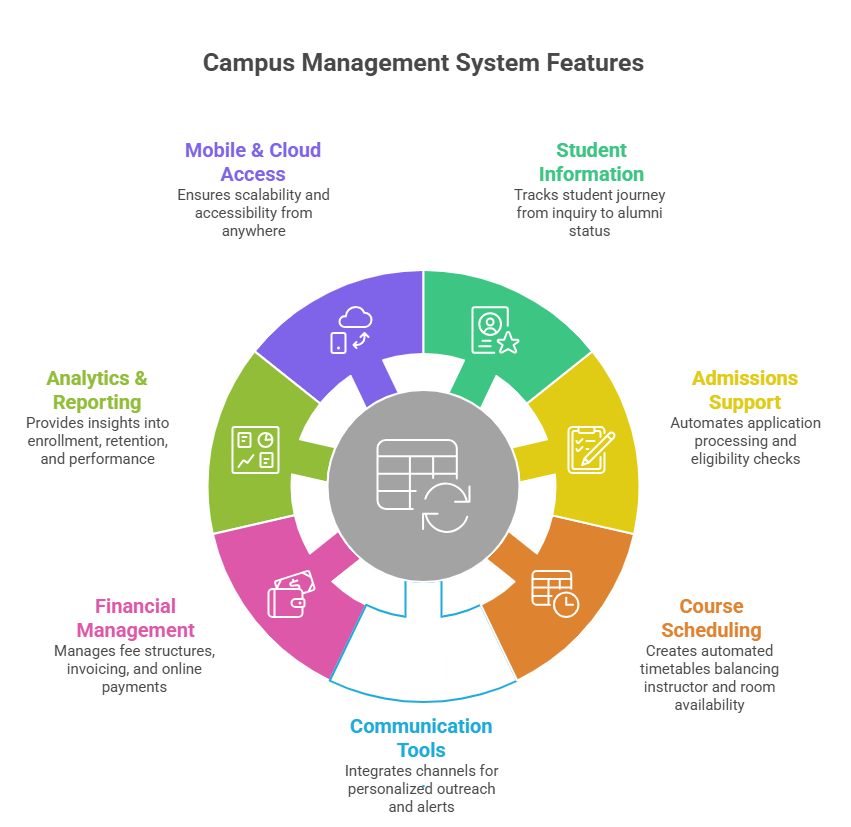
Campus Management System

An education erp should be more than a collection of modules; it should holistically address the unique challenges of educational institutions. Here are the key components every system should include:

1. Student Information & Life-Cycle Management

Track the entire student journey, from inquiry and admissions to enrollment, academic performance, certificates, and alumni status, all in one place.

2. Admissions and Enrollment Support

Automate application processing, document verification, eligibility checks, and intake planning to enhance recruiter and applicant experience.

3. Course Planning & Scheduling

Enable automated timetable creation that balances instructor availability, room capacity, and course demand, eliminating manual clashes.

4. Communication & Engagement Tools

Integrated channels (email, SMS, in-portal notifications) support personalised outreach for deadlines, alerts, and student advisories.

5. Finance & Fee Management

Manage fee structures, invoicing, online payments, scholarships, and reconciliation workflows transparently and efficiently.

6. Analytics & Reporting

Intuitive dashboards deliver insights into enrollment patterns, retention risks, financial performance, and operational KPIs, enabling leadership to act with clarity.

7. Mobile and Cloud Access

Cloud-based deployment ensures access from anywhere, scalability for growth, and reduced IT maintenance overhead.

How to Choose the Right Campus Management System

Selecting the right system is not just about features; it’s about institutional fit. Here’s a practical checklist:

  • Assess Institutional Needs

       Identify bottlenecks, departmental workflows, and strategic goals.

  • Check Integration Capabilities

       Ensure the system works with existing tools like LMS, finance software, and alumni platforms.

  • Evaluate User Experience

       The platform should be intuitive for admins, faculty, and students.

  • Prioritise Security & Compliance

       Make sure the system complies with data privacy standards relevant to your region.

  • Plan for Future Growth

     Choose a scalable, cloud-ready solution that can support multi-campus, multi-entity operations and future demand.

Measuring Success: ROI and Impact

A successful implementation goes beyond installation; it transforms outcomes. Track success by monitoring:

  • Reduction in manual administrative effort
  • Improvement in student retention and satisfaction
  • Faster processing of admissions and academic requests
  • Deeper operational insights through reports & dashboards
  • Cost savings from process automation

These metrics show not just value generation but institutional transformation.

Conclusion
In an era where institutional agility, rising student expectations, and operational efficiency are non-negotiable, choosing the right campus management system/education erp becomes a mission-critical decision.

This is where Academia stands out. Designed specifically for modern higher education institutions, Academia unifies academic operations, student data, and decision-making into one intelligent platform. Institutions using Academia don’t just manage campuses; they enable strategic growth, elevate student experiences, and unlock real-time, data-driven insights across every academic and administrative function.

Book a demo with Academia today and see how a future-ready campus management system can transform the way your institution operates.

University Management System Challenges in the Gulf: How an Academic ERP Enables Scalable & Compliant Campuses

“The best way to predict the future is to create it.” — Peter Drucker

This quote resonates strongly with universities across the Middle East. Higher education institutions in the Gulf are not just responding to change, they are actively shaping the future of education. However, ambition alone is not enough. Without the right digital foundation, even the most forward-looking institutions struggle to scale efficiently.

Consider a growing university in the UAE or Saudi Arabia. Student enrollments are increasing, programs are expanding, and regulatory expectations are becoming more structured. Yet, academic data is spread across departments, reporting cycles are stressful, and leadership lacks real-time visibility. This is where the need for a robust university management system becomes critical.

A university management system is a centralized digital platform that connects every core academic function of a higher education institution into one unified ecosystem. It brings admissions, student records, attendance, assessments, examinations, and academic reporting onto a single source of truth. Instead of departments operating in silos, data flows seamlessly across teams, campuses, and leadership levels. 

For higher education institutions in the UAE and Saudi Arabia, this means structured academic execution, real-time visibility into institutional performance, and the ability to meet regulatory and accreditation requirements with confidence—without relying on manual coordination or last-minute reporting.

Result-oriented strategies unfolding ahead. Keep reading the blog to learn more. 

The Gulf Higher Education Landscape: Growth with Complexity

Universities across the Gulf countries operate in a unique environment. Rapid infrastructure development, international collaborations with other universities for joint degree programs, and government-led education reforms are accelerating institutional growth. At the same time, compliance, transparency, and data accuracy are non-negotiable.

As institutions scale across campuses and programs, manual coordination and disconnected systems quickly become bottlenecks. Academic teams feel the pressure, and leadership struggles to gain a consolidated view of institutional performance.

This growing complexity is why many institutions in the Middle East are re-evaluating their digital backbone and moving toward a centralized university management system.

Why Fragmented Systems No Longer Work in the Gulf

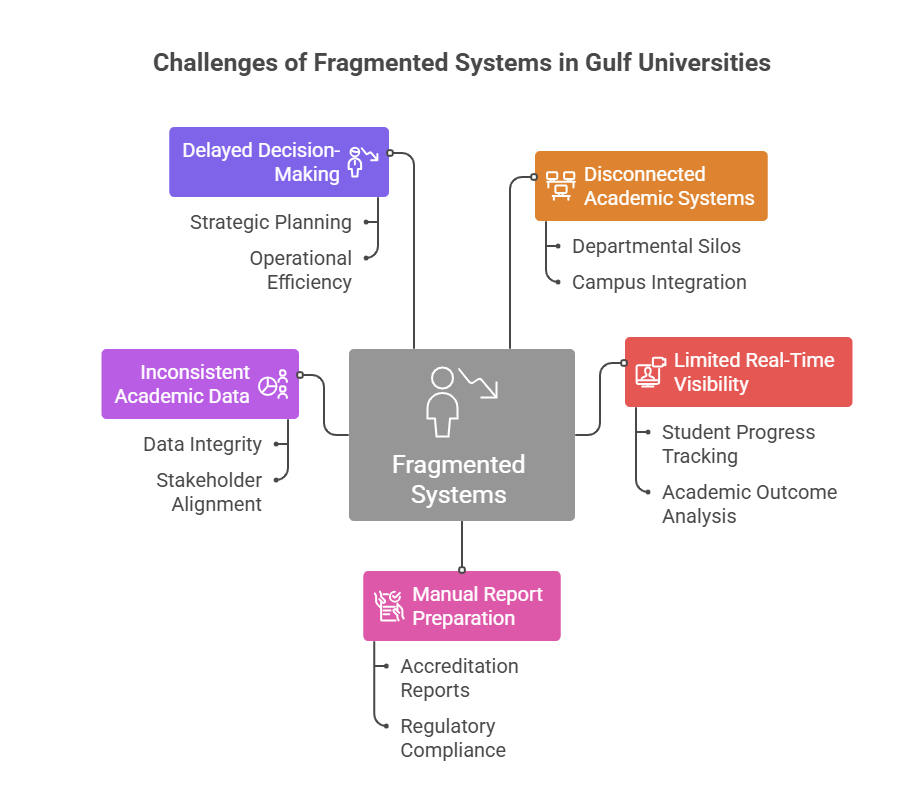
university management system

What once worked for smaller institutions is no longer sufficient for universities aiming to compete regionally and globally. Common challenges faced by Gulf universities include:

  • Disconnected academic systems across departments and campuses
  • Limited real-time visibility into student progress and academic outcomes
  • Manual preparation of accreditation and regulatory reports
  • Inconsistent academic data across stakeholders
  • Delayed decision-making due to a lack of reliable insights

Individually, these challenges slow operations. Collectively, they restrict institutional growth and credibility. In a region where education quality is closely tied to national vision, this risk cannot be ignored.

How Academia Addresses These Challenges

When universities in the UAE, Saudi Arabia, Qatar, and across the Gulf face fragmented data and manual processes, Academia’s AI-powered university management system (UMS) steps in as the strategic backbone for campus operations. 

Built for institutions scaling rapidly and operating across multiple colleges and programs, Academia unifies every academic and administrative function on a single intelligent platform. It automates core processes, from admissions and enrollment to exams, attendance tracking, curriculum, and curriculum completion, so that academic teams no longer juggle spreadsheets or disconnected systems, and leadership can rely on a single source of truth for institutional data

With more than 40+ configurable modules, dedicated web portals, mobile apps, and real-time interoperability, Academia ensures every stakeholder, students, faculty, and administrators work in harmony, saving time and reducing operational friction across departments.

How Academia Helps Drive Compliance and Transparency

  • Centralizes academic records, evaluations, and reports into a single, auditable system
  • Enables role-based access and traceable logs for complete data governance
  • Eliminates last-minute compliance stress with ready-to-export reports and transcripts
  • Supports standardized evaluation frameworks across campuses and programs
  • Strengthens accreditation readiness for national and cross-border authorities

How Academia Provides Real-Time Visibility for Leadership

  • Offers real-time AI-driven reports & dashboards for enrollment, performance, retention, and outcomes
  • Replaces delayed manual reports with instant, decision-ready insights
  • Helps leadership identify trends, risks, and opportunities early
  • Enables faster academic planning, resource optimization, and expansion decisions
  • Reinforces institutional credibility with transparent, data-driven governance

Meeting the Expectations of Modern Gulf Students with Academia

  • Delivers seamless enrollment and academic tracking through student portals
  • Provides mobile access to attendance, assessments, and results
  • Ensures timely communication between students and faculty
  • Reduces confusion with consistent, real-time academic information
  • Improves student satisfaction, retention, and overall academic experience

Why Gulf Universities Are Acting Now

Across the Middle East, universities are at an inflection point. Growth is accelerating, but expectations are rising even faster.

Institutions that delay digital transformation risk operational inefficiencies and reputational impact. In contrast, universities that invest in a scalable university management system are positioning themselves as future-ready education leaders.

Adopting an academic ERP is no longer about operational convenience. It is a strategic decision that defines how institutions compete, comply, and grow in the Gulf region.

From Vision to Execution: Building Future-Ready Campuses

The Middle East has a clear vision for higher education excellence. To realize this vision, universities need systems that support scale, governance, and innovation.

A unified university management system, like Academia, transforms complexity into clarity. It enables institutions to move faster, operate smarter, and lead with confidence.

For Gulf universities, the real advantage lies not just in adopting technology, but in choosing a system that aligns with regional realities and long-term growth goals.

The future of higher education in the Middle East will belong to institutions that act today.

Get in touch with our team of experts and get your free demo today!

The Risk of Standing Still: Education Management Systems in Southeast Asia

Imagine a fast-growing institution in Southeast Asia onboarding thousands of students every intake. Admissions are rising, international programs are expanding, and regulatory reporting deadlines are tightening. As institutions push toward modernizing campus management, expectations around speed, accuracy, and visibility have never been higher.

Yet behind the scenes, academic teams are juggling spreadsheets, disconnected portals, and manual approvals just to keep daily operations moving. What looks like institutional growth on the surface often hides operational strain underneath.

This is the reality for many institutions across Southeast Asia today. As higher education ecosystems mature in countries like Indonesia, Malaysia, Vietnam, the Philippines, and Thailand, institutions are under pressure to rethink how they manage academics at scale. This is where a robust education management system and purpose-built academic management software become not just helpful, but essential.

The Southeast Asian Higher Education Shift

Southeast Asia is witnessing a rapid transformation in higher education. Governments are investing heavily in digital transformation in universities, private institutions are scaling aggressively, and international collaborations are becoming the norm. 

With this growth comes complexity, credit mobility, outcome-based education, and stricter quality assurance frameworks.

However, many institutions still rely on fragmented tools built for a different era. When systems do not talk to each other, even simple tasks like enrollment confirmation or attendance tracking become time-consuming. Leadership, meanwhile, lacks real-time visibility into academic performance and institutional health, limiting data-driven decision-making.

An ERP for colleges supports university automation by unifying academic and administrative processes into a single, structured platform that evolves alongside institutional growth.

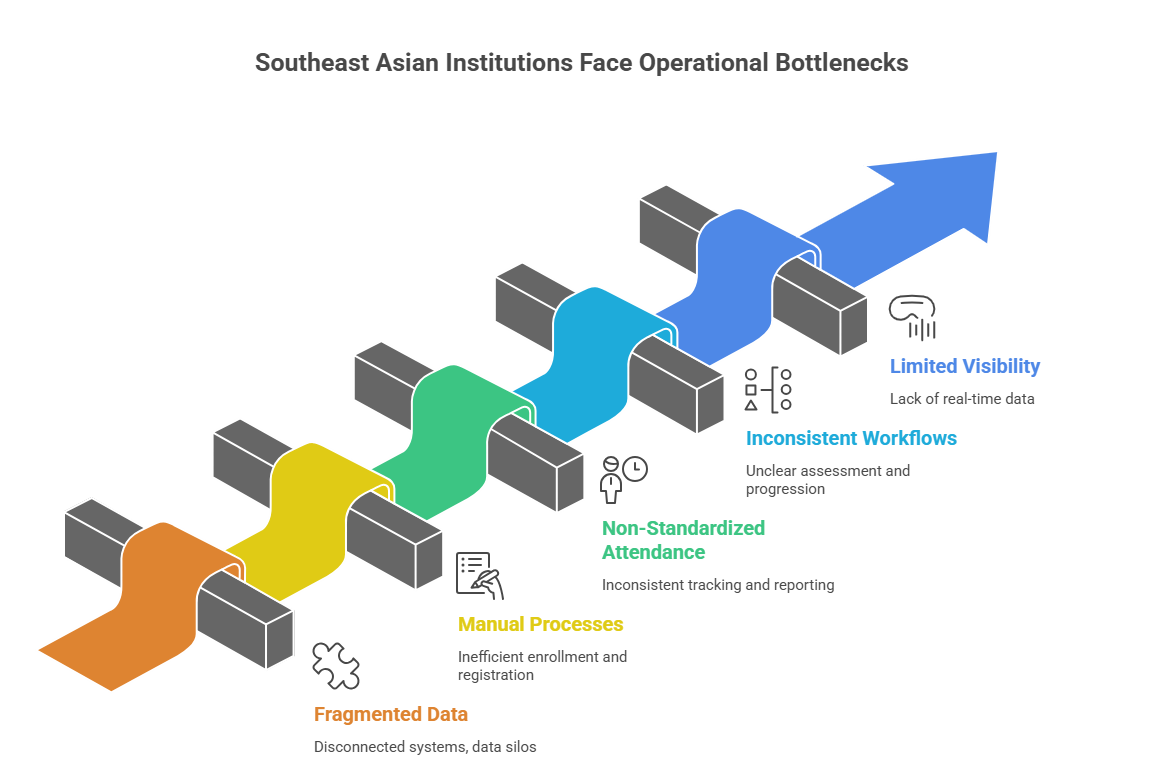
Common Operational Challenges Faced by Southeast Asian Institutions

digital transformation in universities

Despite regional diversity, institutions across Southeast Asia face a common set of operational bottlenecks:


  • Fragmented student data across departments and disconnected systems
  • Manual enrollment and course registration processes
  • Non-standardized attendance management
  • Inconsistent assessment and progression workflows
  • Limited real-time visibility for leadership and regulators

These challenges slow down operations, increase dependency on individuals, and expose institutions to compliance risks. Over time, they also impact student experience and institutional credibility.

A modern education management system simplifies complexity by centralising data, standardising workflows, and automating repetitive academic processes.

Why Traditional Systems No Longer Work

Legacy systems were often built to handle isolated functions—admissions software here, examination tools there, reporting managed manually at term end. As institutions grow, this fragmented approach fails to support scalability.

For Southeast Asian universities managing multi-campus operations, international students, and evolving regulatory expectations, flexibility and scalability are no longer optional. Institutions increasingly require cloud ERP for universities that can support growth without major infrastructure rework or system overhauls.

This is why many institutions are shifting to an ERP for colleges designed specifically for higher education, rather than adapting generic enterprise tools.

How a Modern ERP Supports Academic Excellence

A future-ready platform strengthens academic outcomes by aligning daily operations with long-term institutional goals. Instead of reacting to issues, institutions gain proactive control over their academic ecosystem.

With a unified education management system, institutions can manage the complete student lifecycle, from enquiry and enrollment to progression and graduation—while ensuring data accuracy and governance.

Key capabilities typically include:


  • Centralised student records, accessible across departments
  • Automated enrollment and course registration workflows
  • Real-time attendance and academic progress tracking
  • Standardised assessments, grading, and transcript generation
  • AI-driven reports with live operational insights

Together, these capabilities enable true academic management software functionality, reducing manual workload and improving consistency across campuses.

The Strategic Value of ERP for Southeast Asian Institutions

Beyond efficiency, an ERP for colleges plays a strategic role in institutional expansion. It allows universities to launch new programs faster, manage regional or cross-border campuses with confidence, and respond smoothly to audits and accreditation reviews.

More importantly, it builds a strong digital backbone for innovation, whether through AI-driven student engagement, blended learning models, or global academic partnerships. A cloud ERP for universities ensures institutions remain agile while maintaining governance and control.

As Southeast Asia positions itself as a global education hub, institutions that invest early in scalable digital infrastructure gain a significant competitive advantage.

Looking Ahead: Building Resilient Digital Campuses

The future of higher education in Southeast Asia will be defined by agility, transparency, and student-centricity. Institutions can no longer rely on systems that merely store data; they need platforms that actively enable digital transformation in universities.

By adopting a comprehensive education management system like Academia, institutions move from reactive administration to proactive governance. With AI-powered workflows, real-time dashboards, and unified data management, Academia supports sustainable growth without compromising compliance or clarity.

Digital transformation is no longer a long-term aspiration, it is a present-day necessity. For Southeast Asian institutions, the question is no longer whether to modernize campus management, but how quickly they can do so effectively.

Book a demo with Academia today to see how your institution can streamline operations, empower leadership, and deliver a seamless student experience.

Why APAC Universities Are Rethinking Their Student Information System Strategy

“Technology is best when it brings people together.”

In higher education, this couldn’t be more relevant. A Student Information System is not just about digitizing records or automating tasks; it’s about connecting departments, aligning faculty and administrators, and ensuring leadership operates with a shared, accurate view of institutional data. 

When an SIS truly works, admissions, academics, examinations, and compliance teams stop functioning in silos and start moving in sync. Decisions become faster, collaboration improves, and leadership stays on the same page because everyone is working from one reliable source of truth. 

To understand why this matters so much, let’s look at a real situation many institutions across Southeast Asia face every day.

At 9:00 a.m. on a Monday morning, the registrar’s office at a growing university in Southeast Asia is already flooded with calls.
A student’s enrollment status doesn’t match the exam list.
Faculty are chasing attendance data from three departments.
Leadership wants a consolidated report for an accreditation review by the end of the day.

None of these problems exists because institutions lack intent or effort.
They exist because information is scattered, systems don’t talk to each other, and decisions rely heavily on manual work.

Across the APAC region, higher education institutions are expanding rapidly, but their digital foundations often struggle to keep pace. This is why the conversation around smarter campus technology has shifted from tools to systems, and from isolated platforms to integrated solutions.

The Growing Digital Strain on APAC Higher Education

Universities across Southeast and Central Asia are operating in one of the fastest-evolving education landscapes in the world. Countries like Indonesia, Vietnam, the Philippines, Malaysia, Kazakhstan, and Sri Lanka are witnessing:

  • Rapid enrollment growth

  • Increased regulatory scrutiny

  • Cross-border academic collaborations

  • Rising expectations for digital student experiences

However, many institutions still operate with fragmented platforms, one for admissions, another for academics, spreadsheets for reporting, and emails for approvals. As a result, leadership teams struggle to access real-time insights, while operational teams spend hours reconciling data.

This growing complexity is forcing institutions to reassess how they manage academic and administrative data at scale.

Where Traditional Campus Systems Fall Short

The challenge is not digitization alone; it’s connected digitization.
When systems are not designed to function as a single ecosystem, institutions experience:

  • Data inconsistencies across departments

  • Manual reconciliation during audits and reporting

  • Delayed decision-making due to outdated information

  • Limited visibility into student progression and outcomes

Over time, these gaps don’t just slow operations; they affect institutional credibility, student satisfaction, and leadership confidence.

This is where a modern student information system becomes foundational rather than optional.

What Modern Institutions in APAC Need Today

To operate efficiently in a multi-campus, regulation-driven, and data-intensive environment, institutions now require more than basic automation. They need a unified digital backbone that supports scale, transparency, and governance.

A future-ready campus platform must enable:

  • Centralized academic and student data

  • Automated workflows across departments

  • Real-time dashboards for leadership

  • Audit-ready reporting aligned with regional regulations

In essence, institutions are moving toward platforms that function as a comprehensive education erp, rather than disconnected software tools.

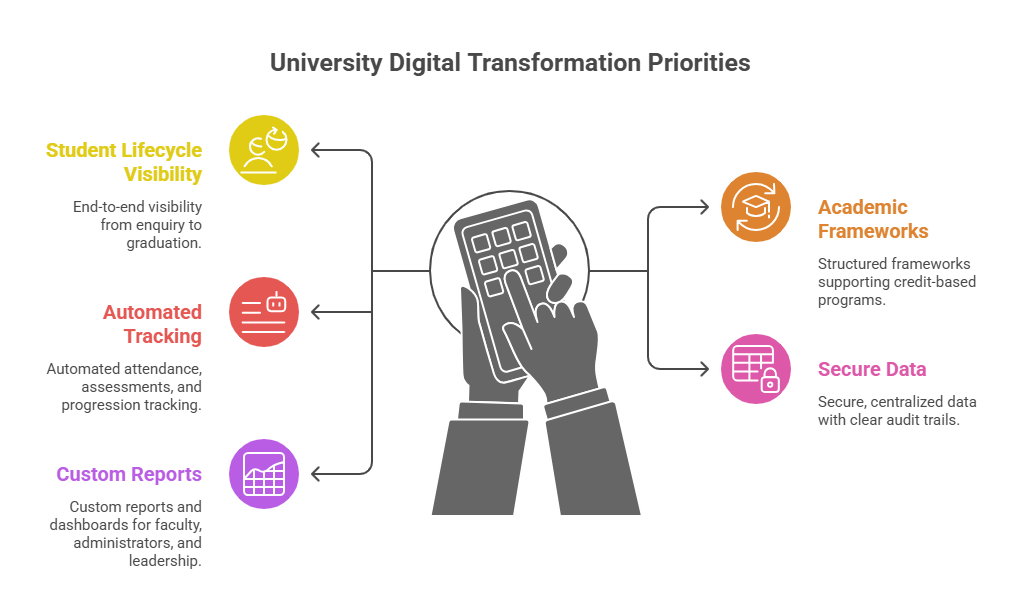
Key Capabilities Universities Are Prioritizing:

Across APAC, institutions evaluating digital transformation consistently look for systems that offer:

digital transformation
 
  • End-to-end student lifecycle visibility, from enquiry to graduation

  • Structured academic frameworks supporting credit-based programs

  • Automated attendance, assessments, and progression tracking

  • Secure, centralized data with clear audit trails

  • Custom reports & dashboards for faculty, administrators, and leadership

These capabilities reduce manual intervention, improve data accuracy, and allow institutions to operate with greater confidence and control.

Why Integration Matters More Than Ever

As institutions scale, every additional department, program, or campus increases data complexity. Without integration, leadership decisions rely on partial or delayed information.

A unified student information system eliminates this risk by ensuring all stakeholders work from the same source of truth. Admissions data aligns with academic records. Attendance connects seamlessly with assessments. Reporting becomes reliable, timely, and consistent.

When paired with a robust education erp, institutions gain not just operational efficiency, but strategic clarity.

APAC’s Shift Toward Data-Driven Governance

Regulatory bodies across the Asia-Pacific are increasingly emphasizing transparency, traceability, and accountability. Accreditation frameworks now expect institutions to demonstrate:

  • Verifiable academic records

  • Consistent reporting methodologies

  • Evidence-backed decision-making

Institutions relying on manual processes often find compliance stressful and time-consuming. In contrast, digitally mature universities use automation to stay audit-ready at all times, without last-minute data compilation.

This shift is accelerating the adoption of platforms that combine academic depth with enterprise-grade reliability.

From Operational Burden to Strategic Advantage

The real value of a modern student information system lies in how it transforms everyday operations into strategic assets. When data is accurate and accessible, leadership can:

  • Identify enrollment trends early

  • Monitor student performance proactively

  • Allocate resources more effectively

  • Respond faster to regulatory or market changes

This is why forward-looking institutions are no longer asking whether to modernize, but how quickly they can transition to a connected education erp model.

Why Academia SIS Is the Future-Ready Solution APAC Universities Are Searching For:

As higher education across APAC grows in scale and complexity, institutions need a connected digital backbone, not fragmented tools. Academia SIS is a future-ready student information system designed to unify departments, automate academic operations, and give leadership real-time visibility through AI-driven intelligence.

Key Capabilities Powering APAC Campuses

  • Attendance Management – Capture accurate attendance via QR, biometric, or mobile methods, with instant compliance-ready reports.

  • Exam & Marksheet Management – Automate exam scheduling, marks processing, and generation of transcripts with complete data accuracy.

  • AI-Powered Admissions – Enable students to self-enroll using an Agentic AI chatbot, simplifying applications and reducing manual workload.

  • AI-Driven Reports & Analytics – Access 800+ built-in reports and interactive dashboards for faster, data-backed leadership decisions.

Conclusion: Building Resilient Digital Campuses in APAC

Higher education in the APAC region is entering a decisive phase. Growth, complexity, and accountability are rising simultaneously. Institutions that continue to rely on fragmented systems risk operational strain and missed opportunities.

On the other hand, those that invest in a unified digital foundation position themselves for long-term resilience, better governance, and stronger student outcomes.

This is where Academia SIS becomes a strategic advantage. Designed for the evolving needs of APAC institutions, Academia enables universities to connect departments, automate critical processes, and lead with data-driven confidence.

Book a free demo today or speak with our experts to see how Academia can help your institution build a future-ready digital campus.

Why Education ERP Is No Longer Optional for Indian Institutions Facing Scale and Compliance Challenges

Every admission season in India tells the same story. Campuses buzz with activity, teams work overtime, and leadership expects seamless execution. 

Yet behind the scenes, administrators juggle spreadsheets, departments chase missing data, and reports are stitched together at the last moment. The ambition is digital transformation, but the reality often feels anything but digital.

As Indian institutions expand student intake, launch new programs, and respond to regulatory bodies, operational complexity increases. This is exactly where erp for colleges becomes a necessity rather than a long-term plan.

The Real Challenges Indian Colleges Face Today

India’s higher education ecosystem is evolving rapidly. Institutions are expected to scale without compromising academic quality, compliance, or student experience. However, many colleges still rely on disconnected systems that were never designed to work together.

Admissions data may sit in one tool, academics in another, and examinations somewhere else entirely. As a result, leadership lacks real-time visibility, teams depend on manual effort, and compliance reporting becomes stressful instead of structured. Without a unified campus management system software, operational efficiency remains a challenge, no matter how experienced the staff may be.

Why Traditional Systems Struggle at Scale

Legacy systems often solve isolated problems but fail to support the institution as a whole. Over time, this leads to duplicated work, inconsistent data, and delayed decisions. Moreover, regulatory reporting, NAAC preparation, and internal audits demand accuracy and traceability, something manual processes struggle to deliver consistently.

This is where a modern erp for colleges plays a transformative role, acting as a single operational backbone rather than just another system.

What a Modern Campus System Needs to Deliver

For Indian colleges, the expectation from technology has changed. Institutions now look for systems that reduce workload, improve coordination, and support long-term growth, not just automate tasks.

A purpose-built campus management system software enables institutions to standardize workflows, centralize data, and create transparency across departments. When data flows seamlessly from admissions to academics to examinations, reporting becomes reliable and decision-making improves significantly.

Key Capabilities Institutions Look for Today

  • Centralized student records are accessible across departments
  • Automated admissions, registration, and academic workflows
  • Accurate examination and progression tracking
  • Compliance-ready reporting for accreditation and audits
  • Real-time dashboards for institutional leadership

These capabilities ensure that daily operations support strategic goals rather than slowing them down.

From Daily Firefighting to Structured Growth

Once implemented effectively, erp for colleges changes how institutions operate at every level. Administrative teams spend less time reconciling data. Faculty benefit from structured academic processes. Leadership gains confidence in reports and analytics used for planning and governance.

Most importantly, students experience smoother journeys, from application to graduation, without being affected by internal inefficiencies. This is the tangible impact of adopting the right campus management system software.

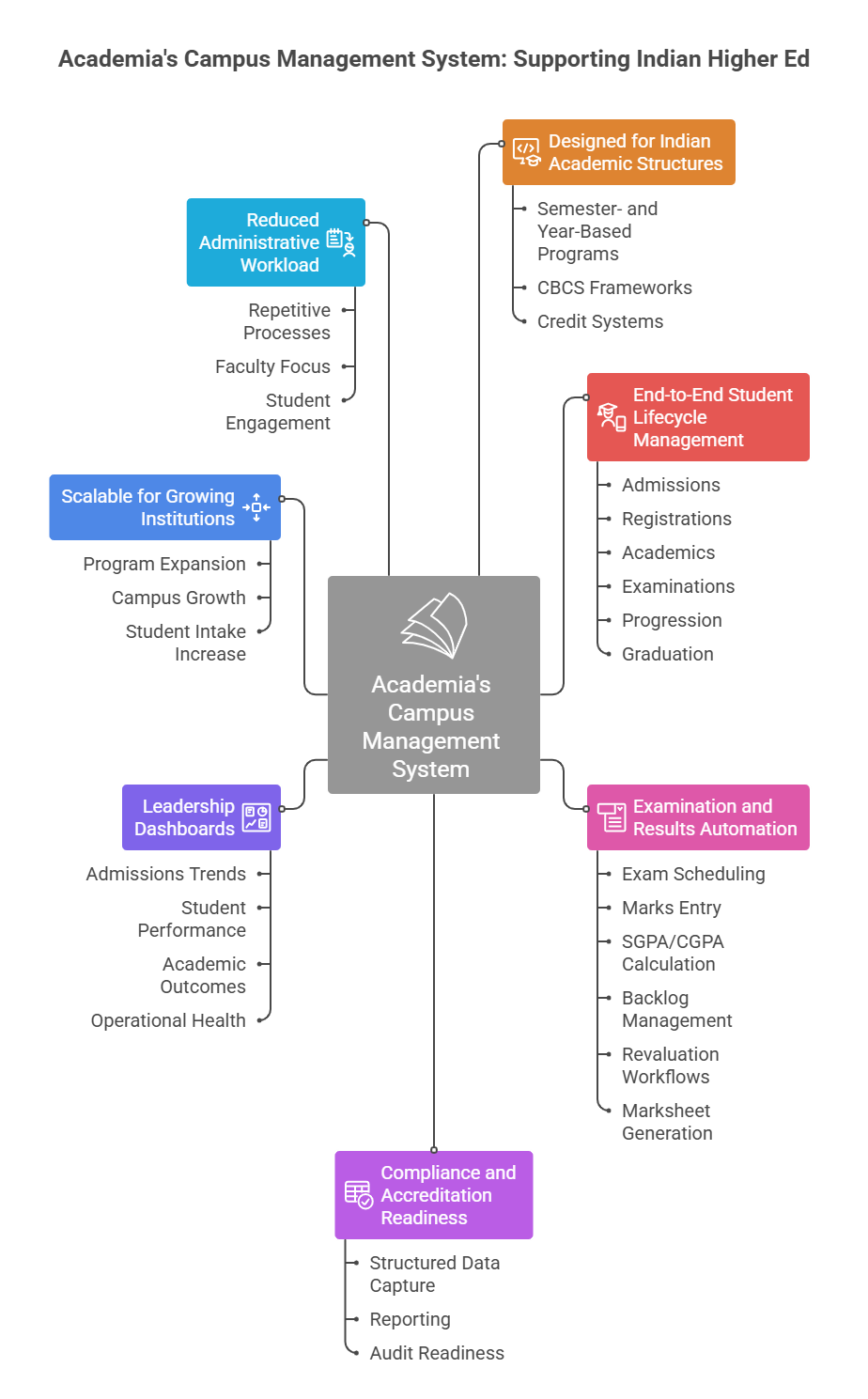
How Academia’s Campus Management System Supports Indian Higher Ed Institutions

Campus Management System

  • Designed for Indian academic structures
    Supports semester- and year-based programs, CBCS frameworks, credit systems, and diverse program hierarchies common across Indian universities and colleges.
  • End-to-end student lifecycle management
    Manages admissions, registrations, academics, examinations, progression, and graduation on a single platform, eliminating dependency on multiple tools and spreadsheets.
  • Examination and results automation at scale
    Handles exam scheduling, marks entry, SGPA/CGPA calculation, backlog management, revaluation workflows, and marksheet generation, critical for institutions managing large student volumes.
  • Compliance and accreditation readiness
    Enables structured data capture and reporting aligned with Indian regulatory and accreditation requirements, making audits and reviews more systematic and less manual.
  • Leadership dashboards and institutional reporting
    Provides real-time visibility into admissions trends, student performance, academic outcomes, and operational health, supporting informed decision-making at the management level.
  • Scalable for growing institutions
    Built to support institutions expanding programs, campuses, and student intake without compromising performance or data accuracy.
  • Reduced administrative workload for teams
    Automates repetitive academic and administrative processes, allowing faculty and staff to focus on teaching quality and student engagement rather than manual coordination.

Why Indian Institutions Are Acting Now

With increasing competition, stricter accreditation norms, and higher expectations from students and parents, institutions can no longer afford fragmented operations. Colleges that delay modernization often find themselves constrained by systems that cannot scale or adapt.

In contrast, institutions that invest early in erp for colleges build resilience, improve institutional credibility, and position themselves for sustainable growth in a dynamic education landscape.

The Strategic Takeaway for Institutional Leaders

Digital transformation is no longer about adding tools; it’s about building a connected operational ecosystem. A well-implemented campus management system software like Academia allows Indian institutions to move from reactive administration to proactive governance.

Keen to know more about Academia’s efficiency-enabling features and capabilities? Reach out to our team of experts, as they will be happy to assist you.

Why Middle East Universities Are Rethinking Student Information System Software in 2026

At universities across the Middle East, leadership meetings are no longer dominated by expansion plans alone. Instead, a different question keeps surfacing: Can our current systems actually support the scale, compliance, and student expectations we are committing to?

As institutions grow faster, welcome international students, and operate across multiple campuses and regulators, operational cracks begin to show. Manual workarounds multiply. Data lives in silos. Decision-making slows down. This is precisely why forward-looking institutions in the region are reassessing the role of student information system software as a strategic foundation rather than just an IT tool.

The Middle East’s Higher Education Reality Has Changed

Over the last decade, universities in the Middle East have transformed dramatically. Cross-border programs, international accreditations, and government-mandated reporting are now standard, not optional. 

However, many institutions are still relying on disconnected tools that were never designed for this level of complexity.

As a result, 

  • Academic teams spend more time reconciling data than improving outcomes.
  • Admissions teams struggle with visibility. 
  • Leadership lacks real-time insights. 

Without a modern education management system, institutions risk slowing down at the very moment they need to accelerate.

Where Traditional Systems Fall Short

Legacy campus systems often evolved department by department. Admissions adopted one tool, academics another, and examinations something else entirely. Over time, this creates operational friction that directly impacts both staff efficiency and student experience.

Common challenges seen across Middle East institutions include:

  • Limited visibility across the complete student lifecycle 
  • Manual intervention for compliance and accreditation reporting 
  • Delays in academic decision-making due to fragmented data 
  • Inconsistent student communication across departments 

These issues don’t stem from the lack of effort; they stem from systems that were never designed to work as one.

What Modern Institutions Expect Today

Universities that are scaling successfully in the region share one common trait: they treat digital infrastructure as an institutional strategy. They expect student information system software to support leadership decisions, not just administrative tasks.

A modern platform is expected to unify academic operations, automate workflows, and create a single source of truth across campuses and departments. This is where a purpose-built education management system begins to deliver measurable value.

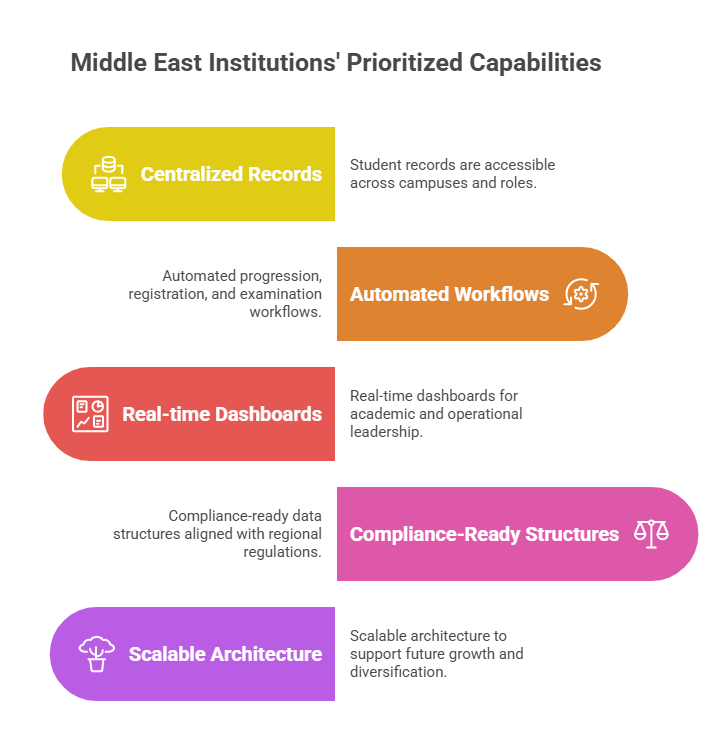
Key Capabilities Middle East Institutions Now Prioritize

student information system software

  • Centralized student records are accessible across campuses and roles 
  • Automated progression, registration, and examination workflows 
  • Real-time dashboards for academic and operational leadership 
  • Compliance-ready data structures aligned with regional regulations 
  • Scalable architecture to support future growth and diversification 

These capabilities are no longer “nice to have.” They are essential for institutions competing regionally and globally.

From Operational Burden to Strategic Advantage

When implemented correctly, student information system software changes how institutions function at every level. Administrative teams shift from reactive tasks to proactive planning. Faculty gain clarity and consistency in academic processes. Leadership benefits from reliable, real-time insights instead of delayed reports.

More importantly, students experience smoother journeys, from application to graduation, without feeling the friction of internal processes. This is where the true return on investment of an integrated education management system becomes visible.

How Academia SIS Addresses Daily Operational Challenges for Institutions

To turn a modern vision into daily reality, institutions need more than just strategy – they need a system built for end-to-end operational excellence. Academia SIS, recognised in the Gartner® Magic Quadrant™ for Student Information System SaaS 2025, is a cloud-native, AI-powered education management system that helps universities overcome everyday bottlenecks and scale with confidence.

How Academia SIS Simplifies Campus Operations

  • Modern Student Lifecycle Hub

Academia SIS serves as a centralized source of truth for student data across departments. From admissions to results, every update flows through one unified platform, eliminating data silos, manual reconciliation, and fragmented reporting.

  • Admission & Enrollment with Agentic AI Support

Academia automates end-to-end admissions workflows, from enquiry capture to offer letter generation. Agentic AI-assisted enrollment significantly reduces manual data entry and decision delays, enabling faster onboarding and improved accuracy even at high application volumes.

  • Automated Student Registration & Program Management

Academia simplifies course registration through bulk uploads and job-based automation for mapped programs. This reduces repetitive administrative work while ensuring students are enrolled accurately and efficiently.

  • Fee & Financial Management

Academia enables integrated billing with auto-generated invoices and multi-channel payment tracking across programs. Finance teams gain complete visibility, reduced errors, and better control over collections and follow-ups.

  • Examinations & Results Management

Academia’s examination module supports exam scheduling, hall planning, attendance-initiated exam holds, bulk marks entry, automatic SGPA/CGPA calculations, custom marksheet templates, and performance dashboards, all managed from a single interface. Results and analytics can be published via portals, email, or SMS with minimal manual effort.

  • AI-Driven Reports & Analytics for Leadership

Academia provides real-time dashboards and automated, command-based report generation. Leadership teams gain immediate insights into admissions trends, student performance, financial health, and operational efficiency, without manual data compilation.

  • Attendance, Portal & Engagement Tools

Academia integrates attendance tracking (including QR-based and biometric options) with student portals and mobile apps, ensuring timely communication, improved engagement, and academic transparency for all stakeholders.

Each of these capabilities doesn’t just automate work; it connects processes, reduces dependency on spreadsheets, and creates systemic transparency. As a result, institutions can focus less on administrative firefighting and more on academic quality, compliance, and strategic planning, precisely what the modern higher education landscape demands.

Why This Shift Matters Now

The Middle East higher education market is becoming increasingly competitive. Students compare experiences globally, regulators demand transparency, and leadership teams are expected to make faster, data-backed decisions. Institutions that delay modernization often find themselves constrained by systems that cannot keep up.

In contrast, universities that invest early in the right student information system software position themselves to scale confidently, maintain compliance, and deliver consistently high-quality student experiences across campuses.

The Strategic Takeaway for Institutional Leaders

Digital transformation in higher education is no longer about replacing tools-it’s about building a connected operational backbone. A well-implemented education management system enables institutions to move from fragmented execution to coordinated excellence.

For Middle East universities focused on sustainable growth, international credibility, and operational resilience, the question is no longer if modernization is needed-but how soon it can be achieved. Platforms like Academia by Serosoft help institutions simplify daily operations, improve visibility across the student lifecycle, and scale with confidence.

If your institution is ready to move toward a truly connected digital campus, book a free demo of Academia SIS and see how it can support your operational and academic goals.

Attendance Management System: Turning Attendance Data Into Academic Insight

On a university campus during mid-semester reviews, the academic council is trying to identify students at risk of failing. Faculty members open different Excel sheets, some incomplete, some formatted differently, and some stored on personal laptops. 

Attendance registers from a few departments are still in paper form, and a couple have been misplaced after internal audits. Program heads debate whether a student’s attendance is actually 62% or 71% because records don’t match across classes. Meanwhile, parents are requesting clarity, accreditation teams are asking for verified reports, and leadership wants quick patterns – but no one has a single source of truth.

This is exactly what happens when an institution does not have a centralized attendance management system. Activity is happening, classes are running, and data exists, but it is fragmented, unreliable, and difficult to act upon. 

Consistent attendance data powers better learning outcomes, timely interventions, and informed leadership decisions, and that is where a modern attendance management system truly makes a difference.

Attendance is no longer a register; it’s a strategy: 

Today, attendance connects directly to engagement, retention, accreditation readiness, and funding decisions. When records live across diaries, Excel sheets, and disparate portals, patterns remain hidden, and compliance becomes stressful. 

However, when attendance becomes digital, centralized, and real-time, institutions gain clarity: who is present, who needs support, and where learning friction exists. Therefore, the shift is not merely from paper to software; it is from guesswork to evidence-based planning.

Moreover, leadership teams increasingly seek analytics that go beyond counts and percentages. They want trends across courses, visualization of chronic absenteeism, and early warning indicators for at-risk learners. A well-designed attendance management system turns raw presence into meaningful, actionable insight that directly influences student success.

Connecting attendance with broader academic operations:

Attendance becomes truly powerful when it does not live in isolation. When linked with robust student information system software, attendance data blends with enrollment records, assessment data, progression rules, and graduation eligibility.

As a result, institutions unlock unified profiles, program-level insights, and effortless reporting, all without duplicate data entry. Additionally, this integration reduces manual errors, improves compliance documentation, and supports data-driven decision-making at every level.

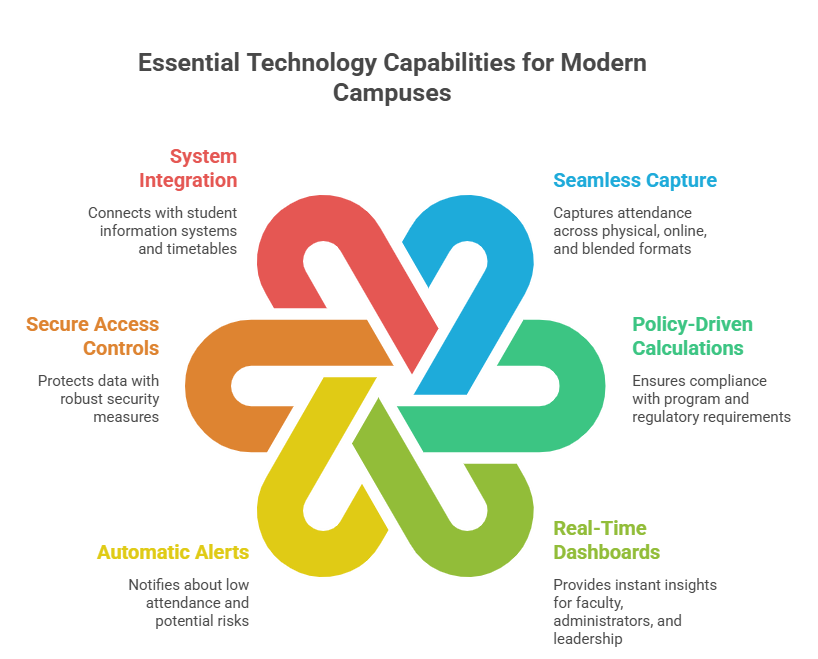
Core capabilities institutions value today:


Attendance management system

Here is a concise snapshot of what progressive campuses expect from technology that manages attendance intelligently:

Implementation considerations that really matter

Selecting technology is no longer just about features; it is about adoption. Faculty should find it intuitive, students should access it easily through mobile, and administrators should configure policies without complex IT dependency. 

At the same time, seamless alignment with student information system software ensures that attendance data flows naturally into marks, progression, and eligibility rules. Transitioning from manual to digital, therefore, is both an operational and cultural shift, and ease of use accelerates both.

Furthermore, data security, scalability, and integration readiness should sit at the top of every evaluation checklist. Institutions often outgrow standalone tools quickly; platforms that evolve with academic models and regulatory expectations offer longer-term value.

From visibility to measurable outcomes

Once attendance becomes accurate and automated, institutions start noticing more than convenience. Early alerts enable mentoring before dropouts happen. Transparent records reduce disputes. Department-level trends reveal teaching gaps, timetable challenges, or student support needs. Step by step, attendance data moves from “record keeping” to “academic intelligence.”

A capable attendance management system is therefore not simply an automation tool; it is an enabler of student success, operational clarity, and institutional accountability.

How Academia Eases Attendance Management Seamlessly:

Academia’s attendance capabilities are part of its comprehensive student information system software, built to streamline attendance tracking while eliminating the typical challenges faced by higher ed institutions. With Academia’s Attendance Management System, attendance is no longer a fragmented or manual task; it becomes connected, accurate, and actionable.

Infographic Link: 

attendance management system

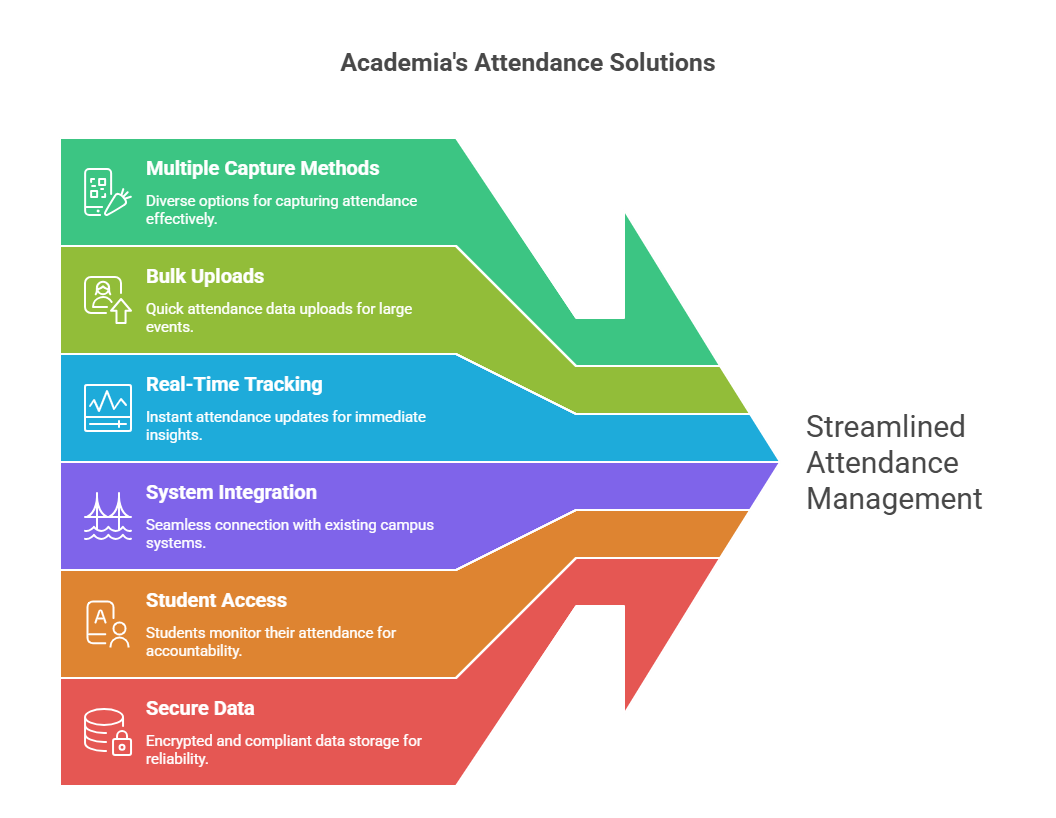
Here’s how Academia makes attendance effortless and effective for colleges and universities:

  • Multiple attendance capture methods: Whether you prefer QR code scans via the student mobile app, RFID badges, or biometric devices, Academia supports all these methods and lets teachers mark attendance directly from their mobile or web interface. 
  • Bulk attendance uploads: For large lecture halls or campus-wide attendance events, administrators can upload attendance data in bulk with a single click, saving time and reducing errors. 
  • Real-time tracking and reporting: Attendance is recorded instantly and synced across the platform, enabling administrators, faculty, and even students to view daily, monthly, or subject-wise attendance reports with rich visual insights. 
  • Seamless integration with existing systems: Academia can integrate with current biometric or RFID systems already deployed on campus, ensuring attendance data flows securely into the central SIS without disruption. 
  • Student access and transparency: Students can track their own attendance records via their portal or mobile app in real time, helping them stay accountable and engaged. 
  • Secure and compliant: All attendance data within Academia’s platform is encrypted and stored securely, aligning with data protection standards while making record-keeping reliable and audit-ready. 

By combining flexible capture methods, real-time reporting, secure storage, and analytical capabilities, all directly tied to the broader student information system software, Academia helps institutions eliminate manual hassles, reduce administrative workload, and gain true academic insight from attendance data.

Conclusion: Precision presence, smarter decisions:

Accurate attendance isn’t just record-keeping; it is the foundation for engagement, compliance, and student success. A modern attendance management system, combined with powerful student information system software, turns raw data into actionable academic insight.

Academia delivers this seamlessly with integrated attendance tracking and real-time analytics. Ready to move from paperwork to precision? 

Book your free demo with Academia today and experience effortless, accurate attendance management.

Back to top