

Pankaj Joshi
Estd. Reading Time : 4 Min.
3rd Mar, 2026
Campus Management System
Share On:
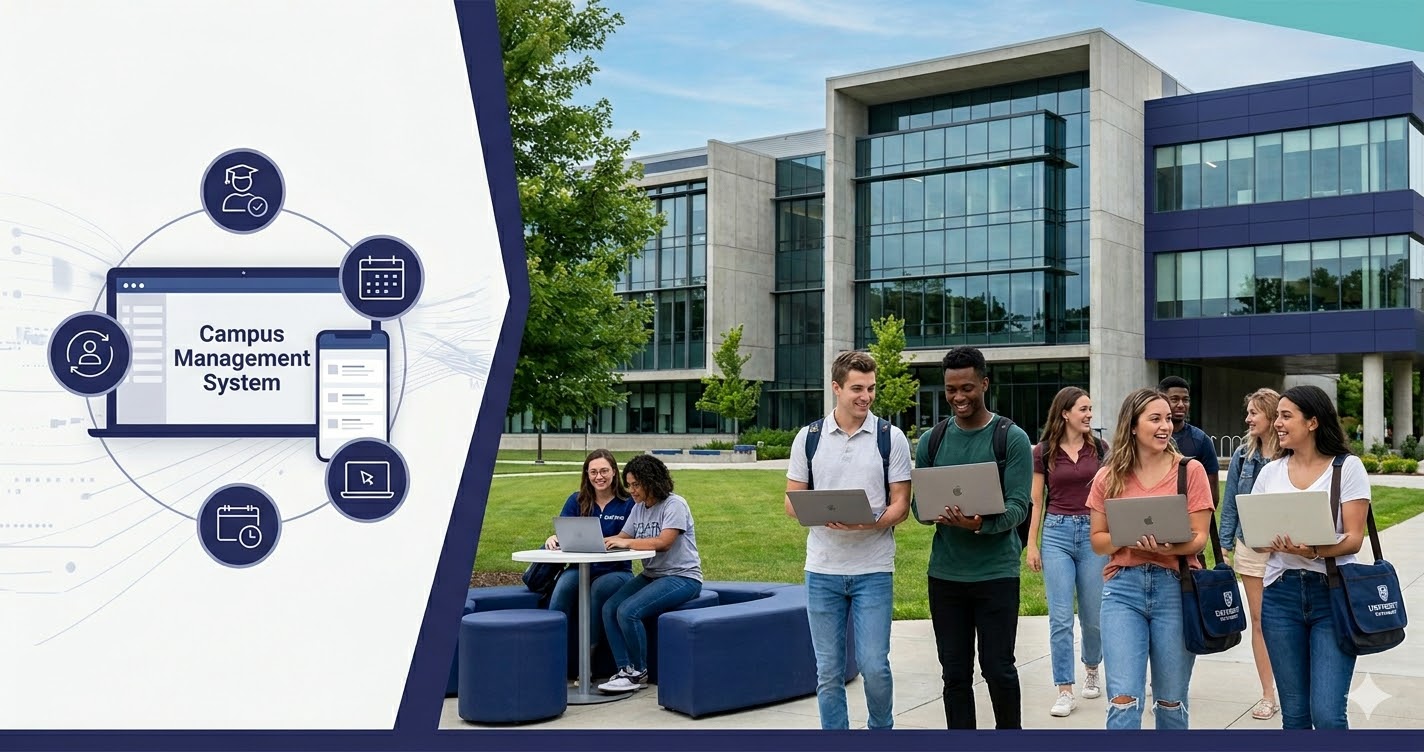
A Campus Management System is an integrated platform that manages the complete student lifecycle, from admissions and enrollment to academics, attendance, examinations, communication, and reporting, within a single digital environment.
Institutions ask whether they truly need one, whether spreadsheets and legacy tools are enough, and how it connects with broader transformation goals. The answer lies in operational complexity: as student numbers grow, compliance requirements increase, and accreditation standards become stricter, disconnected systems create inefficiencies, data silos, and reporting delays.
A modern Campus Management System, a.k.a Education ERP, serves as the backbone of institutional digital infrastructure, ensuring real-time data visibility, process automation, and leadership-level decision intelligence.
In regions like the Middle East, where national visions emphasize digital governance and smart campuses, adopting a robust Campus Management System is no longer optional, it is a strategic necessity for institutional competitiveness, regulatory readiness, and student satisfaction.
Across the Gulf and wider Middle East, higher education institutions are facing three simultaneous pressures:
Academia Insights:
According to global higher education digital transformation surveys, over 70% of institutions report that fragmented systems limit operational efficiency.
Additionally, industry research consistently shows that universities using integrated Education ERP platforms reduce administrative processing time by 30–50% compared to manual workflows.
For leadership teams, the question is no longer “Should we digitize?” but rather “How do we build a sustainable digital infrastructure?”
When admissions, academics, finance, and exams operate on separate tools, leadership struggles with a single source of truth. Reports take days to compile, and decision-making slows.
Registrars and administrators spend significant time reconciling spreadsheets instead of focusing on strategic planning.
Accreditation bodies increasingly require transparent audit trails. Without a centralized Campus Management System, institutions risk delays and inconsistencies.
Today’s students expect digital self-service portals, instant notifications, and mobile-first engagement. Legacy systems cannot deliver this consistently.
A regional survey conducted among higher education administrators in emerging markets revealed that process inefficiency and lack of integration were cited as top operational concerns by more than half of respondents.
A modern Education ERP goes beyond digitization. It creates institutional architecture.
Instead of isolated tools, it builds a connected ecosystem:
When implemented as a comprehensive Campus Management System, it transforms governance, not just operations.
Below is a simplified digital architecture model:
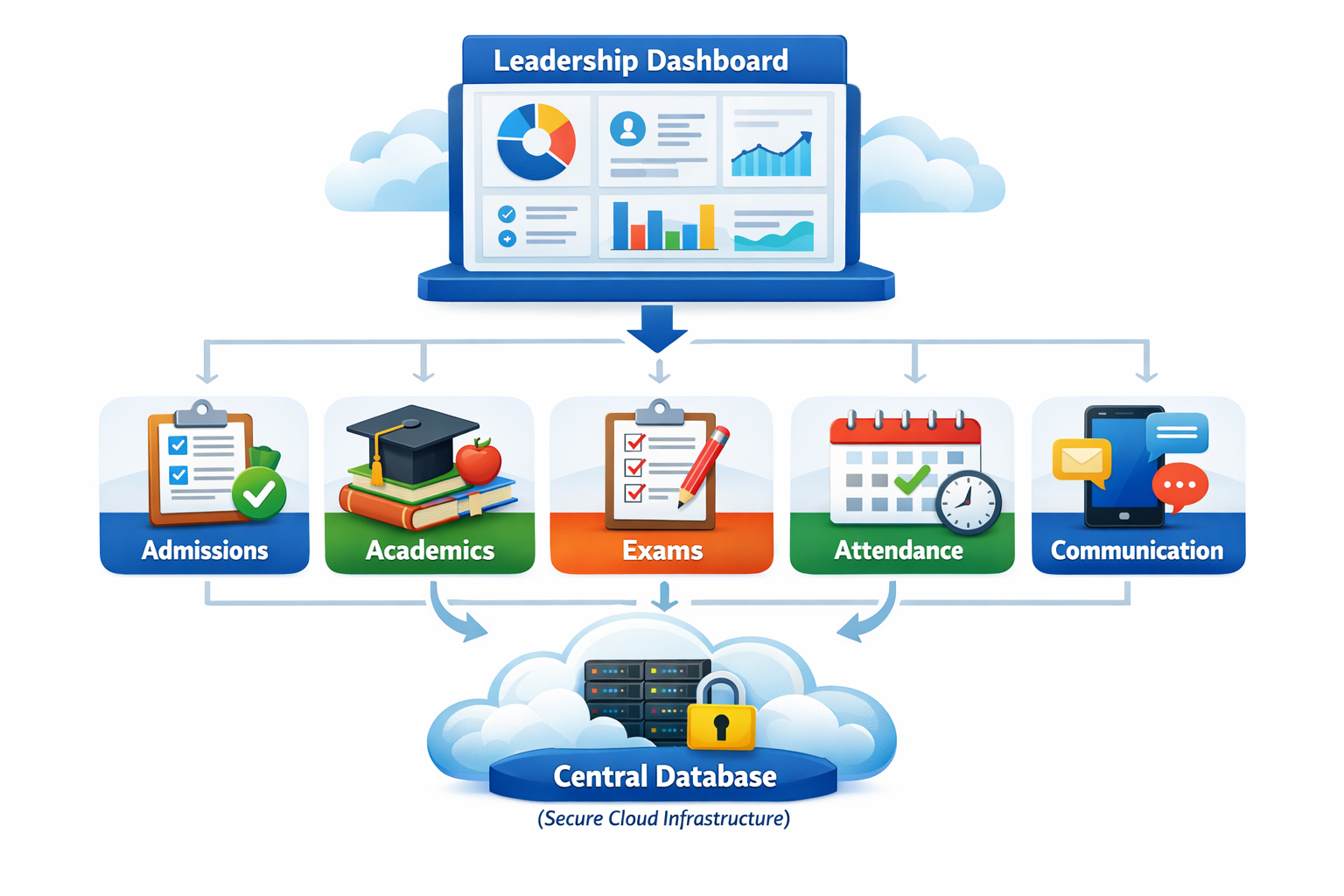
A properly implemented Education ERP becomes the institutional nervous system.
The market is signaling a shift: fragmented systems are being replaced by centralized Education ERP ecosystems.
Strategic dashboards provide visibility into enrollment trends, academic performance, and operational efficiency.
Automated workflows reduce manual processing, minimizing human error.
Cloud-based Campus Management System architectures reduce on-premise infrastructure burden and enhance cybersecurity resilience.
Data-driven insights support curriculum planning and student performance monitoring.
Every semester managed manually increases:
Institutions that delay digital transformation often face reactive decision-making. In contrast, those adopting a structured Education ERP model move toward predictive governance.
In a competitive regional education landscape, operational excellence directly influences reputation, rankings, and student trust.
When implemented thoughtfully, a Campus Management System becomes the foundation of institutional growth.
Governments are investing heavily in digital infrastructure. Students are increasingly digital-native. Accreditation bodies demand structured data. Stakeholders expect transparency.
And in such an aggressively evolving landscape, can your institution afford to struggle with fragmented systems and fall behind?
Pause for a second. Be honest, what was your answer?
Institutions that fail to modernize risk falling behind in:
An advanced Education ERP is not merely software; it is a complete digital infrastructure institutions can truly rely on.
The transition to a modern Campus Management System is ultimately about long-term resilience. It is about empowering leadership with real-time intelligence, enabling staff with automation, and delivering students a seamless academic journey.
If your institution is evaluating transformation strategies, exploring an integrated Education ERP platform can provide clarity on scalability, compliance readiness, and operational optimization.
To see how a future-ready Campus Management System can align with your institutional roadmap, book a free demo with Academia and explore how digital transformation can be structured, scalable, and strategically impactful.

Experience Academia – Your partner in transforming campus operations, a trusted all-in-one ERP/SIS solution.
Get the latest insights, trends, and updates delivered straight to your inbox!