
Type your keyword below

Role of ICT Team in Education Institute

As technology continues to create wonders in various industries, it becomes essential to discuss its impact and effectiveness. It is vital to define its role and develop implementation strategies. You need to pre-define these crucial things to ensure better results through digital transformation. Strategizing helps an organization stay prepared for any risks and stay practical while analyzing the results.

The same follows for the education industry as well. When discussing the role of ICT in our lives, how can we forget about the transformations it is making in education? The blog would help you ensure technology makes a positive difference in the lives of students, teachers, administrators, and parents. 

What is ICT? 

ICT is a commonly used acronym for Information and Communication Technology. It is an umbrella term used to describe various things that fall under the information and communication segment, like telecommunication (telephones and wireless signals), computer technology, enterprise software, middleware, audiovisuals, and mobile applications. It also covers data management, storage, transmission, and manipulation of information. For more information, you can refer to the following Wikipedia page. 

The benefits of using ICT in education

Technology has recently started to make its way into the education industry. But the good thing is some of the technologies are already tried and tested in other industries, and the education sector has a lot of available literature to learn about them. This gives the industry the required push to start building their understanding of their key challenges and practical tools that can solve them. 

Technology in the education sector opens a whole new realm of opportunities where technology penetrates learning processes, learning methodologies, resource planning, financial management, performance management, reporting, etc. 

  • Technology in the classroom

One of the best ways to put technology to use in the education sector is in teaching. Technology allows teachers to go beyond textbooks and introduce various learning tools to students. From PowerPoints to gamified learning, pedagogy has changed drastically over the last 10 years. 

  • Use of technology tools like laptops, computers, AI, VR, & AR in the classrooms
  • Use online learning tools such as learning management systems. 
  • Use of data analytics for student performance analysis. 
  • Use tools such as Google Meet and Zoom for collaboration between students, teachers, and parents. 
  • Use of tools to manage homework and assignments.
  • Use of education ERP solutions for lesson plan management, program, and course management, timetable management, attendance management, etc. 
  • Technology for Student Engagement 

To create an interactive learning environment, communication with peers and teachers of any student must be seamless. It ensures the exchange of ideas and builds a student’s interest in participating in the learning process. It helps improve student outcomes through student success. Students must be inspired to participate in academic and extracurricular activities rather than obligated. 

  • Use of technology that promotes interactions and two-way communication. 
  • Use polls, messages, and personal and group chat rooms in an online learning environment. 
  • Creating digital space for students to express their opinions and grow effectively. 


  • Technology for campus management

Before technology reached the education sector, most operations were done manually. Operations were paper-bound, and mismanagement of resources and finances was widespread. With advanced education ERP solutions, campus management can be done digitally. 

  • Use of Student information systems for student management
  • Use an attendance management system for automating attendance marking
  • Use an admission management system for pre-admission, admission, and post-admission automation. 
  • Use of finance management software 
  • Use of education ERP for resource management and planning
  • Use of software and technology for unifying experience and centralizing information 

And more. 

Wrapping Up 

Information and Communication Technology in education is here to change the experience of all the stakeholders in the system. It is helping teachers build better teaching methodologies and ensuring higher student success through student engagement tools. It allows students to increase their communication with peers and teachers and get access to a variety of knowledge resources. It will enable students to find economically viable options for continuing education. Apart from this, technology has a significant role in administration and management. It allows improved decision-making through data analytics and modern tools. 

7 Benefits of Using an Accounting Software in Educational Institutions

Higher education institutions, universities, and schools involve the seamless flow of finances in different departments. With the increasing advancements in education technology, school administrators must choose a technology that provides complete finance management. A cloud-based school accounting software provides all the capabilities to store and access finance and accounting data in the cloud. 

What is school accounting software?

School accounting software is a useful and worthy software for any type of educational institution across the globe. It provides complete data tracking of financial aids along with managing all finance-related tasks in an institution. 

How is school accounting software beneficial for your institution? 

There are various benefits of using school accounting software, here are a few of them:

  • Remote data access 

Using efficient accounting software, schools can get access to any kind of data from anywhere having transparency and accuracy in records, calculations, and management. It also reduces costs, increases productivity, and helps in generating revenue. 

  • Mobile application to access data from anywhere

It allows users to access any information from anywhere through the mobile application. Robust accounting software used in schools should include financial, accounting, procurement, and budgeting to check the financial status and other important information in real-time. 

  • No need for extra hardware and software 

Effective accounting software like Academia will help educational institutions to make long-term investments in hardware and software or any educational accessories. It manages complete finances (fee & payments) in just one software that can be accessed from anywhere in just one tab. 

  • Share data with anyone and anywhere 

An educational institution includes various departments, chains, and sections in which various data, information, documents, and files get exchanged. A School accounting software provides a data migration feature that allows institutions to easily exchange or import any type of data from any system, along with mapping the document easily. 

  • Increased collaboration

A productive school finance software provides seamless access, workflows, and approvals that can automate all the processes and enforces enhanced collaboration, communication, and engagement between students, departments, staff, and parents. 

  • Effective expense tracking 

It is always a critical thing to maintain expense tracking in an institution. The school accounting software provides a convenient way to store and track financial data and information correctly and effectively like investing in real-time. 

  • Easier mode of payment

School accounting system provides an easier mode of payments across multiple academies using just one single platform for admission, enrollment, library, hostel, transport, or any other academic or administrative tasks in the institution. All these processes can be possible by just using an online portal or mobile application. It is safer, quicker, and secure. 

Conclusion 

You must have got a better understanding of accounting software and its application in schools. 

Still, have doubts? No worries, we have got you covered. Let’s schedule time for further discussion! One of our experts will reach out to you to provide you with clarity on it.

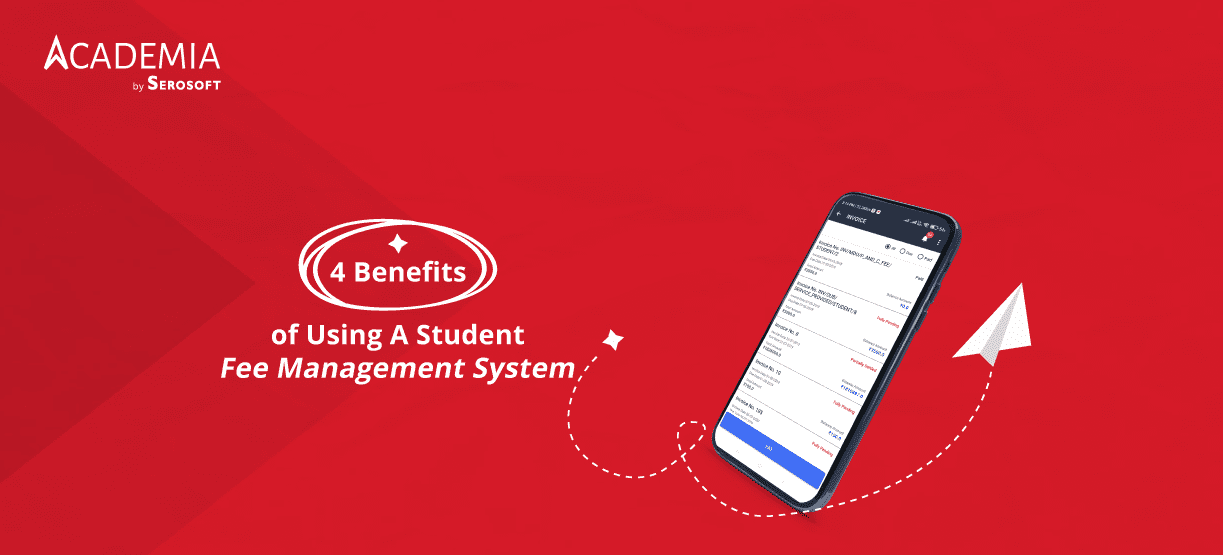
4 Top Benefits Of Using A Student Fee Management System

The fee management process in K-12 and higher education institutions is huge and extensive. Managing it manually is difficult and brings situations of human errors and malfunctioning 

This is the reason most educational institutions are moving onto an online fee management system. It is helping institutions in bringing transparency in all the fee-related tasks targeting ease and efficiency in all manners.

Nevertheless, let’s examine how a fee management system can benefit an institution.

  • A simple and easy-to-implement solution

An online fee management system is easy to implement and easy to use. Institutions need to choose an advanced and tech-updated fee management system that can be very efficient and easily used by all the stakeholders at their ease. Teachers and parents can access it from anywhere at any time.

  • Transparency, visibility, and clarity

An effective fee management system provides complete transparency and visibility in all transactions. Each transaction gets generated, recorded, and logged in a centralized database reducing data redundancy and duplication. All the data gets stored in the system securely and is encrypted with advanced tech solutions. It also restricts role-based data access to the centralized database for administrators and higher authorities.

  • Reminders and updates on time

There are various personal and professional tasks that students have in which students find it difficult to check their due date, collect receipts, check their status, paid amount, pending amount, and other things. A fee management system provides a check on all this, as students and parents can expect SMS and email reminders, and with a highly efficient ERP, it is possible to get WhatsApp notifications for the same. 

With regular notifications and alerts through SMS, emails, and WhatsApp messages, it is straightforward to track due dates, the status of pending and paid amounts, and many other things. Also, the student/parent mobile application also provides a receipt management system that helps store all the details of their transactions. 

  • Streamlined and paperless processes

An educational institution involves multitudes of tasks, data, fee transactions, processes, applications, approvals, and a lot more. With manual intervention, it involves an abundance of papers, files, documents, and even using digitized resources like computers with lakhs of files and folders. 

A fee management system automates and streamlines the complete process and creates a paperless environment. It provides a centralized web portal and mobile application to manage and ease the complexities for all the stakeholders.

The purpose of Academia ERP’s fee management system?

As discussed above there is an abundance of tasks that needs to be managed in an educational institution. Managing fees & finances effectively are crucial for institutions. To this, Academia provides an efficient platform that is its fee management system, it manages and controls all the fee and finances-related tasks and brings transparency, accountability, and accuracy to the whole academic and non-academic processes.

There are various features that the Academia fee management system provides one of its efficient features is – Finance Hold’. This provides institutions the authority to restrict students to participate in activities for which the fees are pending like examinations, admissions, and more.  This serves as a good tool for the institutes to streamline their operations. 

School Administration Management Through Automation

Wrapping Up!

Hope you liked the article and it helped in getting an understanding of the role of the fee management systems in modern educational institutions. 

So how are you managing fees and finances in your institution? Is it still manual or you are using an efficient fee management system? If your answer is a manual one, you immediately need to switch to an automated system that helps your institution in the real aspects. We can help you with the same, Request Demo now and one of our tech experts will get back to you as soon as possible!

Artificial Intelligence in Education

Advances in the development of artificial intelligence are spreading at incredible speeds around the world, creating incredible hype that raises our expectations. In this article, we have compiled some ways to use artificial intelligence in education.

Automated classification

Automated Qualification is an AI-based specialized computer program that simulates a teacher’s behavior to assign grades to essays written in a pedagogical setting. They can evaluate the students’ knowledge, analyze their answers, give feedback and create individual training plans.

The intermediate interval of training

Overhaul of knowledge if you forget that it is an effective pedagogical and technological solution. Using artificial intelligence, one can know when you probably forgot something and it is recommended that you review it. It only takes a few revisions to make sure that the information is now stored in your memory for many years.

Feedback loops for teachers

The feedback, the assessment of the teachers by the students, has a history that goes back a century. Despite the shift from paper to online surveys, little or no progress has been made in the field of commenting. Assessment of lessons by students is often the most valuable source of information.

With modern technologies such as AI-based discussion robots, machine learning, and natural language processing, there are many interesting ways to improve the quality of the comments.

How Academia ERP Enables Artificial Intelligence in Education

A chatbot can gather opinions through a dialogue interface, like a real interviewer, but with some work that a person requires. A conversation can be adapted to the answers and personality of the student. A chatbot can even find the reasons for this or that opinion. It can also filter out personal insults and obscene expressions that are sometimes present in teachers’ qualifications.

Virtual moderators

Students were intrigued by new assistant teacher Mr. Academia, who responded quickly and accurately to student requests. The students did not know, however, that Mr. Academia true identity was actually a computer equipped with an AI system. Such virtual moderators can be very useful in education.

Campus Chat

The online discussion page can answer questions on any questions a student needs to know about life on campus. How to find the next conference room, how to apply for the next semester, how to do homework, find a parking space, or address a teacher: these are the questions that AI ChatBots’ online discussion campus can answer

Personalized learning

Personalized learning refers to a variety of educational programs that optimize the pace of learning and the educational approach for each student’s needs. The experience is tailored to the learning preferences and specific interests of the different students. Artificial intelligence can adapt to the pace of individual learning and can offer ever more complex tasks to speed up learning. As a result, slow, fast students can continue learning at their own pace.

Adaptive learning

Adaptive learning is perhaps one of the most promising applications of artificial intelligence in education. It is assumed that artificial intelligence in schools can track each student’s progress and adjust the course, or inform the teacher about material that a student has difficulty understanding. In this sense, some intelligent tutoring systems should also be mentioned.

Monitoring

Distance learning, the driving force of modern high-tech training, involves conducting remote examinations. How can we do this to make sure a student does not cheat? AI-based protection systems come to the rescue. The supervision or supervision test is a mechanism to ensure the authenticity of the person to be carried out and to prevent that trap from being present by a supervisor during the test.

Capture and personalization of the data

Using the geolocation data and our previous searches, AI can now offer us the ideal coffee nearby or, for example, create a route to the store closest to your favorite comics. The same technology can be applied if we study a grammatical rule based solely on examples of the sphere that interests us with all educational content appropriate for us.

How ERP Makes Education Proactive?

“Doing the best at this moment puts you in the best place for the next moment.”

The education sector is a very huge sector like any other large industries where data-driven decision-making is critical yet important. Education ERP software like Academia is important to ensure a transparent system of flow of data which shall boost the process of decision making.

Academia provides integrated, flexible, comprehensive and scalable Education ERP system for universities, colleges, schools and training institutes that serve as the foundation for creating and delivering accurate, reliable info across your educational institution. Since all the institutions have different needs and challenges, Academia helps you automate the whole system resulting in data-driven (Available through our dashboards and reports) decision making.

ERP Implementation in Institutions brings together the knowledge necessary for making analytical decisions, taking beyond the reporting of historical data and giving you the power to look ahead using predictive analytics. A leading-edge Education ERP software helps you understand trends to facilitate overall planning and intervene where trends need further attention.

Besides such benefits of an ERP there are furthermore which can be listed:how an ERP makes Education Proactive - academia erp - education management software

  • Improved communication & collaboration among stakeholders can be done: The increased communication helps the institutions to get feedback and give critical information in time.
  • ERP increases efficiency: Educational ERP helps to ease down day-to-day activities to improve processes by automating it.
  • Parents, teachers & students can easily share real-time data through various modes and help each other to improve the overall educational structure ensuring accurate decision making.
  • Information is streamlined and improved on the idea of sharing valuable data.
  • Reporting is inbuilt in ERP: Reporting is altogether a different tool available in education automation software which can help teachers to easily generate reports for students and parents to see and evaluate.
  • Analytical capabilities are also built within the ERP: Institution can take advantage of the analytics to generate reports which in turn can help them to make quick and accurate decisions.
  • Information is accessible at all times: Relevant information such as dashboards and reports can be accessed anytime, anywhere using the browser, mobile or any other terminal.

Technology has played a super awesome role in education to make it proactive. Let’s see how?

ERP solutions provide a complete centralized control panel which can be used to improve the daily work-flow of any institutes. It also helps in the administrative process and management handling with automated approach. Information sharing also becomes easy with one-click data storage and retrieval.

To become successful, collaboration is the key. With ERP solution, everyone can easily collaborate and help make the system a better place. Report generation is automated and there is no need to spend hours after hours to generate reports for students and other causes.

Educational ERP software is now becoming mainstream in the education sector. The main reason for the change in demand is how schools and colleges are becoming complex day by day. More data is flowing through the organization and it is always a good idea to keep track of the data and make good decisions based on the data which can easily be done through an automated system one like Academia ERP.

Back to top