Type your keyword below

7 Emerging Technologies that are Reshaping Education

In the field of education, emerging technologies are revolutionizing the learning process for students by enhancing the way students, teachers and institutions work. Technology has changed the world and cutting-edge technologies  are reshaping education in innovative and unimaginable ways. Students are getting the opportunities and unique experiences they need and deserve as emerging technologies promise to deliver exciting new resources for learners.

Let us take a closer look at the seven emerging technologies that are earmarked to make major waves and reshape education.

1. Augmented Reality & Virtual Reality

Mixed Reality and Simulations are pathbreaking experiences for learners and teachers too. AR, considered as one of the best emerging technologies in the world, can be used by educators in innovative ways to make lessons interesting and interactive. AR is useful in overlaying interactive digital elements to give real time experience and for promoting skills like creativity, critical thinking analysis and problem solving. AR promises to help learners capture their dreams and imaginations and take learning to the next level.

Virtual Reality, the next big thing in education, enhances student learning and engagement by cutting across all barriers and immersing students in what they are learning and helping them to process information better.

learning and helping them to process information better.

2. Artificial Intelligence

Artificial Intelligence (AI) in education is already transforming the way curricula are implemented in schools, with innovations that would have been impossible a few years back. AI applications have made the academic world more convenient and personalized. One of the key impacts of AI from kindergarten to graduate school is the different levels of individualized learning with adaptive learning programs, games and software, where students can work at their own pace.

AI aims to reshape education by supporting the sharing of first-person perspectives which will be useful for students research. From artificially generated content to image recognition and smart tagging systems, AI is also automating basic activities like grading homework and tests as it takes up a lot of time for teachers. While human grading may not be fully replaced, AI can help in providing detailed analysis of student performance in exams, and help in grading to a certain extent.

AI has resulted in automation of administrative jobs, saving time for educators.

3. 5G Technology

5G is the fifth generation of wireless technology which promises high speed and low latency wireless technology. 5G is meant to change the way educational institutions interact with much quicker downloads and increased efficiency and expanding the scope of connected devices and technology within the classroom.

Some universities have started implementing IoT integration for higher education where lectures and discussions on specialized topics can be conducted through virtual reality experiences. Seamless connectivity will bring in better engagement which will be a big boon for international students, along with faster downloads of files and resources and more powerful networks. 

Interestingly, 5G was supposed to be launched in India in 2020 and would have been extremely beneficial for students learning from home during the COVID-19 pandemic. However, things didn’t go as planned and the launch has been pushed to mid 2021.

4. Internet of Things

The Internet of Things (IoT) has tremendous potential to create smarter and connected schools and is already impacting the education sector by making learning simpler, faster and safer. IoT can save energy and lighting, and sensors across the campus can track traffic and the strategic positioning of security features like lighting would help students and visitors too.. IoT can help break the usual barriers to education like language, location or certain disabilities, besides helping everyone with bottom-line solutions.

5. Adaptive Learning

The Adaptive learning technology provides learning activities to students, based on their needs and learning style and behavior. It helps students with unique learning paths that are based entirely on their interests and learning ability. 

It can play a huge role in the educational system as it uses computer algorithms to orchestrate the interaction with the learner. Although this technology originated from AI, it actively caters with individualized resources and top learning activities to take care of the special needs of a learner.

6. Learning Analytics

When it comes to the process of learning for students, it needs efficient tracking and analyzing to understand results better. This is essential to bring about improvement which is a very important factor in education to improve the learning experience of every student. The learning analytics technology helps teachers to better record the learning rate and behavior of students so that teachers can provide targeted improvements to courses.

7. Blockchain

The Blockchain technology which has changed every industry dynamically, can prove to be very useful in the education sector as well. It is especially useful to collaborate around distributed information in a database. Blockchain can help in examination management, verifying student credentials, verifying certificates, managing life-long learning records etc. Besides effective analyzing and tracking, it can help teachers provide targeted improvement for courses and help students deliver enhanced results.
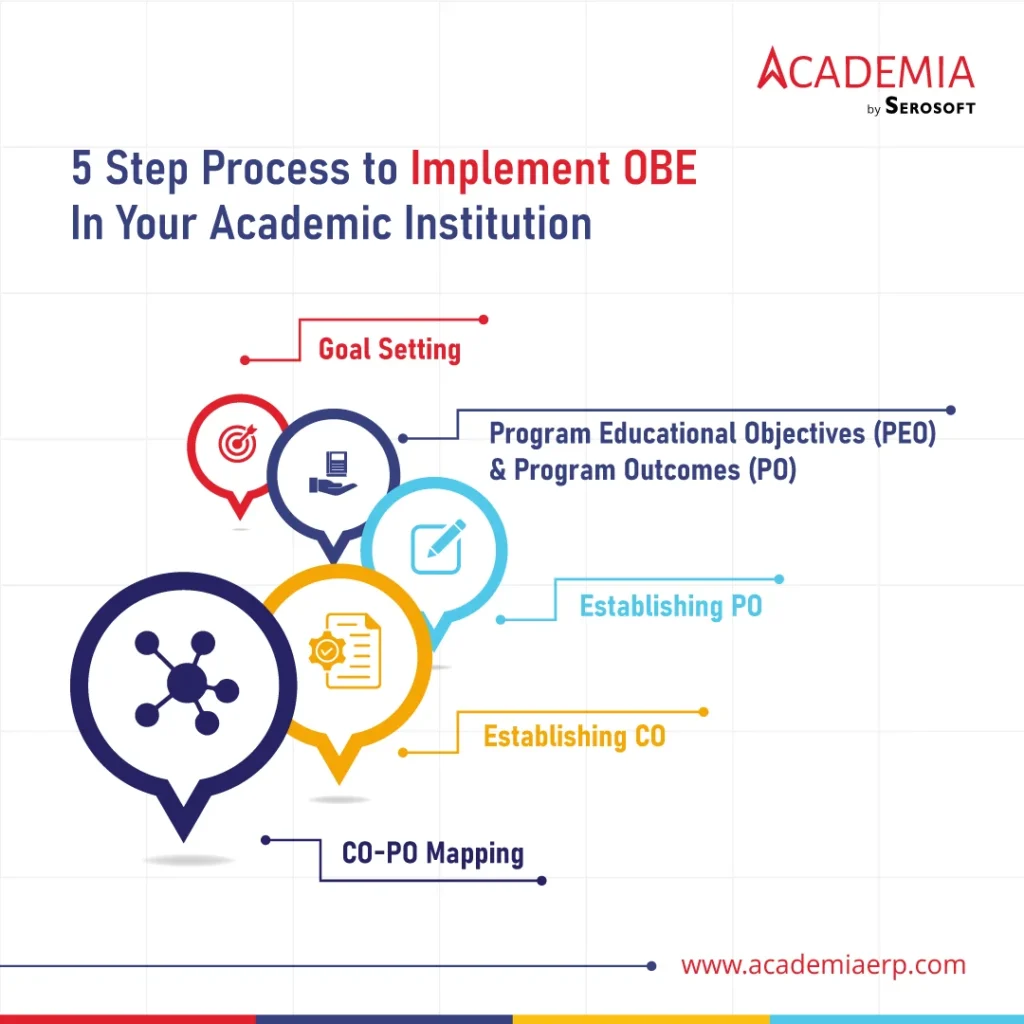
5 Step Process to Implement OBE In Your Academic Institution

Outcome-based education or OBE is the latest development in the education industry. It is a type of education delivery model that focuses on mapping, measuring, and achieving pre-determined educational goals. It prioritizes student learning and development by nurturing the pre-existing skills in students to help them grow in their professional and personal life. 

Clearly, it is a major leap from the existing education delivery model where a lot of time and effort is spent on scoring good marks in examinations rather than skill development and knowledge acquisition. OBE thus can help you change that, and provide a definite solution for the increasing problems such as unemployment, skill alignment as per the global market standards, and more. 

If you are thinking about implementing OBE in your education institute, here are some tips to successfully implement it, and ensure better student outcomes.


Outcome-based Education Process – Step By Step OBE Implementation

  • Goal Setting 

First and foremost, it is imperative to set short-term and long-term goals for individual students in terms of learning outcomes, personal growth, skill development, and institute overall performance. Institutes can follow the given steps to define vision and mission department-wise. 

  • Start by brainstorming with experts and experienced faculty of various departments
  • Speak with industry professionals and alumni batches
  • Analyse the opinion and define a solid plan of action 

Once the vision and mission are clear, the institute needs to focus on teaching and learning processes.

  • Program and Education Objective and Program Outcomes

Program Educational Objectives help teachers define the expected outcomes for the students once they graduate, this includes academic and behavioral aspects both that are absolutely necessary to excel in their career. 

  • The vision and mission set in the first step should be central to the action plan.
  • Experienced faculty members and the heads of various departments must draft and share it across their respective departments. 
  • The draft and processes need to be implemented and discussed thoroughly for gaining the approval of authorities. You can iterate the draft to prepare a final draft. 
  • Once the final draft is ready after taking all the considerations of people involved in the implementation process, it is presented to Program Assessment Committee so that it can further be forwarded to Departmental Advisory Board. 
  • The Departmental Advisory Board reviews the points mentioned in the draft and sends them to the Board of Studies & Academic Council for final approval. Once the approval comes in, the draft is taken as a guide to design a fresh curriculum for the students to grow personally and professionally. 
  • Institutions need to analyze the student learning outcomes periodically to identify the learning gaps and rectify them. It is usually focused on Professional Skill Development, Problem-Solving Skills, Industry-Specific Skill Development & Creative Enhancement. 
  • Establishing Program Outcomes 

POs or Program Outcomes are defined as the objective achieved at the end of the specialization or discipline. These attributes are defined while a student is undergoing education and determined when they get a degree. 

Here is a step-by-step approach to establishing the POs for the institution. 

  • The Program Coordinator consults with the senior faculty to prepare a draft for program outcomes. 
  • The Coordinator speaks with alumni, industry experts, and various employers to understand the skill requirement and new trends in the industry. On analyzing the views, a synthesized version of the draft is created and sent to the Program Assessment Committee. 
  • The Program Assessment Committee reviews the draft and sends it to the Department of Advisory Board to get the final approval from them. 
  • Department Advisory Board makes the final decision by moderating the draft.
12 Graduate attributes mentioned By the National Accreditation Board In Their Guidelines to attain POs successfully
PO1 Knowledge PO7 Environment
PO2 Problem Analysis Capability PO8 Ethics of Individuals
PO3 Development & Designing of System PO9 Teamwork & Individual Contribution
PO4 Analyze & Solve Complex Problems PO10 Communication
PO5 Use of Latest Tools & Devices PO11 Finance & Management of Project
PO6 Society’s Responsibilities PO12 Life-long Learner
  • Establishing the Course Outcomes

Course Outcomes are different than Program Outcomes. The objective of CO or Course Outcome is to define the objectives that are achieved at the end of a semester/year. It is basically the outcome that is achieved in theory and practical lessons concluded at the end of the year or semester.

  • CO-PO Mapping Process

To thoroughly analyze if a student has successfully achieved the goals set at the beginning of the process, it is important to map Course Outcomes with Program Outcomes. To do that, follow these steps: 

  • Specify and obtain the course outcomes
  • Map COs with POs
  • Set an appropriate weightage for the CO assessment
  • Measure the COs through assessment given to students
  • COs & POs attainment calculation needs to be done. 

Concluding

Outcome-based Education can help you stand out in the education market and offer a quality education. But for that to happen you must have a great implementation strategy on your hands. Use the above-mentioned steps to achieve successful implementation of OBE. To assist you in your course toward redefining education consider an ERP solution that offers process streamlining, simplified processes, better results, easy CO-PO mapping, and more. Explore the Academia ERP OBE module here. 

Back to top