
Type your keyword below

Benefits of Teaching Diversity in Education

Diversity is a primary goal of modern educational institutes. Diversity has suddenly become an important thing for education institutes, as the world becomes more aware and tolerant of the varying perspectives, views, and approaches of individuals. People are more accommodating to a variety of ideas and have become more respectful towards the apparent differences in ethnicity, gender, age, race, religion, gender identity, and more. 

In the past, institutes dreaded diversity, but not today. Students feel it is very important that institutes don’t have bias and are catering to all segments of society equally. They need to know if the institute is strengthening intercultural tolerance. Surprisingly, technology can help you create a more inclusive environment for students hailing from a variety of places, having their views, and perspectives to create a diverse environment at your institute. 

Why is teaching diversity in education important for advanced institutions?

Many educational institutions, businesses, and organizations across the world are operating on international standards and scale. Teaching diversity to students helps them become global citizens and provides exposure to different cultures, religions, and belief groups. 

There are various benefits of promoting diversity at your institute, let’s have a look at a few of them:

  • Diversity Enriches Educational Experience

Teaching cultural diversity in institutions helps in providing a wider opportunity to learn from peer groups that hail from different cultural backgrounds. This gives them an enriched learning experience and makes them more flexible towards adopting new things, sharing knowledge, improving communication, and increasing collaboration.

Various institutions are being more diverse than ever and creating experiences, perspectives, backgrounds, and beliefs. 

  • Diversity Improves learning 

Diversity helps in improving communication and provokes the feeling of brotherhood. This, in turn, results in an exchange of new ideas, beliefs, thoughts, knowledge, skills, etc. .  It brings peace and harmony to the campus and promotes a positive attitude toward learning new things. 

  • Diversity Challenges Stereotypes

The modern generation of students often gets raised around people of similar socioeconomic, racial, or cultural backgrounds. In the development process, they create several stereotypes that can be a hindrance to their growth and do not allow them to mingle with people that do not share cultural or economical commonalities. Thus, diversity can challenge their restrictive approach toward the world and help in creating a positive atmosphere among students. 

  • Diversity Helps in Leadership

With various other benefits, cultural diversity also helps in thought leadership. They also get the chance to see and experience various leadership styles along with faculty, staff, administrators, and all the stakeholders. It’s a chance to see someone from other cultures and backgrounds and even emulate them. It is also impactful for students from various communities, considering the initial qualities of students along with their leadership skills.

  • Diversity Foster Creativity

Diversity in institutions encourages solving various problems and brings in creativity. Creating collaborative groups is an excellent tool for classroom and overall institutional management. Students can also bring various perspectives that can challenge their peers to think creatively and find easy solutions to complex problems. It also provides students with the opportunity to work with a diverse group of peers along with confronting creativity in all ways.

  • Diversity in the adoption of technology

With the increased competition, it is also crucial to adopt a digital tool. It is imperative to know that innovation is needed to diversify with the ability to utilize the right digital tool that can engage, communicate, and collaborate. Along with increased opportunities, students and faculty members need a platform that can keep them connected and more focused on their end goal i.e, uninterrupted learning. 

Conclusion

Diversity in education is a crucial aspect on which modern education institutions need to focus on. Hope this blog helps you in having a better understanding of the same. Various techniques can be used to implement the same using good technological support. If you need any tech assistance we can help!
Edtech is an essential component of India’s education system

The COVID-19 pandemic has led various educational institutions to opt for remote learning solutions. Various digital tools and software helped in continuing the academic and non-academic activities at the institutes. 

Now as the world copes with the COVID-19 pandemic, institutions are resuming operations from campuses, but it is crucial to understand that tech-savvy students need more engaging teaching methods that fit their learning patterns. Hybrid learning thus evolves as a prominent solution. 

How Edtech plays an important role in the Indian education system?

EdTech platforms in India are playing a vital role, providing seamless support to education institutes to enhance learning and teaching styles. Solutions such as ERP are allowing institutes to fight some of the biggest challenges of the education industry, such as; low student outcomes, low knowledge retention, inefficient resource management, and more. 

Let’s look over some of the key EdTech solutions:

  • Immersive Learning

The modern student demands resources that can enrich real-time experiences of what is being taught. Immersive learning environments are learning solutions that are constructed using a variety of technologies and software tools, along with game-based learning, simulation-based learning, and virtual 3D worlds.

  • Personalized Management

Personalization is one of the primary focuses of every industry. Leaving no stone unturned, the education sector is using technologies to the best of its potential to offer personalized experiences to all stakeholders. This not just includes students, but also faculty and administrative staff. 

Software solutions such as Education ERP / SIS (Student Information System) are providing personalization in all the management of academic and non-academic tasks. It provides personalization in managing enquiry, admission, assignment, fee, examination, and all other operations. One example of this is a student checking their assignment details or submitting assignments through a web or mobile application. 

There are a lot more features and functionalities that can be managed by an ERP/SIS in an institution. 

  • Fun-Learning

In the world of online learning, students often get bored with the traditional form of learning. Education institutions must accustom technology that can boost students’ interest in learning. Various tech concepts like gamification, augmented reality, and more can be considered the best options for the same. Adding these flavors to Indian education can level up the interest of students, faculty members, and students to enjoy the learning experience and teaching processes.

  • Bridging the Gap between Stakeholders

Effective communication is one of the crucial elements that most Indian institutions lack. In the traditional pattern of teaching, learning, and operational management, students often stay back in asking questions and raising queries, and likewise between the faculty members and higher authorities. This creates a gap among stakeholders creating various issues in the overall functioning of the institution.

Opting for a robust EdTech solution can process the best in this regard. Solutions like an ERP/SIS can help bridge the gap among stakeholders. It can provide an easy platform to connect with all the stakeholders to manage any of the academic, non-academic, and administrative tasks. A good ERP system provides a mobile application and web portal through which any stakeholder can raise his query and find a solution accordingly from anywhere and anytime.

How do you think your institutions would fare?

With technological advancements, it is a must that Indian educational institutions should attain advanced tools and software. However, understanding the advantages of different EdTech tools and software is important before finalizing one. In this digital era of learning, institutions must attain & equip EdTech as much as possible. 

So is your institution still working on operational methods? If so, then it is the correct time to switch to a highly responsive EdTech solution that can entail student retention, stakeholder satisfaction, and a lot more. Want to have expert advice on this? Contact us now!


The Top 5 Priorities for Higher Education in Cybersecurity

Education organizations are easy targets for hackers, but institutions must opt for techniques that can make them manageable and efficient. With a proactive approach, it is the right time for educational institutions to prioritize security as an important issue and find a solution for it. 

The institutions are easy targets of cybercriminals. Whether internal or external, there are various types of data hacking practices like phishing, data breaches, ransomware, and IoT vulnerabilities present in the system. It creates a lot of risks and reduces students’ rights and wreaks havoc on the lives of students, staff, faculty, parents, and administrators.

  • Data Encryption

Data hackers today can obtain and damage institutional data by intercepting it while actively in transit. Institutions must opt for technologies that can automate all institutional tasks, along with the prevention of stealing real-time data. A good ERP system can provide you with data encryption as using it, institutions can attain automation of all the institutional tasks and update data into a single system that is highly secure and safe.

  • Network and Data Monitoring

An educational entity involves multitudes of data that need to be restored efficiently. It needs to be the top priority of institutions to monitor the data and network. Proper monitoring and tracking with the right tool can help prevent security breaches and plays a vital part in the cybersecurity of the business. 

  • Comply with Cyber Protocols

With the security improvements in institutions, most of the institutions are strict with all the stakeholders, particularly for adherence to data security. Meanwhile, institutions must adopt advanced technical support that can monitor stakeholders’ actions, and bring transparency. You can aim at creating a centralized channel to manage and protect any kind of information initially. It is also crucial that institutions should bring transparency to the rules in all departments, sections, and locations.

  • Backup Your Data

There are chances that any data in an institution related to admission, enquiry, or maybe examination needs to be accessed and used multiple times by different groups of individuals. In this case, institutions must generate the backup of the data regularly. It can also prevent data in ransomware-style attacks and help in securing data and continuing the functioning of the institute. 

  • Protect Your Devices From Physical Attacks

Whether an institution has security software that has zero tolerance for cyber crimes, it is equally essential to secure data from physical damage. For this, institutions need to secure automating all the institutional tasks that can reduce the chances of physical theft, malware attacks, and more. 

Why only Academia ERP for Securing Your Institution?

Cybercrime is becoming very common nowadays, and the world is finding ways to fight it.  As a leading ERP / SIS solution provider, Academia fights cybercrime with modern security solutions to enhance and improve the overall functioning of the institution.

Academia features data encryption, and GDPR compliance and focuses on regular security updates. Ensure security with multi-factor authentication, log reporting, and many more. One of its main functions is to deliver a next-level security environment to all the stakeholders in an institution.

Did you know that security compliance is a crucial aspect to get a higher NAAC accreditation? Contact our technology experts to get full details on how you can achieve the grade “A” in your next evaluation through Academia. Don’t forget to request a free product demo.

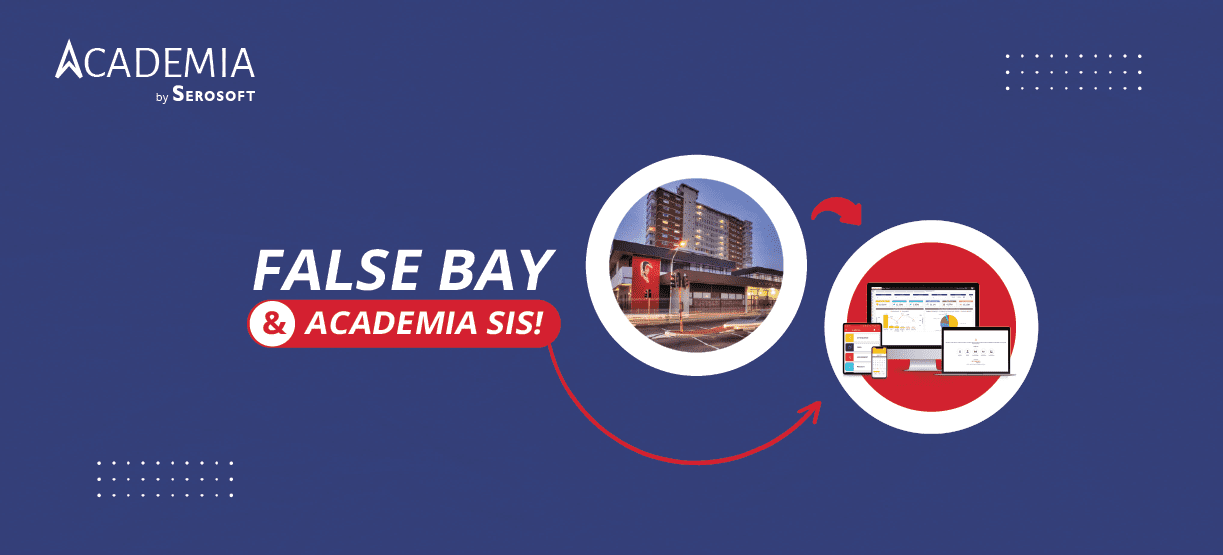
False Bay College, South Africa – The First TVET College In South Africa to Implement Student Information System

Education institutions around the world are adopting digital transformation to overcome challenges and adapt to digital infrastructure. Technologies like ERP/SIS and others are helping with digital transformation and removing old processes that restrict growth and achievements.  

False Bay College from South Africa also moved ahead adopting Academia SIS as their advanced tech companion to achieve digital transformation. With the ongoing enhancements in technology, institutions need to be agile to keep up with the ever-changing demands and needs of the education sector. A modern, fit-for-purpose Student Information System should not only support the attainment of the College’s strategic goals but also be flexible (configurable) enough to accommodate changing needs of the businesses with time and support new or changing strategic objectives/direction. 

In 2021, False Bay Technical and Vocational Education and Training (TVET) College broke new ground. It was the first TVET College in South Africa to implement Academia Student Information System (SIS) and go live for applications and registrations. It has been an accomplishment as all project meetings, workshops, and training were delivered remotely during the pandemic and global lockdown. 

While this was no easy feat, it illustrates the pioneering journey that also Bay TVET College undertook to adopt a robust SIS and replace its existing systems. 

“We wanted a customizable solution as per the needs of our vocational & occupational programs. Academia ERP was the system of choice as it provided us with rich functionalities and customization as per the College SIS requirements. We are very satisfied with the implementation and post-implementation services provided by Academia that helped us achieve automation and digital transformation”.

Mark Cramer 

Acting Deputy Principal, False Bay College

Muizenberg, South Africa

Challenges Faced & their Solution with Academia

  • Mismanaged Enquiry & Admission Management

The admission season is one of the busiest times of the year for all stakeholders in the institution. In COVID-19 it became a lot more difficult for institutions across the world to manage admissions. False Bay also witnessed difficulty in managing the enquiries & applications in moving ahead with the admission process. 

Solution:

Academia proved to be a true solution to solve this issue. It automated the complete enquiry and application process. It streamlined and processed more than a hundred thousand applications. This helped institutions efficiently manage the entire admission process during the COVID-19 period.

  • Improper Communication

Effective communication is the key to success for modern educational institutions. It is crucial to create a clear chain of communication among all the stakeholders, departments, and locations. False Bay faced gaps in communication in various processes throughout the organization.

Solution:

With the advancement in technology, institutions need to create a crystal clear line of communication among stakeholders. Academia provided a robust solution for this – a feature-rich mobile application and an easy-to-use portal! 

Using Academia, it became so easy for False Bay to create a smooth communication channel with facilities like easy notifications on mobile apps, SMS, emails, and more to circulate any information among stakeholders. The students and faculty members also get it easier to connect from anywhere and anytime according to their needs.

  • Manual Intervention among Multiple Locations

There are various branches of False Bay college in South Africa. It was difficult to manage all the departments altogether manually. There were a lot of files, documents, and multitudes of data and information that they had to exchange regularly. 

Solution:

To this, Academia offered a robust feature, i.e., Multi-centre Capability. All the data associated with all the departments, campuses, and locations remain centralized in a single system that can be accessed according to the authorities. 

It also provided a facility for students, as a TVET student, students can remain active in multiple campuses, batches, and courses at a time.

  • Problem in managing data with legacy system

The False Bay college was using a legacy system that lacked various features like multi-center capability, effective data management, and more. The administrators and higher authorities were unable to organize and track huge amounts of data associated with students.

Solution:

Academia provided efficient management of all the data associated with each student. It also generated and transferred data of approx. one million students easily leading to bringing a level of transparency and accountability.

Major Benefits with Academia

  • Efficient & streamlined enrollment and admission processes
  • Chatbot integration benefiting students with a rich conversational experience
  • Various efficient module-leading automation, for example, task management to generate minutes of meeting (MoM) and details related to any task.
  • Separate portal for faculty members to reduce the workload of administrators and faculty members.
  • A specific module to track inward and outward courier services.

Features that Attracted the Most

  • Interoperability with integrations like Sage X3, LMS (Moodle), Chatbot, Koha, and a lot more.
  • Multi-center capability provided a balance and connectivity between all the campuses around different locations.
  • Boost in enquiry and admission during the COVID-19 pandemic.

Academia ERP/SIS – A Feature-rich ERP/SIS Platform for Advanced Institutions

Being the core of multiple institutions from across the world. Academia is proud to provide automation and digital transformation to institutions for more than a decade. 

Just like Academia found solutions to major problems for False Bay College South Africa, it is helping various other institutions, providing them with configurable solutions according to the number of students, the number of campus locations, and various other aspects. 

Your institute can also become the next one to overcome all the hurdles through a digital transformation! Reach out to us to discuss your major challenges and how Academia can help efficiently solve them!

5 Ways to Create Productive School Culture

Managing a school means juggling various tasks and managing various stakeholders in the system. They need collaboration, connection, and a balanced atmosphere to grow, and stay productive

You need to make various social and cultural reforms, along with better process and operation management for the seamless function of academic, non-academic, and administrative tasks. 

For this, you can adopt modern techniques that encourage a positive atmosphere in a school and strengthen the integrity of various stakeholders at the school. 

Why is a Positive or Productive School Culture Important?

To inculcate positive culture at your school you have to work on bringing more inclusivity to your institution and win the trust of your stakeholders.

Education leaders in a school need to make strategies effective and focus on stakeholders’ satisfaction. For this, they can initiate an efficient routine for the institution with proper rules and regulations, good practices, real-time feedback, and efficient planning targeting a productive environment.

5 Ways to Create Productive School Culture

  • Use all the data efficiently

If you are using the web and mobile applications you can generate a large scale of data that can provide you in-depth insights on various aspects of the school’s functioning. Not only is it good to perform management-related tasks, but you can also create a centralized database for the same and allow your employees to access it based on their role and improve their functioning.  

  • Create an engaging atmosphere for faculty members 

Improvements in day-to-day operations can help you in creating a positive environment at your school. You must ensure your employees have ease of work and can manage the workload easily. School Management System (often known as ‘School ERP System’) would allow you to optimize your work processes by streamlining them. People can have more transparency in their work and hence they would be able to match the requirements of the institution and contribute to its common goals. 

  • Build a highly valued learning environment

The new age learning environment needs an interesting and engaging curriculum for learning and teaching patterns. It is crucial to create a highly valued learning environment that can not only attract students’ interest but also provide them with a worthy learning environment. A well-planned curriculum and learning environment indicate the values and mission of your institution.

To a good start, institutions can start automating institutional tasks to set that standard and build a great sculpture among stakeholders.

  • A communication channel between faculty members and parents

Effective communication is the secret source to success in any organization. You must make a crystal clear line of communication between faculty members, students, and parents. Creating a centralized platform for the same like a robust mobile application and a portal can be a very good option through which faculty members can share any update with the students and parents from anywhere and anytime.

An effective chain of communication among all the stakeholders creates a productive atmosphere and promotes an enthusiastic culture in all ways.

  • Set coherent expectations

Often, institutions create rules and regulations to set a level of discipline that are not always acceptable to stakeholders. It is a must to adhere to rules and regulations that can be followed by all with ease. Boosting transparent and positive rules can be an encouragement to this. 

To this, institutions can initiate transparent and unified laws using tech solutions that can help in the easier processes from both ends, like performing the action and tracking the same. 

Setting clear and coherent expectations can boost productivity with the completion of actions expected from any stakeholder in the organization.

Wrapping Up!

The process of improving school culture takes time. Using a centralized process with strategic decision-making can help in making it more productive and efficient. Targeting students and faculty members as end-users and opting for processes to make their lives easier can help in this way. 

An easy step to check the accuracy of your action for improving school culture is to run different kinds of surveys. By receiving real and immediate feedback from different stakeholders, you’ll be able to make improvements and changes to your actions or perhaps announce their success.

So, I hope the article helped you get an understanding of productive school culture. If you still have questions and doubts, we have a team of experts that can guide you through this. Just contact us here and one of the product experts from our team will get back to you as soon as possible!

Back to top