
Type your keyword below

Streamlining Operations: Enhancing Efficiency with College Education ERP Software

In the dynamic landscape of higher education, efficiency and streamlined operations are key pillars for success. With the increasing complexities in managing academic institutions, traditional methods often fall short in meeting the demands of modern educational ecosystems. This is where the College Management System (CMS) emerges as a transformative solution, revolutionizing the way colleges and universities manage their operations.

The Need for Efficiency in Higher Education

Operating a college or university involves managing multifaceted tasks, ranging from admissions and student records to faculty management and financial operations. With an ever-growing student population and evolving regulatory requirements, manual processes become cumbersome and prone to errors. These inefficiencies not only impact productivity but also hinder the overall student experience.

College Management System for Digital Transformation

College Management System (Higher Education ERP) offers a comprehensive solution to streamline administrative processes, integrate disparate systems, and provide real-time insights for informed decision-making. By leveraging a centralized platform, institutions can automate routine tasks, optimize resource allocation, and enhance collaboration across departments.

Key Features and Benefits:


    • Unified Data Management: Centralizing student information, academic records, and administrative data eliminates silos and ensures data integrity.
    • Efficient Admissions Process: From application submission to enrollment management, ERP software simplifies and accelerates the admissions process, enhancing prospective student experience.
    • Academic Planning and Scheduling: Dynamic scheduling tools facilitate efficient course planning, allocation of resources, and optimization of classroom utilization.
    • Faculty and Staff Management: Streamlining faculty recruitment, onboarding, and performance evaluation processes improves workforce management and fosters a conducive academic environment.
    • Financial Management: Integrated financial modules enable institutions to manage budgets, track expenses, and streamline procurement processes, ensuring financial sustainability.
    • Student Engagement and Support: ERP systems facilitate personalized communication, academic advising, and support services, enhancing student engagement and retention rates.


The Academia Advantage

Among the myriad of College Management solutions available, Academia’s College Management Solution stands out as a beacon of excellence. With its robust features, user-friendly interface, and scalable architecture, Academia empowers educational institutions to optimize operations, drive innovation, and deliver unparalleled student experiences.

Why Choose Academia?

    • Comprehensive Functionality: Academia offers a comprehensive suite of modules tailored to meet the diverse needs of colleges and universities, ensuring seamless integration and efficient operations.
    • Highly Configurable: With flexible customization options, Academia adapts to the unique requirements of each institution, empowering administrators to tailor the system according to their specific workflows.
    • Scalability and Reliability: Built on cutting-edge technology infrastructure, Academia scales effortlessly to accommodate the evolving needs of institutions, ensuring reliability and performance at scale.
    • Exceptional Support and Training: Academia provides dedicated support services and comprehensive training programs to empower users and maximize the benefits of the ERP system.


Conclusion

In an era defined by digital transformation and evolving educational paradigms, College Management System Software emerges as a catalyst for change, revolutionizing the way institutions manage their operations. Among the plethora of options available, Academia’s College Management Solution stands out as the epitome of excellence, empowering colleges and universities to enhance efficiency, drive innovation, and deliver exceptional student experiences. Embrace the power of ERP software and embark on a journey toward operational excellence in higher education.


Modernizing Education: Indicators Your ERP System Needs an Update

In the rapidly evolving landscape of education technology, Education Enterprise Resource Planning (ERP) systems play a pivotal role in managing various administrative and academic tasks efficiently. From student enrollment to managing faculty, from handling finances to monitoring academic performance, ERPs streamline operations for educational institutions. However, just like any other technology, ERPs require regular updates to stay relevant and effective. But how can you tell when it’s time for an update? Let’s delve into the factors that signal the need for an education ERP upgrade.

Outdated User Interface: One of the most apparent signs that an education ERP needs updating is an outdated user interface. If the system looks and feels archaic compared to modern software, it may hinder user experience and productivity. A clunky interface can slow down tasks, frustrate users, and deter them from utilizing the ERP to its fullest potential.

Lack of Scalability: As educational institutions grow, so do their data and operational needs. If your current ERP struggles to accommodate increasing volumes of data or users, it’s a clear indication that an update is overdue. A scalable ERP ensures smooth operations even as your institution expands, preventing bottlenecks and performance issues.

Inadequate Integration Capabilities: In today’s interconnected world, seamless integration with other systems and applications is crucial for efficiency. If your ERP lacks compatibility with other essential tools like Learning Management Systems (LMS), library management software, or communication platforms, it may be time for an upgrade. An updated ERP should offer robust integration capabilities to streamline processes and data flow across various systems.

Security Vulnerabilities: With the rising threat of cyber-attacks and data breaches, security is a top priority for educational institutions. An outdated ERP may need more essential security features and patches, leaving sensitive data vulnerable to exploitation. Regular updates ensure that your ERP stays fortified against evolving security threats, safeguarding student and institutional information.

Limited Mobile Accessibility: In today’s mobile-centric world, the ability to access ERP functionalities on the go is indispensable. If your current ERP lacks mobile compatibility or offers limited functionality on mobile devices, it may hinder productivity and accessibility for users who rely on smartphones or tablets. An updated ERP should prioritize mobile responsiveness and offer dedicated mobile apps for enhanced usability.

Inefficient Reporting and Analytics: Data-driven decision-making is integral to improving educational outcomes and operational efficiency. If your ERP lacks robust reporting and analytics capabilities or provides outdated, cumbersome reporting tools, it can impede your institution’s ability to derive insights from data. An updated ERP should offer advanced analytics features, customizable reports, and real-time dashboards to empower administrators and educators with actionable insights.

Poor User Adoption and Satisfaction: Ultimately, the success of an ERP hinges on user adoption and satisfaction. If users express dissatisfaction with the current system due to usability issues, performance bottlenecks, or outdated features, it’s a clear signal that an update is necessary. Engaging stakeholders and soliciting feedback can help identify pain points and inform the decision-making process for ERP updates.

In conclusion, staying abreast of technological advancements and evolving user needs is paramount for ensuring the effectiveness of education ERPs. By recognizing the telltale signs that signal the need for an update, educational institutions can proactively enhance their ERP systems to support their mission of delivering quality education efficiently and effectively. Regular updates not only optimize system performance but also future-proof educational institutions against emerging challenges in the ever-evolving landscape of education technology. Request Demo to understand end to end capabilities of education ERP systems.

Revolutionizing Higher Education: The Student Enrollment Management System

In the ever-evolving landscape of higher education, staying competitive and relevant is key to success. Institutions are constantly seeking innovative solutions to enhance student experiences, streamline administrative processes, and optimize operations. One such solution that has been gaining traction is the Student Enrollment Management System (SEMS).


SEMS is a comprehensive platform designed to revolutionize the way higher education institutions manage student enrollment processes. From admissions to graduation, SEMS offers a holistic approach to student lifecycle management, empowering institutions to make data-driven decisions and enhance student success.

Here are some key benefits and features of SEMS that make it a game-changer for higher education institutions:


Streamlined Admissions Process: SEMS automates and streamlines the admissions process, from application submission to enrollment. This reduces paperwork, eliminates manual errors, and accelerates decision-making, leading to a smoother experience for both students and staff. 


Enhanced Student Engagement: SEMS provides a centralized platform for students to access important information, such as course offerings, academic calendars, and financial aid opportunities. With features like online registration and self-service portals, students can easily manage their academic journey, resulting in higher engagement and satisfaction.


Data-Driven Insights: SEMS collects and analyzes data throughout the student lifecycle, offering valuable insights into enrollment trends, retention rates, and academic performance. Institutions can use this data to identify areas for improvement, implement targeted interventions, and ultimately enhance student success.


Personalized Communication: SEMS allows institutions to communicate with students in a personalized and timely manner. Whether sending reminders about important deadlines or providing academic support resources, institutions can tailor their communications to meet the unique needs of each student, fostering a sense of connection and support.


Integration with Existing Systems: SEMS seamlessly integrates with existing institutional systems, such as learning management systems (LMS) and student information systems (SIS). This ensures data consistency and interoperability, enabling institutions to leverage their existing infrastructure while maximizing the benefits of SEMS.


Scalability and Flexibility: Whether a small college or a large university, SEMS is designed to scale according to the needs of the institution. With customizable features and flexible deployment options, institutions can adapt SEMS to fit their unique requirements and growth trajectory.


Compliance and Security: SEMS prioritizes compliance with data privacy regulations and industry standards. Robust security measures safeguard sensitive student information, ensuring confidentiality and peace of mind for both students and institutions.


In conclusion, the Student Enrollment Management System is a powerful tool for empowering higher education institutions to thrive in today’s competitive landscape. By streamlining processes, enhancing student engagement, and providing actionable insights, SEMS enables institutions to focus on what matters most: student success. As prospective channel partners, embracing SEMS presents an opportunity to revolutionize higher education and make a positive impact on the future of learning.

Unlocking Academic Efficiency: Top 10 Benefits of Implementing a Fee Management System for Education Institutions

In the dynamic landscape of education, efficiency and organization are paramount for institutions to thrive. One such crucial aspect is managing fees seamlessly. Manual fee management processes can be tedious, error-prone, and time-consuming. However, with the advent of Fee Management Systems (FMS), institutions can revolutionize their administrative operations. Let’s delve into the top 10 benefits of implementing an FMS:

Streamlined Fee Collection: An FMS automates the fee collection process, reducing paperwork and manual errors. Parents can conveniently pay fees online, eliminating the need for physical visits to the Institutions.

Enhanced Financial Transparency: Institutions gain real-time insights into their financial data, facilitating better decision-making. With detailed reports and analytics, administrators can effortlessly track fee payments, outstanding dues, and revenue streams.

Time and Cost Savings: By automating repetitive tasks, such as fee calculation and receipt generation, an FMS frees up valuable time for Institution staff. Moreover, it reduces administrative costs associated with manual fee management.

Improved Parental Satisfaction: Parents appreciate the convenience of online fee payments and access to transparent fee-related information. This enhances their satisfaction levels and fosters a positive Institution-parent relationship.

Accurate Record-Keeping: Manual record-keeping is prone to errors and inconsistencies. An FMS maintains accurate records of fee transactions, ensuring compliance with audit requirements and minimizing financial discrepancies.

Customization and Flexibility: Fee structures may vary from one Institution to another. An FMS offers customization options to adapt to diverse fee models, including tuition fees, transportation charges, and extracurricular activity fees.

Automated Reminders and Notifications: Timely reminders and notifications regarding fee payment deadlines can significantly reduce instances of late payments. An FMS sends automated alerts to parents, ensuring timely fee settlements.

Secure Transaction Processing: With robust security measures in place, FMS platforms ensure the confidentiality and integrity of financial transactions. Encryption techniques safeguard sensitive payment information, mitigating the risk of data breaches.

Efficient Fee Reconciliation: Reconciling fee collections with bank statements can be a cumbersome task. An FMS automates this process, reconciling transactions seamlessly and eliminating reconciliation errors.

Scalability and Integration: As institutions grow, their administrative needs evolve. An FMS offers scalability to accommodate increasing student populations and expanding fee structures. Furthermore, integration capabilities enable seamless connectivity with other Institutions’ management systems, enhancing overall operational efficiency.

In conclusion, implementing a Fee Management System is a strategic investment for institutions seeking to streamline administrative processes, enhance financial transparency, and improve parent satisfaction. Among the myriad solutions available, Academia ERP stands out as a probable choice, offering comprehensive features tailored to the unique needs of educational institutions. By harnessing the power of Academia ERP, institutions can embark on a journey towards academic excellence and operational excellence hand in hand.

Affiliated Vs. Autonomous Colleges: Deciphering Higher Education

In the landscape of higher education, colleges play a pivotal role in shaping students’ future. However, the structure and governance of these institutions vary significantly, with two prominent models being affiliated and autonomous colleges. Understanding the nuances between these two systems is crucial for educators and students.

As the name suggests, Affiliated colleges are affiliated with a more prominent university or institution. These colleges follow the curriculum, rules, and regulations set by the affiliating university. While this provides a structured framework and ensures uniformity across affiliated colleges, it also limits the autonomy of individual institutions. Decisions regarding curriculum, examinations, and administrative matters are primarily governed by the affiliating university, leaving little room for independent innovation and customization.

On the other hand, autonomous colleges enjoy greater freedom and flexibility in decision-making. These institutions can design their curriculum, conduct examinations, and manage administrative affairs. This autonomy enables them to adapt quickly to changing educational trends, cater to the specific needs of students, and foster a culture of innovation. However, with independence comes responsibility, as autonomous colleges must ensure that their policies and practices adhere to regulatory standards and maintain academic integrity.

The choice between affiliated and autonomous status depends on various factors, including institutional goals, academic priorities, and regulatory requirements. While some colleges opt for affiliation to leverage a prestigious university’s resources and brand value, others seek autonomy to pursue academic excellence and foster a culture of innovation.

Technological advancements are crucial in streamlining administrative processes and enhancing academic outcomes in this dynamic educational landscape. Academia ERP emerges as a comprehensive solution for institutions seeking to automate their operations and achieve efficiency in management. With modules tailored to meet the diverse needs of colleges and universities, Academia ERP offers seamless integration of academic, administrative, and financial functions. From student admissions and fee management to examination scheduling and result processing, Academia ERP simplifies complex tasks and enables institutions to focus on their core mission of education.

In conclusion, the debate between affiliated and autonomous colleges underscores the importance of a balance between structure and autonomy in higher education. While both models have advantages and challenges, the key lies in leveraging technology to enhance operational efficiency and academic excellence. With Academia ERP, institutions can navigate the complexities of modern education and pave the way for a brighter future for students and educators alike. Request a live demo of Academia ERP.

Unveiling the Emergence of College Management Systems and Their Growth

In the dynamic landscape of education, the emergence of College Management Systems (CMS) has revolutionized how academic institutions operate, manage resources, and deliver quality education. CMS has become indispensable for modern-day educational institutions, from streamlining administrative tasks to enhancing communication channels. Let’s delve into the evolution, benefits, and significance of College Management Systems in higher education.

Evolution of College Management Systems:

The evolution of College Management Systems can be traced back to the increasing complexities and challenges educational institutions face in managing administrative tasks, student information, and academic resources. With advancements in technology and the digitization of processes, traditional manual record-keeping and administrative management methods became outdated and inefficient. This paved the way for the development of automated systems that could streamline operations, improve efficiency, and enhance overall institutional effectiveness.

Growth and Adoption of CMS:

Over the years, the adoption of College Management Systems has witnessed exponential growth across educational institutions worldwide. From small-scale colleges to large universities, institutions of all sizes and types have embraced CMS to optimize their operations and provide a seamless experience for students, faculty, and administrative staff. The growing demand for integrated solutions that address diverse needs such as admissions, enrollment management, academic planning, student information management, and financial administration has fueled the expansion of CMS offerings in the market.

Benefits of College Management Systems:

The implementation of College Management Systems offers a myriad of benefits to educational institutions, including:

Enhanced Efficiency: CMS automates routine administrative tasks, reducing manual efforts and saving time and resources.

Improved Communication: CMS facilitates seamless communication among stakeholders, fostering collaboration and engagement within the academic community.

Data Centralization: CMS centralizes student data, academic records, and administrative information, providing easy access and retrieval when needed.

Strategic Decision-Making: CMS provides valuable insights through analytics and reporting tools, empowering institutions to make informed decisions and drive strategic initiatives.

Enhanced Student Experience: CMS enhances the overall student experience by providing access to academic resources, course materials, and support services through online platforms.

Academia ERP: A Leading CMS Solution:

Among the plethora of College Management Systems available in the market, Academia ERP stands out as a premier solution that offers comprehensive functionalities and robust features tailored to the needs of educational institutions. With its user-friendly interface, scalability, and flexibility, Academia ERP streamlines administrative processes, optimizes resource utilization, and enhances institutional performance. From admissions and enrollment management to academic planning and student information management, Academia ERP provides a holistic solution that empowers educational institutions to excel in today’s competitive landscape.

In Conclusion:

As educational institutions continue to adapt to the evolving demands of the digital age, College Management Systems have emerged as indispensable tools for fostering efficiency, innovation, and excellence. With their ability to streamline operations, improve communication, and enhance the overall educational experience, CMS solutions like Academia ERP play a crucial role in driving the growth and success of academic institutions worldwide. Embracing the transformative power of CMS is essential for institutions seeking to thrive in the dynamic landscape of higher education. Request Demo for your college digital transformation.

Insights from Educationists & Stakeholders on Academia

In the realm of educational technology, Academia ERP stands out as a transformative solution, empowering institutions worldwide to streamline operations, enhance academic standards, and embrace digital transformation. Let’s delve into the firsthand experiences of educationists who have leveraged Academia ERP to drive success within their institutions.

De Montfort University Kazakhstan:

Sunil Ramapura, Lead IT Operations, extols Academia ERP’s diverse modules and multi-currency capabilities, highlighting its role in streamlining processes with seamless integration, which is essential for academic administration. Watch the video here.

SIS Group, Indonesia & Southeast Asia:

Andrew, Director of Operations, enthusiastically shares how Serosoft’s Academia ERP swiftly became the cornerstone of their educational strategy. With a keen focus on data-driven decision-making and unparalleled customer service, Serosoft’s solution has empowered SIS Group to streamline operations and elevate academic standards across the region. Watch the video here.

CECOS College, London:

Aakif Tanveer, Communication Director, shares why they turned to Academia by Serosoft and how it promptly fulfilled the college’s automation needs. Watch the video here.

Arch College of Design, Jaipur:

Archana Surana, Founder & Director, elucidates how digital transformation with Academia, its integration with Learning Management System, and other software proactively assists institute management. Watch the video here.

TSM, Madurai:

Academia ERP has facilitated the digital transformation of processes at TSM. The institute, satisfied with the support provided, has been utilizing Academia for the last four years. Watch the video here.

INIFD, Bhopal:

Punit Surekha, Director of INIFD, shares their experience of shifting all operations to Academia and expresses delight in using the ERP for managing admissions, examinations, fee management, and more. Watch the video here.

VJIM, Hyderabad:

VJIM Hyderabad lauds Academia for aiding in optional-based grade calculation through its robust grading system and other features like a timetable, which are backed by excellent services from Team Serosoft. Watch the video here.

Ghana Technology University, Ghana:

Dr. Asunka, Head of IT Support Services, reflects on his experience with Academia and its impact on improving overall efficiency at GTUC. Watch the video here.

Furthermore, the voices of students and parents echo the positive impact of Academia ERP:

INIFD, Indore:

Students at INIFD express their gratitude for Academia, which aids them in managing attendance, assignments, timetables, and more seamlessly.

Raisoni Group of Institutions, Nagpur:

A delighted student from the Raisoni Group of Institutions shares the benefits provided by Academia in managing data, attendance, and assignments more effortlessly.

VJIM, Hyderabad:

Students at VJIM, Hyderabad, share their experiences using the Academia ERP portal and mobile application, highlighting its convenience and efficiency.

IIHMR University, Rajasthan:

Academia ERP Solution’s dedicated student application receives praise for providing a digitalized experience to effectively manage academic and non-academic tasks.

Swasthya Kalyan College of Physiotherapy, Jaipur:

Both students and parents at Swasthya Kalyan College of Physiotherapy commend Academia Education ERP for its user-friendly interface and comprehensive features.

Check out a complete Youtube playlist for students and parents videos.

These testimonies underscore Academia ERP’s pivotal role in revolutionizing educational administration and fostering success across diverse institutions and regions. As educators continue to embrace technological advancements, Academia remains steadfast in its commitment to driving excellence in education. Learn more with a live demo of Academia.

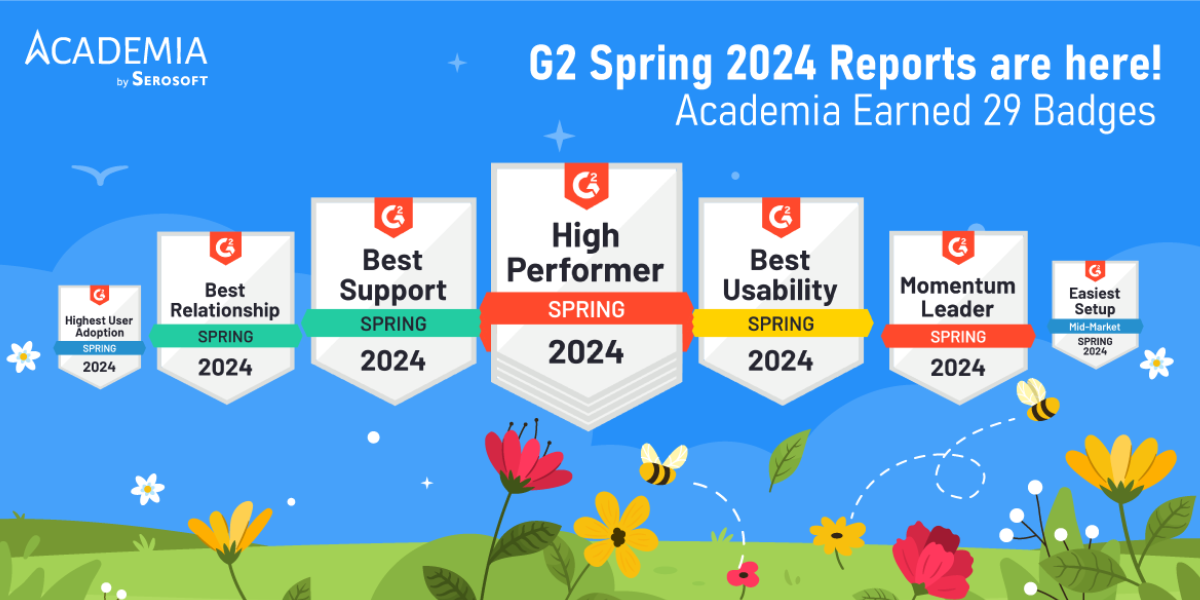
This Spring 2024 – Serosoft Achieves 29 G2 Badges for Excellence in Academic Solutions

In the ever-evolving landscape of Academia ERP/SIS solutions, standing out amidst the competition requires dedication, innovation, and unwavering commitment to customer satisfaction. At Serosoft, we are thrilled to announce a momentous achievement that speaks volumes about our relentless pursuit of excellence. We have proudly earned an outstanding 29 G2 badges, a testament to our dedication to providing unparalleled solutions and exceptional customer service.

Among these prestigious badges are recognitions for High Performance, Best Support, Easiest Setup, Highest User Adoption, Momentum Leader, Best Relationship, and Best Usability, among others. Each badge represents a pillar of our commitment to delivering innovative solutions that empower educational institutions to thrive in today’s dynamic environment.

High Performance: Our solutions are engineered to deliver superior performance, enabling educational institutions to streamline operations and achieve their goals efficiently and effectively.

Best Support: We prioritize customer satisfaction above all else, offering unparalleled support to ensure that our clients receive the assistance they need, when they need it.

Easiest Setup: With user-friendly interfaces and seamless integration processes, we strive to make the implementation of our solutions as smooth and hassle-free as possible.

Highest User Adoption: Our solutions are designed with the end user in mind, ensuring widespread adoption and utilization across educational institutions of all sizes and complexities.

Momentum Leader: Our forward-thinking approach and innovative solutions have positioned us as leaders in the industry, driving momentum and setting new standards for excellence.

Best Relationship: Building strong, lasting relationships with our clients is at the core of everything we do. We value trust, transparency, and collaboration, fostering partnerships that stand the test of time.

Best Usability: We understand the importance of intuitive design and user experience, and we are committed to delivering solutions that are easy to use and navigate, enhancing productivity and satisfaction.

These accolades are a reflection of our unwavering dedication to providing exceptional solutions and outstanding customer service. We extend our heartfelt gratitude to our clients for their continued trust and support. It is through their feedback, collaboration, and partnership that we are able to continuously innovate and evolve, driving positive change in the education sector.

As we celebrate this remarkable achievement, we remain committed to pushing the boundaries of innovation, empowering educational institutions to thrive and succeed in an ever-changing world. Thank you for joining us on this journey of excellence. Together, we will continue to shape the future of academia, one milestone at a time.

Read our G2 reviews: Academia by Serosoft on G2, currently stands with 4.7/5 rating out of 23 reviews.

#Serosoft #Academia #SIS #G2 Badges #CustomerSuccess #AwardWinning

We have always been G2’s favorite brand and winning badges: Learn more with this blog post.


Streamlining Access: Selecting the Optimal Single Sign-On Solution for Higher Education

In today’s digital age, seamless access to a plethora of platforms and resources is imperative for higher education institutions. Single Sign-On (SSO) software stands as the cornerstone, simplifying access by enabling users to navigate multiple applications with just one set of login credentials. Nevertheless, amidst the array of options available, choosing the most suitable SSO software for higher education can be a daunting task. In this discourse, we delve into pivotal considerations for selecting SSO solutions tailored for the academic realm.

Understanding the Significance of SSO in Higher Education

SSO obviates the cumbersome chore of managing multiple login credentials, empowering users to authenticate once and access all authorized resources seamlessly. This holds particular relevance in educational settings where students, faculty, and staff necessitate access to an array of applications and platforms.

Key Factors to Deliberate When Choosing SSO Software

Integration Capabilities: Ensure seamless assimilation with existing systems such as Student Information Systems (SIS) and learning management systems (LMS), fostering interoperability and data consistency.

Security Features: Prioritize stringent authentication methods, fortified encryption protocols, and adherence to industry standards, safeguarding sensitive institutional data.

User Experience: Opt for an intuitive solution that furnishes a seamless login experience across various devices, enhancing user satisfaction and productivity.
Scalability and Performance: Select software endowed with scalability features, adept at accommodating escalating user volumes without compromising operational efficiency.

Cost and Affordability: Strike a judicious balance between initial expenditures and long-term benefits, scrutinizing potential cost savings and return on investment.

Conclusion

To navigate the complex landscape of single sign-on software for higher education, institutions must conduct a thorough evaluation of factors such as integration capabilities, security features, user experience, scalability, and cost considerations. By doing so, they can strengthen their access management systems and enhance security in today’s digitally-driven educational environment. Discover how Academia can serve as your comprehensive solution for higher education digitalization, complete with SSO functionality. Learn more by requesting a live demo.

Back to top