
Type your keyword below

Why Southeast Asian Universities Are Betting Big on AI-Powered Student Information Systems

14 years ago, managing a university of 5,000 students with spreadsheets was annoying. Managing 20,000 students the same way today is a crisis waiting to happen.

Quick Answers — Before You Read On

Q: We’ve been managing fine without a formal system for years. Why is now the right time to make this investment?

“Managing fine” usually means your staff is absorbing the inefficiency personally, through overtime, workarounds, and institutional knowledge that lives in people’s heads. That works until a key person leaves, enrolment crosses a threshold, or an accreditation body asks for data you can’t produce cleanly. The cost of the status quo is real; it’s just invisible until it isn’t.

Q: Our leadership is supportive, but faculty and administrative staff will resist the change. How do institutions handle that realistically?

Resistance comes from fear of extra work during transition, or distrust that the new system will actually be better than what people have built their routines around. 

The institutions that manage this well don’t lead with technology, they lead with the specific frustrations each group already has. Show the registrar how reconciliation disappears. Show advisors how they stop hearing about at-risk students too late. When people see their own problems being solved, resistance drops fast.

Q: What’s the biggest mistake universities make when buying a campus management system?

Choosing price over configurability, then spending double on customizations over three years. Always evaluate how well the system maps to local accreditation frameworks. 

The Problem No One Talks About Openly

Across Southeast Asia, higher education enrollment has exploded. Indonesia added 200+ universities in a decade. Vietnam’s enrollment nearly doubled. The Philippines now hosts over 2,000 institutions.

But most of these institutions are running on infrastructure built for a fraction of their current size. The student information system, if one exists, was purchased in the early 2000s and patched so many times that it barely resembles the original product.

The result is what analysts call “administrative debt.” And in higher education, that debt doesn’t just hurt efficiency. It directly hurts students through delayed records, missed at-risk flags, and compliance failures that put accreditation at risk.

Where AI Is Actually Making a DifferenceWhere AI Is Actually Making a Difference
The real shift happening right now isn’t just about digitizing records. It’s about moving from backward-looking reports to real-time, predictive intelligence.

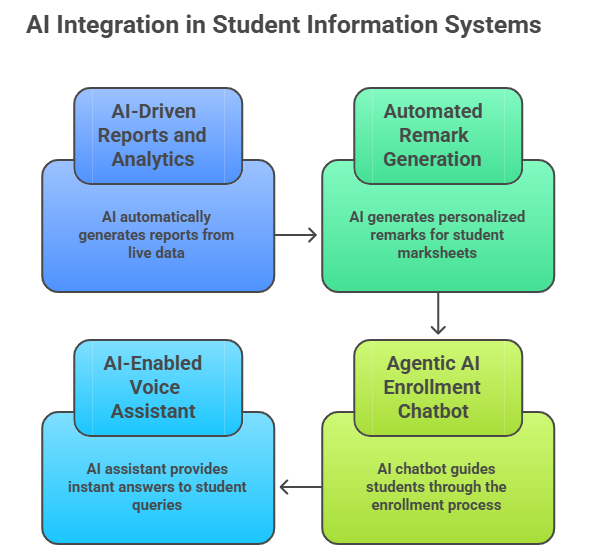
Modern student information systems embed AI-driven capabilities directly into daily workflows. Here’s what that looks like in practice:

AI-driven reports and analytics generation. The system continuously pulls live data across enrollment, attendance, grades, and financials to generate institutional reports automatically, no manual compilation, no reconciliation across spreadsheets. 

Leadership gets real-time dashboards; IR teams get accreditation-ready outputs formatted to local regulatory standards. Decisions that used to wait weeks for a report now happen in the same meeting they’re raised.

Automated remark generation in marksheets. Instead of faculty manually writing performance remarks for hundreds of students, AI analyzes each student’s academic data and generates contextual, personalized remarks directly on marksheets. What used to consume days of faculty time at the end of every semester is handled in minutes, consistently, and without the fatigue-driven errors that come with manual entry at scale.

Agentic AI enrollment chatbot. Students no longer need to visit counters, wait in queues, or chase administrative staff to complete enrollment. An AI-powered chatbot guides them through the entire enrollment process conversationally, selecting courses, confirming fee structures, submitting documents, and securing their seat, entirely via chat, at any hour. 

For institutions managing thousands of enrollments simultaneously, this removes one of the most resource-intensive bottlenecks in the academic calendar.

AI-enabled voice assistant. Students can get immediate answers to queries — fee deadlines, exam schedules, admission status, academic policies, and assignment details- through a voice-enabled AI assistant available around the clock.

Country-by-Country Spotlight: Where AI-Driven Student Info Systems Are Making the Biggest Impact

Every Southeast Asian market has its own distinct higher education challenges. Here’s where the adoption pressure is highest and what it’s driving.

  • Indonesia — Over 4,500 higher education institutions, many operating with fragmented data systems. BAN-PT accreditation reform is accelerating SIS adoption as institutions scramble for automated compliance reporting.
  • Philippines — High dropout rates (especially in state universities) and CHED’s CMO directives are pushing institutions toward AI-powered early alert systems embedded in modern student information systems.
  • Malaysia — A mature private higher education sector is driving demand for competitive analytics. MQA compliance automation and international student enrollment management are the top priorities.
  • Thailand — The government’s Thailand 4.0 education policy explicitly ties funding to digital capability. Institutions adopting higher education ERP platforms with analytics gain measurable advantages in government assessments.
  • Vietnam — Rapid expansion of the private higher education sector with limited legacy system debt creates a greenfield opportunity to implement modern campus management systems from scratch.
  • Singapore — Institutions here are already advanced, driving demand for sophisticated ERP in education that integrates with workforce development platforms and industry partnership systems.

The Compounding Advantage of Moving Early

Here’s the strategic reality: institutions that move first on AI-powered analytics build an advantage that compounds over time. Every semester of data makes the models smarter. Better predictions lead to better interventions. 

Better interventions improve outcomes. Better outcomes improve reputation and enrollment quality. The loop runs in your favor — but only if you start it.

The barriers are lower than they’ve ever been. Modern cloud-based student information systems are accessible to institutions of all sizes, deploy faster than legacy systems ever did, and don’t require significant on-premise infrastructure investment.

The question isn’t whether you can afford to upgrade. It’s whether you can afford to keep running on what you have.

Conclusion

If you’re evaluating your options, Academia is worth a close look. It’s a purpose-built higher education ERP designed specifically for Asian institutions — combining student lifecycle management, AI-powered retention analytics, and automated accreditation reporting in a single platform, with Southeast Asian localization built in from the ground up.

The best way to evaluate any system is to see it working with real scenarios from your country and institution type.

Book a free demo with Academia today — and see what modern campus intelligence actually looks like in practice.

Why Middle East Universities Can’t Afford to Ignore Higher Education ERP in 2026

Saudi Vision 2030. UAE National Agenda. Qatar National Vision 2030. Every GCC government is betting billions on higher education as the engine of economic diversification.

Yet walk into most university administrative offices across Riyadh, Dubai, or Doha, and you’ll find the same reality: disconnected software, manual compliance reporting, and data that doesn’t talk between departments.

That’s not a technology gap, it’s a strategic liability. And in a region where governments are demanding measurable outcomes from institutions, the stakes couldn’t be higher.

Quick Answers: What Institutional Leaders Are Actually Asking

Q: What is a higher education ERP, and why does it matter in the GCC context?

A higher education ERP is a unified platform built to manage every operational layer of a university, including admissions, academics, finance, and compliance, within a single, real-time environment. In the GCC context, it’s also the backbone behind CAA, NCAAA, and QAA accreditation readiness. Without it, institutions are building world-class ambitions on fragmented infrastructure.

Q: Our university already has tools in place. Why change?

Because disconnected tools are what’s costing you accreditation readiness. When your student management system doesn’t communicate with your MoE reporting module, and your finance office operates on different data than your registrar, compliance becomes a fire drill, not a process. A purpose-built campus management system ends this permanently.

Q: Does a higher education ERP support multilingual interfaces for diverse regions like the Middle East?

Yes, a robust global ERP solution like Academia is designed to support multilingual interfaces, including Arabic, ensuring accessibility for all users across the institution.

The Real Pressure Middle East Universities Are Under Right Now

The Middle East’s higher education market is valued at $115 billion and projected to reach $175 billion by 2027, with governments in Saudi Arabia, UAE, and Qatar driving the region toward global competitiveness through heavy investment in digital skills and sector specialization.

That growth creates enormous operational pressure.

Saudi Arabia alone will need to add approximately 800,000 to 900,000 new higher education seats by 2030, driven by a young population, economic diversification targets, and a push into AI, robotics, and advanced manufacturing. Scaling to that level without a robust higher education ERP is operationally impossible.

Meanwhile, institutions continue to struggle with disconnected admissions, academics, and reporting tools, making digital transformation reactive rather than strategic.

The gap between ambition and infrastructure is where institutions fall behind.

What a Purpose-Built Higher Education ERP Delivers

What a Purpose-Built Higher Education ERP

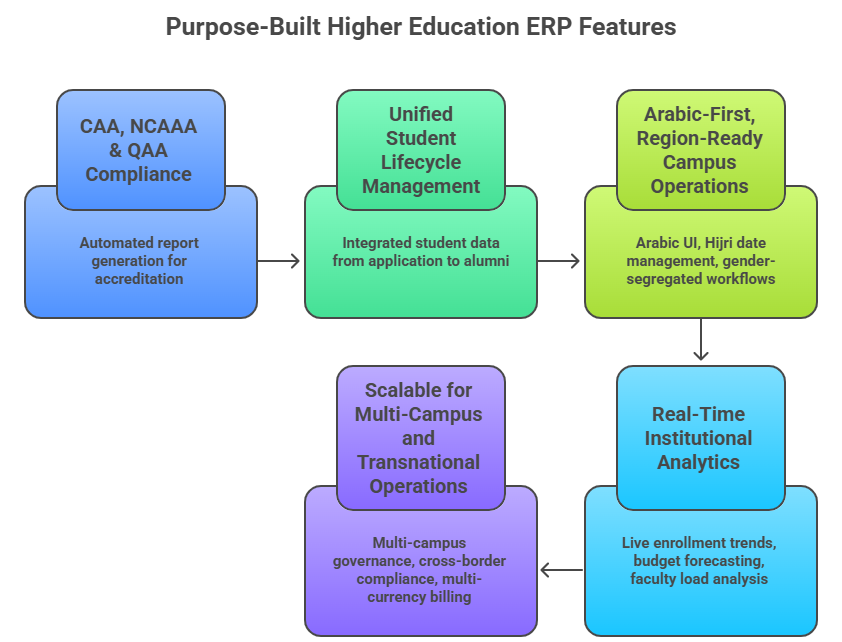
The strongest higher education ERP: platforms deployed across the region aren’t just administrative tools. They’re the operational intelligence layer that connects Vision-aligned strategy to day-to-day execution. Here’s what they actually do:

CAA, NCAAA & QAA Compliance, Automated: Accreditation in the UAE, Saudi Arabia, and Qatar is increasingly data-intensive. A modern Education ERP generates the reports your accreditation teams need automatically, no end-of-cycle scramble, no data reconciliation across departments.

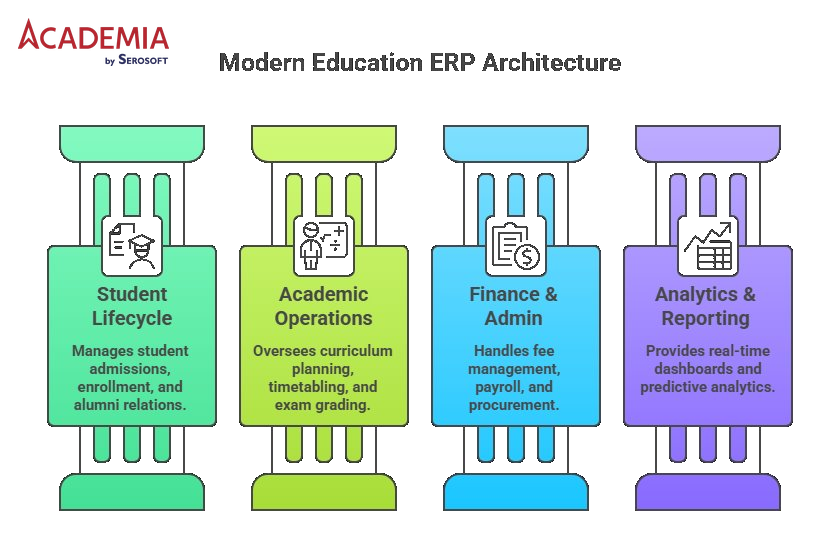
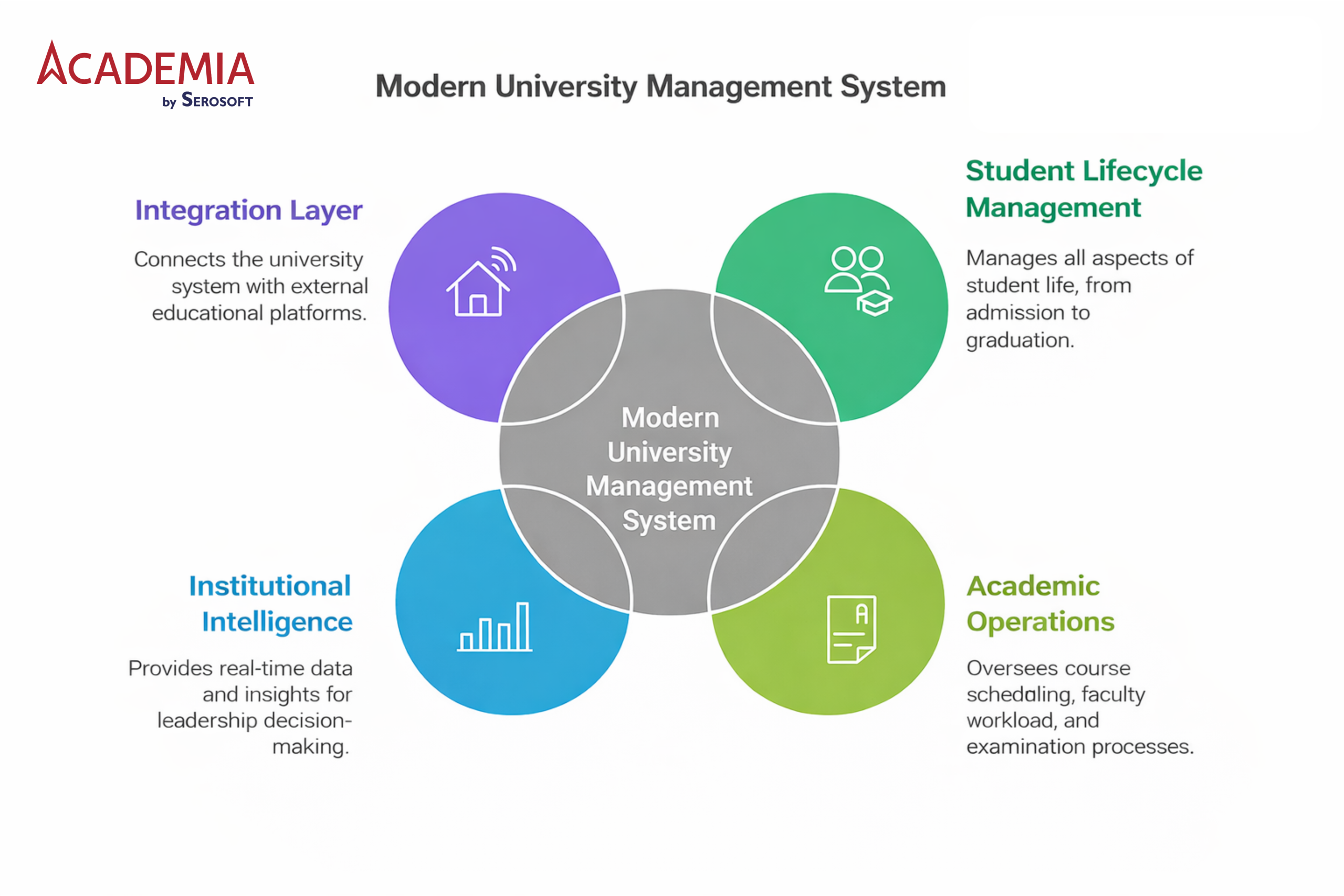
Unified Student Lifecycle Management: From application through alumni, every touchpoint lives inside your student information system, fully integrated with academic records, fee management, and student support. Advisors, registrars, and faculty all work from one record.

Arabic-First, Region-Ready Campus Operations: A genuine campus management system for the Middle East supports Arabic UI, gender-segregated campus workflows where applicable, and multi-nationality student records for diverse Gulf campuses.

Real-Time Institutional Analytics for Leadership: With Vision 2030 mandating outcomes-based reporting, your leadership team can’t wait for quarterly data. A student ERP built for the region delivers live enrollment trends, budget forecasting, and faculty load analysis, directly aligned with MoE KPIs.

Scalable for Multi-Campus and Transnational Operations: The Middle East’s location at the crossroads of Europe, Asia, and Africa makes it a central hub for global business and education, and institutions are scaling accordingly. Global ERP solutions built for higher education handle multi-campus governance, cross-border compliance, multi-currency billing, and international branch operations without added complexity.

The Competitive Reality No GCC Administrator Can Ignore

Universities across the UAE, Saudi Arabia, Qatar, Bahrain, Kuwait, and Oman are no longer competing locally. Gulf states have positioned themselves deliberately as a serious site for higher education expansion, attracting branch campuses, research partnerships, and internationally mobile students.

In that environment, institutional efficiency isn’t a back-office concern; it directly shapes your rankings, accreditation outcomes, and your ability to attract international faculty and students.

The institutions winning this race have one operational foundation in common: a purpose-built higher education ERP that lets them execute at the speed their national visions demand.

Ready to Transform Your Institution’s Operations?

If your university is navigating Vision 2030 compliance, CAA accreditation cycles, rapid enrollment growth, or multi-campus expansion, the right Education ERP isn’t a luxury. It’s the operational infrastructure that everything else depends on.

Academia is a purpose-built Education ERP trusted by universities and colleges across the MENA region. From your student information system to institution-wide compliance workflows, Academia is designed specifically for the demands of GCC and broader Middle East higher education — with Arabic-language support, regional accreditation readiness, and scalable global ERP solutions built in from day one.

Book your free demo today and see exactly how Academia can align your institution’s operations with your national vision.

What Is a Student Information System, And Why Your Institution Can’t Afford to Ignore It

Let’s be honest. Most institutions are still running on a dangerous cocktail of spreadsheets, WhatsApp groups, and manual registers. And for a while, it works. Until it doesn’t.

A missed fee record here. A duplicate student entry there. An admission form that got lost in someone’s inbox. These aren’t just administrative headaches; they’re costing you time, revenue, and credibility.

The good news? There’s a smarter way. And it’s called a Student Information System.

Quick Overview — Common Questions Answered

  • What is a Student Information System?
    A Student Information System (SIS) is a centralised digital platform that manages all student-related data, from admissions and attendance to fee collection, exam results, and communication. Think of it as your institution’s single source of truth.
  • Who needs a Student Information System?
    Schools, colleges, coaching institutes, and universities, basically any institution managing 100+ students that still relies on manual processes or disconnected tools.
  • How long does implementation take?
    For most institutions, a cloud-based Student Information System can be up and running in a couple of months. Modern platforms are designed for quick onboarding with minimal IT dependency.
  • Is it expensive?
    Far less than the cost of inefficiency you’re already paying. Most SIS platforms offer flexible pricing based on student strength, and the ROI, in saved staff hours, reduced errors, and improved fee collection, typically shows up within the first semester.

The Real Cost of “Getting By” Without a Student Information System

You probably don’t think of your admin team as a bottleneck. But when a parent calls asking about their child’s fee status and your staff spends 10 minutes flipping through registers, that’s a bottleneck. When your principal needs attendance data for a board meeting and nobody can pull it in under an hour, that’s a bottleneck.

Now multiply that across 500 students, three academic terms, and a dozen departments. Suddenly, your “system” isn’t a system at all, it’s organised chaos.

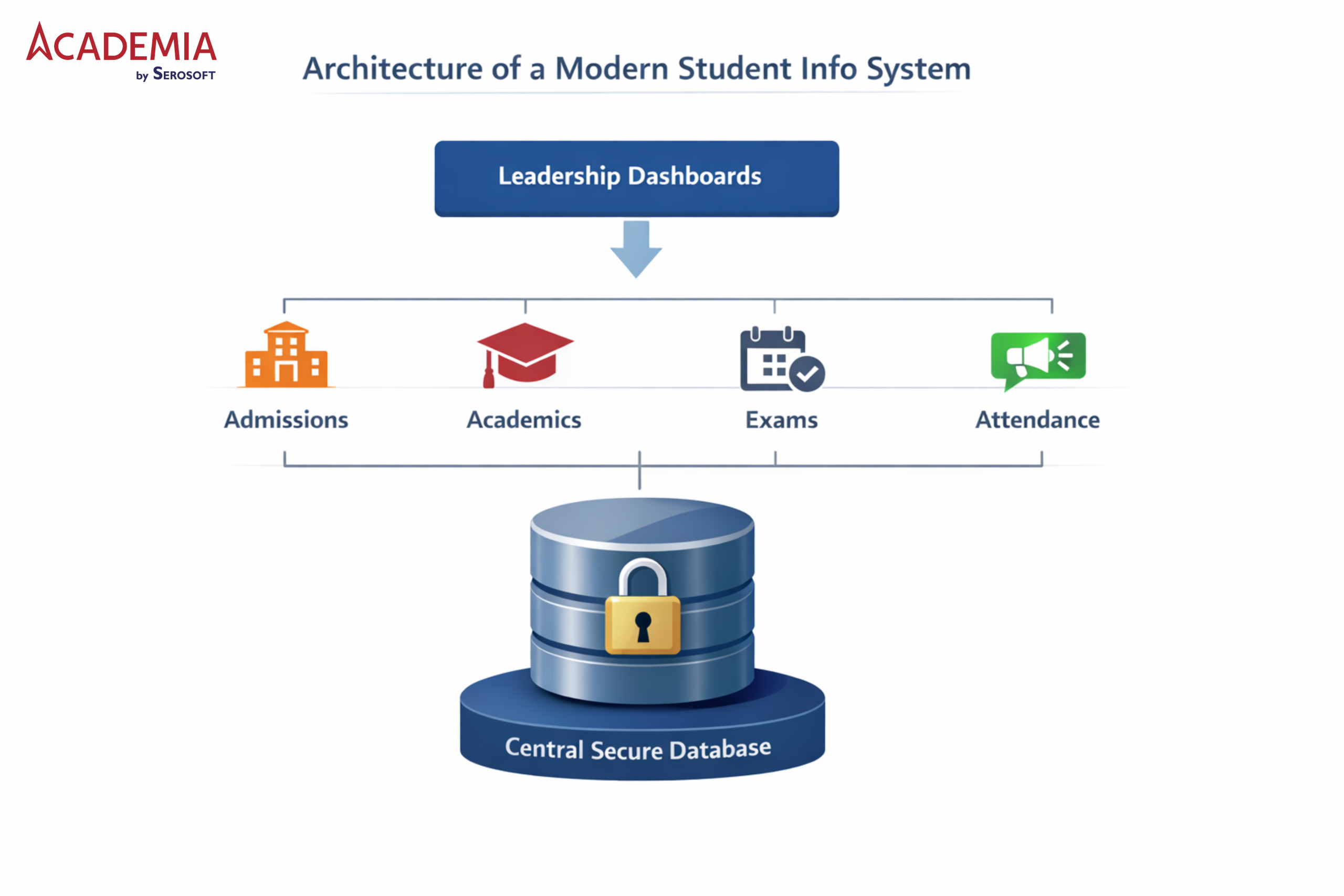
A Student Information System eliminates exactly this. It brings every critical data point, student profiles, academic records, fee history, and communication logs into one place, accessible in real time, by anyone with the right permissions.

What Does a Student Information System Actually Do?

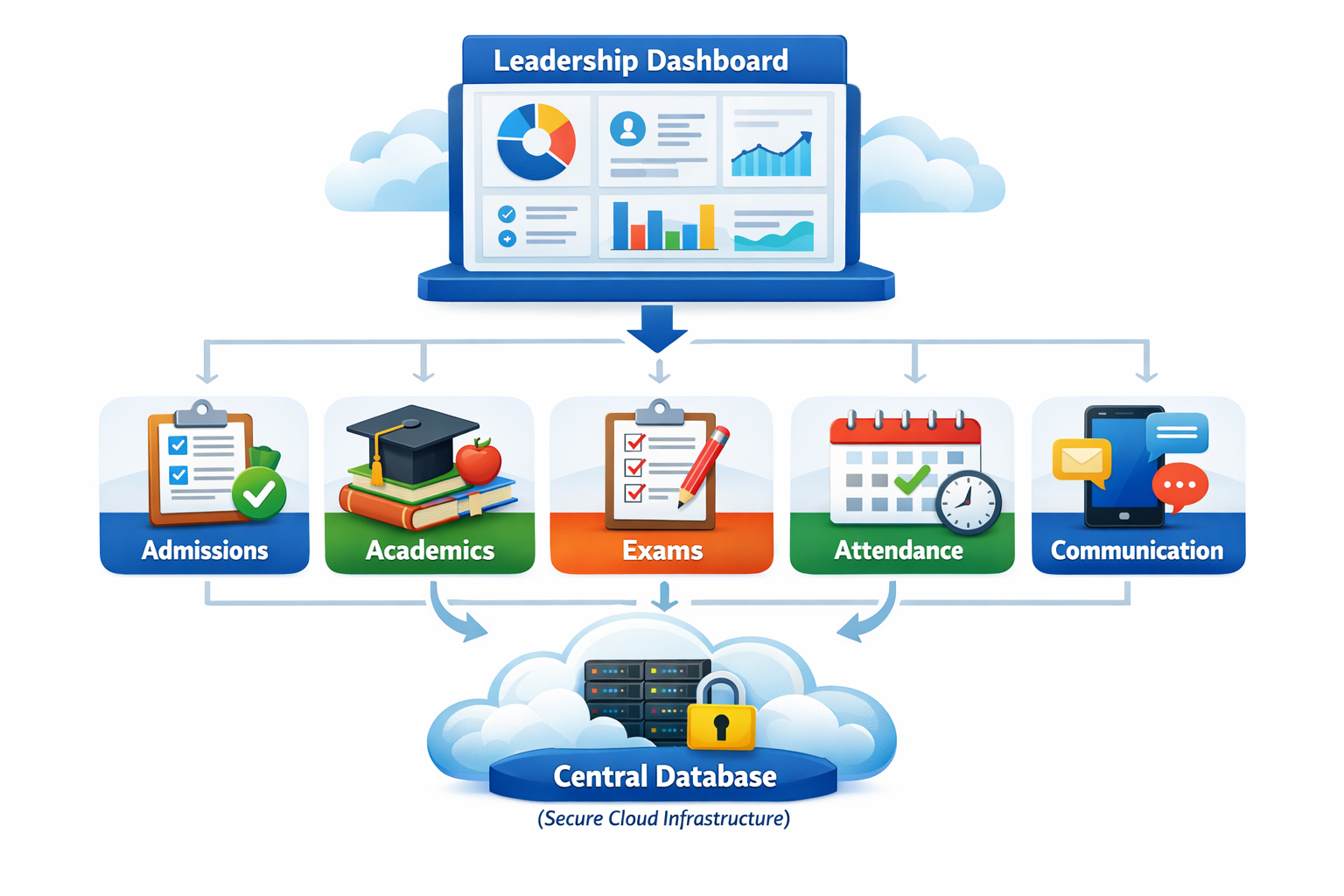
Think of it less as software and more as a nervous system for your institution. Here’s what a robust Student Information System handles on a daily basis:

  • Admissions Management — Online applications, document uploads, merit-based shortlisting, and offer letter generation, all without a single paper form.
  • Attendance Tracking — Real-time attendance marking, automated parent alerts, and monthly reports for each student and class.
  • Fee Management — Fee structure creation, instalment tracking, online payment collection, automated reminders, and defaulter reports.
  • Academic Records — Timetables, exam schedules, marks entry, report cards, and performance analytics in one place.
  • Communication Hub — SMS, email, and app-based notifications to students, parents, and staff — no third-party tools needed.

Every module talks to the other. When a student’s attendance drops below the threshold, the system can automatically flag it, notify the parent, and log the concern, without anyone lifting a finger.

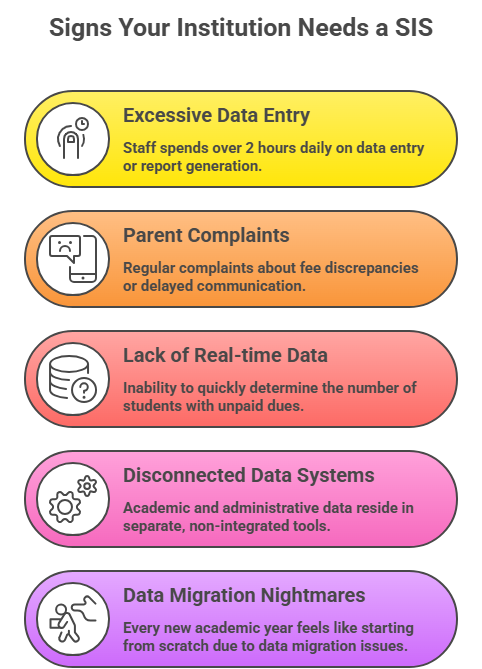
5 Signs Your Institution Desperately Needs a Student Information System

5 Signs Your Institution Desperately Needs a Student Information System

Not sure if you’re ready to make the switch? Here are the red flags most institutions ignore for far too long:

  • Your staff spends more than 2 hours a day on data entry or report generation.
  • Parent complaints about fee discrepancies or delayed communication are a regular occurrence.
  • You can’t tell, right now, in under 30 seconds, how many students have unpaid dues this month.
  • Your academic and administrative data live in separate tools that don’t talk to each other.
  • Every new academic year feels like starting from scratch because data migration is a nightmare.

If two or more of these hit home, you’re already overdue.

How a Student ERP Transforms the Parent Experience

Here’s something institutions often overlook: a great Student ERP isn’t just an internal tool. It’s a parent-facing experience too.

Today’s parents, especially in urban and semi-urban markets, expect real-time visibility into their child’s academic life. They want to know about today’s attendance. This week’s homework. The upcoming exam. The pending fee reminder. And they want it on their phone, instantly.

A modern Student Information System delivers a dedicated parent portal or app where all of this lives. The result? Fewer inbound calls to your admin desk, higher parent satisfaction scores, and a genuine competitive edge during admissions season.

Choosing the Right Student Information System: 

4 Questions to Ask

Not all platforms are built the same. Before you commit, run every vendor through these four questions:

  • Is it cloud-based? On-premise software ties you to servers and IT teams. A cloud-based Student Information System means updates are automatic, access is remote, and your data is backed up without extra cost. 
  • How customisable is it? Your institution has its own fee structures, grading patterns, and workflows. The platform should fit your processes — not the other way around. 
  • What does onboarding look like? A great product with poor implementation support is still a headache. Ask for a clear onboarding timeline and dedicated support. 
  • Can it scale? Whether you have 200 students today or plan to grow to 2,000, your Student ERP should scale without switching platforms midway.

The Bottom Line

Running an institution in 2025 without a proper Student Information System is like navigating a city without maps, possible, but painfully inefficient and full of wrong turns.

The institutions that are winning, in enrolment, retention, parent satisfaction, and operational efficiency, aren’t doing anything magical. They’ve simply made a decision to replace guesswork with data, and chaos with systems.

If you’re looking for a platform that brings all of this together, Academia is worth a close look. It’s a complete Student ERP built specifically for the Indian education ecosystem — covering everything from admissions to alumni, trusted by hundreds of institutions across the country, and designed to be up and running without disrupting your existing workflows.

Ready to see it in action? Book a free demo today.

Education ERP in the Africa Region: What Institutions Need to Know Before It’s Too Late

Digital transformation is no longer a distant aspiration for educational institutions across the African region, it is an operational imperative. As student enrolments grow, administrative complexity deepens, and regulatory accountability increases, institutions are turning to Education ERP platforms to bring order, efficiency, and strategic clarity to their operations. 

This blog examines what ERP in education means for the African region, why adoption is accelerating, and what decision-makers must evaluate before committing to a platform.

Your Peers Are Already Asking These Questions, Are You?

The following Q&A addresses the most common questions from Vice-Chancellors, Registrars, and IT Directors across the African region.

Q: Why is ERP in education gaining momentum, specifically in the African region?

The Africa region is experiencing a convergence of factors: rapid growth in higher education enrolment, government-led digital transformation agendas (particularly in the GCC and Sub-Saharan Africa), and increasing demand for data-driven governance. The Middle East & Africa education ERP market was valued at USD 1.04 billion in 2023 and is projected to grow at a CAGR of 21.1% through 2030 — the highest growth rate of any global region — making it the most dynamic market for education technology investment today.

Q: How long does an Education ERP implementation take for a mid-sized university?

A typical phased implementation for a mid-sized university (5,000–20,000 students) takes between 4 to 6 months, depending on the institution’s legacy infrastructure, data migration complexity, and the number of modules deployed. Institutions that invest in change management and staff training from the outset consistently report faster adoption and measurable ROI within the first academic year.

Q: Is cloud-based ERP suitable for institutions in regions with variable internet connectivity?

Yes. Leading Education ERP providers now offer hybrid deployment models — cloud-hosted with offline-capable local instances — specifically designed for markets with connectivity challenges. Cloud-based solutions currently capture approximately 45% of the global education ERP market and are growing fastest in the African region, driven by reduced infrastructure costs and easier upgrades.

The Africa  Market Is Moving Fast — Here Is Exactly Where It Stands

The global Education ERP market is projected to reach USD 44.4 billion by 2031, growing at a CAGR of 13.3%. Within this landscape, the Middle East and Africa (MEA) region stands out as the fastest-accelerating market, with a projected CAGR of 21.1% from 2024 to 2030. 

The UAE alone is forecast to grow at 26.6% annually through 2030, driven by government mandates under national education reform agendas.

For institutions across Africa  — whether in the GCC, East Africa, West Africa, or South Asia — this data points to one clear signal: the window for early adoption advantage is narrowing. Institutions that implement robust university management systems and campus management systems now will be better positioned for accreditation reviews, external audits, and competitive student recruitment.

Why Institutions Still Running On Manual Systems Are Accumulating Risk Every Semester

Spreadsheet-driven administration, siloed departmental software, and paper-based student record systems carry operational costs that compound year on year. 

A registrar’s office managing 10,000 student records manually is not just inefficient; it is a compliance liability. Across African institutions, three pressure points are most commonly cited:

  • Enrolment growth outpacing administrative capacity
  • Regulatory and accreditation bodies are demanding real-time data and audit trails
  • Student expectations are shaped by digital-first experiences in every other aspect of life

A modern student ERP addresses all three by centralising data, automating workflows, and generating the reporting outputs that governance bodies require — without expanding the administrative headcount.

What Leading African Institutions Are Demanding From Their ERP — And Why Others Cannot Afford to Compromise

Leading African Institutions


Not all
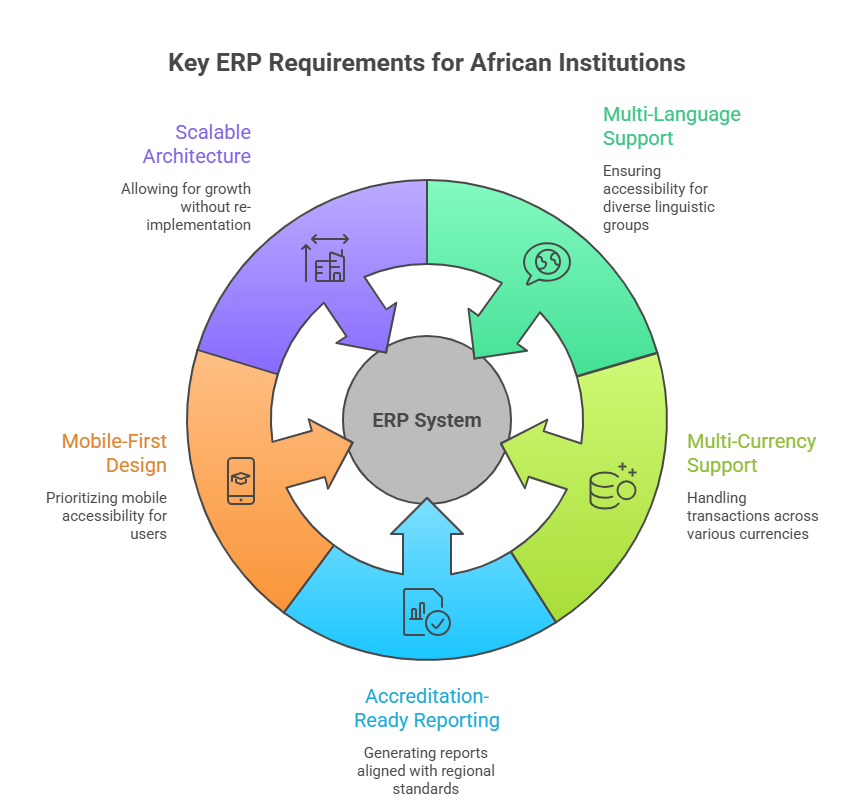
Education ERP platforms are built with African requirements in mind. When evaluating a student ERP or campus management system for this region, institutional leaders should prioritise the following:

  • Multi-Language and Multi-Currency Support: Institutions across the GCC require Arabic interface support. Institutions in East and West Africa often operate across multiple currencies and regulatory frameworks. A university management system without these capabilities creates workarounds that undermine the platform’s efficiency gains.
  • Accreditation-Ready Reporting: Whether institutions are pursuing CAA accreditation in the UAE, NCHE compliance in Kenya, or NAAC-equivalent frameworks elsewhere, the Education ERP must generate structured, auditable reports aligned with regional regulatory standards — not just globally generic outputs.

  • Mobile-First Student Management System: In markets where smartphone penetration outpaces desktop usage — common across Sub-Saharan Africa — a student management system with a mobile-first interface is not optional. It determines adoption rates among students and teaching staff alike.

  • Scalable Architecture: An institution with 3,000 students today may have 15,000 within a decade. A campus management system must scale without requiring full re-implementation. Cloud-native architectures with modular expansion are the standard to benchmark against.

The ROI Data Is In — And Institutions Without ERP Are Already Falling Behind

Institutions that have implemented ERP in education report measurable operational improvements: adoption of ERP platforms has increased by over 60% globally, with institutions reporting faster decision-making and optimised administrative workflows. While institution-level ROI varies by deployment scope and change management quality, the recurring finding across African early adopters is a significant reduction in manual processing time within the first two academic cycles.

The student management system module consistently delivers the most immediate impact, reducing errors in enrolment processing, automating fee collection reconciliation, and enabling academic staff to access real-time student performance data without administrative intermediaries.

The Evaluation Criteria That Will Separate Smart Adopters From Costly Mistakes

The decision to implement a university management system or campus management system is a multi-year institutional commitment. Beyond feature checklists, African institutions should assess:

  • Vendor’s regional implementation experience and local support capacity
  • Data residency options and compliance with national data sovereignty regulations
  • Integration capability with existing LMS, library, and biometric systems
  • Total cost of ownership over a 5-year horizon, including training and upgrades
  • Reference institutions in comparable African contexts

The Institutions Acting Now Will Set the Standard — Will Yours Be One of Them?

The adoption of Education ERP across Africa is not a trend; it is a structural shift in how institutions are managed, governed, and experienced by students. With the regional market growing at over 21% annually, the infrastructure for a fully digitised campus management system is being built now. Institutions that approach this investment strategically, selecting a platform aligned to their regulatory context, growth trajectory, and operational culture, will define the benchmark for educational management in the region over the next decade.

For institutions ready to move from evaluation to action, Academia offers a purpose-built Education ERP designed with the complexity of African institutions in mind, from multi-campus university management systems to mobile-first student management capabilities built for high-growth markets. If you are mapping out your institution’s next step, a free demo is a practical place to start.

Your Peers Have Already Moved to a Modern Student Management System, Here’s What You’re Losing Every Semester You Wait

Here’s What You’re Losing Every Semester You Wait

Your Key Questions Answered:

Q: What is a student management system and why does it matter in 2026?

A student management system (SMS) is a centralised digital platform managing the complete student lifecycle — from inquiry and admission through academics, fees, assessments, and alumni engagement. In 2026, institutions still running legacy or siloed tools are actively losing enrolments, rankings, and accreditation scores to those that aren’t.

Q: How long does it take to implement a campus management system across a large university?

A single-campus deployment typically takes 3–6 months, while multi-campus networks can range from 8–18 months. Cloud-native platforms with modular rollout strategies significantly compress these timelines.

Q: What global ERP solution is purpose-built for higher education institutions outside the US and Europe?

Academia is built specifically for the regulatory and academic structures of emerging markets across South Asia, Southeast Asia, Africa, and the Middle East — offering region-specific compliance, multilingual support, and flexible deployment models.

Q: What ROI can a university expect from implementing a student management system?

Nucleus Research indicates an average ROI of $7.23 for every $1 spent. Institutions typically report a 20–35% reduction in administrative overhead and a 15–25% improvement in fee collection rates within the first two academic years.

The Hidden Cost of Your Legacy System That Nobody Is Calculating

Most institutional finance leaders calculate the cost of a new student ERP implementation. Very few calculate the cost of not implementing one. That asymmetry is where institutions quietly lose the competitive ground they’ve spent decades building.

Consider what legacy, fragmented systems actually cost at scale. When your admissions team uses one tool, your registrar another, your finance office a third spreadsheet, and your faculty a fourth portal, the real cost isn’t licensing fees. It’s the invisible tax paid in duplicated effort, delayed decisions, and student frustration.

Operational cost data from EDUCAUSE’s 2024 survey of 312 higher education institutions globally:

  • Administrative time lost to manual data re-entry: 68%
  • Fee collection delays due to siloed finance systems: 54%
  • Accreditation data preparation time (manual processes): 72%
  • Student grievances related to administrative delays: 41%

The academic registrar who spends 3 weeks before each semester manually reconciling student records across three different platforms isn’t a productivity problem. It’s a systems design problem. And the registrar is spending political capital managing data instead of enabling academic policy.

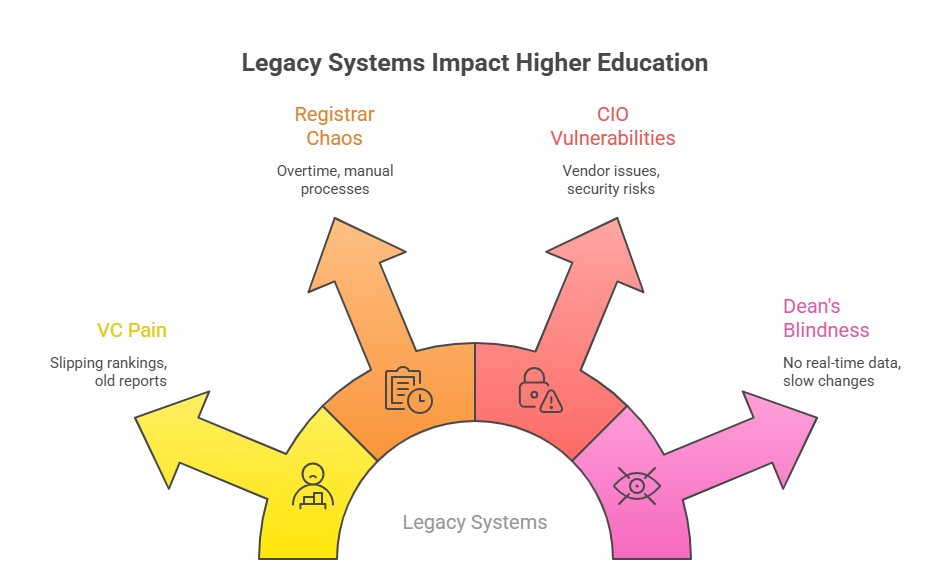
Who Is Actually Losing Sleep Over This? A Persona-Based Reality Check

Who Is Actually Losing Sleep Over This_ A Persona-Based Reality Check

The pressures of running modern higher education aren’t uniform.

Understanding who bears what burden is critical before evaluating any university management system.

The Vice Chancellor / President
Primary Pain Point: Rankings slipping. Accreditation audits are approaching. No single dashboard to see institutional health. Decisions are made on reports that are 6 weeks old by the time they land on the desk.

The University Registrar
Primary Pain Point: Managing 15,000+ student records across multiple legacy systems. Exam scheduling conflicts. Manual transcript generation. Semester-start chaos that costs her team 800 hours of overtime annually.

The Chief Information Officer
Primary Pain Point: Maintaining 8 different vendor relationships for systems that don’t talk to each other. Security vulnerabilities in legacy on-premise software. No API architecture for future integrations.

The Academic Director / Dean
Primary Pain Point: Cannot see student performance data in real time. Faculty feedback loops are broken. Curriculum changes take a full semester to reflect in the system. Zero predictive insight on at-risk students.

Each of these personas is experiencing a different symptom. But they all trace back to the same root cause: an institution running without a unified student management system architecture.

The Student Experience Deficit: 

What Your Students Feel That Your Data Doesn’t Show

Every metric your institution tracks, enrolment numbers, fee collection rates, and pass percentages, is a lagging indicator. By the time the data is visible, the student experience that generated it has already happened. And in 2026, that student experience is being shaped every day by the quality of your student management system.

Consider the journey of a first-year international student arriving at your campus. That student needs to complete fee payment, confirm hostel allocation, register for elective courses, and access the timetable, ideally before orientation week ends. In an institution operating fragmented systems, each requires a different portal, login, and often a different physical counter.

That particular student came from a world where banking, transportation, entertainment, and food delivery are all managed through a single, intelligent app. Your administrative system is the first real experience of your institution’s culture. And right now, for too many students at too many universities, that first experience communicates: we are not built for you.

Academia’s Insights:

McKinsey’s 2024 Education Insights report found that 41% of students cited “frustrating administrative processes” as a contributing factor in their intention to transfer or drop out, second only to academic difficulty.

The Market Won’t Wait: Competitive Pressure Reshaping the Higher Ed Technology Landscape

In the next 36 months, pressure on higher education institutions is coming from three directions at once.

The Accreditation Arms Race — Bodies like QS, THE, and NAAC are increasingly weighing data transparency and operational efficiency. Institutions without real-time, audit-ready data will find accreditation far more burdensome.

The Transnational Education Expansion — Demand for internationally recognised credentials is surging across Africa, the Middle East, and Southeast Asia. Only institutions with the right operational infrastructure can capture this market.

The AI-Native Generation — Students entering from 2026 onward expect personalisation and intelligence from institutional systems. AI-driven ERP capabilities are rapidly becoming a baseline expectation, not a differentiator.

The Institutions That Will Lead in 2030 Are Making the Decision Today

There is no globally competitive higher education institution in 2030 still running the same fragmented, legacy stack it had in 2020. The question is not whether your institution needs a modern student management system; it is whether you act proactively or are forced to react under pressure from an accreditation audit, a competitor’s enrolment surge, or a student satisfaction crisis.

ERP in education is not a cost centre. It is the operating infrastructure on which academic excellence, institutional efficiency, and student success are built.

Academia is purpose-built to be that infrastructure, designed specifically for institutions across South Asia, Southeast Asia, Africa, and the Middle East, and trusted by universities ready to lead rather than follow.

The institutions that make this decision in 2026 will be the ones their peers benchmark against in 2030.

Ready to see it in action? Book your free Academia demo today.

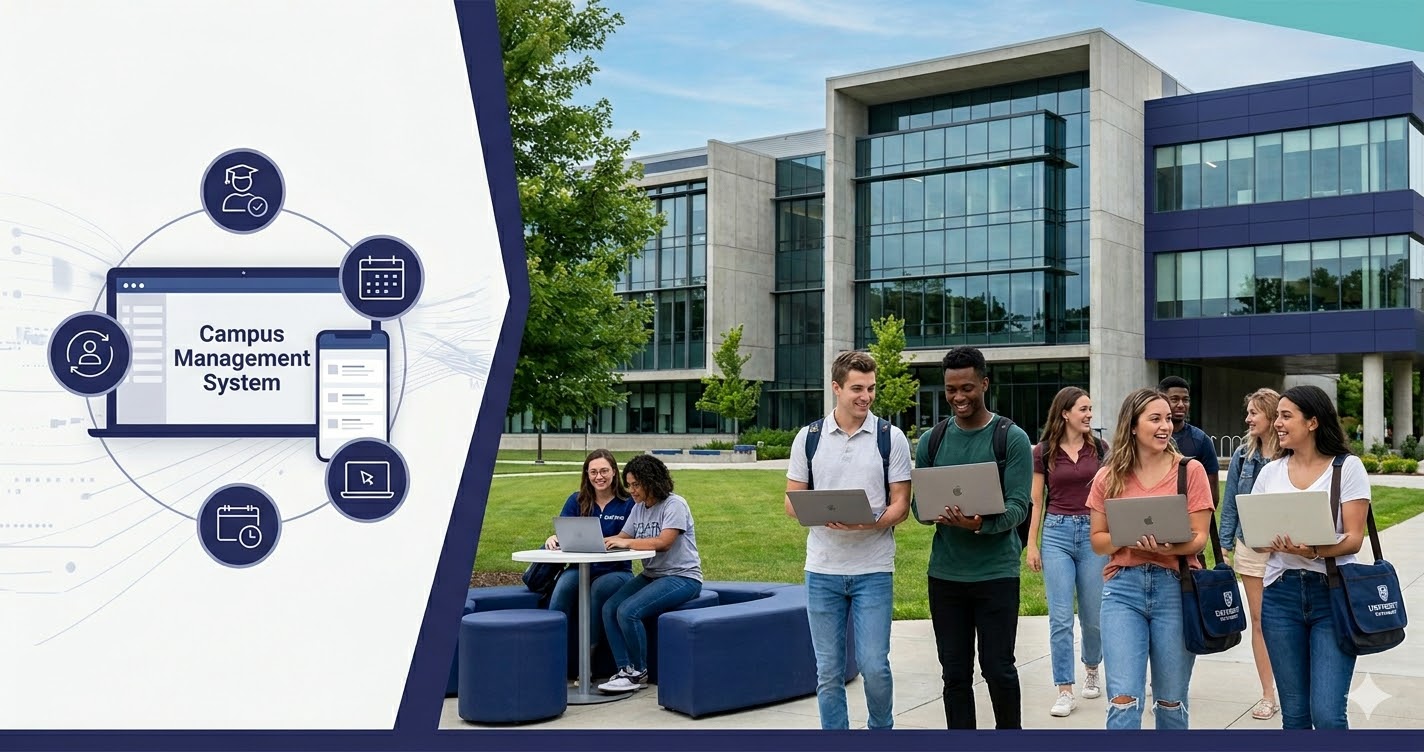
Why Every University Needs a Campus Management System – And What to Look for in 2026

Key Questions Answered

Q1. What exactly is a Campus Management System, and how is it different from the software we already use?

A Campus Management System, also called a Student Information System or university management system, is an all-in-one platform that connects every part of your university: admissions, academics, finance, HR, compliance, and student support. Most universities currently run these functions on separate tools that do not communicate, forcing staff to manually transfer data, fix errors, and chase information across departments. A Campus Management System eliminates that entirely.

Q2. Does our institution actually need a Campus Management System, or is our current system enough?

It depends on what your current system can actually do. Many universities operate older or partial implementations that only handle student records and enrollment, leaving all other departments to be managed separately. If that describes your setup, then yes, a modern Campus Management System will close those gaps significantly. The right platform should manage not just student data but your entire institution, from fee collection and faculty payroll to accreditation reporting and multi-campus operations, all in one place.

Q3. How long does it take to implement a Campus Management System, and will it disrupt our ongoing operations?

Implementation typically ranges from 4 to 6 months, depending on institution size, data complexity, and modules deployed. Disruption is a legitimate concern, but it is largely avoidable. Institutions that choose vendors with a structured implementation methodology and a phased rollout approach experience minimal operational impact. A well-managed implementation runs parallel to your existing systems and transitions department by department, not all at once.

Introduction

73% of universities cite data silos as a top operational barrier. The average mid-size university loses $2.1 million annually to administrative inefficiency. And yet, most institutions are still running student admissions, finance, HR, and compliance on disconnected systems that were never designed to talk to each other. 

The solution is not another point solution. It is a unified Campus Management System, and in 2026, it will be the single most consequential technology decision a higher education institution can make.

This guide is written for University CIOs, Registrars, Academic Administrators, College Presidents, and EdTech procurement teams who need an authoritative, data-driven framework for evaluating, justifying, and implementing the right platform for their institution.

1. What Is a Campus Management System?

A Campus Management System is an integrated digital platform that unifies every administrative, academic, and operational function of a higher education institution, from student admissions and course management to finance, compliance, and alumni engagement, into a single, connected ecosystem.

Unlike standalone tools that handle one function in isolation, a Campus Management System acts as the institutional nervous system. It enables real-time data flow between departments, automates repetitive workflows, and surfaces actionable intelligence for leadership at every level, from registrars managing enrollment cycles to CIOs governing institutional data strategy.

In 2026, the definition has expanded further. Modern Campus Management Systems include AI-powered predictive analytics, mobile-first student portals, regulatory compliance engines, and seamless integration with third-party platforms, making them the backbone of what analysts now call the Intelligent Campus.

A well-implemented Campus Management System is not a technology purchase; it is an institutional transformation.

2. The Real Cost of Fragmented University Operations

The Real Cost of Fragmented University Operations

Before evaluating solutions, institutional leaders need to honestly account for what fragmented operations actually cost, not just in software licensing fees, but in compounding operational drag.

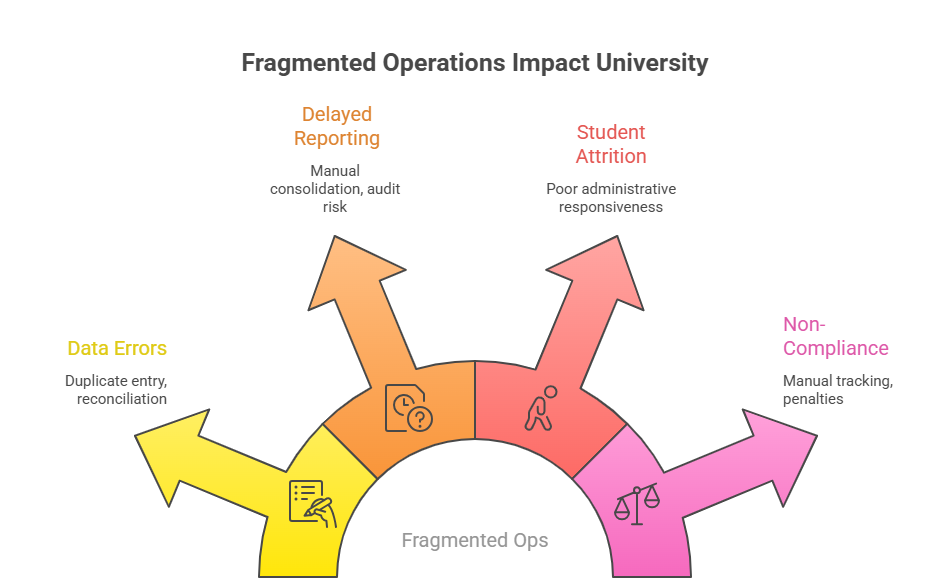
Duplicate data entry and reconciliation errors. Administrative staff at a typical 15,000-student university spend an estimated 1,200+ hours annually re-keying data across disconnected systems, a direct payroll cost exceeding $48,000 per year, before accounting for error-correction cycles.

Delayed financial reporting and audit risk. Without a unified Higher Education ERP, generating consolidated financial statements requires manual consolidation across systems, creating reporting delays of 3 to 6 weeks and increasing audit exposure significantly.

Student attrition from a poor experience. 70% of students who leave an institution in year one cite poor administrative responsiveness as a contributing factor. A fragmented student information system means slower responses, lost records, and frustrated students who have no shortage of alternatives.

Regulatory non-compliance penalties. Manual compliance tracking across accreditation bodies, government reporting, and financial aid regulations creates material risk. Fines and remediation costs from compliance failures average $340,000 per incident in higher education.

What changes post-implementation? Universities that implement a unified Campus Management System report an average 28% reduction in administrative overhead within 18 months, with measurable improvements in student satisfaction scores and accreditation audit readiness.

3. Modern Campus Management System vs. Traditional Student Information System

Many institutions already operate a student information system — so the natural question is: why upgrade to a modern Campus Management System like Academia? The distinction matters more than most IT teams initially assume.

A traditional student information system covers the basics — student records, enrollment, and grades. It was built for data storage, not institutional intelligence. It captures what happened. It cannot predict what is about to happen, automate what needs to happen next, or give students the real-time, self-service experience they now expect as a baseline.

A modern Campus Management System like Academia is built around a fundamentally different philosophy. Every module, Admissions, Student Portal, Fee Management, Examinations, Marksheets, Attendance, and Outcome-Based Education, is designed not just to store data, but to act on it.

Consider what that looks like in practice. When a student misses a threshold number of classes, the attendance module does not just log it; it flags it. When exam results are processed, marksheets are not manually written; remarks are generated automatically by AI, saving faculty hours per assessment cycle. When a prospective student wants to enroll, they do not fill out a form and wait. 
Academia’s AI-driven enrollment assistant bot lets them complete the entire enrollment process through a simple chat interface.

This is the gap that traditional systems cannot close, no matter how many integrations are added on top.

Academia also addresses one of the most persistent pain points in university administration: student query management. 

SERA, Academia’s AI-enabled voice assistant, handles student queries around the clock — from fee payment status to exam schedules — without requiring staff intervention. For institutions managing thousands of students, this is not a convenience feature. It is an operational shift.

On the analytics side, the difference is equally significant. Traditional systems produce reports when someone runs them. 

Academia’s AI-driven analytics engine generates institutional insights automatically, surfacing enrollment trends, attendance patterns, fee collection gaps, and academic performance signals without requiring a dedicated data team to ask the right questions.

Institutions that have moved from legacy student information systems to Academia consistently report the same outcome: less time spent managing the system, and more time spent acting on what it tells them.

The Decision Has a Cost Either Way

Every year an institution delays the move to a unified Campus Management System is a year of compounding administrative cost, growing compliance risk, and widening competitive disadvantage relative to institutions that have already modernized.

The question is no longer whether your institution needs one. The question is whether you lead the transition strategically — or get forced into it reactively when legacy systems fail at the worst possible moment.

Academia is built for institutions that are ready to move forward. From AI-driven enrollment and automated marksheet generation to SERA’s round-the-clock student support and outcome-based education tracking, everything your university needs is in one platform — purpose-built for higher education.

Book a free demo today and see exactly how it fits your institution.

Why African Universities Need a Smarter Student Management System in 2026

Questions African Institutions Ask Us Most

Q: Why do we need a Student Management System?

Spreadsheets work when you have a few hundred students. But as your institution grows, things start to fall apart, fee records get mismatched, exam results take weeks to process, and staff spend more time fixing errors than serving students. A Student Management System brings everything into one place, so your team spends less time on paperwork and more time on what actually matters.

Q: We have a tight budget. Is an Education ERP realistic for a mid-sized African university?

Yes, and it is more affordable than most institutions expect. Many Education ERP solutions today are cloud-based, which means there is no upfront hardware investment. You pay for what you use, and the savings from reduced administrative hours, fewer fee collection errors, and faster compliance reporting typically outweigh the cost within the first year of implementation.

Q: Will this system work reliably given our internet connectivity challenges?

This is one of the most common concerns we hear across the ROFA region, and a fair one. The right Education Management System is built with low-bandwidth performance and offline capability in mind. Staff can continue capturing data even without an active connection, and everything syncs automatically once connectivity is restored. Always confirm this feature with your vendor before signing any agreement.

Introduction

Across the African region, from Ghana and Kenya to Rwanda and Mozambique, university enrollment is climbing at an unprecedented pace. 

Yet many universities, polytechnics, and colleges across the continent still manage thousands of students through fragmented spreadsheets, paper-based registrar offices, and disconnected finance systems.

The operational cost of this inefficiency is enormous, in staff hours, revenue leakage, compliance failures, and ultimately, student experience.

A purpose-built Student Management System/Education ERP is how leading African higher education institutions are finally closing that gap.

The Higher Education Challenge Across Africa

Universities in the African region operate in one of the most complex administrative environments in the world. They must simultaneously manage:

  • Large, multi-faculty student populations — often 10,000 to 50,000+ students, making student data management and tracking increasingly difficult
  • Multi-campus and satellite operations, leading to disconnected processes and a lack of centralized visibility
  • Strict government and accreditation compliance, requiring continuous reporting and documentation
  • Complex student lifecycle management, from admissions to graduation, is often handled across disconnected systems
  • High student-to-staff ratios that make manual administration unsustainable

What a Student Management System Delivers for Higher Education

A Student Management System designed for higher education manages the complete student journey, from application and admission to graduation and alumni management.

Within a unified Education ERP ecosystem, it connects your institution’s most critical functions seamlessly:

  • Centralized student data management across faculties→ Enables seamless tracking of student records, performance, and progression across large, multi-faculty populations
  • Unified multi-campus operations→ Connects main and satellite campuses within a single system, ensuring consistent processes and real-time visibility
  • Automated accreditation and compliance reporting→ Simplifies regulatory requirements with accurate, audit-ready reports generated from real-time data
  • End-to-end student lifecycle management→ Integrates every stage—from admissions to graduation—into one continuous, connected workflow
  • Workflow automation for administrative efficiency→ Reduces manual effort, minimizes errors, and enables staff to manage high student volumes with ease

5 Ways Education ERP Transforms African Universities

1. End-to-End Admissions at Scale

Managing thousands of applications across undergraduate, postgraduate, and professional programs is operationally demanding. An Education ERP digitizes the entire admissions pipeline, online applications, document uploads, merit-based shortlisting, offer letters, and enrollment confirmation, without a single paper form.

2. Tuition Fee Management With Local Payment Integration

Revenue leakage from untracked fee payments is a chronic issue for African universities. A Student Management System built for the African market integrates directly with local bank transfers and payment gateways. Every transaction is logged, receipted, and reconciled automatically.

3. Academic Records and Transcript Management

Delayed transcripts and manually computed GPA calculations create bottlenecks for students applying to postgraduate programs or employment. A digital Education Management System computes academic standing in real time, generates official transcripts on demand, and maintains tamper-proof, auditable academic records, critical for accreditation reviews.

4. Regulatory and Accreditation Compliance

Higher education regulators across Kenya, Nigeria, Ghana, Uganda, and South Africa are tightening reporting requirements. An Education ERP automates data submission to national higher education bodies, generates statistical & insightful reports, and maintains the institutional data integrity that accreditation audits demand, eliminating last-minute scrambles before review cycles.

5. Student Engagement and Retention Analytics

Retention is one of the most under-focused metrics in African higher education. A modern Student Management System tracks engagement indicators, attendance, portal logins, assessment submissions, support service utilization, and flags at-risk students before they drop out. Institutions using predictive analytics in their Education Management System have reported measurable improvements in completion rates.

What to Look for in an Education ERP for African Higher Education

Selecting the right platform requires evaluating more than feature lists. African university leaders should prioritize:

  • Scalability — from a 2,000-student college to a 40,000-student multi-campus university
  • Low-bandwidth and offline resilience — essential for institutions outside major city centers
  • Mobile-first architecture — students and staff primarily access services via smartphone
  • Localization support — Multi-lingual interfaces to increase user convenience and improve experience
  • Integration capability — open APIs that connect with existing LMS, library, and government platforms
  • Regional compliance frameworks — pre-built reporting templates for national higher education regulators

A global ERP vendor with no experience in African deployments will require costly, time-consuming customization. Look for providers with a proven presence in Africa. 

The Measurable Impact

Student Management System

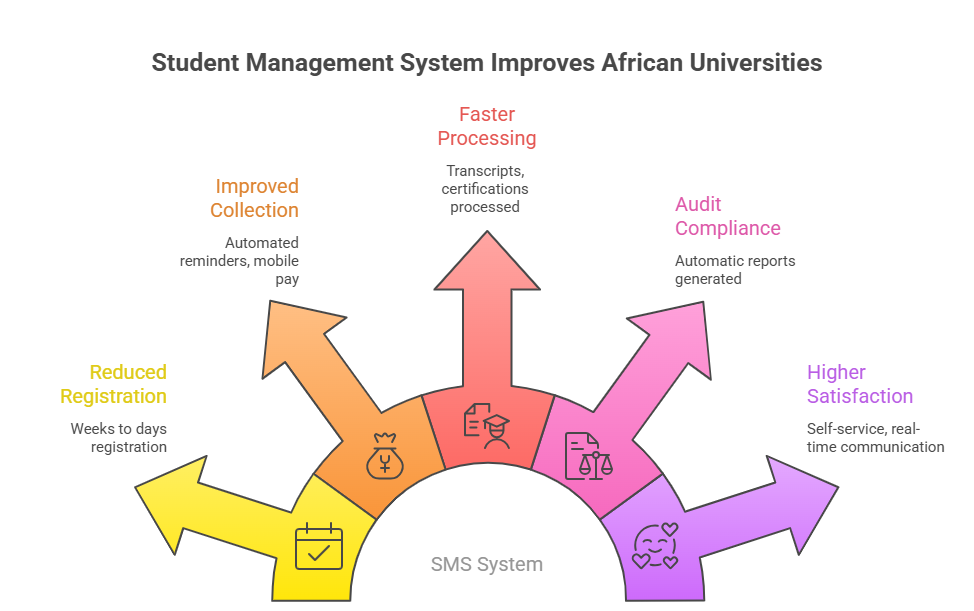
African universities that have implemented a modern Student Management System report outcomes including:

  • Significant reduction in registration cycle times — from weeks to days
  • Improved fee collection rates through automated reminders and mobile payment convenience
  • Faster transcript and certification processing for graduating students
  • Audit-ready compliance reports generated automatically at the close of each academic year
  • Higher student satisfaction scores driven by self-service portals and real-time communication

Digital Transformation Is a Strategic Imperative

For universities and higher education institutions across the African region, digital transformation is no longer optional; it is a prerequisite for institutional credibility, regulatory compliance, and competitive positioning.

A modern Student Management System/Higher Education ERP gives African universities the operational foundation to grow with confidence, serve students better, and meet the demands of tomorrow’s knowledge economy.

The institutions that lead this shift will define African higher education for the next decade.

Ready to modernize your institution? Discover how Academia’s Education ERP is purpose-built for higher education across the African region, with local integrations, regulatory compliance modules, and scalable architecture.

[Book a Demo for Your Institution]

The Reporting Gap and Its Impact on Southeast Asian Institutions

Your Key Questions Answered Here

What Is an Education ERP, and Why Southeast Asia Can’t Afford to Wait Anymore?

An Education ERP is an integrated platform managing every institutional function, admissions, attendance, finance, examinations, and compliance through one unified system. Southeast Asia’s rapidly expanding higher education sector is outgrowing fragmented systems faster than ever, making the shift to a modern Education ERP urgent.

How do I know if my current system is no longer enough?

If your staff spends more time compiling reports than acting on them, or if your leadership cannot access real-time institutional data on demand, your system has already fallen behind.

What should I look for when choosing an Education ERP?

Look for real-time dashboards, automated reporting, seamless data integration, mobile accessibility, and regional compliance readiness. Scalability matters too; your system should grow with your institution rather than restrict it.

Southeast Asia’s Education Boom Has a Data Problem

Something remarkable is happening across Southeast Asia. University enrollment has climbed over 40% in the past decade. Indonesia alone has more than 4,500 higher education institutions. Vietnam, the Philippines, Thailand, Malaysia, and Cambodia are all rapidly expanding their tertiary capacity.

And yet, behind the scenes, many institutions are running on systems that were not built for this moment.

According to a 2023 Asian Development Bank report, over 65% of higher education institutions in developing Southeast Asian economies still rely on fragmented administrative systems, where data lives in disconnected modules, reports are compiled manually in spreadsheets, and leadership makes decisions on information that is weeks out of date.

This is the data problem hiding behind Southeast Asia’s education boom. And it is getting more expensive by the day.

Why Southeast Asia Specifically Demands Smarter Analytics

Every region has its own pressures. Southeast Asia’s problems are particularly acute.

Accreditation bodies like ASEAN University Network Quality Assurance, the Philippine Accrediting Association, and Indonesia’s BAN-PT are raising data submission standards year on year. 

Government ministries are demanding more granular institutional performance data as a condition of licensing and funding. International university partners expect data-driven institutional profiles, enrollment statistics, graduation rates, and financial health indicators. 

And with private universities proliferating across the region, institutions that can identify trends early and demonstrate outcomes with data are winning students and talent.

A modern Education ERP with embedded analytics is not just an operational upgrade in this context. It is a competitive survival tool.

The Hidden Cost of Staying Where You Are

The Hidden Cost of Staying Where You Are - visual selection
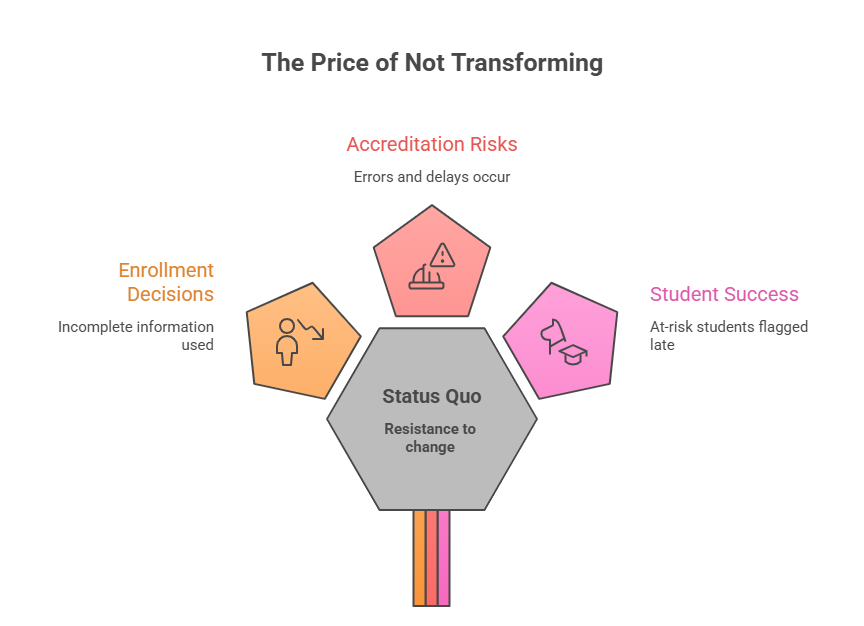
There is a tendency in institutional decision-making to treat the status quo as the safe option. It rarely is.
  • Every semester without real-time analytics is a semester where enrollment decisions are made on incomplete information. 
  • Every accreditation cycle managed through manual reporting is a cycle where errors and delays put your standing at risk. 
  • Every at-risk student your system fails to flag early is a student who might not complete their degree.

A McKinsey study on digital transformation in education found that institutions delaying technology modernization face an average of 23% higher administrative overhead compared to digitally mature peers, a gap that widens every year.

The institutions moving to modern Education ERP platforms right now are not taking a risk. They are eliminating one.

What Reporting Actually Looks Like with Academia

Let us make this concrete. Here is what Academia’s reporting capabilities deliver across your institution’s core functions.

Admissions reporting gives you drill-down dashboards across individual campaigns, applicant profiles, campuses, and programs, so you can evaluate exactly where your admissions pipeline is strong and where it needs attention. Fee collection throughout the application process is also tracked, giving leadership financial insights to optimize admission strategies.

Attendance and performance reporting provide detailed attendance pattern analysis for every student, alongside comprehensive academic performance reports. Low attendance counts and poor performance indicators surface automatically, giving faculty the early warning signals they need to identify at-risk students and intervene before it is too late.

Fee management reporting provides detailed invoice and receipt comparisons, payment mode analysis, and transaction pattern tracking. Outstanding amounts are visible by location, department, or any key parameter. Aging analysis identifies overdue payments before they become a problem, and every report supports granular drill-downs for complete financial visibility.

Examination reporting lets you analyze course-wise pass and fail trends, track student inflow and outflow across intake years, and view student distribution by marks range, giving academic leadership a clear picture of institutional performance across programs.

This is what a modern Education Management System software delivers, not just data storage, but data intelligence that drives real decisions across every department.

The Institutions That Move First Will Define the Standard

Southeast Asia’s education sector is at an inflection point. Institutions that invest in modern Education Management System software in the next two to three years will set the benchmark that everyone else is measured against: stronger accreditation profiles, better student outcomes, faster leadership decisions, and a competitive position that compounds over time.

The window to be among the first movers in your market is still open. But it will not stay open indefinitely.

Ready to See What Modern Analytics Can Do for Your Institution?

Academia by Serosoft is a purpose-built Education ERP designed for the ambitions of modern institutions. With powerful analytics, automated reporting, real-time dashboards across admissions, finance, examinations, and attendance, and a seamless implementation methodology, Academia gives institutions across Southeast Asia the data intelligence they need to lead.

Book a free demo today and see firsthand what modern education management looks like for an institution like yours.

Why Your Institution Can’t Afford to Wait: The Complete Guide to Migrating to a Modern Student Information System

Your Questions Answered

What is a student information system (SIS), and why does it matter? 

A student information system is the centralised digital backbone of any educational institution. It manages everything from admissions, enrollment, and academic records to fees, attendance, timetables, and compliance reporting. A well-built SIS eliminates silos, reduces manual errors, and gives administrators, faculty, and students a unified experience, all in one place.

How do I know if my current SIS system has outgrown my institution’s needs? 

If your staff is still manually exporting data into spreadsheets, if students are complaining about slow portals, if generating a compliance report takes days instead of minutes, or if your IT team dreads every academic year rollover, your system has already outgrown you. 

According to Gartner, over 60% of higher education institutions report that their legacy administrative software is a primary barrier to achieving their digital transformation goals.

Is migrating to a new student information system risky? 

Migration carries risk only when it is unplanned. With a structured migration methodology, a robust platform, and an experienced implementation partner, migration is not just safe; it is transformative. Modern Student Information System platforms like Academia are purpose-built to make migration seamless, with zero disruption to ongoing operations.

The Uncomfortable Truth About Legacy Systems in Education

Let’s be direct: most educational institutions are running on systems that were built for a world that no longer exists.

The average higher education institution in India is still operating on software that was implemented between 8 and 15 years ago. These platforms were designed for smaller student populations, simpler compliance requirements, and a paper-dominant administrative culture. Today, they are collapsing under the weight of real-time demands.

Academia’s Insight:
According to a 2023 EDUCAUSE survey, 74% of higher education technology leaders identified their legacy student information system as a “critical obstacle” to operational efficiency. A further 68% said their current platform could not support hybrid learning workflows, digital fee collection, or real-time accreditation reporting without significant manual workarounds.

The question is no longer whether to migrate. 

The question is how to migrate without disrupting the academic calendar, losing historical data, or overwhelming your staff.

What a Modern Student Information System Actually Looks Like

Before diving into a migration strategy, it is worth establishing what you are migrating toward, because the destination defines the journey.

A modern student information system is not just a database with a better interface. It is an integrated ecosystem that connects every department through a single source of truth. Here is what that looks like in practice.

Unified data architecture — any update made in one module instantly reflects across the entire system, no manual syncing, no duplication.

Real-time analytics and dashboards — leadership gets instant visibility into enrollment, fee collection, student performance, and faculty workload.

Role-based access and workflow automation — every user sees exactly what they need, nothing more and nothing less.

Mobile-first design — attendance, assignments, fee payments, and notifications, all accessible from any device, anywhere.

Compliance-ready reporting — NAAC, NBA, NIRF, and AICTE reports generated in minutes, not weeks.

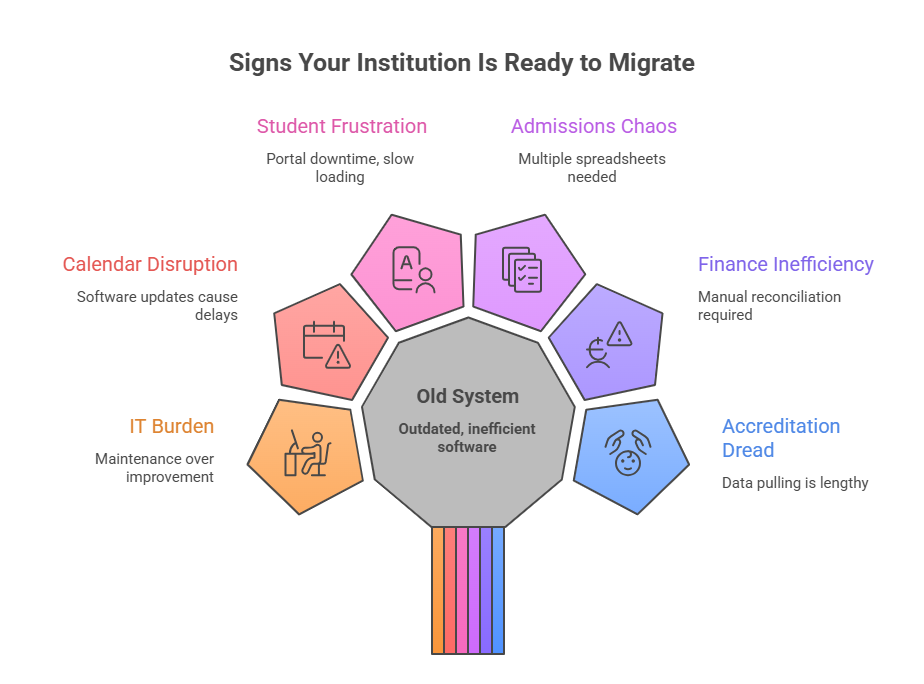
Signs Your Institution Is Ready to Migrate

There is a pattern to how institutions recognize they have reached the migration tipping point.
Check if any of the following situations sound familiar.

The Signs Your Institution Is Ready to Migrate - visual selection

  • Your IT team spends more time maintaining the old system than improving it. 
  • Your academic calendar gets disrupted every time there is a software update. 
  • Students routinely report portal downtime or slow load times. 
  • Your admissions team is managing numerous spreadsheets in addition to your SIS because the system cannot support their workflows. 
  • Your finance office cannot reconcile fee-collection records without manually cross-referencing six or seven separate reports. 
  • And your accreditation committee dreads submission season because pulling the required data is a months-long effort. 

These are not isolated technical complaints. They are symptoms of a system that has fundamentally stopped serving your institution’s mission.

How a Robust Student Information System Ensures a Safe, Seamless Migration

Most migration guides go vague at exactly the point where clarity matters most. A high-quality migration follows a disciplined, phased methodology. Here is what that actually looks like.

Phase 1: Discovery and Data Audit: Before any data moves, the implementation team conducts a thorough audit of your existing system — cataloguing every module, identifying duplicate records, data gaps, and inconsistencies, and establishing exactly what needs to move and in what condition it needs to arrive.

Phase 2: Data Mapping and Transformation Every legacy system has its own quirks — non-standard field names, outdated structures, and custom configurations. Data mapping creates a precise translation layer between your old system and the new one. Without this step being done rigorously, records end up misattributed, orphaned, or simply wrong — and the consequences cascade across every dependent function.

Phase 3: Parallel Operation and Testing: The new system runs alongside your existing one simultaneously for a defined validation period. Staff uses it for real workflows while the legacy system stays live as a fallback. Discrepancies are caught and resolved in a controlled environment before the formal switchover, think of it as a dress rehearsal before opening night.

Phase 4: Controlled Go-Live: Go-live is not a single dramatic moment; it is a gradual, monitored transition running in the background of normal operations. The switchover is staggered by module, rollback procedures are tested in advance, and a hypercare period of 30 to 60 days ensures any live issues are resolved before they impact students or staff.

How Academia’s Student ERP Makes Migration Exceptionally Easy

Academia is not a generic enterprise platform that has been adapted for education. It was designed for the specific operational realities of colleges, universities, and school groups across the globe.

That specificity matters enormously during migration.

When a platform understands that your admissions cycle, your fee structure, your examination scheduling, and your accreditation reporting all have interdependencies that are unique to a higher education institution, it can build migration tools that account for those realities rather than working against them.

Here is what makes Academia’s migration approach different.

Phased implementation for uninterrupted migration. A good student ERP does not migrate your institution all at once. Academia adopts a phased implementation approach, breaking the migration into structured, sequential stages that are completed and validated one at a time. This ensures your day-to-day operations continue without disruption, right through to go-live.

Zero-downtime migration architecture. Academia’s cloud-native infrastructure means that data transfer and system configuration happen in the background. Your students can still log into the old portal, your admissions team can still process applications, and your finance office can still collect fees while Academia is being set up and populated. The transition is invisible to the people who depend on continuous access.

Dedicated migration project managers. Every institution that migrates to Academia is assigned a dedicated project manager who owns the migration timeline, communicates with all stakeholders, manages dependencies, and escalates issues before they become problems. This is not a support ticket queue. It is a named, accountable person who is invested in your success.

Comprehensive staff training woven into the migration timeline. One of the most underestimated risks of any migration is the human one. Staff who do not understand the new system will resist it, work around it, or create the same inefficiencies the migration was supposed to eliminate. Academia integrates role-specific training into the migration timeline so that by go-live day, every department is already comfortable with the workflows they will use every day.

Historical data preservation with full audit trails. No institution can afford to lose decades of student records. Academia’s migration process preserves the complete academic history of every student, including grades, attendance, fee payments, disciplinary records, and examination history, with full audit trails that meet regulatory requirements.

Starting Your Migration: What the First 30 Days Look Like with Academia

The first 30 days with Academia are designed to be straightforward and pressure-free.

Week one begins with a discovery session where Academia’s team takes the time to understand your institution’s structure, current system, and migration goals. Weeks two and three involve a preliminary data audit, resulting in a clear feasibility report covering timelines, resource requirements, and risk mitigation. By week four, a detailed migration roadmap is agreed upon, milestones are set, and your dedicated project manager is in place.

From there, migration proceeds on a transparent, agreed timeline, all the way through go-live and into the hypercare period.

Considering a migration? Speak to Academia’s team for a no-obligation institutional assessment and find out what a move to a modern student ERP would look like for your institution.

Why Middle Eastern Universities Are Rethinking Their Student ERP Strategy in Uncertain Times

Your Key Questions, Answered

Why are universities in the Middle East suddenly prioritizing digital student management systems?

Higher education across the Middle East is expanding rapidly, but operational complexity is growing even faster. Universities today must manage international enrollments, regulatory reporting, hybrid learning models, and rising student expectations, often simultaneously. A modern Student ERP helps institutions unify admissions, academic records, analytics, and communication so leaders can make faster decisions during uncertain conditions.

Is a Student ERP really necessary if we already use multiple campus tools?

Many institutions rely on disconnected tools, spreadsheets for admissions, portals for grades, and separate systems for communication. This fragmentation creates operational blind spots. A unified student information system centralizes the entire student lifecycle, ensuring data accuracy, automation, and real-time visibility across departments.

How does this help universities stay resilient during disruptions?

Periods of geopolitical tension, policy shifts, or sudden enrollment fluctuations can disrupt campus operations. Institutions equipped with a modern Student ERP can quickly adapt, managing enrollments digitally, communicating with students instantly, and maintaining continuity even when physical operations slow down.

The Digital Pressure Facing Middle Eastern Universities

Across the Gulf region, higher education institutions are undergoing a rapid transformation.

Student populations are rising, cross-border education is expanding, and governments are investing heavily in digital infrastructure.

Yet many universities are still managing critical processes through legacy systems.

Academia Insight:

Recent market research shows that over 55% of universities in the Middle East still operate with legacy education management systems, creating major barriers to digital transformation.

At the same time, 44% of institutions in the region are actively investing in modern SIS platforms to streamline student administration and reporting.

This shift isn’t just about technology.

It’s about institutional survival in an increasingly unpredictable world.

Universities today must be able to respond quickly to enrollment fluctuations, remote operations, regulatory changes, and unexpected disruptions.

That requires something many campuses still lack:

A centralized, intelligent Student ERP.

Why Student ERP Has Become a Strategic Priority

Not long ago, administrative systems were considered back-office tools.

Today, they are strategic infrastructure.

A well-designed Student ERP does far more than store records; it connects every stage of the student lifecycle:

  • Admissions
  • Enrollment management
  • Academic planning
  • Attendance and progression tracking
  • Student engagement analytics

The result is a single source of truth across the institution.

According to global research, 68% of universities using modern SIS platforms report improved student retention and graduation rates.

Why?

Because leaders finally gain visibility into what is actually happening across campus.

And when leadership has data, they can act before problems escalate.

Student ERP vs Traditional Campus Systems

Many universities assume they already have adequate infrastructure.

But most campuses still operate with fragmented systems.

Admissions teams maintain one database.
Academic offices maintain another.
IT departments manage integrations between multiple platforms.

The result?

  • Data duplication
  • Delayed reporting
  • Manual administrative work
  • Poor student experience

A unified Student ERP eliminates these silos by centralizing every process into one integrated platform.

Instead of chasing spreadsheets, administrators access real-time insights about enrollment, progression, and performance.

In a region where higher education competition is intensifying, this visibility is becoming essential.

How a Student Information System Strengthens Institutional Resilience

Universities rarely plan for disruption.

But disruption arrives anyway.

Whether it’s global crises, regional instability, policy shifts, or sudden enrollment changes, institutions must adapt quickly.

A modern student information system acts as the operational backbone during such moments.

It ensures that:

  • Student records remain secure and accessible
  • Admissions processes continue digitally
  • Academic communication remains uninterrupted
  • Leadership receives real-time operational insights

When campus operations face uncertainty, institutions equipped with a reliable student information system maintain continuity while others struggle with manual processes.

Why the Middle East Is Accelerating SIS Adoption

The Middle East is quickly emerging as one of the fastest-growing markets for education technology.

Governments across the region are investing heavily in digital education initiatives.

At the same time, international universities are entering the market, raising the competitive bar.

Global vendors are already responding.

Major platforms have expanded their presence in the region, even launching localized Arabic versions of their systems to support universities and schools.

This growing competition is pushing institutions to modernize faster than ever before.

Because today, digital readiness is not optional.

It’s a competitive advantage.

What University Leaders Should Look For in a Student Information System

student information system
Selecting the right student information system is not simply a technology decision.

It is a strategic leadership decision.

University executives should evaluate platforms based on several key capabilities:

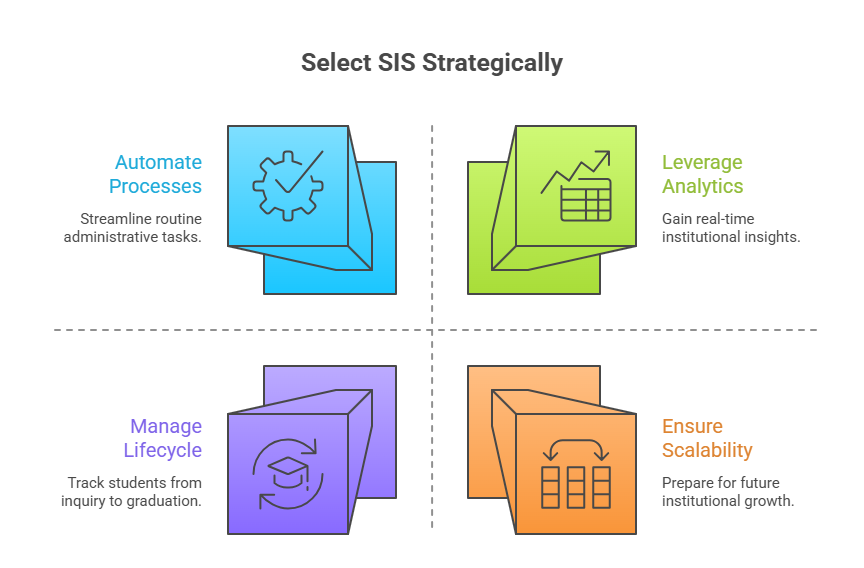
Unified Student Lifecycle Management

The system should manage everything from first inquiry to graduation.

Real-Time Institutional Analytics

Leadership should have dashboards that provide instant insights into student performance, enrollment trends, and operational efficiency.

Automation of Administrative Processes

Routine tasks like enrollment processing, attendance tracking, and reporting should be automated.

Scalability for Future Growth

As universities expand internationally and enroll more students, the system must scale accordingly.

Mobile and AI-Driven Capabilities

Modern platforms increasingly include predictive analytics and AI insights to help institutions identify risks early.

Without these capabilities, institutions risk falling behind.

Moving Forward: The Role of Smarter Campus Technology

As higher education evolves, institutions need technology partners that understand the complexity of modern campuses.

This is where platforms like Academia come into the picture.

Academia is designed specifically for higher education institutions, helping universities digitize admissions, streamline student lifecycle management, and gain real-time insights across campus operations.

Instead of fragmented tools and manual processes, universities gain a single intelligent platform to manage their entire student journey.

If your institution is exploring how to modernize campus operations and build resilience for the future, book a free demo with Academia today and discover how a smarter digital campus can transform your university.

Why Your Institution Can’t Afford to Run Without an Education ERP in 2026

The Data, the Disruption, and the Decision Every University Leader Must Make

Quick Overview: Your Questions Answered

Q1: What is an Education ERP?

An Education ERP (Enterprise Resource Planning) is an integrated software platform built specifically for educational institutions. It connects all operations — admissions, academics, finance, HR, hostel, library, and more- into a single unified system, eliminating data silos and manual processes.

Q2: Who needs an Education ERP?

Any school, college, or university managing 500+ students, multiple departments, or complex administrative workflows can benefit. It’s especially critical for institutions running disconnected legacy systems, experiencing rapid enrollment growth, or preparing for accreditation.

Q3: How is a Higher Education ERP different from a school ERP?

A Higher Education ERP is designed for universities, colleges, and polytechnics with added complexity — multiple campuses, autonomous departments, research management, alumni tracking, regulatory compliance (NAAC, NBA, UGC), and advanced analytics. It goes beyond basic school management into institutional intelligence.

Q4: What does an Education ERP typically cost?

Costs vary widely based on institution size, modules, and deployment model (cloud vs. on-premise). Most institutions find that the ROI from reduced manual work, fewer errors, improved collections, and better compliance far outweighs the investment within 12–24 months.

The Silent Crisis Running Through Your Campus

There’s a problem hiding in plain sight inside most educational institutions today.

It doesn’t appear in the annual report. It doesn’t come up in faculty senate meetings. But it costs institutions hundreds of hours every week, contributes to student frustration, delays critical decisions, and quietly erodes competitive advantage.

The problem is fragmentation.

Admissions run on one system. Finance runs on spreadsheets. The academic office uses a legacy SIS. HR has its own database. The exam cell? A combination of email chains and printed registers.

And somewhere in between all of this, a student is waiting three days for a No Objection Certificate that should take three minutes.

Academia Insight:

According to a 2024 survey by the Education Technology Alliance, over 67% of university administrators report spending more than 30% of their workweek on tasks that could be automated, tasks like data re-entry, report compilation, and manual approvals.

That’s one-third of your team’s time. Every week. Year after year.

This is the institutional cost of not having a unified Education ERP. In 2026, with enrollment competition at an all-time high and accreditation bodies raising the bar, it’s a cost institutions can no longer afford to absorb.

The Numbers Are Talking. Is Leadership Listening?

Let’s ground this conversation in data, because the scale of the opportunity becomes impossible to ignore once you see it.

  • 67% Of university admins say manual tasks consume 30%+ of their week (EdTech Alliance, 2024)
  • $2.4T global education technology market projected by 2030 (HolonIQ, 2024)
  • 41% Of students cite poor administrative experience as a reason for disengagement (Salesforce, 2024)

These aren’t abstract figures. They represent real students who feel let down, real staff members burning out on avoidable work, and real institutional reputations at stake.

Academia Insight

A 2024 McKinsey Education Report found that institutions that adopted integrated ERP solutions saw a 34% improvement in administrative efficiency within the first year of implementation.

Additionally, 58% of higher education CIOs ranked ‘system integration’ as their top technology priority, ahead of AI tools and cybersecurity.

Source: McKinsey Global Education Survey 2024 | EdTech Alliance Annual Report 2024

The message is clear: the institutions investing in unified systems are pulling ahead, and the gap is widening every academic year.

What Exactly Is an Education ERP, And What It Isn’t

Let’s clear up a common misconception first.

An Education ERP is not just a student management system. It’s not a fee collection app or a digital attendance register dressed up in a fancy interface.

A true Education ERP is an institution-wide operating system, one that integrates every functional area of your institution into a single, interconnected platform with real-time data flow, automated workflows, and role-based access for every stakeholder.

Core Modules of a Modern Education ERP

Here’s what a robust Education ERP architecture looks like:

Higher Education ERPThe Student Experience Crisis You Might Not Know You Have

Here’s something that doesn’t appear on any administrative dashboard in most institutions: student frustration with admin processes.

And it’s costing institutions more than they realize.

Academia Insight

Salesforce’s 2024 Connected Student Report surveyed 3,100 students across 14 countries.

41% said poor administrative processes negatively affected their overall satisfaction with their institution.

29% said they would consider transferring to another institution that offered better digital services.

Only 34% of students said they could complete common admin tasks (enrollment changes, fee queries, certificate requests) without visiting a physical office. 

Think about that. Nearly one in three of your students is at risk of leaving, not because of academics, not because of faculty quality, but because the administrative experience is broken.

In an era of rising competition, word-of-mouth matters enormously. The student who waits in line for 45 minutes to get a transcript issues a signed document, they’ll tell their story on social media, on college rating platforms, and to every junior in their network considering where to apply.

A well-implemented Education ERP flips this entirely. Students can view their grades, pay fees, request documents, check exam schedules, and communicate with advisors, all from a single mobile-friendly portal, at 2 AM if they want to. 

That’s not a luxury feature. In 2025, that’s the baseline expectation.

Accreditation Readiness: The Hidden ROI of a Higher Education ERP

Ask any Registrar who has gone through an accreditation review cycle how they felt in the months leading up to the visit. The answer is almost always the same: overwhelmed, understaffed, and swimming in data that wasn’t ready to present.

Accreditation has become one of the most demanding institutional exercises, and it’s getting more complex with every cycle. Modern accreditation frameworks now require more granular data, stronger evidence of learning outcomes, and deeper visibility into institutional governance and performance.

What an Education ERP Does for Accreditation

→ Maintains continuous, audit-ready data across all accreditation parameters

→ Auto-generates NAAC, NBA, IQAC, and UGC reports at the click of a button

→ Tracks Outcome-Based Education (OBE) metrics in real time

→ Logs all governance activities, meeting minutes, and compliance actions

→ Provides a clean digital trail for every administrative decision

→ Reduces accreditation data preparation time by an estimated 60–70%

From Gut Feel to Data-Driven: How an Education ERP Changes Leadership

One of the most underappreciated benefits of an Education ERP is what it does for institutional leadership, not just administration.

Most university leaders today make strategic decisions with a significant data lag. By the time enrollment data is compiled, formatted, and presented, it may be six to eight weeks old. By the time fee collection trends are analyzed, the window for intervention has passed. By the time faculty performance data is compiled, it’s time for the next appraisal cycle.

This isn’t a people problem. It’s a systems problem.

The Intelligence Layer of a Modern Education ERP

Leading ERP platforms now include embedded analytics and AI-powered dashboards that give institutional leaders a real-time view of:

  •       Enrollment trends and conversion rates across programs and geographies
  •       Fee collection efficiency, outstanding receivables, and payment behaviour patterns
  •       Faculty workload distribution, teaching hours, and performance metrics
  •       Student academic health indicators, early warning systems for at-risk students
  •       Campus resource utilization, classrooms, labs, hostels, and infrastructure
  •       Comparative benchmarks against peer institutions and national averages

This transforms leadership from reactive to proactive. Instead of finding out that first-year dropout rates have increased after the academic year ends, you identify at-risk students in week three of the semester and intervene. 

That’s not just better management, it’s better education.

Conclusion: The Decision That Defines the Next Decade

Let’s be honest about where we are.

The institutions that will thrive in the next decade of higher education are not necessarily the ones with the biggest campuses or the most famous alumni. They’re the ones that make smart, decisive infrastructure investments today, investments that compound in value over the years as data accumulates, processes improve, and institutional intelligence grows.

An Education ERP like Academia is purpose-built for higher education institutions, with deep compliance support and a mobile-first student experience. 

From admissions to alumni, from fee management to accreditation reporting, Academia brings your entire institution onto one intelligent platform — without the chaos of a big-bang implementation.

Book a Free Demo Today, See exactly how Academia can transform your institution’s operations in under 60 minutes. No commitment. No generic pitch. Just a live walkthrough of your actual use cases.

Higher Education ERP: What It Takes to Lead the Modern University

Higher education is undergoing one of the most significant transformations in its history. Universities today are expected to deliver world-class learning experiences, digital services, regulatory compliance, and operational efficiency simultaneously.

Yet many institutions still rely on fragmented systems, spreadsheets, and manual processes to run complex academic operations.

This is where a Higher Education ERP becomes a strategic foundation rather than just another technology tool.

Across the world, institutions are adopting integrated digital platforms to manage the entire academic lifecycle, from admissions and student records to examinations, analytics, and institutional reporting. 

In fact, more than 80% of universities globally are investing in digital infrastructure, with ERP systems playing a central role in that transformation.

What Universities Must Manage Today

Universities today are far more complex organizations than they were a decade ago.

Universities must manage:

  • Increasing student enrollment 
  • Multi-campus and international operations 
  • Accreditation and regulatory compliance 
  • Hybrid and online learning models 
  • Massive volumes of institutional data

Without a centralized system, these processes often become disconnected across departments.

Admissions teams operate on one platform. Academic departments maintain separate databases. Examination offices maintain their own records. Finance and administration rely on another set of tools.

The result?

Data silos, delays, reporting challenges, and operational inefficiencies.

A modern Education Management System solves this problem by connecting the entire institution through a unified digital platform.

Why Higher Education ERP Is Becoming a Strategic Priority

The adoption of Higher Education ERP systems is accelerating globally because universities recognize the need for institution-wide digital governance.

Recent industry reports highlight several important trends:

  • 68% of new ERP implementations are now cloud-based. 
  • Institutions adopting ERP systems have reported 35% improvement in administrative efficiency. 
  • Many universities now deploy ERP analytics to monitor 20+ academic and behavioral variables for student success. 

These platforms allow universities to move beyond operational firefighting and toward strategic institutional leadership.

Instead of reacting to problems, leadership teams can anticipate trends, optimize resources, and improve student outcomes.

How a Modern Education Management System Transforms University Operations

A well-designed Education Management System integrates every academic and administrative function into a single digital ecosystem.

Rather than managing multiple disconnected tools, universities gain a single source of truth for institutional data.

Here’s how it transforms core university operations.

1. Streamlined Admissions and Enrollment

Admissions management is often one of the most complex processes within a university.

Manual workflows can slow down application processing, cause documentation errors, and reduce transparency for applicants.

With a Higher Education ERP, institutions can digitize the entire admission process:

  • Online applications and document submission 
  • Automated application tracking 
  • Merit-based selection workflows 
  • Admission analytics and enrollment forecasting 

This not only speeds up the process but also improves the applicant experience, which is increasingly important in competitive higher education markets.

2. Centralized Student Lifecycle Management

From the moment a student applies to the day they graduate, universities generate enormous amounts of data.

A modern Education Management System manages the entire student lifecycle:

  • Academic records 
  • Attendance tracking 
  • Course registration 
  • Examination management 
  • Transcript generation 

Centralized data management ensures accuracy, transparency, and faster decision-making across departments.

Institutions that centralize student data through ERP platforms often experience significant improvements in operational efficiency and reporting accuracy.

3. Data-Driven Institutional Leadership

University leadership today requires data-backed decision-making.

Without real-time insights, strategic planning becomes guesswork.

A Higher Education ERP provides institutional dashboards that track:

  • Enrollment trends 
  • Academic performance 
  • Student retention risks 
  • Resource utilization 
  • Program demand 

According to research, institutions using advanced analytics within ERP systems report improved decision-making in enrollment strategy and resource planning.

This enables leadership teams to make faster, more informed decisions that directly impact institutional growth.

4. Improved Student Experience in the Digital Era

Modern students expect the same digital convenience from universities that they receive from banks, airlines, or online services.

A connected Education Management System empowers students with self-service capabilities such as:

  • Viewing academic records and grades 
  • Tracking attendance 
  • Accessing timetables & assignments 
  • Applying for certificates 
  • Checking examination results 

Self-service portals improve transparency and reduce administrative dependency for students and faculty alike.

Ultimately, a smoother digital experience contributes to higher student satisfaction and engagement.

5. Stronger Data Security and Compliance

Universities handle highly sensitive data, including student records, research information, and financial data.

Legacy systems often expose institutions to security risks.

Modern Higher Education ERP platforms incorporate:

  • Role-based access control 
  • Data encryption 
  • Multi-factor authentication 
  • Audit trails for compliance 

Cloud-based ERP systems also report 36% fewer critical security incidents compared with legacy infrastructure.

For universities operating under strict regulatory frameworks, this level of security is essential.

Why Regional Universities Must Think Differently About ERP

Universities in emerging education markets, including Africa, Southeast Asia, and the Middle East, face unique challenges.

These include:

  • Handling rapid enrollment growth 
  • Generating real-time, insightful reports & analytics 
  • Adhering to compliance & accreditation requirements 
  • Managing multi-campus academic structures 

For example, ERP adoption across the Middle East and Africa education sector is growing steadily, driven by national digital transformation initiatives and smart campus programs.

Institutions in these regions are increasingly investing in centralized Education Management Systems to support large student populations, regulatory reporting, and digital student services.

In these environments, ERP systems are not just operational tools; they are essential for institutional scalability and credibility.

Choosing the Right Higher Education ERP for Your Institution

Selecting the right Higher Education ERP requires careful evaluation.

University leaders should consider several factors:

1. Academic Lifecycle Coverage

The system should manage the full student journey, from admissions to graduation.

2. Cloud Architecture

Cloud-native platforms offer scalability and lower infrastructure costs.

3. Integration Capability

The ERP should integrate easily with third-party platforms, including LMS and financial tools. 

4. Data Analytics and Reporting

Advanced dashboards help leadership teams make strategic decisions.

5. Regional Compliance Support

Universities must ensure the system supports local accreditation and reporting requirements.

Ultimately, the right ERP should serve as the complete digital infrastructure that higher ed institutions can rely on.

Moving Toward a Smarter Digital Campus

For universities looking to modernize their operations, the journey typically begins with a robust Higher Education ERP platform.

Solutions like Academia are designed specifically for universities and higher education institutions, helping them manage admissions, academic operations, student records, and institutional analytics within a single ecosystem.

Instead of managing disconnected tools, institutions gain a unified platform that simplifies operations while empowering leadership with real-time insights.

If your institution is exploring how a modern Education Management System can transform campus operations, book a free demo with Academia today and see how a connected digital campus can drive efficiency, transparency, and student success.

Why a Modern University Management System Is Becoming the Core of Future-Ready Campuses

Key Answers About the Modern University Management System

A University Management System is a centralized digital platform that manages academic and administrative operations across the entire institution. It integrates processes such as admissions, enrolment, student records, attendance, examinations, reporting, and institutional analytics into a single unified system.

Why are universities adopting it now?
Rising student enrolments, expanding digital learning ecosystems, and growing regulatory demands require institutions to efficiently manage massive volumes of data. 

Modern University Solutions helps institutions automate workflows, centralize institutional data, and provide leadership with real-time insights for decision-making.

What problems does a University Management System solve?

Institutions typically implement modern systems to address challenges such as:

  • Fragmented academic and administrative systems 
  • Manual processes slowing institutional operations 
  • Limited data visibility across departments 
  • Difficulty scaling as student numbers grow 
  • Increasing compliance and reporting requirements 

For many universities, adopting integrated University Solutions is not just about technology modernization; it is about building a sustainable digital foundation for institutional growth.

The Growing Complexity of Higher Education Operations

Universities across the world are facing unprecedented operational pressure.

Student expectations are evolving rapidly. Digital learning environments are expanding. Governments and accreditation bodies are demanding higher levels of transparency and compliance.

At the same time, institutional leadership must make faster, data-driven decisions.

Academia Insight:

According to Educause research, nearly 74% of higher education leaders say improving institutional data capabilities is now a strategic priority.

However, many institutions still rely on fragmented legacy systems or homegrown software that were never designed to support modern campus ecosystems.

CIOs’ most common statement from Southeast Asian universities clearly reveals that:

“The internal systems work till when we manage one campus and fewer students. Once we expand, data fragmentation becomes the biggest operational challenge.”

If you’re a CIO, does this sound familiar to you? 

In such environments, a modern University Management System becomes critical for maintaining operational efficiency.

Why Universities Are Moving Toward Integrated University Solutions

For years, institutions have relied on a patchwork of independent systems to manage different campus functions.

Admissions systems, academic records databases, examination tools, and reporting platforms often operate independently.

While this approach evolves gradually, it eventually creates significant operational friction.

Modern University Solutions aims to eliminate this fragmentation by integrating all critical academic processes into a single institutional platform.

These solutions typically enable universities to:

  • Manage the complete student lifecycle from admissions to graduation 
  • Centralize institutional data for real-time decision-making 
  • Automate administrative workflows 
  • Integrate with learning management systems and digital platforms 
  • Improve reporting accuracy for compliance and accreditation 

The result is not just improved efficiency.

It is greater institutional agility.

The Hidden Risks of Operating Without a Modern University Management System

Many universities underestimate the long-term impact of outdated or disconnected systems.

While legacy platforms may still function operationally, they often introduce hidden institutional risks.

Data Silos Across Departments

Different departments may maintain separate databases, leading to inconsistencies in student information.

Without a centralized University Management System, maintaining a single source of truth becomes extremely difficult.

Compliance and Reporting Challenges

Accreditation bodies increasingly require accurate institutional reporting and standardized data formats.

Manual reporting processes increase the risk of errors and delays.

Limited Institutional Insight

Leadership teams often struggle to answer strategic questions such as:

  • Which programs are experiencing declining enrolment? 
  • Which students are at academic risk? 
  • Which departments require operational support? 

Modern University Solutions address these issues by creating real-time institutional visibility.

What Defines a Modern University Management System Architecture

The next generation of campus technology is built around flexible and scalable digital architecture.

Instead of rigid legacy systems, modern University Solutions are designed with modular components that integrate seamlessly across campus ecosystems.

University Management SolutionsCore Components of a Modern University Management System


Student Lifecycle Management

  • Admissions and enrolment processes 
  • Student academic records 
  • Attendance and course participation tracking 
  • Graduation and certification management 

Academic Operations

  • Course scheduling and timetable management 
  • Faculty workload planning 
  • Examination workflows and grading systems 

Institutional Intelligence

  • Real-time dashboards for leadership teams 
  • Student performance tracking 
  • Institutional performance indicators 

Integration Layer

Modern University Solutions also integrates with external systems such as:

  • Learning Management Systems (LMS) 
  • Digital payment platforms 
  • national education databases 
  • accreditation reporting frameworks 

This architecture ensures that universities can operate as connected digital ecosystems rather than isolated departments.

Survey Insights: Where Universities Are Struggling Today

Across multiple regions, institutional surveys highlight common operational challenges faced by universities.

Key areas of concern include:

  • Difficulty scaling systems as enrolment grows 
  • Limited integrations with external platforms 
  • fragmented student data across departments 
  • complex reporting requirements for regulators 

These challenges are pushing institutions to rethink their technology infrastructure and adopt more integrated University Solutions.

The Rise of Data-Driven Universities

Modern universities are increasingly relying on data to guide academic strategy and operational planning.

Leadership teams are asking new questions:

  • Which student groups require additional academic support? 
  • Which programs demonstrate strong completion rates? 
  • Where should institutional investments be prioritized? 

According to McKinsey education insights, universities that successfully adopt data-driven strategies can improve student success outcomes by up to 20%.

However, such insights are only possible when institutions operate on centralized data platforms supported by a modern University Management System.

Without an integrated data architecture, institutional analytics remain fragmented and unreliable.

Why the Next Generation of University Solutions Will Be AI-Ready

Artificial intelligence is beginning to transform higher education operations.

Institutions are experimenting with:

  • automated admissions workflows 
  • early student success indicators 
  • predictive academic performance analysis 
  • intelligent reporting systems 

But AI capabilities depend heavily on structured and centralized data.

A fragmented system environment makes advanced analytics nearly impossible.

A well-designed University Management System provides the structured data infrastructure necessary for AI-driven insights.

In other words, AI in higher education begins with integrated University Solutions.

Building the Digital Foundation for Tomorrow’s Universities

Higher education institutions are entering a new era where data, digital infrastructure, and institutional strategy are deeply interconnected.

At the center of this transformation lies the University Management System, a platform that connects students, faculty, administrators, and institutional leadership through unified data and streamlined workflows.

Platforms like Academia, trusted by institutions across multiple countries, are designed to help universities centralize operations, strengthen data visibility, and modernize the entire student lifecycle.

If your institution is exploring ways to modernize its campus operations and build a future-ready digital ecosystem, you can schedule a free demonstration of Academia today to see how a modern University Management System can transform institutional efficiency and decision-making.
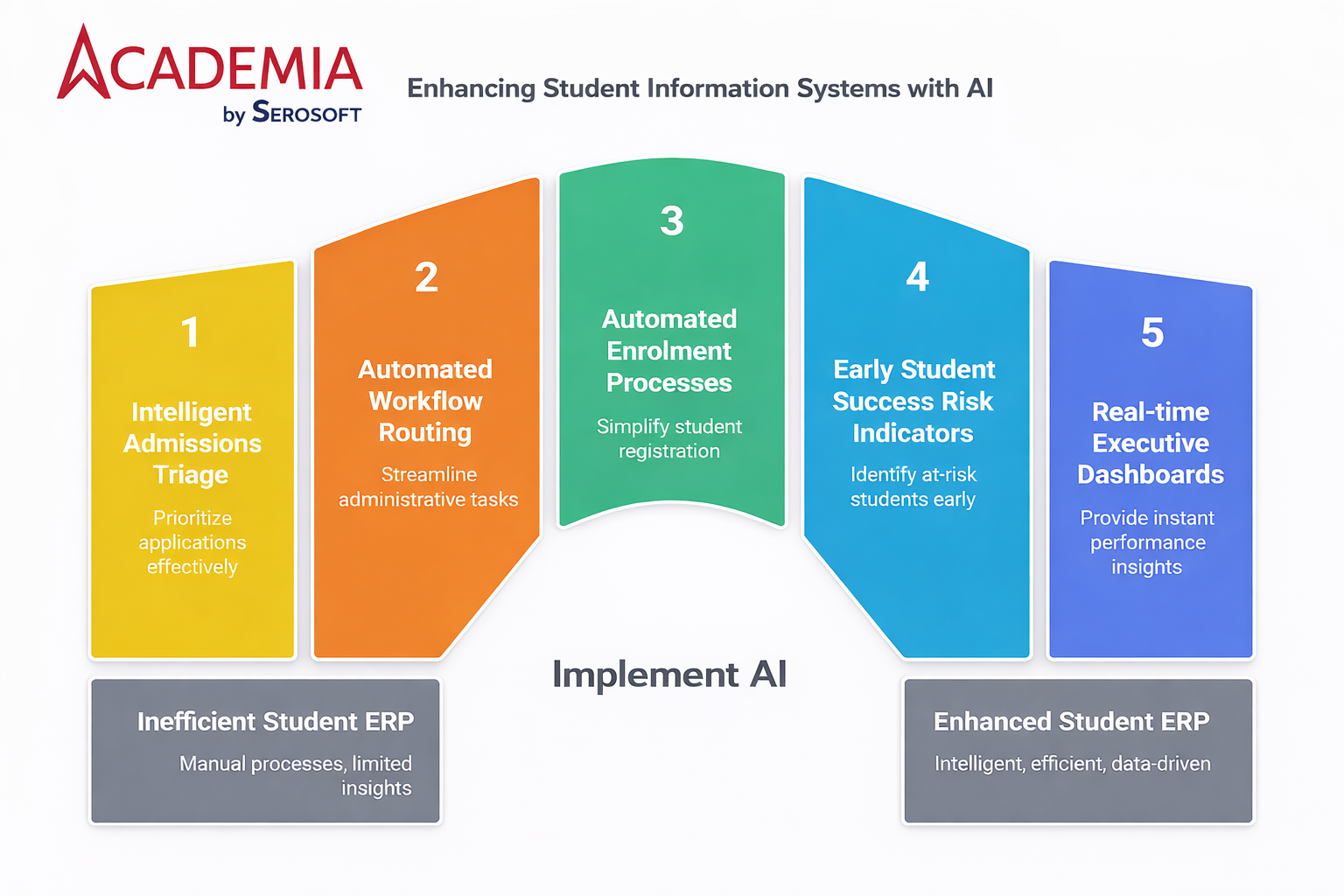
Higher Education ERP and the Future of the Attendance Management System: From Compliance to Student Success

Overview

Why are universities around the world rethinking how they track attendance? Why is attendance suddenly becoming a strategic metric rather than just an administrative task? And why are more institutions shifting from manual registers to a Higher Education ERP-powered Attendance Management System? 

The answer lies in a simple reality: attendance data is no longer just about marking presence; it has become a critical indicator of student engagement, retention risk, and institutional performance.

In many universities today, attendance is still recorded manually or through fragmented systems. Faculty spend hours compiling spreadsheets, administrators struggle with delayed reports, and leadership lacks real-time visibility into student participation trends. These inefficiencies create compliance risks, reduce academic oversight, and delay interventions for students who may already be falling behind.

A modern Higher Education ERP solves this challenge by integrating an intelligent Attendance Management System directly into the academic ecosystem. 

Why Attendance Data Has Become a Strategic Necessity in Higher Education

For decades, attendance tracking was viewed as an operational necessity. Today, it has become a predictive indicator of student success and institutional health.

Academia Insights:

A 2023 EDUCAUSE Student Success Survey found that institutions using integrated student data systems saw 27% faster identification of at-risk students compared to institutions relying on manual tracking.

Similarly, a report by Times Higher Education Insights revealed:

  • 63% of universities struggle to generate real-time attendance analytics
  • 58% of faculty still rely on manual or spreadsheet-based attendance records
  • Institutions with automated attendance systems report 30–40% faster academic interventions

“Attendance is the earliest signal that something is wrong. When students stop showing up, performance usually declines shortly after. Without real-time visibility, universities lose valuable intervention time.”

This is why institutions are increasingly embedding attendance intelligence within their Higher Education ERP ecosystems.

The Evolution of the Attendance Management System in Modern Universities

Traditional attendance tracking was designed for compliance. Modern universities need systems designed for student engagement, data intelligence, and operational efficiency.

A modern Attendance Management System inside a Higher Education ERP typically supports multiple capture methods:

  • Mobile faculty attendance marking
  • RFID or biometric classroom access
  • QR code check-ins
  • Learning Management System integrations
  • Hybrid class attendance tracking

But the real transformation lies in what happens after attendance is recorded.

Instead of static records, attendance data now feeds into:

  • Student engagement dashboards
  • Early warning systems
  • Faculty performance analytics
  • Accreditation compliance reporting

This shift turns attendance into a strategic institutional dataset.

How a Higher Education ERP Transforms Attendance Intelligence

When attendance operates inside a Higher Education ERP, it becomes part of a connected digital ecosystem.

Below is a simplified architecture of how modern attendance intelligence works within an ERP environment.

Instead of manual reporting cycles, institutions gain continuous visibility.

This enables leadership teams to answer questions like:

  • Which programs have declining class participation?
  • Which students are showing early disengagement signals?
  • Which courses experience the highest absenteeism?

These insights are nearly impossible without an integrated Higher Education ERP.

The Administrative Cost of Manual Attendance Systems

Universities often underestimate the operational cost of outdated attendance tracking systems.

A survey conducted by University Business Magazine found that faculty members spend an average of 4–6 hours per week managing attendance records and related reporting.

For large universities, this results in:

  • Hundreds of administrative hours are lost every semester
  • Delayed academic reporting cycles
  • Higher chances of data errors
  • Limited institutional visibility

To summarize the situation of most of the universities bluntly:

“They have attendance data everywhere, Excel sheets, paper registers, departmental logs. But no single source of truth.”

A centralized Attendance Management System within a Higher Education ERP eliminates these fragmentation issues.

Attendance as an Early Warning System for Student Success

Forward-thinking institutions now treat attendance as an early student success indicator.

Research from the National Student Clearinghouse suggests that consistent class attendance strongly correlates with course completion and retention rates.

Universities using advanced Attendance Management Systems now monitor patterns such as:

  • Consecutive class absences
  • Declining participation trends
  • Attendance drops after mid-semester
  • Course-specific absentee spikes

When this data is captured through a Higher Education ERP, automated alerts can notify:

  • Faculty members
  • Academic advisors
  • Student success teams

This enables timely academic intervention, which significantly improves retention outcomes.

What University Leaders Expect from a Modern Attendance Management System

Today’s university leadership teams expect more than simple attendance tracking.

CIOs, registrars, and academic leadership now prioritize the following capabilities:

Real-Time Attendance Analytics

Leadership dashboards showing participation trends across departments and programs.

Automated Compliance Reporting

Instant generation of reports required for accreditation bodies and regulatory agencies.

Faculty-Friendly Interfaces

Mobile or web-based tools that allow faculty to mark attendance in seconds.

Student Engagement Insights

Integrated analytics linking attendance patterns with academic performance.

ERP-Level Integration

Attendance is connected with admissions, course scheduling, and student lifecycle management within the Higher Education ERP.

Without these capabilities, attendance remains an operational burden rather than a strategic asset.

Experience The Future: AI-Driven Attendance Intelligence

The next evolution of the Attendance Management System will be powered by AI and predictive analytics.

Emerging capabilities include:

  • AI-driven attendance anomaly detection
  • Predictive engagement modelling
  • Automated risk scoring for students
  • Behavioral pattern analysis

These innovations will transform attendance tracking from record keeping to strategic foresight.

“The future of attendance isn’t about counting who is present. It’s about understanding why students disengage before they disappear.”

This is where a robust Higher Education ERP becomes the backbone of digital campus intelligence.

Final Thoughts: Attendance Is No Longer Administrative, It’s Strategic

Universities that still treat attendance as a routine administrative task risk missing one of the earliest indicators of student success and institutional performance.

An integrated Higher Education ERP like Academia, with a modern Attendance Management System, enables institutions to automate attendance tracking, improve accuracy, and gain real-time visibility into student participation.

The institutions that recognize this shift today will be the ones that build smarter, more responsive, and more student-centric universities tomorrow.

Student Info System for Southeast Asia: Turning Institutional Data into Leadership Decisions

Are Your Reports Helping You Lead, or Just Helping You Review the Past?

If you’re a university leader in Southeast Asia, you’ve likely asked yourself:

  • Why do our reports arrive late and still lack clarity? 
  • Why do different departments show different numbers for the same metric? 
  • Why does decision-making feel reactive instead of strategic? 
  • Why are we investing in digital systems but still relying on spreadsheets for board meetings? 

The answer often lies in the absence of a unified Student Info System.

A modern student info system/student management system does more than store student records. It becomes the intelligence layer of your institution — transforming admissions, academics, examinations, attendance, and engagement data into leadership-ready insights.

In a region where regulatory scrutiny, cross-border mobility, and private-public competition are intensifying, Southeast Asian universities cannot afford fragmented data ecosystems. Leadership today demands clarity. And clarity demands architecture.

The Southeast Asia Imperative

According to regional higher education outlook reports, Southeast Asia is expected to see continuous enrolment expansion driven by:

  • Growing middle-class demographics 
  • Government investment in internationalization 
  • Rapid private university growth 
  • Increased cross-border partnerships 

A 2024 ASEAN Higher Education Digital Readiness survey revealed:

  • 61% of institutions still rely on partially manual reporting processes 
  • 47% report data discrepancies between departments 
  • 52% of leadership teams lack real-time academic performance dashboards 

This creates a dangerous gap: operational data exists, but strategic insight does not.

As one Malaysian university registrar noted:

“We don’t suffer from lack of data. We suffer from lack of consolidated, decision-ready data.”

That distinction defines the role of a next-generation Student Info System.

From Data Collection to Decision Intelligence

Traditional systems function as record-keeping tools. Modern systems must function as intelligence engines.

A robust student management system in 2026 must enable:

  • Real-time enrolment tracking 
  • Department-level performance benchmarking 
  • Early at-risk student identification 
  • Regulatory compliance reporting 
  • Outcome-based performance dashboards 

But how is this achieved technically? It begins with architecture.

The Architecture of a Modern Student Info System

A leadership-ready digital ecosystem typically follows a centralized architecture model:

Student info system

This architecture ensures:

  • A single source of truth 
  • Cross-departmental visibility 
  • Clean, structured, analytics-ready data 
  • Scalable cloud infrastructure 

When admissions data connects seamlessly with academic progression and exam outcomes, institutional patterns become visible. Without this integration, leadership sees isolated snapshots instead of systemic trends.

This is where technical credibility matters.

A properly designed Student Info System must support:

  • API-enabled integrations 
  • Secure cloud hosting 
  • Role-based access control 
  • Department-specific reporting layers 
  • AI-driven data modeling 

Without structural integrity, dashboards become decorative rather than strategic.

Why Reports Drive Leadership in Southeast Asia

In Southeast Asia, university boards and education ministries increasingly demand measurable outcomes.

Leadership today is judged on:

  • Graduation rates 
  • Student retention 
  • Employability outcomes 
  • Revenue optimization 
  • Accreditation compliance 

An Indonesian Vice Chancellor recently shared in a regional roundtable:

“Our board does not want operational summaries. They want predictive indicators.”

This shift marks a turning point.

A powerful student management system must therefore move beyond static reports and offer:

  • Trend comparisons across semesters 
  • Forecast modelling for enrolment 
  • Cohort performance analysis 
  • Department productivity insights 

Because leadership decisions today are not about reviewing what happened, they are about preparing for what’s next.

Survey Insight: What Leaders Actually Want

In a 2025 regional leadership survey across Singapore, Malaysia, Thailand, and Vietnam:

  • 68% of respondents prioritized real-time executive dashboards 
  • 72% demanded department-wise reporting transparency 
  • 64% wanted automated compliance-ready reports 
  • 59% sought AI-based performance indicators 

This indicates one clear trend:

Institutions are no longer asking for “software.”
They are asking for a decision architecture.

A well-structured Student Info System becomes the backbone of that architecture.

The Reporting Gap in Traditional Systems

Many institutions believe they already have reporting capabilities.

However, common limitations include:

  • Reports are generated only at the month-end 
  • Heavy IT dependency for custom reports 
  • Limited visualization formats 
  • Disconnected departmental exports 
  • Manual consolidation for board meetings 

This leads to leadership fatigue, where critical decisions are delayed because reports are incomplete or unreliable.

A forward-looking student management system must eliminate these friction points.

AI-Driven Reporting: The New Standard

The next wave of institutional systems is defined by AI-enhanced reporting layers.

AI-driven reporting enables:

  • Automated anomaly detection 
  • Student risk identification through performance tracking 
  • Pattern recognition across cohorts 
  • Instant multi-department summaries 
  • Executive-ready visual dashboards 

This reduces reporting time from days to minutes.

800+ Built-In Reports: What Leadership Actually Needs

A modern Student Info System, like Academia, empowers institutions to generate functional, insight-driven reports instantly, all with a single click.  

Academia provides:

  • 800+ in-built reports across departments 
  • Admissions analytics reports 
  • Academic progression summaries 
  • Examination performance matrices 
  • Attendance intelligence dashboards 
  • Accreditation-ready compliance formats 
  • Executive summary dashboards 

Each department gains granular clarity.
Leadership gains macro-level intelligence.

The result?

  • Faster board-level decision cycles 
  • Reduced data ambiguity 
  • Clear KPI tracking 
  • Evidence-based policy formation 

Instead of requesting data from five departments, leadership accesses unified dashboards — securely and instantly.

Future-Ready Institutions Think Differently

The institutions leading Southeast Asia’s transformation share three characteristics:

  • Unified digital ecosystems
  • Centralized data governance
  • AI-backed decision intelligence

A modern student management system is no longer an IT purchase.
It is a governance decision.

It determines whether your university operates in silos or as an intelligent, connected institution.

Make The Move Today: From Reporting Burden to Strategic Advantage

Southeast Asia’s higher education landscape is evolving rapidly. Competition is rising. Regulatory frameworks are tightening. International collaboration is expanding.

In this environment, leadership cannot afford fragmented reporting systems.

Having said that, adopting a powerful Student Info System like Academia has become a necessity for institutions. 

Because institutions that lead tomorrow will be those that see clearly today.

If you would like to explore how interactive dashboards and AI-driven reports can transform leadership decision-making at your institution, book a free live demo and experience how insights are generated in a single click with Academia.

Campus Management System in the Middle East: Meeting Digital Transformation Pressure with a Future-Ready Education ERP

What Is a Campus Management System and Why Is It Critical Today?

A Campus Management System is an integrated platform that manages the complete student lifecycle, from admissions and enrollment to academics, attendance, examinations, communication, and reporting, within a single digital environment. 

Institutions ask whether they truly need one, whether spreadsheets and legacy tools are enough, and how it connects with broader transformation goals. The answer lies in operational complexity: as student numbers grow, compliance requirements increase, and accreditation standards become stricter, disconnected systems create inefficiencies, data silos, and reporting delays. 

A modern Campus Management System, a.k.a Education ERP, serves as the backbone of institutional digital infrastructure, ensuring real-time data visibility, process automation, and leadership-level decision intelligence. 

In regions like the Middle East, where national visions emphasize digital governance and smart campuses, adopting a robust Campus Management System is no longer optional, it is a strategic necessity for institutional competitiveness, regulatory readiness, and student satisfaction.

The Middle East Context: Why the Pressure Is Increasing

Across the Gulf and wider Middle East, higher education institutions are facing three simultaneous pressures:

  • National transformation agendas
  • Rising student expectations
  • Accreditation-ready, accurate, and real-time data

Academia Insights:

According to global higher education digital transformation surveys, over 70% of institutions report that fragmented systems limit operational efficiency. 

Additionally, industry research consistently shows that universities using integrated Education ERP platforms reduce administrative processing time by 30–50% compared to manual workflows.

For leadership teams, the question is no longer “Should we digitize?” but rather “How do we build a sustainable digital infrastructure?”

Challenges Faced Without a Campus Management System

1. Data Silos and Inconsistent Reporting

When admissions, academics, finance, and exams operate on separate tools, leadership struggles with a single source of truth. Reports take days to compile, and decision-making slows.

2. Manual Workload on Administrative Teams

Registrars and administrators spend significant time reconciling spreadsheets instead of focusing on strategic planning.

3. Compliance and Accreditation Risk

Accreditation bodies increasingly require transparent audit trails. Without a centralized Campus Management System, institutions risk delays and inconsistencies.

4. Student Experience Gaps

Today’s students expect digital self-service portals, instant notifications, and mobile-first engagement. Legacy systems cannot deliver this consistently.

A regional survey conducted among higher education administrators in emerging markets revealed that process inefficiency and lack of integration were cited as top operational concerns by more than half of respondents.

Why an Integrated Education ERP Is the Strategic Solution

A modern Education ERP goes beyond digitization. It creates institutional architecture.

Instead of isolated tools, it builds a connected ecosystem:

  • Unified database
  • Automated workflows
  • Role-based dashboards
  • Real-time analytics
  • Secure cloud infrastructure

When implemented as a comprehensive Campus Management System, it transforms governance, not just operations.

Architecture of a Modern Campus Management System

Below is a simplified digital architecture model:

Campus Managememt System
This architecture ensures:
  • Single data source
  • Cross-department synchronization
  • Instant reporting
  • Scalable infrastructure

A properly implemented Education ERP becomes the institutional nervous system.

Research Insights: What the Market Is Showing

  • Institutions with integrated Campus Management System platforms report improved data accuracy and faster decision cycles.
  • Digital-first universities show higher student satisfaction scores in administrative responsiveness.
  • Over 60% of higher education leaders globally identify system integration as a top investment priority in technology roadmaps.

The market is signaling a shift: fragmented systems are being replaced by centralized Education ERP ecosystems.

Persona-Specific Impact

For Vice Chancellors & Presidents

Strategic dashboards provide visibility into enrollment trends, academic performance, and operational efficiency.

For Registrars

Automated workflows reduce manual processing, minimizing human error.

For IT Heads

Cloud-based Campus Management System architectures reduce on-premise infrastructure burden and enhance cybersecurity resilience.

For Academic Deans

Data-driven insights support curriculum planning and student performance monitoring.

The Cost of Inaction: What Delay Is Really Costing Your Institution

Every semester managed manually increases:

  • Administrative burnout
  • Compliance stress
  • Reporting delays
  • Operational inefficiencies

Institutions that delay digital transformation often face reactive decision-making. In contrast, those adopting a structured Education ERP model move toward predictive governance.

In a competitive regional education landscape, operational excellence directly influences reputation, rankings, and student trust.

Strategic Benefits of a Campus Management System

  • End-to-end student lifecycle automation
  • Real-time performance analytics
  • Audit-ready reporting
  • Centralized communication
  • Reduced operational costs
  • Improved institutional transparency

When implemented thoughtfully, a Campus Management System becomes the foundation of institutional growth.

Market Pressure Narrative: Why Now?

Governments are investing heavily in digital infrastructure. Students are increasingly digital-native. Accreditation bodies demand structured data. Stakeholders expect transparency.

And in such an aggressively evolving landscape, can your institution afford to struggle with fragmented systems and fall behind?

Pause for a second. Be honest, what was your answer?

Institutions that fail to modernize risk falling behind in:

  • Enrollment competitiveness
  • Operational efficiency
  • Brand perception
  • Regulatory alignment

An advanced Education ERP is not merely software; it is a complete digital infrastructure institutions can truly rely on. 

Wrapping Up:
Build the Future with Academia

The transition to a modern Campus Management System is ultimately about long-term resilience. It is about empowering leadership with real-time intelligence, enabling staff with automation, and delivering students a seamless academic journey.

If your institution is evaluating transformation strategies, exploring an integrated Education ERP platform can provide clarity on scalability, compliance readiness, and operational optimization.

To see how a future-ready Campus Management System can align with your institutional roadmap, book a free demo with Academia and explore how digital transformation can be structured, scalable, and strategically impactful.

Student Information System Modernisation in 2026: Why Universities Can No Longer Delay the Shift to a Unified Student ERP

Across global higher education, digital transformation is no longer aspirational; it is existential.

Academia Insights:

According to EDUCAUSE research, over 70% of university leaders identify legacy systems and data fragmentation as primary barriers to institutional agility. 

Meanwhile, insights from Gartner indicate that institutions operating on disconnected administrative platforms face up to 30–40% higher operational inefficiencies during peak cycles like admissions and student enrollment registration.

A Growing Web of Interconnected Pressures:

  • Funding models are tightening. 
  • Student expectations are digital-first. 
  • Compliance frameworks are expanding. 
  • AI is reshaping competitive advantage.

And at the center of this transformation sits one foundational question:

Is your Student Information System enabling strategy or constraining it?

The Market Pressure Narrative: Universities Are Competing on Experience

Higher education is no longer competing solely on academic prestige. It competes on:

  • Ease of Registration 
  • Speed of admissions decision 
  • Transparency of communication 
  • Digital accessibility 
  • Ease of data consolidation & accuracy of reporting

A recent survey conducted across 150 university CIOs (global higher education digital benchmarking study, 2025) revealed:

  • 62% believe their current Student Information System lacks real-time visibility. 
  • 58% report integration challenges between SIS and finance/HR systems. 
  • 47% cite data duplication as a recurring governance risk. 
  • 71% say student expectations have “accelerated faster than system upgrades.”

Case in Point: A Real Institutional Transformation

One of our institutional partners in Southern Africa experienced growing operational strain as manual and legacy processes struggled to keep pace with expansion.

“Managing enquiries and applications was inconsistent. Communication across campuses lacked coordination. Generating timely reports for leadership and stakeholders was increasingly difficult. Our systems were not built for this scale.”

The institution recognised that incremental fixes would not solve a structural problem.

Read the full case study to discover how the university overcame these challenges with Academia’s unified Student Information System and modern Student ERP.

https://www.academiaerp.com/wp-content/uploads/2025/05/Case-Study-False-Bay-College.pdf

What a Modern Student Information System Must Deliver

Today’s Student Information System cannot merely store records. It must function as:

  • A real-time institutional intelligence hub 
  • An integration-ready digital core 
  • A compliance-aligned governance engine 
  • A performance visibility layer for executive leadership

In other words, the modern Student ERP is not a back-office tool. It is a complete digital infrastructure that institutions can rely on.

Emotional Reality: The Weight on Institutional IT Leaders

CIOs and digital leaders operate under a paradox:

Modernise rapidly — but do not disrupt stability.
Introduce AI — but maintain oversight.
Improve reporting — but reduce workload.

And while technology leaders carry operational accountability, Vice Chancellors are envisioning something bigger.

They are thinking about institutions that:

  • Move with digital confidence, not digital hesitation 
  • Operate on one coherent architecture instead of scattered systems 
  • Deliver immediacy to students without sacrificing governance 
  • Provide boards with real-time performance visibility 
  • Satisfy regulators without creating administrative fatigue

That architecture is what a modern Student ERP provides when designed correctly.

The Data Governance Imperative

Compliance frameworks such as national data protection acts and education reporting requirements demand:

  • Role-based access control 
  • Audit-ready reporting 
  • Clean master data 
  • Controlled integration pipelines

According to higher education governance studies, institutions using unified Student Information Systems reduce reporting preparation time by up to 40%.

Why?

Because data integrity is built into the architecture, not assembled manually.

AI Within the Student Information System

AI in higher education is an absolute enhancement and not a disruption.

The objective is not to replace administrative teams.
It is strengthening decision intelligence.

Embedded within a modern Student ERP, AI enables:

  • Intelligent admissions triage 
  • Automated workflow routing 
  • Automated enrolment processes 
  • Early student success risk indicators 
  • Real-time executive dashboards

Student Information System

AI should sit within the Student Information System, not outside of it.

Inside the Data:
What Distinguishes Digitally Mature Universities

Top-performing institutions:

  • 78% operate on unified Student ERP platforms 
  • 69% report improved cross-department collaboration 
  • 64% reduced manual reconciliation processes 
  • 55% increased reporting speed for accreditation

What stands out is not the technology spend.
It is an architectural discipline.

Technical Credibility: What CIOs Evaluate in a Student ERP

When assessing a Student Information System, experienced CIOs evaluate:

1. Architecture Model

  • API-first microservices 
  • Modular extensibility 
  • High availability during peak cycles

2. Deployment Flexibility

  • Cloud 
  • Hybrid 
  • On-premise

3. Governance Controls

  • Role-based access 
  • Compliance-aligned data structures 
  • Audit trails

4. Integration Depth

  • Finance systems 
  • HR platforms 
  • LMS

A modern Student ERP must serve as a digital backbone, not a collection of loosely connected modules.

The Strategic Shift: From Record-Keeping to Institutional Intelligence

The role of a Student Information System has evolved:

From:

  • Database management 
  • Transaction recording 

To:

  • Institutional performance visibility 
  • Real-time insights & analytics 
  • Decision acceleration

The modern Student ERP becomes the nervous system of the university.

Not visible to students, but felt in every interaction.

A Clear Persona Question for Digital Leaders

If you are a CIO or digital transformation leader, consider:

  • Can you generate a real-time institutional performance snapshot within minutes? 
  • Does your architecture allow for AI integration without compromising governance? 
  • Are you confident your data model will support the next five years of regulatory change? 
  • Can admissions scale without increasing administrative strain?

Difficulty answering these questions clearly often indicates that your existing Student Information System is limiting institutional agility.

The Student ERP as a Competitive Advantage

Modern universities cannot afford fragmented infrastructure.

The institutions that thrive over the next decade will be those that:

  • Build unified digital cores 
  • Prioritise governance-led AI adoption 
  • Align architecture with strategy 
  • Treat their Student Information System as an enterprise infrastructure

The shift is not about replacing software.
It is about building a unified digital infrastructure that expands institutional capability.

This is precisely where a modern, integration-ready Student ERP like Academia becomes strategic, not as another platform, but as a unified digital backbone designed to strengthen governance, enable intelligence, and support long-term institutional growth.

In a competitive, compliance-heavy, student-centric landscape,
that distinction determines who leads and who struggles to catch up.

If your institution is evaluating the future of its Student Information System,
Book a free strategic demo to explore how a unified Student ERP can support your next phase of digital maturity.

Back to top