Technology has a way to transform the lives of people it connects. Many positive, some negative – but our sense is technology largely means good, and technology means providing tailor-made solutions to the problems faced by all industries and their biggest stakeholders.
Talking of personalized learning in the education ecosystem, we cannot ignore the role of technology – especially in achieving adaptive learning. By definition, adaptive learning means devising educational methods using AI-driven algorithms in a digital learning environment. It enhances interaction with the learner and delivers personalized learning experiences through highly customized resources. This includes innovative learning activities, the use of modern technology, and continuous improvements in practices to reach the ultimate goal.
In this particular piece of content, we would try to unravel the path that has helped achieve adaptive learning and discuss several steps taken by technology experts for the benefit of education organizations.
Adaptive Learning, Adaptive Hypermedia, and Identifying the Learning Style of Students
- Adaptive Learning
Easier said than done, there are many pieces of research from renowned educational theorists on adaptive learning. Formally starting from identifying the learning styles of students and mapping the teaching styles with it, today technology is making this task easier and also digitally possible.
Adaptive learning is a fascinating concept. Time and time again research has surfaced proving that every individual has a different learning style. Teaching styles must differ based on these findings. For the concept to work successfully and give positive results, it demands academicians to go beyond just measuring knowledge retention in terms of marks and grades. It requires teachers to closely analyze various aspects of a student’s personality and build a deep analysis of their individual learning patterns.
But how do they do it? Is there a definite process to do it? Or do they give you a list of characteristics that must be analyzed to understand the learning behavior of a student? For years, teachers just went round and round orbiting around this concept. Meaning, that even though they had the motivation, they lacked the resources.
With time, scales tipped towards technology. Adaptive learning was made possible with Adaptive Hypermedia and we are where we are today – successfully providing personalized learning to students.
- Adaptive Hypermedia
Over time technology evolved and started penetrating various industries. Educational institutes in the west started using various types of media other than books to bring more variety into their teaching styles. This entire chain of change gave birth to the term hypermedia.
More research surfaced and people found adaptive learning with hypermedia is easier to provide individualized learning experiences to the students. According to Peter Brusilovsky, individualized instructions influenced the behavior of the education community. For which he aggressively proposed the use of hypermedia. He supported analyzing learners based on their profiles or records. He also highlighted the importance of user modeling to personalize learning successfully.
In 1998, Mario Paolucci proposed an adaptive hypermedia system that was capable of diagnosing and identifying each student’s misconceptions. He was taking individualized learning to the next level. Building the base for Lo, Wang, and Yeh, Paolucci’s research is seen as a game changer.
In 2004, Lo, Wang, and Yeh used Paolucci’s concepts to develop a hypermedia-based English Learning System for Prepositions. Not going deep into the product, we would just appreciate the sheer futurism in the concept and product modeling. The team of three started learning the online behavior of the students. They defined various touch points that allowed them to know the online learning behavior of their students. Various student behaviors were defined using data points such as idle time, response time, effective learning time, ineffective learning time, and login time.
Although, just the tip of the iceberg, we believe it was a great achievement. Using the parameters the three successfully detected various learning attitudes of the students such as concentration, willingness, patience, and more. They used this knowledge to build a more individualized learning environment and teaching style. But, it was a time-intensive, manual process that was hard to achieve on practical grounds.
The modern concept of Adaptive Learning
There are so many other instances, various research, and technological advancements that have led us here. Today, if we can talk about creating a personalized learning experience and changing the content per user to attain the results it is because people before us have invested a great deal of time in creating a base for us theoretically and technologically.
If we talk about the current scenario, the education industry is on a brink of change. The wheels of transformation are churning as more and more universities and colleges adapt to digital infrastructure and popularize online learning. Today, we have products that are collecting data at all stages to help us build an understanding of student behavior.
Introduction to Education ERP and achieving Adaptive Learning Goals
As the world moves towards providing more immersive learning experiences to students, adaptive learning is expected to play a dominant role in the education sector. Past experiences and studies suggest achieving adaptive learning requires data-backed reasoning and tools that reinforce learning and adapt to the individual student’s needs.
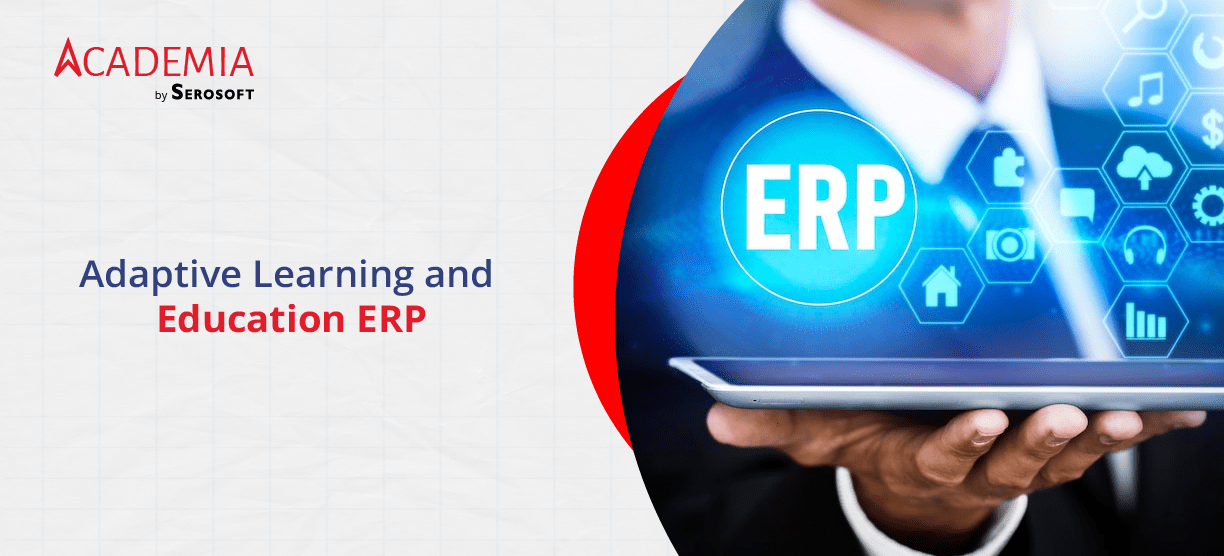
As more and more digital tools emerge the goals appear to become easier to achieve. Especially, the multi-faceted quality of ERP solutions is highly praised by education theorists and administration. It is because of the provision it provides to collect data at several touchpoints through student mobile applications, web portals, faculty and administration performance and behavioral inputs about students, and also their quality to seamlessly get integrated with online learning tools.
Through ERP you get to have a better understanding of a student’s pattern of learning, their interest, their effective time of learning, and even their response to different teaching styles. This opens new doors for the education system around the world and gives them a chance to break the barriers and move ahead. This also, helps them plan resources better for the students and allows them to not blindly invest their resources and force students to adapt to the redundant methods of learning. Through the education ERP solution not only do you get tools to better manage your institute, but also make teaching more centralized to student needs.
What is an Education ERP?
Enterprise resource planning is an umbrella term used for a host of mini-programs that are collectively used by enterprises to manage their resources better and bring more ease to functioning.
The definition does not change much with the addition of ‘education’ as a prefix to the term. Education ERP solutions are highly-configurable and tailor-made solutions built for education institutes such as schools, universities, and training institutes. They help in:
- Data Management, Analytics, and Reports
ERP solutions allow you to centralize your institute data and allow various stakeholders to use it for improved functioning. But one of the biggest things that this system does for you is data collection and data management. This gives institutes the added benefit of data insights.
With the removed opaqueness in the system, institutes can improve their strategies and achieve institute goals faster. It is a digitalized narrative that was set decades ago by educationists and researchers that allows for modifications in teaching styles, academic processes, and various other things for higher knowledge retention and student outcomes.
- Helps learn about risks
Predictive analysis is the latest addition to Education ERP. Like other industry segments, education too is now using data to allow Artificial Intelligence and Machine Learning to learn about the risks present in the ecosystem and provide effective solutions to address them.
Risks such as bad resource planning, financial crisis, reduced student engagement, non-availability of important resources, and student dropouts can be easily identified before they cripple your institute. It is a great way to ensure higher revenue, and student outcomes even in global stumbling blocks such as Covid-19, or recession.
- Implementing AI in Learning Management System
Using ERP in combination with Learning Management System allows you to save time in personalizing education for students. It allows you to learn about the existing knowledge and skills of the student and use it to define new teaching styles for improved student engagement. Also, the system tells you about areas in which student needs attention and counseling and helps them master new skills, gain new knowledge and also build a sustainable career path.
Going Forward
Adaptive learning is one of the most sought-after concepts in the education industry. Surprisingly, it has been on the agenda of every institute not just in the present but decades ago as well. As technology progresses we can expect new understanding sprouting from all the knowledge, research, and technology that we have.
We can assure you, that adaptive learning would rule the world as it is not only practical, profitable, and beneficial but also meaningful. People have different learning styles and the world must embrace this fact and start looking beyond just books and giving skills, knowledge, learning pattern, and style the due stance in strategies that could have made things so much better years ago.
Solutions such as ERP are highly supportive for education institutes to build the right infrastructure to learn, grow and implement adaptive learning. You can talk to our technology experts to understand how our product Academia ERP is fulfilling the needs of the industry and supporting adaptive learning. We would love to be of any assistance.
Stay tuned for more information, and exciting news in the edtech domain.