
Type your keyword below

Top EdTech Trends in the USA Market to Pay Attention to in 2023

The technology adoption in the current scenario is improving at a steady pace. It is the right time for educational institutions to adopt techniques that can help overall management. Educational institutions need to understand that it is the time when today’s needs will become tomorrow’s obsolete.

Tech adaption is going to be a decisive factor in the competition for the year and beyond. Institutions need to prepare for their digital evolution that can improve their market positioning and share. 

The USA is one of the fastest growing countries in all aspects, especially in terms of education. In recent years, EdTech in the USA is expanding exponentially and institutions across the country are adopting new technologies that can help in the overall development and growth of the institution. Let’s have a look at the top EdTech trends the USA institutions need to pick in 2023.

Top EdTech Trends the Industry should pick in 2023

  • Institutional ERP/SIS

With the growth in the education sector, institutions must ensure efficiency in all academic and administrative operations. An institutional ERP/SIS provides end-to-end automation of operations along with managing the entire student lifecycle. Automating all the processes leads to complete digital transformation of the institution making processes more transparent, smooth, and efficient. 

So with the emerging competition, institutions in the USA need to be equipped with an ERP/SIS to ensure better operational activities along with an enhanced learning experience.

  • Artificial Intelligence

Artificial intelligence is truly impacting the education world. It is helping enhance the education sector right from the classroom experience to commercial and organizational decision-making.

If implemented effectively, AI can help educational institutions strengthen the classroom experience along with improving the overall institutional experience. It helps in filling the needed gaps in learning and teaching allowing institutions to drive efficiency, and personalization, along with streamlining learning experiences.

The institutions in the USA need to leverage artificial intelligence in combination with good software/tools.

  • Gamification

Gamified lectures in an online learning setup are a huge success for improved student participation and knowledge retention. It has been implemented in all other fields and likewise in education. It is helping students improve their learning experience tremendously. It starts with the action of automating institutional tasks and also bringing enhanced learning experiences for institutions. The basic implementation of gamification can be initiated by replacing the traditional marking or grading system with the point system. It simplifies the marking processes for students in the competitive age along with reducing peer pressure to earn more marks or percentages in the examination. 

It helps faculty members and students in psychological processes that motivate learning and overall development in the best ways.

  • Focus on Student-Centered Learning

Student experience should be the biggest focus of the education industry. Institutions must adopt software/tools that support student learning in all ways. The USA in the current scenario is a hub for students from across the world. Institutions must adopt techniques like adaptive learning that provide personalized experience and help in the overall management and especially ease to students to motivate them for focused learning.

Conclusion

Institutions in the USA are adopting EdTech technologies at a pace. So it is high time for your institution to adopt or replace your old technique with a new, improved, and efficient solution. There are countless software, tools, and technologies that can become helpful but may remain a tricky and crucial job for you to choose the best one. 

We can help with this! 

Just Contact Us Now and one of our expert team will get back to you for a detailed discussion.
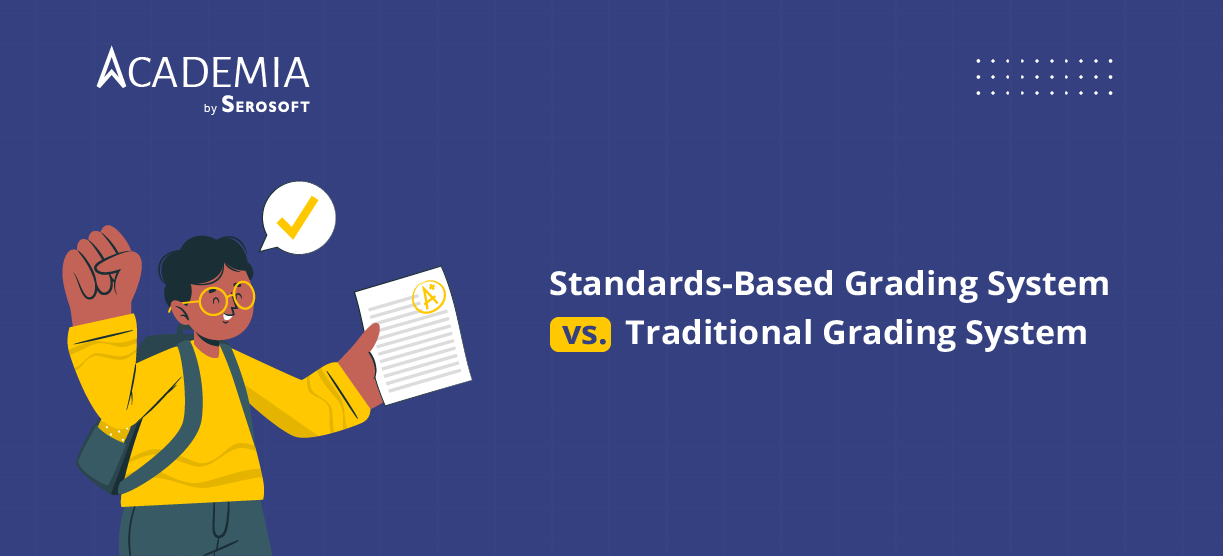
Standards-Based Grading System Vs. Traditional Grading System

Traditional grading approach only focuses on marks and goals, while standards-based grading system gives due importance to the learning progress. In a way, standards-based grading does not bind a student to show progress in a stipulated time and gain good grades. It accepts the uniqueness of each student and hand-holds them to achieve learning goals rather than grades. Here is what is standards-based grading system and how it is different from the traditional method of grading. 

What is a standards-based grading system?

Contrary to the traditional grading system, a standards-based grading system focus on measuring a student’s understanding by setting learning targets and testing the demonstration of their learning, i.e., Standards. 

The standards range from “below requirement’ to ‘mastery’, which is why it is also known as a mastery-based education system. As per a student’s performance throughout the academic year, standards can change for better or for worse. The grading system focuses on students’ learning progress and makes sure the educator, and parents can communicate about the student’s learning progress. 

Standards-based grading system widens the spectrum of assessing a student, as it largely focuses on the learning progress, and its growth and declines to help students. 

Key Differences between Standards-based Grading System and Traditional Grading System

S.no Standards-based Grading System Traditional Grading System
1 Setting learning targets to assess student’s progress. Relies on set grades/ percentages for assessments.
2 Assessment criteria given to students throughout the academic year decide is it has passed or failed.  Grades and percentages achieved by the overall assessment by a student decide if it has passed or failed. 
3 Students get multiple opportunities to improve their learning strategy, and only the latest assessments are used for grading for accuracy.  Students are assessed holistically by assignment of a single grade at the end of the term, based on theoretical assessment. 
4 Students get to know their strengths and weaknesses and thrive for better performance.  Students do not get a scope of improvement as a single grade summing their performance is implicit in their improvement areas. 

Why is standards-based grading a better assessment method? 

A standards-based grading system is a process-driven approach toward assessment rather than result-driven. The system does not bind a student to a fixed standard of intelligence and performance but rather allows them to explore their own uniqueness. Here are some other reasons, why we believe a standards-based grading system is a better method:

  1. It helps educators provide detailed feedback to the students on their learning progress. This means students get more clarity on the areas they have mastered and move on to the areas where they need to make an improvement. With detailed feedback, students’ outcomes improve remarkably. 
  2. Students and parents find it difficult to understand the grading system. It makes it hard for them to understand what factors have been taken into account, to sum up, this grade. Standards-based grading thus helps a student to know where they have gone wrong and what needs to be improved. They take ownership of their studies and work closely with teachers and guides to achieve their goals. 
  3. Standards-based learning provides an opportunity for a personalized learning experience. They can be assigned tasks and work based on their mastery level, rather than fit in a fixed box of measurement in a stipulated time.
  4. The system tests more than just the memory of a student. It challenges their existing knowledge and increases curiosity in students to learn more as the focus is on mastering something, rather than achieving a grade. 

How does a standards-based grading system help students? 

The standards-based grading is beneficial for students in all educational institutions. Here are a few benefits of it:

  • Higher engagement and motivation in students towards learning as the assessment is performance-based rather than percentage-based. 
  • Focus on mastering a concept than achieving grades for the sake of passing. 
  • Testing their knowledge and skills in real-life. It gives them a healthy approach to learning and keeps them motivated for lifelong learning. 
  • Gives students more control over their learning pace or have an idea regarding the areas on which they need to work. Students become an active part of their learning process, track their progress, and target achievement, increasing student outcomes. 

How does the Standards-based grading system benefit teachers/educators? 

Here are a few benefits it provides to the teachers/educators:

  • This increases the scope for teachers to focus on the student progress rather than holistic assessment. Teachers focus on teaching rather than grading. 
  • Teachers work towards personalizing lessons to help students better and improve mastery of the subject. Personalized lesson planning is beneficial in improving the quality of education. 
  • Increases the room for creative teaching methods and resources. It also, helps teachers to personalize the learning experiences to meet the needs of a student. 
  • Gives more understanding of a student’s learning level, areas of excellence, and areas of improvement. 

This was everything about the standards-based grading system. If you are using an ERP solution that does not have the functionality to offer grading as per standards-based assessment, you can try Academia ERP. Wherein we configure our product to meet your needs. To learn more about Academia ERP, contact our ERP experts today

Back to top