
Type your keyword below

Strategies for Implementing an Enterprise Resource Planning System in Ghana’s Public Universities

Educational institutions on a global scale are taking a major turn towards digital transformation and institutions are getting more systematic, aligned, and effective using technologies like ERP – Enterprise Resource Planning, SIS – Students Information System, and more. 

Ghana’s education system is also changing rapidly, and public institutions here are choosing ERP/SIS for overall management and growth. When it comes to the education ERP system, it’s often known as SIS (Student Information System).

If your institution is considering an ERP/SIS system as supportive software for managing all the academic & administrative tools, you are on the right track. 

An SIS system can efficiently help educational institutions by making all the academic and administrative solutions easier for all the stakeholders, like student management, and faculty management, and even helping parents with the best prospects. But with all these, Ghana’s universities must learn about strategies for implementing an ERP that will help the institution’s overall management. 

Strategies for Implementing an Enterprise Resource Planning System

Choose the right ERP/SIS platform 

Multiple vendors provide ERP services to educational institutions globally. Institutions in Ghana must choose the right platform & vendor that can effectively provide all the needs and requirements. The right ERP system can help save time in institutional tasks, eliminate tonnes of paperwork, and collates everything in a central place accessible to all stakeholders, like principals, teaching, administrative staff, parents, students, and more. 

Smooth & clear communication between ERP vendors and administration 

Communication is considered one of the most vital parts of educational institutions. It needs to be effective in any form.

Various things need to be discussed while implementing an ERP system in your institution, so it is a must that the ERP vendor you choose must assign you a team that can communicate and connect with your administrators and faculty members. The ERP team should also understand your needs & requirements and explain all the functionalities and features like student management software, admission management, fee management, and any other that can help you in the long run. 

Analyze & research 

Institutions in Ghana are on an ultimate digital transformation journey, they need to analyze & perform proper research before implementing an education ERP/SIS system. You have to analyze & research each & everything that can become more efficient after ERP implementation. You can study details from your institutions like

  • Inquiry & admission 
  • Fee management and accounting operations 
  • Program & course management 
  • Examination management 
  • And a lot more… 

Understand the product from demonstration & templates 

An Education ERP can help educational institutions in the best prospects until and unless all the stakeholders here know the complete functionalities of the software being used. The ERP vendor you choose must provide you with a comprehensive demonstration & tour of the product along with customizable templates according to your needs. 

2-3 rounds of detailed product demonstration can help in the effective implementation of ERP concerning the needs & requirements of the institution.

Carefully manage the data migration 

While implementing a new and modern ERP, you must be exceptionally careful in transferring or migrating important data from a legacy or a manual system. Firstly you will need to differentiate and select your necessary data that needs to be migrated in any case, keeping aside the unnecessary information or data. 

While migrating the data, your staff and administrators need to be attentive along with the ERP migration team. To understand it better, let’s say, your institution owns data for 12K stakeholders. So this huge data will need to be migrated using some integrations like MS tools or any other tool. For this, it becomes too crucial that the ERP you choose must have all the capabilities to migrate the data along with having interoperability features with other systems. 

How does Academia ERP help Ghana Universities/Institutions?

Among n-numbers of ERP vendors across the world, Academia ERP stands out to be different and exceptionally helpful for educational institutions across the world. Looking into Ghana’s digital transformation journey, we are a part of various universities/institutions in Ghana. 

Being one of the core ERP presenters in the world, we follow an institution-centric approach that focuses on accomplishing the customizable needs of all stakeholders. We have a tremendous implementation process with a highly qualified team that supports all the pre-implementation & post-implementation processes. It also provides integration with all the pre-built connectors/plug-ins, Web services API, and integration platforms along with having a multi-center capability feature supporting multiple academy locations of an institution.  

Watch the video to check the reviews of one of our prestigious clients in Ghana:

SIS & LMS: What’s the difference?

In the modern scenario, the education ecosystem is expanding exponentially and educational institutions need to choose a technology that can bring differentiation, making all the operations systematic and efficient. But having varieties of EdTech tools and technologies institutions often gets confused among their usages and their meanings. 

Do you know the difference between SIS and LMS? Both these systems serve distinct purposes but record similar data to help teachers and administrators along with managing day to day operations. 

What is the Student Information System (SIS)?

A Student Information System is software that allows institutions to manage student data and information efficiently. It provides functionalities for all the academic and administrative operations like admission, enrollment, examinations, fee management, attendance record management, program and courses, and all the operations related to faculty and student life cycle. 

What is a Learning Management System (LMS)?

A Learning Management System (LMS) is software to empower learning and development in institutions. It helps in the documentation and delivery of all the courses, training programs, and learning and development programs of an institution. It promotes e-learning and teaching processes, automating and directing the processes. 

What is the difference between SIS and LMS?

Both LMS and SIS own administrative management functionalities, but none of them can replace each other’s functionalities to help the institution. Let’s discuss what are the differences between the two:

SIS LMS
1. The SIS helps universities, colleges, or schools to manage their academic and administrative operations in regards to students, faculty members, and the authorities. 1. The LMS enables the faculty to improve their relationship with the students in terms of learning and teaching.
2. It stores, manages and automates each process of the management. 2. It is used for the management of course resources – basically to enhance the classroom experience.
3. It deals with student admissions. 3. It deals with the knowledge and talents of prospective students.
4. It provides student enrollment and keeps program and course option choices. 4. It manages and enrolls classroom administration for students.
5. It handles examinations, assessments, grades, and academic progression. 5. It handles authorship for course materials.
6. It manages rewards, scholarships, qualifications, certificates, and graduations. 6. It handles the syllabus and certifications for each student in the class.
7. It provides complete financial aid for students and faculty members. 7. It does not always include financial aid for students to check.

Wrapping Up!

Hope you got a strong understanding of the differentiation between SIS and LMS. The SIS is a way you are thinking to manage all the academic and administrative operations of your institution effectively and efficiently. An LMS will function as an online classroom to manage your training if you provide lots of e-learning and corporate training. The SIS and LMS can work hand in hand to provide effective management leading to the growth and success of the institution. 

Want to know more? Let’s discuss it in more detail having more clarity for the same, contact us now!


What are the Benefits of School Fee Management Software?

Managing fee records in school is difficult if done manually. There are multiple fee structures, various departments, and n-numbers of students; it’s an art to keep track of everything and be able to access the exact details whenever there is a need. It is time-consuming and lacks flexibility, transparency for parents, and students. 

However, it becomes smooth with a fee management system to handle all the fee-related tasks in school.  It gives a platform that connects the entire campus, multiple academies in one place, and simplifies administrative processes. 

Here are the seven benefits of using fee management software in school:

  • Streamline Fee Collection

Online Fee Management System gives you a centralized platform to handle all the resources in one place. It makes the entire process super easy, simplifies data management, and makes the workflow seamless. There is no need to use multiple software programs for a particular function. Parents can submit the fee online via Parent Portal or Mobile Apps; there is no need to come to the institute and wait in line to do the same. 

  • Scalable & Configurable 

Every school strives for growth, and therefore it should have the software that can support the development. Academia ERP is such enterprise resource planning for educational institutions. Its fee module is scalable to the needs of the school. It is adjustable to increasing numbers of free spectrums, making it easy to use education ERP. If a school has multiple campuses in various locations, it is configurable, according to every institution.

  • Mobile Apps, SMS & Email Integration

No more paper waste! School Fee Management Software is provided with the facility with the SMS & Email. Students and parents get the notifications for upcoming/pending fee details. After the fee submission, they again get the confirmation message for the same. Not only that, but they can also access all these details and previous fee records via the app. Academia ERP offers a Student/Parent App for the same to give them the power to access the details anytime, anywhere. 

  • Invoice Management

With the automation of fee management processes, invoice management becomes hassle-free. All the invoices for tuition fees, registration fees, scholarships, sponsorships, etc. all can be done quickly with this software. Users can send the e-invoice to parents/students or share the document in their portal. It reduces the stress of paperwork and storage. 

  • Fast payment

Fee submission can be as simple as buying stuff from Amazon e-commerce. Within a few clicks, parents/students can do the transaction any time they want. Fee management software is integrated with multiple payment gateways that provide quick remittance for fast payment, which is safe & secure. They also access various payment modes, such as VISA, MAESTRO, credit/debit card, internet banking, etc.

  • Comprehensive Reports

School Fee Management applications provide a comprehensive and smart reporting engine for the entire department. With its analytics, you can efficiently deal with fee structure student-wise, course-wise, and more. It also offers visual aids with colorful charts that help in faster and better-informed decision making.

  • Easy Calculation

Some schools offer scholarships, sponsorship, sibling discounts, and more facilities like that. With the school fee management software, you can perform all the calculations within seconds. There is no need to go through calculators and paperwork.  

In Conclusion

Implementing this software is highly beneficial for schools as well as higher education. It empowers educators, saves significant time, makes management processes proficient, and easy for everyone. It reduces the staff workload, makes fee records error-free, and allows them to focus on students.

Do you want to streamline the fee management process in your school? Check out the working of the Fee Management Module in a FREE EDUCATION ERP DEMO with our experts. Book Now!

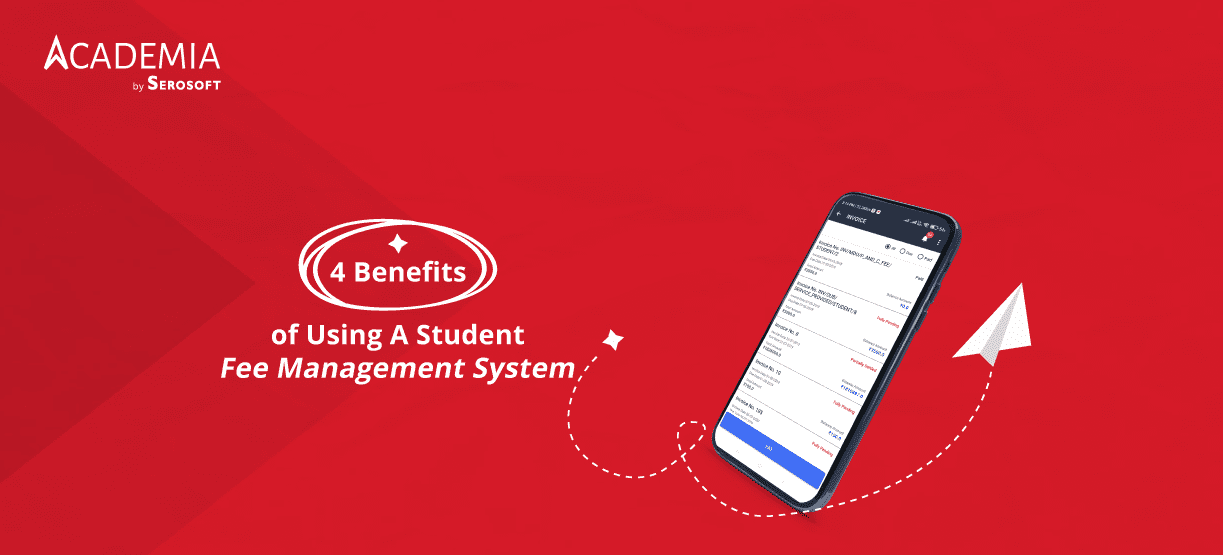
4 Top Benefits Of Using A Student Fee Management System

The fee management process in K-12 and higher education institutions is huge and extensive. Managing it manually is difficult and brings situations of human errors and malfunctioning 

This is the reason most educational institutions are moving onto an online fee management system. It is helping institutions in bringing transparency in all the fee-related tasks targeting ease and efficiency in all manners.

Nevertheless, let’s examine how a fee management system can benefit an institution.

  • A simple and easy-to-implement solution

An online fee management system is easy to implement and easy to use. Institutions need to choose an advanced and tech-updated fee management system that can be very efficient and easily used by all the stakeholders at their ease. Teachers and parents can access it from anywhere at any time.

  • Transparency, visibility, and clarity

An effective fee management system provides complete transparency and visibility in all transactions. Each transaction gets generated, recorded, and logged in a centralized database reducing data redundancy and duplication. All the data gets stored in the system securely and is encrypted with advanced tech solutions. It also restricts role-based data access to the centralized database for administrators and higher authorities.

  • Reminders and updates on time

There are various personal and professional tasks that students have in which students find it difficult to check their due date, collect receipts, check their status, paid amount, pending amount, and other things. A fee management system provides a check on all this, as students and parents can expect SMS and email reminders, and with a highly efficient ERP, it is possible to get WhatsApp notifications for the same. 

With regular notifications and alerts through SMS, emails, and WhatsApp messages, it is straightforward to track due dates, the status of pending and paid amounts, and many other things. Also, the student/parent mobile application also provides a receipt management system that helps store all the details of their transactions. 

  • Streamlined and paperless processes

An educational institution involves multitudes of tasks, data, fee transactions, processes, applications, approvals, and a lot more. With manual intervention, it involves an abundance of papers, files, documents, and even using digitized resources like computers with lakhs of files and folders. 

A fee management system automates and streamlines the complete process and creates a paperless environment. It provides a centralized web portal and mobile application to manage and ease the complexities for all the stakeholders.

The purpose of Academia ERP’s fee management system?

As discussed above there is an abundance of tasks that needs to be managed in an educational institution. Managing fees & finances effectively are crucial for institutions. To this, Academia provides an efficient platform that is its fee management system, it manages and controls all the fee and finances-related tasks and brings transparency, accountability, and accuracy to the whole academic and non-academic processes.

There are various features that the Academia fee management system provides one of its efficient features is – Finance Hold’. This provides institutions the authority to restrict students to participate in activities for which the fees are pending like examinations, admissions, and more.  This serves as a good tool for the institutes to streamline their operations. 

School Administration Management Through Automation

Wrapping Up!

Hope you liked the article and it helped in getting an understanding of the role of the fee management systems in modern educational institutions. 

So how are you managing fees and finances in your institution? Is it still manual or you are using an efficient fee management system? If your answer is a manual one, you immediately need to switch to an automated system that helps your institution in the real aspects. We can help you with the same, Request Demo now and one of our tech experts will get back to you as soon as possible!

Back to top