Type your keyword below

Modern Technological Tools That can Improve Classroom Experience

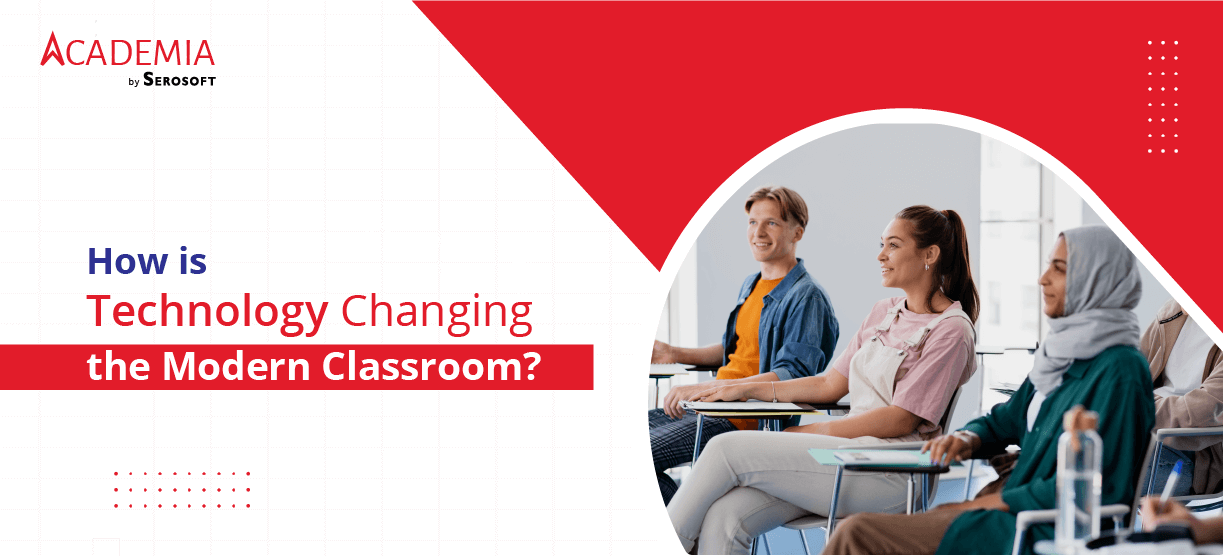
Educational institutions in today’s time need a power booster that can essentially help them in shaping complete institutional operations effectively along with making the classroom experience enhanced and better. Educational institutions need to maintain their level by choosing a modern classroom technology that can help in increasing the experience of the classroom making them more modern and technologically upgraded.  

Various technologies can help institutions to meet all the technical aspects of having smooth, consistent, and transparent management in the institution. There are various designed tools for educational institutions that can help teachers, staff, and students in day-to-day tasks like daily attendance, timetable management, managing academic and administrative tasks like and most importantly in enhancing the student and modern classroom technology.

Let’s discuss some of the points that can help institutions attain classroom technology trends: 

  • Virtual Reality and its effects on modern learning

Virtual reality is one of the most important and basic uses of modern technology in classroom teaching, it provides a next-level experience for higher education classrooms giving a lot of potential for immersive learning. 

Education relies on appropriate learning activities in a simulated environment, it provides a safe, interactive, and engaging, it helps in expanding properly. 

Virtual reality helps faculty to teach students, providing them experience destinations from across the world in the same classroom. This leads to enhancing students’ learning providing them a different experience from any aspect. 

  • Audiovisual presentation for better understanding

Old were the days when manual interventions of teaching and learning in institutions led to improper understanding among students and faculty. In the modern world, various technologies promote the audio-visual presentation of lessons through which students can understand more properly and learn accordingly. 

  • Tech-upgraded digitally smart blackboard to enhance learning

Blackboards are considered as one of the oldest and best ways of teaching and learning in any educational institution. But with the enhanced technology in this sector and uses of modern technology in classroom teaching blackboards are also now digitally smart and are helpful in modern education. Teachers can operate a whiteboard, allowing a person to write on them with real or digital markers. 

  • An efficient and robust ERP for completing academic and administrative operations 

ERP for higher education institutions is one of the best technological tools that increase the experience for modern classroom technology, an efficient and robust ERP manages all the academic and administrative tasks like examinations management, fee management, admission management, library management, and all other tasks removing manual interventions of the institutions by bringing automation and digital transformation in best ways. Institutions must choose a very good ERP solution like Academia. It is one of the best ERP/SIS solutions that focuses on improving the overall experience of the institution and the classroom in the best way. 

  • Artificial intelligence to let the students aware of the modern world

Artificial intelligence (AI) is considered a key driver of growth and innovation across every sector and the education sector is one of them. While AI-powered solutions have been in the Edtech space for some time, it helps in the learning and teaching experience of students in the best prospects, evolving better benefits for students and faculty. AI ultimately automates and streamlines the education process, providing access to the right courses, improving communication skills, it also gives a deep impact on their educational journey. 

  • Effects of Cross-lifecycle CRM on the modern classroom

Educational institutions often hold a false perception about CRM that it can only manage transactions between different departments, Gartner says “Student cross-life-cycle CRM is a deployment that creates a campuswide, 360-degree view of students across their entire life cycle in the institution”. A CRM can be considered as one of the most advanced technological tools that can help educational institutions manage and enhance student life experience in the best way.

What Gartner report states about Top Technology Trends Impacting Higher Education?

In this extremely competitive world, educational institutions must opt for technological tools that can enhance the learning experience of students along with classroom technology trends. According to Gartner, higher education CIOs should weigh recommendations in light of these trends as they shape their IT strategy and priorities. Check this blog on Top Technology Trends Impacting Higher Education in 2021 to know what Gartner has to say about this. 

Download Exclusive Gartner Reports Brought to You by Serosoft (Academia):
Gartner research reportConclusion

So, what do you think about making your institution’s classrooms tech-friendly and more advanced? Do you already have some of the above tools executed in your institution? Let’s discuss more! Contact us now! 

6 Steps To Perform Student Enrollment Management In Higher Ed

Enrollment management refers to the ability of institutions of higher education to exert more systematic influence over the number and characteristics of new students, as well as influence the persistence of students to continue their enrollment from the time of their matriculation to their graduation. The emergence of enrollment management as a new administrative structure within institutions of higher education originated in North America, but it has also been employed in Europe, Africa, and Asia.

The Concept

Enrollment management can be viewed as a synergistic organizational concept that can be used to link several administrative functions within a college or university in order to optimize institutional enrollment goals. Examples of this approach can be found among the financial strategies of many college campuses, where important linkages have emerged between senior enrollment managers and chief financial administrators. Both private and public colleges use some of their tuition income to fund campus-based scholarships for students. Tuition revenue accounts for millions of dollars, and campus-based financial aid has become a large expenditure at most four-year institutions. Enrollment management efforts have therefore become closely linked to budgeting and campus financial planning. Successful enrollment management strategies and practices must also consider the growing importance of university and college rankings. For many institutions of higher education, enrollment management has come to involve a combination of student enrollment strategy, budgeting strategy, and institutional positioning strategy.

Roadmap

1.  Set goals for enrollments

Setting up realistic goals and working in that very same direction to achieve them is the first necessity of systematic enrollment management for an institute. It is a crucial step since it involves market analysis and calculation of the expected rate of growth.

2.  Resource requirements

To identify the need for the required resources according to the set goals is the next step in the roadmap for enrollment management.

3.  Campaigning and recruiting plan

It is important to create a target focused marketing plan for move in the right direction and reach the set goals. The right kind marketing mix may help you get to the right target audience which would ultimately help us meet enrollment management goals.

4.  A strong follow-up on your marketing and recruitment activities

Tracking your activities is a must in the process of enrollment management to get the results. Following steps can be followed to keep on a regular check on these activities:

1) Identify which metrics to track.
2) Know how to track the metrics you identified.
3) Guide your decisions with the data you collect.
4) Monitor the effect of your efforts and adjusting accordingly.

Having a solid set of marketing and recruitment metrics you can track allows you to benchmark your efforts from year to year and make crucial decisions on allocating resources and strategies.

5.  Systematic communications within the process to develop and implement the right strategy.

With the seemingly chaotic mix of print, e-mail, Web, and social media, there may not seem to be much “flow” with recruitment communications. As with student qualification, though, building a communications flow remains a bountiful recruitment strategy if it is handled strategically.

First, you still must think through the communications at various enrollment stages—inquiry, applicant, admit, deposit. Regardless of where a student enters the flow, progressing them to the next enrollment stage remains the goal.

Second, focus your electronic communications wisely. Having a Web site that engages students is paramount. You want to invite communication in addition to delivering information. Give students opportunities to provide their e-mail addresses or even opt in to text messaging. Do the same with social media but be careful not to go overboard. You are better covering fewer social media outlets well rather than spreading yourself too thin.

Finally, get parents and guardians involved in the flow. According to our E-Expectations research, 60 percent are involved with the college research process. Target them with communications and make them ambassadors for your campus.

6.  Award financial aid so students get what they need and expect to enroll

The ability to afford a college education has emerged as the biggest roadblock to attending college. Perhaps nothing will turn away a prospective student faster than a feeling that they cannot afford your institution. You must address this concern immediately and accurately.

Learning in Education

“Education is the Manifestation of the perfection already in man” – Swami Vivekananda

In essence this famous quote from the renowned spiritual Guru from India “Swami Vivekananda” implies a lot and compels us to really think if in today’s time do we really emphasize on learning or just accumulating qualifications from premier institutions.

Especially in developing economies education has evolved as one of the most growing and profitable business resulting in numerous schools, colleges and universities etc., being run by many well known business groups within those geographies. However, really does getting a good degree from a renowned institution means that one is learned. This is something one must ask to measure how much one has learned whilst accomplishing that particular qualification.

This food for thought has resulted in the development of new learning and teaching methodologies and hence, since last decade, new concepts of imparting knowledge such as “Learn by fun” and practical education has evolved significantly as a result of immense research being carried out in recent times.

Another significant aspect is the role of technology and how it can assist educators in transforming teaching and learning process into more of a fun activity to make it easily memorable and more enjoyable for both teachers and students.

Today, technology really empowers education methodology as with latest University/College/School/Campus/Education Management software, institutions can really focus on developing innovative ideas of imparting knowledge. Another important development is the innovation of cutting edge Enterprise Resource planning (ERP) solutions which helps institutions to ensure

  • Effective resource planning/management
  • Enhanced communication among various stakeholders
  • Crystal clear or transparent processes
  • Efficient performance management
  • Optimal use of capital with better return on investments (ROI)

The above listed benefits can easily said to be the top 5 benefits of an ERP/Campus management solution.

This is the time education industry is going to see immense growth and development of effective methods of imparting knowledge which hopefully will focus more on learning rather than distributing degrees or qualifications.

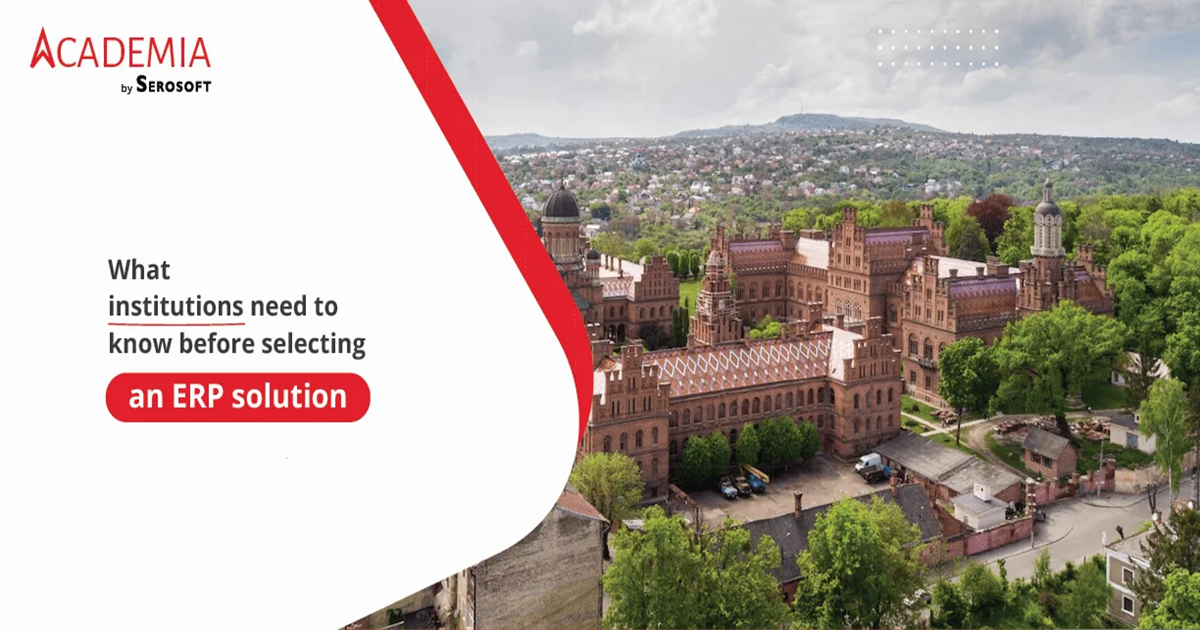
What institutions need to know before selecting an ERP solution

There are thousands of enterprise resource planning solutions available in the market today. But which is the right one? The answer lies in these three biggest factors. Read the blog to reveal the factors you must consider in a vendor before you make a buy decision. 

  • A process review and analysis for ERP.

Start by analyzing your current processes. Include your pain points and strengths. Mention the areas in which you need improvement and also what you are expecting from the software. Include the corresponding needs of various departments present in the organization as well. 

You can share this document with potential software vendors and ask them to demonstrate their products. This would help you cut the chase and directly dive into features and functionalities that are absolutely necessary for you to have in a product. Also, document your experience of the product during the demo. 

  • Evaluate the technical fit of the education ERP solution.

Would you be required to improve the current digital infrastructure in your institute? Would you require an internal IT support team? Is the product aligned with your current infrastructure? These are some of the most important questions to ask as an education ERP software cannot work if you don’t have laptops, computers, or smartphones to use the product on. 

  • Cost is important to discuss.

It is a common sales strategy to downplay the cost and risk associated with purchasing the software. Thus, it becomes necessary that you talk about the overall cost of the product, including implementations, hardware upgrades, maintenance, software upgrades, security, network, storage, etc., during your discussions with the vendor. 

And this is it 

If a vendor stands correct on these 3 factors and your relevant expectations, you have found your Education ERP software provider

The key to finding the right vendor is in knowing what your organization needs and sticking to it. You will find tens of good features and functionalities in the product but they may not be right for your institute. 

Also, ask your colleagues, employees, and other contacts if they recommend any education ERP software. Conduct research on the internet and hire the right vendor only after they provide you with clear answers about the product upgrades, feature upgrades, maintenance, product management, and security of the product. 

Lastly, the right vendor is the one that shows promise and interest in maintaining a long-term relationship. It would ensure they support you all throughout your organization lifecycle. 

Back to top