Imagine a fast-growing institution in Southeast Asia onboarding thousands of students every intake. Admissions are rising, international programs are expanding, and regulatory reporting deadlines are tightening. As institutions push toward modernizing campus management, expectations around speed, accuracy, and visibility have never been higher.
Yet behind the scenes, academic teams are juggling spreadsheets, disconnected portals, and manual approvals just to keep daily operations moving. What looks like institutional growth on the surface often hides operational strain underneath.
This is the reality for many institutions across Southeast Asia today. As higher education ecosystems mature in countries like Indonesia, Malaysia, Vietnam, the Philippines, and Thailand, institutions are under pressure to rethink how they manage academics at scale. This is where a robust education management system and purpose-built academic management software become not just helpful, but essential.
Southeast Asia is witnessing a rapid transformation in higher education. Governments are investing heavily in digital transformation in universities, private institutions are scaling aggressively, and international collaborations are becoming the norm.
With this growth comes complexity, credit mobility, outcome-based education, and stricter quality assurance frameworks.
However, many institutions still rely on fragmented tools built for a different era. When systems do not talk to each other, even simple tasks like enrollment confirmation or attendance tracking become time-consuming. Leadership, meanwhile, lacks real-time visibility into academic performance and institutional health, limiting data-driven decision-making.
An ERP for colleges supports university automation by unifying academic and administrative processes into a single, structured platform that evolves alongside institutional growth.
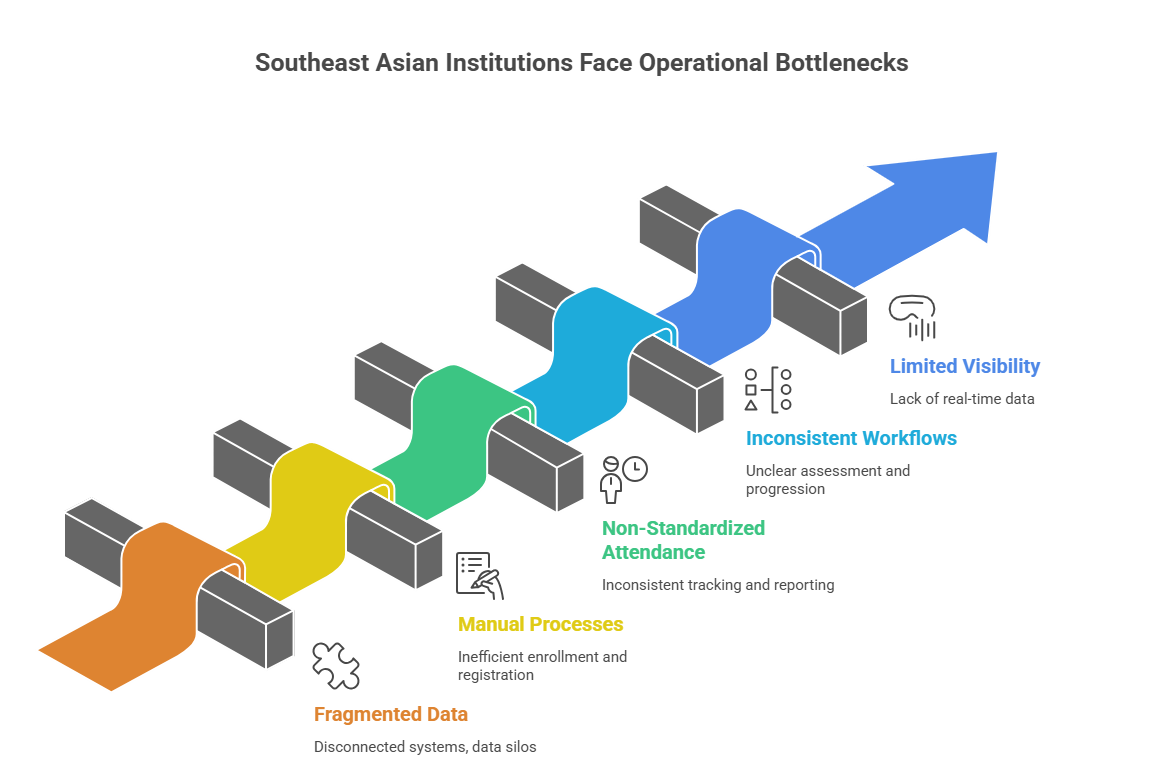
Despite regional diversity, institutions across Southeast Asia face a common set of operational bottlenecks:
These challenges slow down operations, increase dependency on individuals, and expose institutions to compliance risks. Over time, they also impact student experience and institutional credibility.
A modern education management system simplifies complexity by centralising data, standardising workflows, and automating repetitive academic processes.
Legacy systems were often built to handle isolated functions—admissions software here, examination tools there, reporting managed manually at term end. As institutions grow, this fragmented approach fails to support scalability.
For Southeast Asian universities managing multi-campus operations, international students, and evolving regulatory expectations, flexibility and scalability are no longer optional. Institutions increasingly require cloud ERP for universities that can support growth without major infrastructure rework or system overhauls.
This is why many institutions are shifting to an ERP for colleges designed specifically for higher education, rather than adapting generic enterprise tools.
A future-ready platform strengthens academic outcomes by aligning daily operations with long-term institutional goals. Instead of reacting to issues, institutions gain proactive control over their academic ecosystem.
With a unified education management system, institutions can manage the complete student lifecycle, from enquiry and enrollment to progression and graduation—while ensuring data accuracy and governance.
Key capabilities typically include:
Together, these capabilities enable true academic management software functionality, reducing manual workload and improving consistency across campuses.
Beyond efficiency, an ERP for colleges plays a strategic role in institutional expansion. It allows universities to launch new programs faster, manage regional or cross-border campuses with confidence, and respond smoothly to audits and accreditation reviews.
More importantly, it builds a strong digital backbone for innovation, whether through AI-driven student engagement, blended learning models, or global academic partnerships. A cloud ERP for universities ensures institutions remain agile while maintaining governance and control.
As Southeast Asia positions itself as a global education hub, institutions that invest early in scalable digital infrastructure gain a significant competitive advantage.
The future of higher education in Southeast Asia will be defined by agility, transparency, and student-centricity. Institutions can no longer rely on systems that merely store data; they need platforms that actively enable digital transformation in universities.
By adopting a comprehensive education management system like Academia, institutions move from reactive administration to proactive governance. With AI-powered workflows, real-time dashboards, and unified data management, Academia supports sustainable growth without compromising compliance or clarity.
Digital transformation is no longer a long-term aspiration, it is a present-day necessity. For Southeast Asian institutions, the question is no longer whether to modernize campus management, but how quickly they can do so effectively.
Book a demo with Academia today to see how your institution can streamline operations, empower leadership, and deliver a seamless student experience.

Experience Academia – Your partner in transforming campus operations, a trusted all-in-one ERP/SIS solution.
Get the latest insights, trends, and updates delivered straight to your inbox!