Type your keyword below

Technology in schools: What are the opportunities and challenges?

Take a look around and see how technology has changed the lives of today. The same is true of technology in schools: it has certainly opened many possibilities. The adoption of technology in schools has a different image in different countries. Some developed countries, such as the United States, are looking for more technologies to integrate into their schools, but countries in the less developed regions of the world are still having difficulty integrating these technologies into their schools. While technology provides many opportunities for educational institutions at all stages, there are gaps that prevent widespread adoption of technology in schools around the world.

There are many opportunities for technology in schools:

When we talk about ways to integrate technology into schools, we can see how technology is already changing the way teachers teach in schools, a departure from text-based learning to something that includes and engages the school’s students. The possibilities are manifold. We speak of four such possibilities that can promote education.

  • A global learning platform is undoubtedly a blessing for the introduction of technology in schools. Students can choose to study a foreign language through video conference from residents of the affected country. Many Websites have created this type of video conferencing learning session, so students can benefit from the training benefits, fewer travel expenses.
  • An undocumented classroom is on its way. Cloud-based apps and tools like Google Drive, Gmail, and Google Docs provide a smarter way to empower students and teachers to learn on a daily basis. A truly affordable option to save more time than traditional teaching methods.
  • A great opportunity for technology in schools lies in the form of virtual reality (link to our blog) in the classroom. Virtual reality can transform lessons into a workflow where students can experience real-world applications in a virtual world.
  • E-books have great potential to change the image of education in the coming days. Many schools in different parts of the world have already discovered the enormous potential of e-books, but some schools do not yet know it.

There are also challenges:

The introduction of technology in schools is certainly not an easy path to success. It has a share of bad spots that need to be found.

  • Leaving the comfort zone and adopting technology in schools may be one of the biggest challenges. In most cases, teachers and school authorities are reluctant to experiment with new technologies in the classroom, believing that these experiments go beyond their job description
  • Technology in schools has another setback: Most schools are reluctant to set up correspondence courses, unlike universities that have already integrated the online courses
  • The cost factor remains a major challenge for the introduction of technology in schools. Most schools lack the resources to support the use of technology in schools. The purchase and installation of the technology are associated with the acquisition costs. In addition, the costs of maintenance, service, and modernization are associated with running costs, which are sometimes financially unsustainable for most kindergartens through to 12th-grade schools

There are challenges to master; However, the most important test is facing these challenges, overcoming and accepting technologies in schools, and revolutionizing education by offering students better opportunities.

Top Functionalities of ERP Modules for Educational Institutions

Enterprise Resource Planning (ERP) solutions serve various functions utilizing different ERP modules to accomplish institutional goals. According to the nature of the business, modules for ERP solutions solve various departmental needs. Since we at Academia ERP provide ERP solutions for educational institutions, we will keep the scope of this blog post specific to education sector. We will discuss ERP modules for educational institutions.

An ERP for educational institutions comes with multitude of functions fundamental to the type of institution it is being used for, per se, University, a single Higher Education institute such as a college, School or Group of Schools. These solutions are also evolving with time as technology is advancing. If you are looking to implement a solution for your institute then we are listing major modules you should keep an eye for.

Major ERP modules for Educational Institutions are:

  • Campus Management
  • Admission Management
  • Campaign Management
  • Enquiries Management
  • Student Management
  • Fee and Billing Management
  • Subject Management
  • Class Management
  • Timetable Management
  • Examination Management
  • Certificate and Document Management
  • Control Panel
  • Business Analytics
  • Human Resource Management
  • Reporting

The above modules are major ones, a full-fledged Education ERP such as Academia ERP comes with 16 modules and is capable of handling the complete student life cycle management – right from admission to course completions till graduation for higher education. It is capable of managing all the departments in your institute with analytics and reporting for centralized monitoring for group of institutes.

Now, since you know about the available modules in education ERP, let’s also learn about the functionality of these modules.

Here are the top functionalities of Education ERP Modules:

  1. Streamlines Admission Process:

Admission process in educational institutions usually involves these steps: inquiry, form sale, form submission, application, document submission, shortlisting, examination, counselling and whatnot. When it comes to higher education institutions, such as college or university the admission process gets more complex. An education ERP solution helps institutions to integrate all the above processes in one module. It simplifies the process for institutes and life of academic staff.

  1. Trouble-free Program and Course Management:

Higher educational institutions run many programs and courses, simultaneously managing enrolments in these courses. Keeping a manual record of all the programs and courses with student enrolment records can become cumbersome. Using a system such as Academia College ERP software can help to easily manage different programs offered by your institute and enrol or remove pupils as per your requirements.

  1. Efficient Examination Management:

Conducting exams is a task in itself, there are many pre-examination and post-examination operations involved such as finalizing examination schedule, setting up exam centre, staff allocation, assessment scheme setup, exam execution, results declaration and distribution, and much more. The examination module in education ERP comes with a complete set of features to make examination process more efficient. Academia ERP also enables you to control the type of marking you want to use. It can also provide a relative grading system to improve the overall result of your institute.

  1. Easily Govern Institute Administration:

With ERP implementation in your institution, it becomes easy to control hostel, transportation, inventory and other administration activities involved. It provides you access to every minute details related to administrations activities and ancillary units fundamental to functioning of educational institutions such as hostels, transportation, inventory etc. For example, with hostel management module you insert the physical design of your hostel like no. rooms, floor, bed, etc. transportation module provides you real-time geo location information of your institute’s vehicles.

  1. Delight Faculties and Students:

With efficient management of student records, admissions, program and courses, examination, administration activities etc. Faculties or teaching staff save a lot of time to focus their time, energy and creativity on academic activities. With the adoption of new technology teachers become innovative with their teaching methods, students are more involved in class, thus, increasing productivity of the institute overall.

  1. Accurate Finance and Accounts Management:

The fee and bill payments module of education ERP lets you manage all the activities related to finance and accounting, such as, fee and bill payment, employee payrolls, scholarships, and sponsorship. This is gives you the power and control to manage the financial records from one centralized system. You can generate all kinds of associated reports such as receipts, bills, outstanding payments, account settlements, etc.

Conclusion

An ERP solution for educational institutions has many capabilities. The technology is the future of education management. We would encourage you to explore the technology in-depth and give it a try.

Do you think you can give it a try for your institute? A free demo can give you an in-depth understanding of the functionalities.
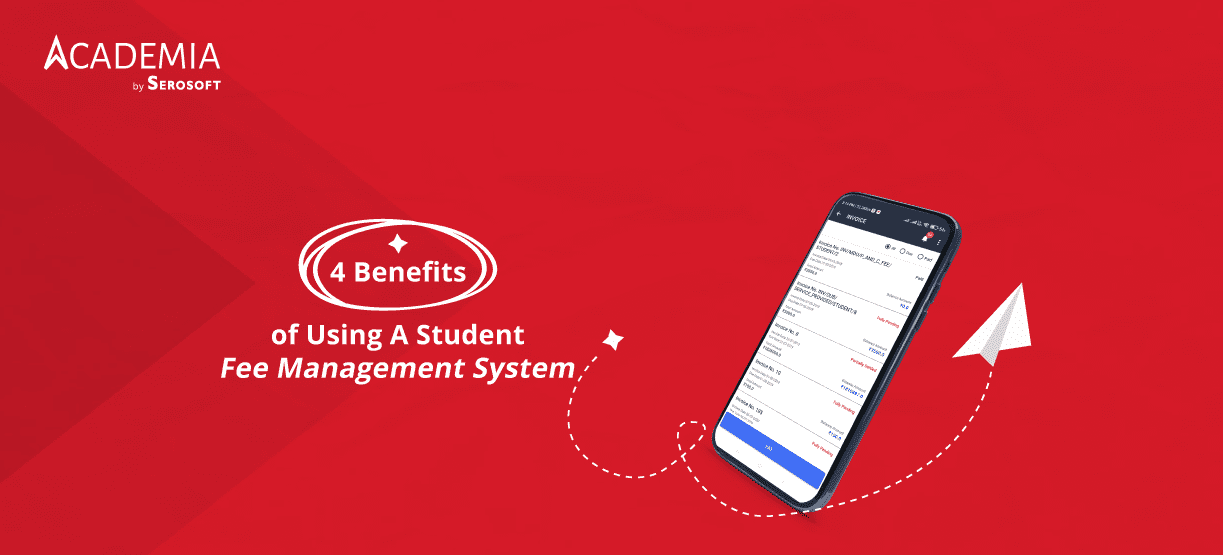

4 Top Benefits Of Using A Student Fee Management System

The fee management process in K-12 and higher education institutions is huge and extensive. Managing it manually is difficult and brings situations of human errors and malfunctioning 

This is the reason most educational institutions are moving onto an online fee management system. It is helping institutions in bringing transparency in all the fee-related tasks targeting ease and efficiency in all manners.

Nevertheless, let’s examine how a fee management system can benefit an institution.

  • A simple and easy-to-implement solution

An online fee management system is easy to implement and easy to use. Institutions need to choose an advanced and tech-updated fee management system that can be very efficient and easily used by all the stakeholders at their ease. Teachers and parents can access it from anywhere at any time.

  • Transparency, visibility, and clarity

An effective fee management system provides complete transparency and visibility in all transactions. Each transaction gets generated, recorded, and logged in a centralized database reducing data redundancy and duplication. All the data gets stored in the system securely and is encrypted with advanced tech solutions. It also restricts role-based data access to the centralized database for administrators and higher authorities.

  • Reminders and updates on time

There are various personal and professional tasks that students have in which students find it difficult to check their due date, collect receipts, check their status, paid amount, pending amount, and other things. A fee management system provides a check on all this, as students and parents can expect SMS and email reminders, and with a highly efficient ERP, it is possible to get WhatsApp notifications for the same. 

With regular notifications and alerts through SMS, emails, and WhatsApp messages, it is straightforward to track due dates, the status of pending and paid amounts, and many other things. Also, the student/parent mobile application also provides a receipt management system that helps store all the details of their transactions. 

  • Streamlined and paperless processes

An educational institution involves multitudes of tasks, data, fee transactions, processes, applications, approvals, and a lot more. With manual intervention, it involves an abundance of papers, files, documents, and even using digitized resources like computers with lakhs of files and folders. 

A fee management system automates and streamlines the complete process and creates a paperless environment. It provides a centralized web portal and mobile application to manage and ease the complexities for all the stakeholders.

The purpose of Academia ERP’s fee management system?

As discussed above there is an abundance of tasks that needs to be managed in an educational institution. Managing fees & finances effectively are crucial for institutions. To this, Academia provides an efficient platform that is its fee management system, it manages and controls all the fee and finances-related tasks and brings transparency, accountability, and accuracy to the whole academic and non-academic processes.

There are various features that the Academia fee management system provides one of its efficient features is – Finance Hold’. This provides institutions the authority to restrict students to participate in activities for which the fees are pending like examinations, admissions, and more.  This serves as a good tool for the institutes to streamline their operations. 

School Administration Management Through Automation

Wrapping Up!

Hope you liked the article and it helped in getting an understanding of the role of the fee management systems in modern educational institutions. 

So how are you managing fees and finances in your institution? Is it still manual or you are using an efficient fee management system? If your answer is a manual one, you immediately need to switch to an automated system that helps your institution in the real aspects. We can help you with the same, Request Demo now and one of our tech experts will get back to you as soon as possible!

5 Mistakes Institutions Are Doing While Choosing Education ERP

When it comes to choosing an Education ERP solution for an institution, decision-makers and administration do multiple mistakes. It is assumed that educators are the decision-maker when selecting an EdTech for an institute, but it’s not like that. Upper management, administration, and educators all are responsible to make a decision for any advancement in their institution.

As they are representative of the institute they are supposed to make effective decisions and set an example for their followers. But it is not always the case. After analyzing various decision-makers of institutes, we realize that there are various mistakes they are making while selecting an Education Technology Solution (Software).

Below are the five such mistakes institutions are making which should be taken care of:

Ignoring the needs of the institution

There are different pain areas for different institutions. Some institutions are able to manage their fee and bill payments some are not. Some institutes provide transportation services for students and employees some do not. There are various kinds of needs for institutions and according to them, there are many EdTech solutions available in the market.

Due to competition and ignorance toward the needs of their institution, they get distracted by multiple options of technology in the market. It is the responsibility of administration and decision-makers to consult with teachers, and discuss with students about the actual need of the institution so that they can avoid waste of time and money on implementing the wrong technology.

Adopting an EdTech that they don’t comprehendInstitutions mistakes when choosing education erp software

The main purpose of implementing an EdTech in schools of higher education institutions is to increase overall efficiency in the management processes. This can be achieved if users understand what they are using.

Many times decision-makers in institutes end up buying technology that they don’t understand completely and the whole purpose of using the solution goes haywire.

Therefore, it is important for institutions they make sure that teachers, students, and other staff members understand what technology they are going to use before buying it.

Not having a proper strategy for technology usage

Technology implementation should be done with a proper plan. Users should know what could be done with the technology in hand. It is the responsibility of the administration department to make a technological model and share it with every other employee, what function is acceptable and what is not. To make the most of technology, it is important to have a strategy for technology usage.

Not preparing educators and other staff

This is the most common mistake that institutions are making while choosing EdTech solutions for their institute. Educators, students, and other management staff are the important user of any technology update in an institute. In spite of that institutes usually, ignore this fact and pre-assume that they will be able to use any technology easily. It is very important to prepare and train educators and other members before making any technological changes within an institution.

Not getting proper training

Education ERP solution providers usually offer implementation and product training. They also provide customer support later on for any query. It is the utmost priority of an institute to have thorough training on the product after the purchase and before implementation.

Without comprehensive training, there will be no output of the product. The administration department of institutes should have a team member from all other departments for the training so that the technology can be used easily and efficiently.

Bottom Line

When choosing an Education ERP for schools or higher education, it is crucial to do a proper analysis of technology, available choices, research of the market, and the status of the institution.

It is obvious to get distracted by the multiple options available and the hype of competition. The main objective should always be kept in mind that you are choosing an EdTech solution to make academic processes streamline, fast and cost-effective not complex and confusing.

Do you know the implementation of an Education ERP can help you to save up to 50% on the operating cost of your institution?

Interested to know more? Then schedule your free demo with us.

How Education Is Being Impacted In The Era Of Automation?

It is not hidden that automation is spreading multidimensionally. We are living on the cusp of automation; robots, artificial intelligence, machine learning, bionic hands, etc are not new. Of course, any advancement or new features still makes us wonder about the capability of science but we are very much aware of its existence in our world.

Why automation?

This era requires a more advanced, efficient, and skilled processing system all around. There is no place for lazy, unproductive work quality no matter what kind of work you are involved with. Business, retail, education, customer service, banking sector, cleaning, etc. everything is running towards advancement.

Time management, productivity, and efficiency have become key principles in the workforce. All these elements for better functionality are being accomplished by technological advancement i.e. Automation.

Being a part of an education domain, my concern moves toward the education sector.

What is automation in education?

NO, I am not talking about a bionic or robotic teacher to deal with students. It will take a few more years to reach there. I am talking about automation in the processing system, in management which is already here.

A study in the US higher education system by a professor at California University found that administrators grew from 3800 to 12,183 between 1974 and 2008 i.e. 221% increase while faculty grew by just 10%. You can have an idea that a huge amount of money is being spent on operational management.

The main goal of the education sector is to attract and educate more students more efficiently yet much of the spending and focus is being given to the administration department.

In this time of automation, there are technologies that ready to streamline and manage administrative tasks effectively. In spite of spending extra money, institutions can arm their staff with these technologies for efficient, productive, smooth academic processes. This would liberate resources for the activities that will directly affect the main objectives – Student and Educators.

Impact of Automation On Education

There are many levels in which automation can impact education altogether. Institutes that are updated with technology such as Education ERP, reshaping the productivity of administrative processes, increasing connectivity between students and teachers, improving the working efficiency of educators and being more creative.

On Teachers

An Education ERP such as Student Management System helps teachers to manage their work in a more integrated and aligned way. This EdTech comes with potential features: record attendance in real-time with the flexibility of time, assignment allotment, grading, and scheduling time table or session diary. These features save a lot of time that free teachers to focus on delivering knowledge which is their main purpose.

On Student

Students in the current time spectrum are more tech-savvy and they are eager to learn more and more. Students are affected most by automation. They get feedback, remark from their educators on a real-time basis, avail all the documents in one platform, upload documents without standing in a long line. With the implementation of automation, they are able to develop a better and meaningful relationship with their educators as both are saving time from tedious academic work.

On Academic Administrative Processes

If you were ever a part of an education system whether in school, higher education, or training institute, you must have a rough idea of how an education institution runs – With tonnes of academic processes. Academic administrative processes perform many back-office tasks like; keeping attendance and document records of each student from each year, maintaining new admission, resolving inquiries, managing bills, payments, payroll of employees and so on. It is the responsibility of the admin department to run things smoothly and effectively. Automation is helping to achieve the overall goal of this department. Everything can be controlled and managed with potential Education ERP software. Automation helping staff members to be more creative and innovative which will help the education institute in the long run.

On Concluding Note

Automation is making the workforce productive in various industries but there is a lot to cover in the Education Industry. As it is one of the most important areas of our social cycle, it needs to be updated with the current EdTech and ready for future possibilities. Many institutions are already availing benefits from automation. It is the responsibility of the government, influencers, decision-makers of the education industry to take a step towards empowering the education system with automation. Moreover, it is the responsibility of us to make it fully functional.

Are you ready to take responsibility to empower the education management system?

A free demo can help you to start. Schedule a free demo now!!!

Back to top