Type your keyword below

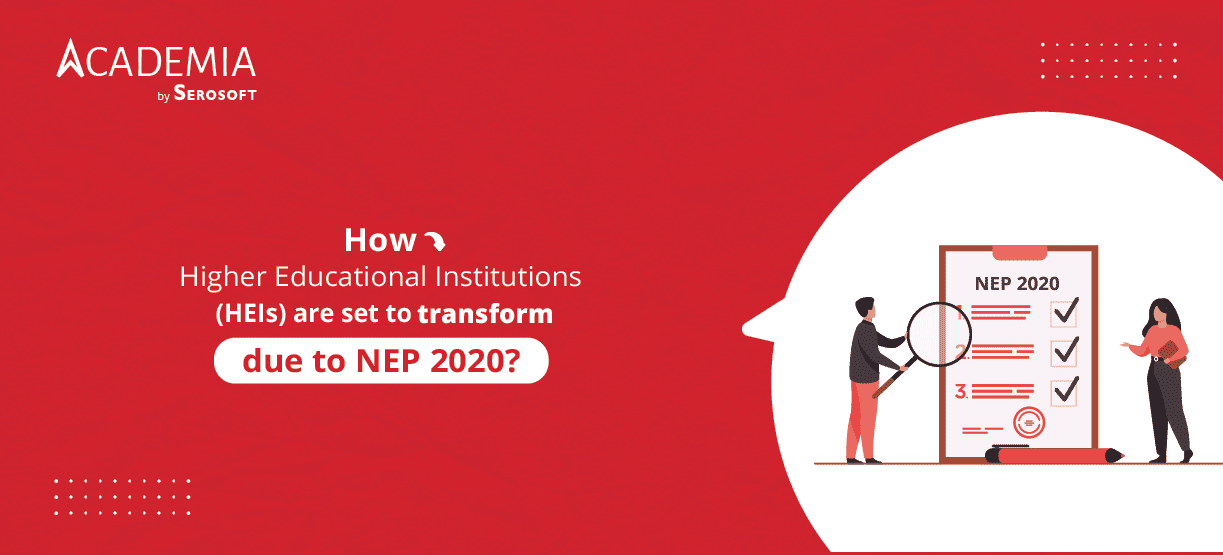
How Higher Educational Institutions (HEIs) are set to transform due to NEP 2020?

The National Education Policy of 2020 is a revolutionary step taken by the Indian government. The policy is envisaged to change the current working of Higher Education Institutes in India and allows students to choose multiple disciplines as per their preference at every stage. 

Higher education in India is widespread. It is partially digitalized and has responsibly transformed the country into a knowledge hub and made it a knowledge economy. 

The National Education Policy (NEP) 2020 is based on five fundamental pillars – access, equity, quality, affordability, and accountability. It is designed to change the current education system

with high-quality knowledge resources and skill-based education.  It also primarily focuses on integrity and promotes equality in participation in varied disciplines, irrespective of what social and economic background they hail from.

What is the New National Education Policy?

Through this new education policy, the government of India aims at bringing more than 2 crore students into proper learning. It is projected that this crucial step would allow the government to achieve 100% GER (Gross Enrollment Ratio) in preschool, secondary, and higher education institutions by the end of 2030. 

These attempts are to prepare India to become a “global Knowledge Superpower”, by making the education ecosystem of India more flexible, holistic, and multi-disciplinary in line with the global skill demand. 

Let’s look at the major reforms the NEP 2020 is set to bring in for HEIs in India –

  1. Opens entry for large education institutions

As mentioned earlier, one goal of NEP 2020 is to increase the Gross Enrolment Ratio in higher education in India, including vocational education from 26.3 percent in 2018 to 50 percent by 2035. As per the NEP, 3.5 crore new seats will be added to higher education institutions. The NEP proposed multi-disciplinary, holistic undergraduate education. The Policy is focused on supporting skill education and streamlining educational planning, administration, and management at all levels.

The primary focus of NEP 2020 in Indian higher education is to transform HEIs into 

(a) Research-Intensive Universities (RUs)

(b) Teaching Universities (TUs)

(c) Autonomous Degree-granting Colleges (ACs)

This goal has to be achieved by 2040. 

According to reports, India needs an additional 1500 HEIs to encourage and accommodate more students. The policy proposes the setting up of large and foreign universities. It seeks to promote India as a global destination for quality and affordable education. It will allow high-performing Indian universities to set up campuses abroad while allowing ‘select’ universities in the top 100 in the world to operate in India. This would promote healthy competition among Indian HEIs. 

  1. Promotes Liberal & Flexible Education

NEP 2020 is designed to generate interest among students in the specialized area of research. This will lead to discoveries and acknowledge the importance of invention and scientific outcomes.

Arts and Science streams will not be separated strictly, as well as curricular  & extracurricular activities and vocational & academic qualifications. This is meant to promote a holistic and very versatile learning environment that will nurture open-mindedness and build well-rounded individuals. 

A revolutionary introduction in the Indian context is the freedom for learners to learn at their convenience. The new policy gives flexibility to students to choose from a variety of subjects and move out with a certificate, diploma, or full degree, depending on the number of years spent on the course. It gives students multiple entry and exit points in degree programs, which further encourages lifelong learning philosophy. 

An Academic Bank of Credit will be introduced which will store the academic credits of students earned from different HEIs digitally and these credits will be counted towards the final degree earned.

The policy has also asked HEIs to do away with high-stake examinations and bring in a continuous and comprehensive evaluation system. 

This reform is meant to help the students to nurture their creativity and critical thinking by motivating them to follow their passion in their chosen field. This will completely change the business models of HEIs in the future, along with their curriculum and delivery methods. Technology will be the integral support that will help in this seamless shift. 

  1. Eases Regulatory Structure

According to NEP 2020, there would be one common regulator for all HEIs in India -National Higher Education Regulatory Authority (NHERA). By eliminating the multiple, overlapping regulators, NHERA will create various verticals and cater to different disciplines and simplify degrees or diplomas. This change will ease the regulatory burden of HEIs and will allow them to focus more on their core role of imparting knowledge. The single regulatory system would provide autonomy to HEIs, which is crucial to innovations in education.  

Initiating a New Education Policy in 2022: Key Highlights

  • The policy emphasizes providing quality and affordable education to all students between 3-18 years of age group all over the country.
  • It also focuses on using technology in education to make it more accessible and effective.
  • The focus should be on online learning to ensure the highest quality education for students. As part of the new system, e-learning will be expanded to include online courses, which will allow students to study from anywhere and at any time.
  • It also promotes holistic and multidisciplinary education replacing rote learning.
  • The curriculum in India has been updated to incorporate more concepts and vocational education.
  • The policy seeks to provide vocational and technical education to students so that they are equipped to enter the workforce.
  • This policy introduces a new 5+3+3+4 education structure replacing the current 10+2 system.
  • The policy aims to increase the Gross Enrolment Ratio in higher education to 50% by 2035.
  • According to NEP, learning should be holistic, joyful, stress-free, and a lifelong process.

Conclusion

A change in the Indian higher education system was long overdue, and NEP 2020 marks a bold move away from the long-standing and established rote and herd learning practices in India. 

While the NEP 2020 aims at improving the operative environment for HEIs across India, it reveals the government’s intent to restrict the commercialization of higher education in India.

The NEP reforms introduced in the Higher Education System are set to result in – 

  • Institutional restructuring and consolidation
  • A holistic education eliminating rote learning
  • Internationalization
  • Teachers training
  • Professional education
  • High-quality research
  • Quality universities and colleges

Changes in the overall ecosystem will bring new challenges for educational institutions, staying updated with the latest developments can help educational institutions to address these challenges. For this, a higher education ERP or SIS can help institutions bring digital transformation and automation, you can also schedule a demo now!


Key 4 Advantages of Implementing a Student Record Management System in Educational Institutions

Understanding Student Record Management and its Benefits 

The primary benefit of utilizing a student record management system is that educational institutions can effectively track students’ data. This includes records such as fees, exams, hostels, and transportation, all provided by the institutions.

As an administrator, you can access this data and more using a unique student ID number. Students can also access their data anytime through their portal and mobile app.

The student record management system is a component of the Student Information System (SIS), which oversees the complete student lifecycle from admission to alumni management.

This software enables your staff to go paperless and reduces manual work. There is no longer a need to spend hours typing student and other data into numerous Excel sheets. Instead, you can organize the information in a simple and accessible format. This allows you to retrieve data within seconds, something that would not be possible without such a system in place.

Here are the main benefits of implementing student record management in your educational institution:

Enhanced Administration – A student data management system greatly improves administrative tasks by integrating all departments into a single platform. It reduces the manual effort of data entry by automatically transferring data from one entry to another. In advanced student information systems, it can generate multiple reports effortlessly. Overall, it simplifies administrative processes and promotes digital management.

Streamlined Time-table Management – With a student information system, you gain better control over operational aspects, including timetable management. Previously, creating timetables consumed a significant amount of time that could have been allocated to more productive activities. However, with the system’s timetable management feature, you can schedule classes, and meetings, assign teachers, manage substitute teachers, ad-hoc classes, and other tasks automatically, without any hassle.

Student-centric Environment – These systems allow users to track every aspect of students’ activities, such as performance in extracurricular activities and sports. In an age where nurturing students’ true potential is prioritized over creating robots, this technology proves to be invaluable.

Seamless Data Flow – Ensuring convenient data access for all stakeholders is crucial for running a successful institution. In addition to students and management teams, teachers and parents can also access these systems. The system provides auto-generated credentials (user ID and password) with privilege control, enabling all relevant parties to utilize the system. Teachers can better manage their classes, track student attendance and assignments, and monitor other assigned tasks through these systems.

Moreover, modern student record management systems come equipped with robust dashboards and analytics, offering an intuitive way to track completed and pending work. With all the necessary information presented on a single screen, you gain a comprehensive overview of the overall data. This streamlined workflow enhances productivity and allows your organization to thrive with minimal effort.

Conclusion 

Implementing student database management software enables you to reduce expenses while increasing efficiency. The benefits include cost-effective maintenance of various services, reduction in the number of personnel required for institute management, and the automation of administrative operations. This liberates educational institutions from mundane tasks, granting them the freedom to focus on creating a better learning environment.

If you seek freedom from monotonous work and aim to build a superior institution, Academia is the solution you need. Explore the features with a free demo of Academia ERP.


How Education Management Software Can Help Educators to Step into the Future

With the incursion of technology in our daily lives, we have started to depend on technologies for our work. It helps us in all the fields by manual efforts, reducing costs, paperwork, etc., and allows us to focus on the core problems. Education Management Software is the greatest management tool for all the sectors that perform various sets of activities and want efficient & cost-effective management.

The days are gone when educational institutions were limited to teachers and students. Today, the education sector has grown into a giant industry that requires extensive interdepartmental collaboration even for minor tasks. This, in turn, has resulted in a need for better management and administration of resources. Nowadays the education sector around the world is transforming digitally. And here comes the Education Management Software in the picture.

What is Education Management Software?

It is a software solution that helps to manage the complete student life cycle from admission to course completion. It gives a centralized platform to educators, staff members to control, monitor, and manage the day to day tasks in a seamless manner. The software comes up with defined modules for each administrative department. The modules are customizable and configurable according to the needs of the institution. It offers interoperability to manage operations such as Learning Management System, Course Management, Data Management, etc. It empowers institutions by enabling digital transformation and allows them to focus on student and institutional development.

Here are the benefits of using Education Management Software:

  • Improved Enrollment Rate

Education leaders can leverage the automation with educational ERP to boost student enrollment rate in their institute. Whether it is higher education or K12, both have a hectic schedule of the difficulties in the decision-making policies, hence, sometimes they get troubles checking in with the enrollment rate of the students. To remove these situations, it is required to implement an advanced software that can eliminate the burden from various mundane activities and brings proper admission management. Educational management software automates the paperwork, digitizes the academic operations, simplifies the complex administrative operation, and enables the institution to focus on increasing the enrollment of the students.

  • Cost-effective

Cost-effectiveness is one of the crucial advantages of Education Management Software implementation. The Educational Software down the paperwork, manual tasks involved in the fundamental methods of campus administration such as the student enrollment process, collection of the fee, examination management, payroll, admission, and other activities to reduce the number of man-hours, leading to the cost-saving. The expenditure saved can be used for other developmental educational purposes.

  • Efficiency & Productivity

The educational management system helps administrators of educational institutes enhance their productivity and eliminate the time & effort required to manage the educational institution. It allows them to accurately organize institution data efficiently. It saves teachers time from mundane activities such as; attendance marking, record management, paperwork, etc. Due to minimizing paperwork and more time towards goals, the Education ERP software enhances the productivity of teachers as well as staff. 

  • Better Decision Management

Education management software fastens the complete operations of institutional management to the next level. All you need to spend time and wait for the implementation of the Education ERP software and you are all set for better, faster, and smarter management of your institution like never before. The enrollment process of the upcoming batch of students or creating customized fee reports or generating marksheet reports will be done in minutes. This system provides faster access to information about the students, admissions, reporting, timetables, employees, examinations, financials, fees, etc. It helps the administrators and educators to analyze various aspects of the institution better that lead to growth planning. Advanced data management also enhances well-informed decision-making through well-strategic data analysis.

  • Enhanced Experience 

A smart Student Management Software puts an end to man-hours of cumbersome resource databases. The software can easily keep track of real-time resource usage and inventory, enabling you to optimize operations, control, and monitor all activities running in your institution. The workload due to the manual resource is eliminated as the teachers need to be technology-driven. This will lead them to work upon the ERP system and send out the information to the students and parents over the system within a few clicks. It reduces the workload and saves ample time, which can be utilized for some other work.

Conclusion

Education management software has offered many more benefits such as online classes, hostel management, library management, employee management, HR management, etc. With the right education ERP software, your institution can have all these benefits. Moreover, it enables you to aim towards the main objective of your organization. 

Academia Education Management Software brings digital transformation in educational institutions of all sizes whether universities, colleges and schools, or training institutes. It is benefitting more than 600K learners & educators around the world. You can be one of the benefactors too. Learn how Academia works for educators with a free demo. Book NOW!

Back to top